
Introduction
- Assam’s sculptural heritage developed through the interaction of religious beliefs, royal patronage, local craftsmanship and wider artistic traditions.
- Its surviving examples include carved stone images, temple doorframes, architectural panels, monoliths and decorative plasterwork.
- Sculpture served several purposes: worship, commemoration, storytelling, architectural decoration and the expression of political authority.
- Important influences came from the Gupta tradition, eastern Indian Pala art, Odisha’s temple traditions and the artistic practices of local communities.
- These influences were adapted to regional needs, producing distinctive forms of Kamarupa and later Assamese art.
- Sites in present-day Nagaland and Meghalaya are also relevant to the wider regional history, but should be distinguished geographically from sites within Assam.
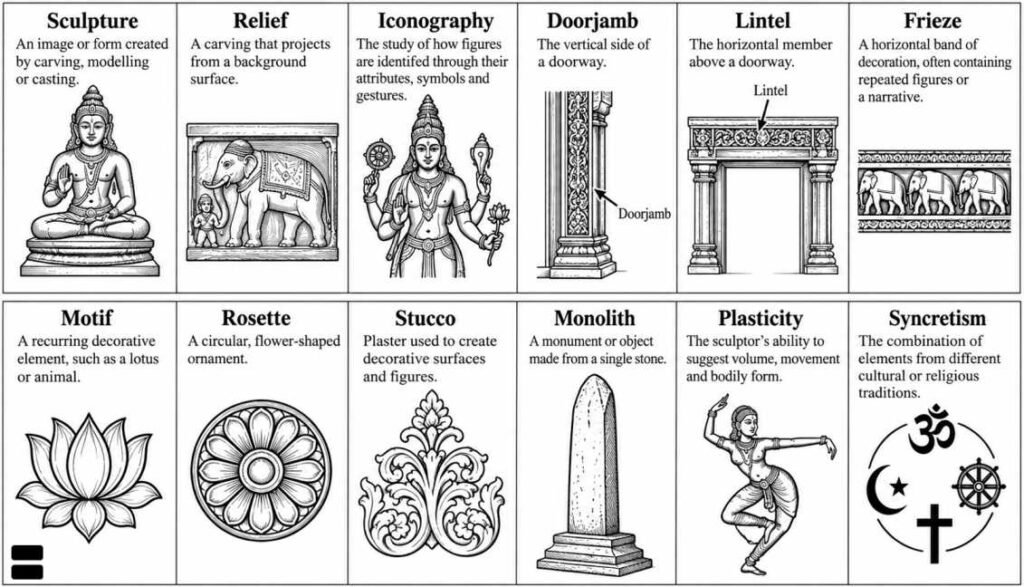
Important Sculptural Terms
| Term | Simple meaning |
|---|---|
| Sculpture | An image or form created by carving, modelling or casting |
| Relief | A carving that projects from a background surface |
| Iconography | The study of how figures are identified through their attributes, symbols and gestures |
| Doorjamb | The vertical side of a doorway |
| Lintel | The horizontal member above a doorway |
| Frieze | A horizontal band of decoration, often containing repeated figures or a narrative |
| Motif | A recurring decorative element, such as a lotus or animal |
| Rosette | A circular, flower-shaped ornament |
| Stucco | Plaster used to create decorative surfaces and figures |
| Monolith | A monument or object made from a single stone |
| Plasticity | The sculptor’s ability to suggest volume, movement and bodily form |
| Syncretism | The combination of elements from different cultural or religious traditions |
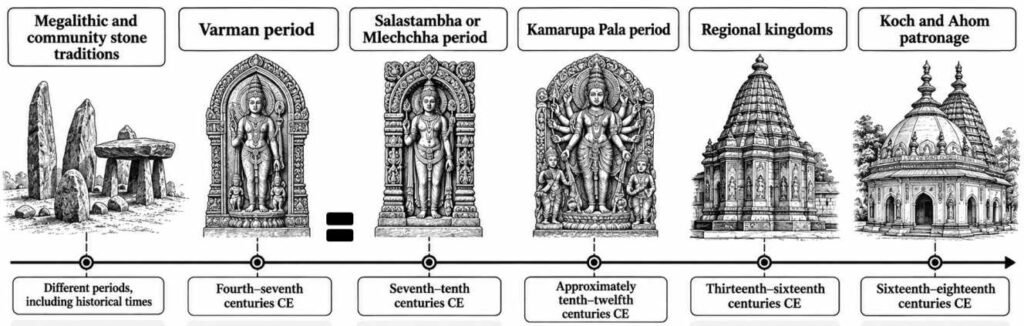
Broad Phases of Development
| Phase | Approximate period | Main characteristics |
|---|---|---|
| Megalithic and community stone traditions | Different periods, including historical times | Memorial stones, monoliths and symbolic carvings |
| Varman period | Fourth–seventh centuries CE | Strong connections with Gupta artistic conventions |
| Salastambha or Mlechchha period | Seventh–tenth centuries CE | Increasing regional character and elaborate temple decoration |
| Kamarupa Pala period | Approximately tenth–twelfth centuries CE | Rich iconography and interaction with eastern Indian artistic traditions |
| Regional kingdoms | Thirteenth–sixteenth centuries CE | Diverse local centres and changing patterns of patronage |
| Koch and Ahom patronage | Sixteenth–eighteenth centuries CE | Temple rebuilding, architectural sculpture and decorative experimentation |
- These divisions are useful for study, but artistic styles do not change precisely when a dynasty changes.
- A temple may contain older carvings reused in a later structure.
Megalithic and Monolithic Traditions
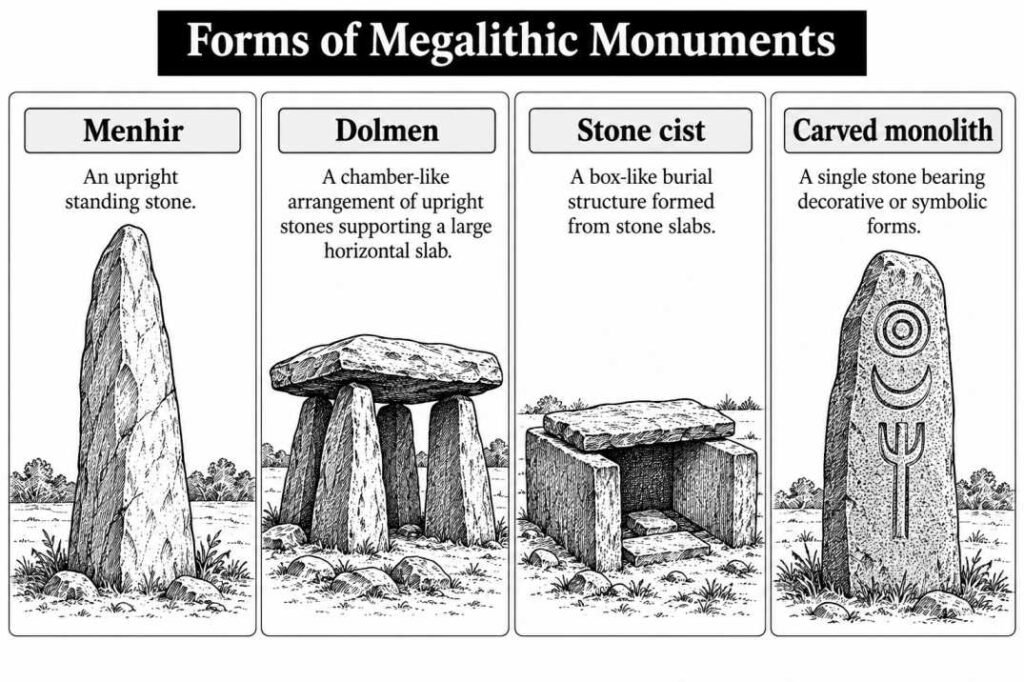
- Megalithic monuments are structures made with large stones.
- They may be associated with burial, remembrance, ancestry, ritual or community status.
| Form | Description |
|---|---|
| Menhir | An upright standing stone |
| Dolmen | A chamber-like arrangement of upright stones supporting a large horizontal slab |
| Stone cist | A box-like burial structure formed from stone slabs |
| Carved monolith | A single stone bearing decorative or symbolic forms |
- Megalithic does not automatically mean prehistoric. Stone-setting traditions continued into medieval and more recent periods.
Sites in Dima Hasao
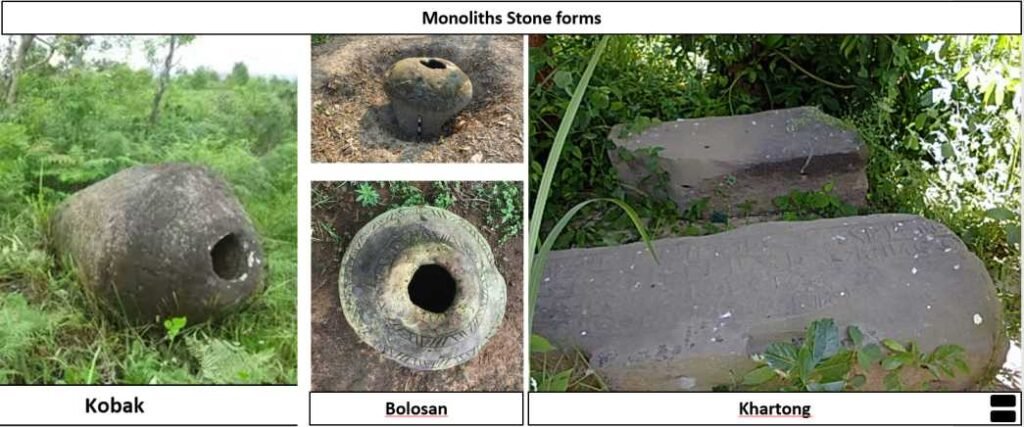
- Important groups occur at Derebara, Khartong, Bolosan and Kobak, in the former North Cachar Hills, now Dima Hasao.
- Some stones display human figures, geometric patterns, animal forms or cavities.
- Their meanings must be studied through archaeological context and community traditions.
- The Archaeological Survey of India places the Bolosan monoliths in the late medieval period, demonstrating the danger of assigning all such remains to prehistory.
Regional Connections
- Related traditions occur in the Khasi and Jaintia Hills of Meghalaya and parts of Nagaland.
- Carvings may include horns, animals, weapons, human figures and other symbols.
- Simple or highly stylised carving should not be treated as proof that a community lacked artistic sophistication.
Sculpture During the Varman Period
General Features
- The Varman dynasty represents an important early historical phase of Kamarupa’s artistic development.
- Sculpture from this broad period shows affinities with the Gupta artistic tradition.
- Typical features include balanced proportions, calm expressions, graceful posture and carefully arranged ornament.
- Local workshops adapted these conventions rather than reproducing them mechanically.
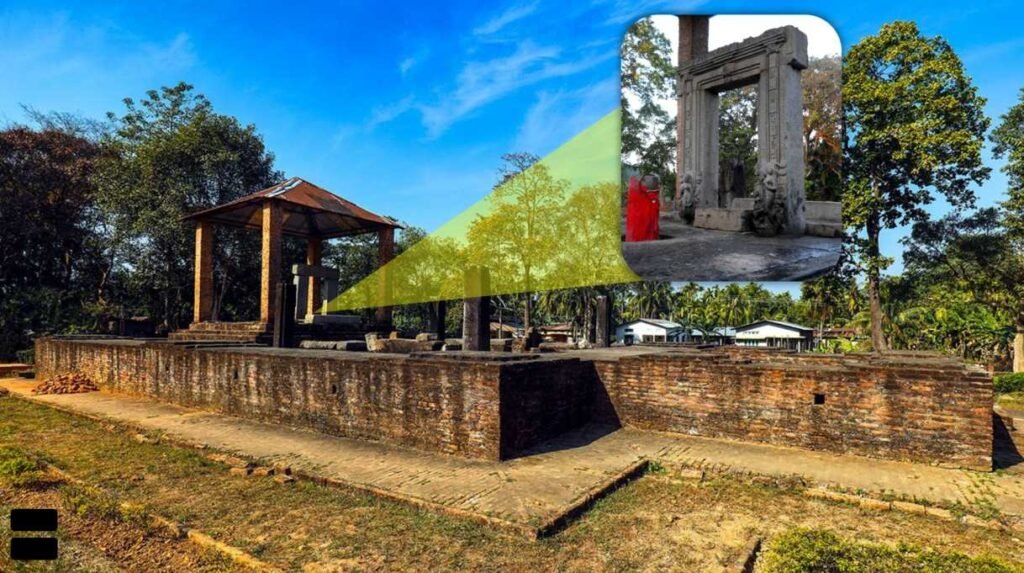
Dah-Parbatia Doorframe
- Dah-Parbatia, near Tezpur, preserves one of Assam’s most important early sculptural monuments.
- Its carved stone doorframe is generally dated to approximately the sixth century CE.
- The vertical sides contain figures of the river goddesses Ganga and Yamuna.
- Other features include scrollwork, decorative bands and figures carved on the lintel.
- The goddesses’ gently inclined postures create an impression of movement and composure.
- The doorframe demonstrates the close relationship between architecture and sculpture.
Artistic Significance
- Dah-Parbatia connects Assam with the wider artistic world of early historical India.
- Comparisons with Gupta centres such as Sarnath and Bhumara help explain its stylistic setting.
- Differences in facial treatment or bodily proportions may reflect workshop conventions and regional preferences.
- Such features cannot reliably establish the ethnic identity of the sculptor or subject.
Sculpture During the Salastambha Period
Emergence of a Regional Style
- During the Salastambha or Mlechchha period, sculptural production developed a stronger regional character.
- Earlier conventions continued alongside greater use of local ornament, vigorous figures and elaborate architectural carving.
- This development is often discussed as part of the emergence of a Kamarupa school of sculpture.
Bamuni Hill
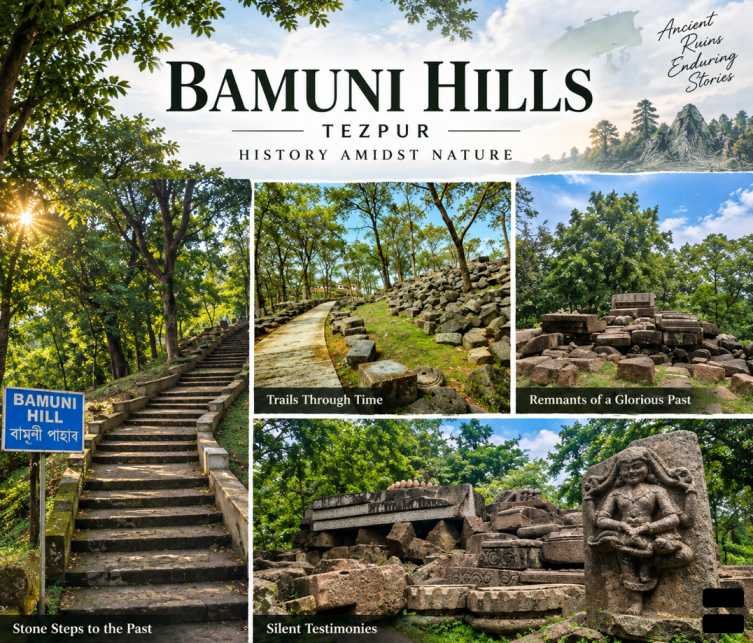
- Bamuni Hill near Tezpur is a major example.
- ASI dates its surviving temple remains to approximately the ninth–tenth centuries CE, associating them with the later Salastambha rulers.
- The remains suggest a Panchayatana temple arrangement: one principal shrine with four subsidiary shrines.
- Surviving pieces include pillars, brackets, lintels, carved panels, capitals and doorsills.
- Panels representing forms of Vishnu, including Narasimha, Parashurama and Rama, suggest a Vaishnavite association for the principal shrine.
Decorative Features
- Common elements include lotuses, floral creepers, miniature shrines, divine figures and dancers.
- Kirtimukha, a stylised protective face, appears in the wider repertoire of temple decoration.
- Sculptural fragments illustrate both religious symbolism and skilled architectural design.
- Surviving carvings around Kamakhya also demonstrate the long history of regional sculpture, although individual pieces require separate dating.
Sculpture During the Kamarupa Pala Period
Main Characteristics
- The Palas of Kamarupa were distinct from the Pala dynasty of Bengal and Bihar.
- Kamarupa’s sculpture nevertheless interacted with Pala-Sena artistic traditions and the temple art of Odisha.
- Images often display ornate jewellery, decorative backgrounds, attendant figures and carefully organised divine attributes.
- Sculpture became a means of expressing several religious traditions, including Shaivism, Vaishnavism and Shaktism.
Important Sites and Features
| Site or area | Sculptural importance |
|---|---|
| Doboka–Gosainjiri–Akashiganga region | Images of deities, architectural fragments and miniature shrine forms |
| Gachtal | Carved architectural members, including doorway elements |
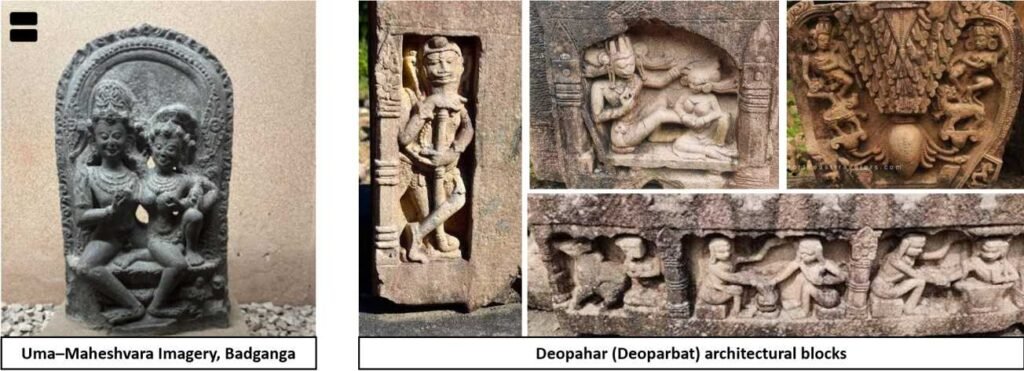
| Badganga | Associated with an important Uma–Maheshvara image |
| Deopahar or Deoparbat | Richly carved temple remains and narrative panels |
| Sri Surya Pahar | Remains associated with Hindu, Buddhist and Jain traditions |
| Kamakhya and Pingaleswar | Important settings for Shaiva-Shakta imagery and related sculptural traditions |
Uma–Maheshvara Imagery
- Uma–Maheshvara represents Parvati and Shiva together.
- Such images combine divine identity, companionship and symbolic unity.
- The image associated with Badganga is noted in discussions of Assam’s sculptural skill.
- Comparisons with sculptures elsewhere in India may help explain its artistic qualities, but do not by themselves establish direct influence.
Deopahar or Deoparbat
- Deopahar, also called Deoparbat, is near Numaligarh in Golaghat district.
- It should not be placed in Sonitpur.
- Its remains include carved architectural blocks, ceiling elements, divine figures, animals and narrative scenes.
- Vidyadharas, or celestial beings, occur within its decorative repertoire.
- Episodes associated with the Ramayana, Mahabharata and Bhagavata traditions illustrate the use of sculpture for storytelling.
- The site is generally associated with the tenth–eleventh centuries, although individual remains require contextual assessment.
Shakta and Tantric Imagery
- Shaktism centres on the worship of the Goddess.
- Some sculptures represent divine couples, powerful female deities and other imagery associated with Tantric religious traditions.
- Mithuna figures, or paired male and female figures, can have auspicious, fertility-related or religious meanings.
- Their interpretation depends on the location, accompanying imagery and religious setting.
Sri Surya Pahar: A Meeting Place of Religious Traditions
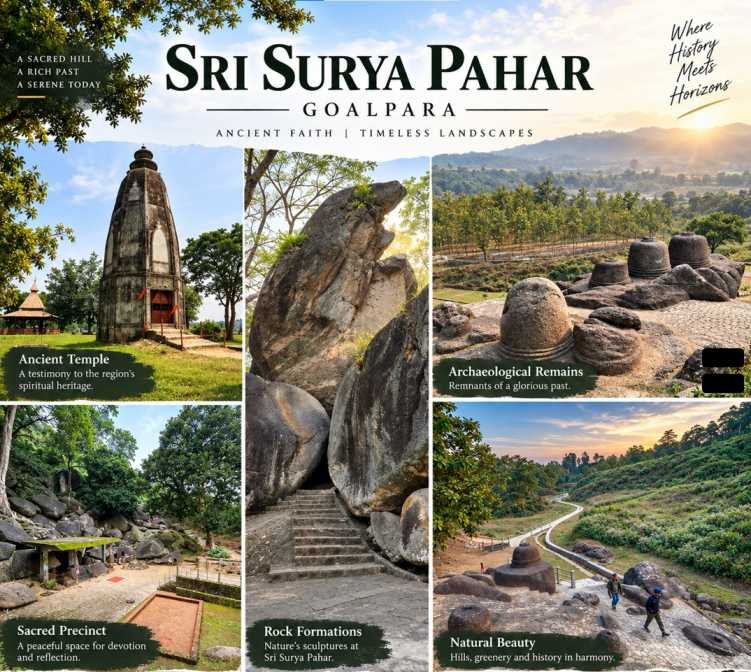
- Sri Surya Pahar, in Goalpara district, is one of Assam’s most important archaeological sites.
- Its remains represent Hinduism, Buddhism and Jainism.
- They include rock-cut images, Shiva lingas, Buddhist stupas, Jain figures and excavated temple remains.
- Important Hindu images include Vishnu, Ganesha, Mahishasuramardini and Hari-Hara.
- Hari-Hara combines attributes of Vishnu and Shiva in one image.
- Excavations have revealed temple complexes and objects dating broadly between the sixth and twelfth centuries CE.
Historical Importance
- The site demonstrates the presence of several religious traditions within the same wider landscape.
- Its remains belong to different periods, so they should not all be assigned to a single dynasty.
- Buddhist and Jain remains should not automatically be placed in the thirteenth–sixteenth centuries simply because they appear beside a discussion of medieval art.
- The evidence supports a history of religious diversity and long-term sacred use.
Regional Developments After the Kamarupa Palas
Changing Political Conditions
- Following the weakening of the Kamarupa kingdom, political authority became distributed among several powers.
- These included Kachari, Chutia, Bhuyan, Jaintia and later Koch rulers, alongside the expanding Ahom kingdom.
- Artistic patronage became more regional.
- Older religious forms continued while local workshops developed different approaches to proportion, ornament and storytelling.
Important Examples
- Naksaparbat, in the Tezpur–Sonitpur region, is associated with carved motifs including trees, serpents and human figures.
- Moiramora Than in Dibrugarh preserves sculptural and architectural remains from different phases.
- Bhuvan Tirtha in Cachar belongs to the wider regional history of sacred images and local religious practices.
- Some older descriptions assign precise community identities or religious mixtures to individual figures.
Understanding Stylistic Change
- Frontal figures, simplified outlines and limited anatomical detail may reflect a deliberate visual convention.
- They should not automatically be described as “degenerate” or artistically inferior.
- A careful assessment considers purpose, materials, patronage, workshop training and the condition of the surviving object.
Sculpture Under the Kacharis
Centres and Artistic Traditions
- The Dimasa-Kachari kingdoms supported distinctive monumental and sculptural traditions.
- Important centres include Dimapur, Maibang and Khaspur.
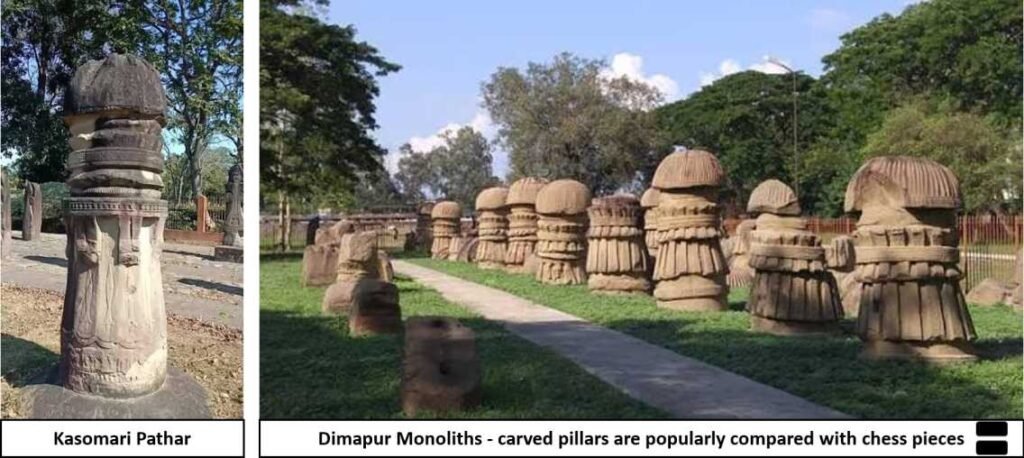
- Kasomari Pathar provides another major group of carved monoliths associated with the region’s medieval heritage.
- These remains combine geometric design, animal imagery, ceremonial forms and religious symbolism.
Dimapur Monoliths
- The remains at Dimapur, now in Nagaland, belong to an important former Dimasa capital.
- The carved pillars are popularly compared with chess pieces because of their shapes.
- Their decoration includes geometric patterns, floral forms and animal motifs.
- Some forms have been interpreted as phallic or fertility symbols, but their exact functions remain debated.
- Their significance lies in demonstrating a developed tradition of monumental stone carving and political-ceremonial space.
Kasomari Pathar
- Kasomari Pathar, in Golaghat district, contains an important group of carved monoliths.
- ASI records thirty-five pillars, broadly divided into chessman-shaped and sword-shaped types.
- Decoration includes animal motifs, floral designs, scrolls and geometric patterns.
- The group is stylistically assigned to approximately the fourteenth century CE.
Maibang and Khaspur
- Maibang, in Dima Hasao, preserves remains associated with a later phase of Dimasa rule.
- Khaspur, in Cachar, contains surviving gateways, temples and other royal remains.
- These sites show how changing political centres also brought changes in building materials, religious imagery and decorative practice.
Sculpture Under the Koch Rulers
Revival of Temple Patronage
- The Koch kingdom developed under Biswa Singha and expanded under Naranarayana and Chilarai.
- Koch patronage supported the rebuilding of important temples during the sixteenth century.
- These projects brought together older sacred sites, reused sculptural elements and new construction.
Kamakhya
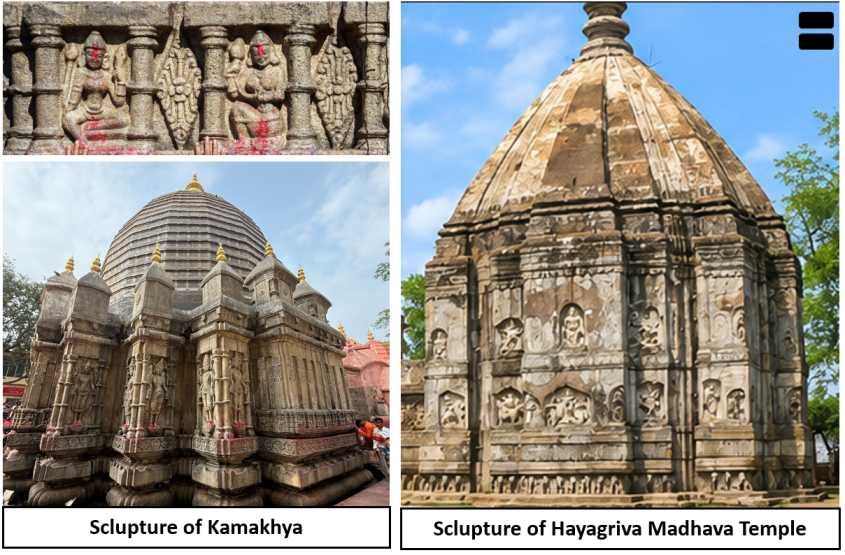
- The rebuilding of Kamakhya under Koch patronage is an important event in Assam’s architectural history.
- Its sculptural repertoire includes divine figures, human forms, animals and floral ornament.
- Lotus medallions and lion motifs contribute to its decorative character.
- Because the temple has a long history of rebuilding, individual sculptures cannot all be assigned to the Koch period.
Hayagriva Madhava at Hajo
- Hayagriva Madhava Temple, at Hajo, is dedicated to Vishnu.
- It was rebuilt in 1583 by Koch king Raghudeva, over an earlier temple foundation.
- ASI associates parts of the older foundation with the tenth–eleventh centuries.
- Its base includes an elephant frieze, known as a Gajathara, and geometric decoration.
- The monument therefore illustrates the continuation and reuse of earlier artistic elements within a later structure.
Sculpture Under the Ahoms
Patronage and Production
- The Ahom kingdom provided substantial patronage to temples, palaces, tanks and ceremonial buildings.
- Hindu temple patronage expanded particularly during the later centuries of Ahom rule, alongside continuing Tai-Ahom traditions.
- Royal construction required specialised stoneworkers, bricklayers, carvers and plaster workers.
- Organised labour and court supervision supported large building programmes.
Materials and Motifs
| Material or technique | Typical use |
|---|---|
| Stone carving | Divine images, temple panels and architectural members |
| Brick construction | Temples, palaces and other substantial buildings |
| Stucco or plaster modelling | Surface decoration, floral patterns and figures |
| Woodwork | Components of buildings and decorative elements |
- Common motifs include lotuses, creepers, lions, elephants, divine figures and fantastic creatures.
- Ahom monuments reflect interaction among local, Tai-Ahom, broader Indian and Indo-Islamic architectural traditions.
- The importance of a sculpture lies in its historical and visual purpose, rather than how closely it follows an earlier classical style.
Kareng Ghar and Talatal Ghar
- Kareng Ghar at Garhgaon and Talatal Ghar at Rangpur illustrate royal investment in monumental architecture.
- Their surviving decoration includes mouldings, floral elements and other ornamental details.
- Sculpture and plasterwork helped communicate royal status and ceremonial importance.
Rang Ghar
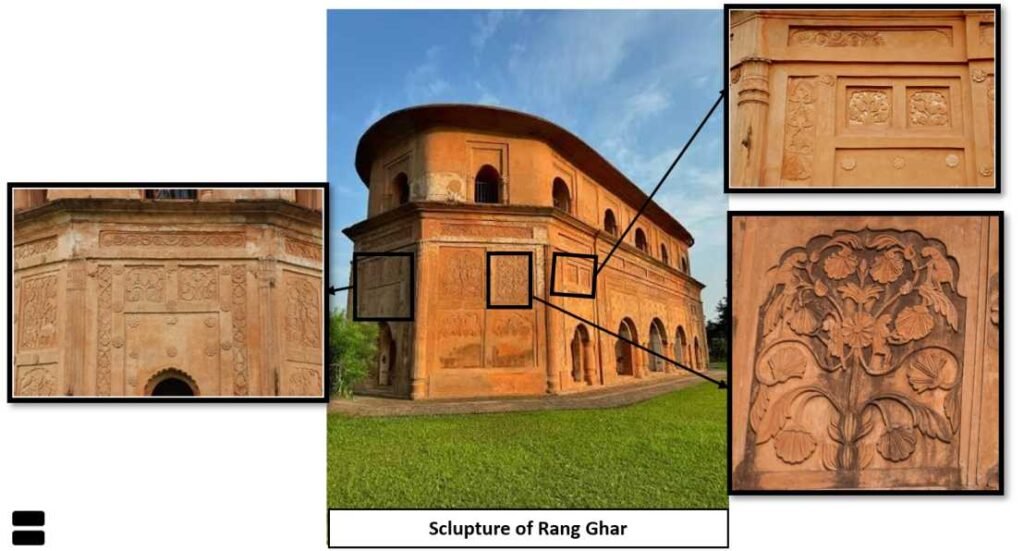
- Rang Ghar functioned as a royal pavilion for viewing public events.
- It is associated with distinctive roof forms and decorative features.
- Descriptions of its fantastic animal motifs sometimes use the term Makara.
- A Makara is a composite mythical aquatic creature; it should not always be translated simply as a crocodile.
Important Ahom Temple Groups
Joydol or Vishnudol at Joysagar
- Joydol, also called Jaidol, Vishnudol or Kesavanarayana Temple, belongs to the reign of Rudra Singha.
- It stands beside Joysagar tank.
- Its exterior contains carved panels of Hindu deities and forms of Vishnu.
- Lotus medallions and patterned surface decoration enrich its appearance.
- The monument demonstrates the close integration of temple architecture and narrative sculpture.
Gaurisagar Temple Group
- The Gaurisagar complex contains temples associated with Shiva, Vishnu and Devi.
- Its decoration includes floral designs, architectural mouldings and figural imagery.
- The grouping of temples illustrates the breadth of religious patronage within the Ahom court.
Sivasagar Temple Group
- The temples beside Sivasagar tank contain images and panels representing several deities.
- Figures such as Shiva, Durga and other members of the Hindu pantheon form part of the sculptural vocabulary.
- Pilasters and recessed panels help organise the external surfaces.
- A pilaster is a shallow pillar-like projection attached to a wall.
Negheriting Sivadol
- Negheriting Sivadol, in Golaghat district, is associated with rebuilding under Rajeswar Singha.
- Its sculpture continues the use of divine figures and elaborate temple ornament.
- More compact or strongly outlined figures should be understood as features of its style, rather than automatically judged inferior to earlier work.
The Sadiya Serpent Pillar
- The Sadiya Serpent Pillar is an important example of the relationship between sculpture, inscription and political memory.
- It is associated with the date 1532 CE.
- A serpent winds around the pillar, giving the monument its familiar name.
- It has been interpreted in connection with relations between the Ahoms and neighbouring Mishmi communities.
- Its inscription is important for the study of early Ahom writing.
Important Sculptural Subjects
| Subject | Identification and significance |
|---|---|
| Nataraja | Shiva represented as the divine dancer |
| Narayana | A form of Vishnu, identified through posture and attributes |
| Varaha | Vishnu’s boar incarnation, associated with rescuing the Earth |
| Uma–Maheshvara | Shiva and Parvati represented together |
| Mahishasuramardini | The Goddess defeating the buffalo demon |
| Surya | The Sun deity |
| Vidyadharas | Celestial beings, often shown flying or carrying garlands |
| Ganga and Yamuna | River goddesses frequently placed beside temple entrances |
| Kirtimukha | A stylised protective face used in architectural decoration |
| Hari-Hara | A composite form combining Shiva and Vishnu |
- An illustrated Nataraja from Ambari, dated in the accompanying museum caption to the thirteenth–fourteenth centuries, demonstrates the continuation of sophisticated sculptural production beyond the Kamarupa period.
- Other illustrated subjects include Narayana, Varaha and flying Vidyadharas.
- Museum collections, including the Assam State Museum, preserve displaced objects and allow comparison across sites and periods.
- Several smaller captions in the final photograph are too faint to assign their precise provenance and dates reliably.
Major Sites
| Site | Present location | Key association |
|---|---|---|
| Dah-Parbatia | Tezpur, Sonitpur | Sixth-century doorframe; Ganga and Yamuna |
| Bamuni Hill | Tezpur, Sonitpur | Ninth–tenth-century temple remains; Panchayatana arrangement |
| Sri Surya Pahar | Goalpara | Hindu, Buddhist and Jain remains |
| Deopahar / Deoparbat | Numaligarh, Golaghat | Carved temple blocks, celestial figures and narrative panels |
| Kasomari Pathar | Golaghat | Fourteenth-century carved monoliths |
| Moiramora Than | Dibrugarh | Sculptural and architectural remains from multiple phases |
| Maibang | Dima Hasao | Dimasa-Kachari heritage |
| Khaspur | Cachar | Temples, gateways and royal remains |
| Dimapur ruins | Nagaland | Former Dimasa capital and distinctive monoliths |
| Kamakhya | Guwahati | Long sculptural history and Koch-period rebuilding |
| Hayagriva Madhava | Hajo, Kamrup | Earlier elephant frieze; rebuilding by Raghudeva in 1583 |
| Joydol | Joysagar, Sivasagar | Vishnu-related panels and Rudra Singha’s patronage |
| Negheriting Sivadol | Golaghat | Later Ahom temple sculpture |
| Sadiya Serpent Pillar | Sadiya region | Serpent carving and an early Ahom inscription |