
Introduction
- Neo-Vaishnavism was a major religious and cultural movement that developed in Assam during the fifteenth and sixteenth centuries.
- Its leading figure was Srimanta Sankardeva, whose teachings emphasised devotion, the remembrance of God’s name and fellowship among devotees.
- His religious path is commonly called Ekasarana Nama Dharma, Eka Sarana Hari Nama Dharma or Mahapurushiya Dharma.
- The movement formed part of the wider Indian Bhakti movement, while developing distinctive Assamese forms of worship, literature and performance.
- Madhavdeva, Sankardeva’s principal disciple, consolidated and extended this legacy.
- The movement’s enduring institutions—the Namghar and the Sattra—became centres of religion, education, art and community organisation.
Srimanta Sankardeva: Early Life and Education
Birth and Family
- Srimanta Sankardeva’s traditionally accepted lifespan is 1449–1568 CE.
- He was born at Alipukhuri near Bordowa, in present-day Nagaon district.
- His father was Kusumbar Bhuyan, and his mother was Satyasandhya Devi.
- His family belonged to the Bhuyan landed elite, whose members exercised local political authority.
- After losing his parents during childhood, he was raised by his grandmother, Khersuti.
Education at Mahendra Kandali’s Tol
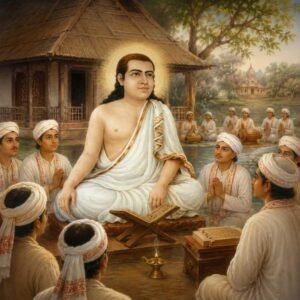
- At about twelve years of age, Sankardeva entered the tol of Mahendra Kandali.
- A tol was a traditional centre of learning, particularly associated with Sanskrit education.
- He studied grammar, literature, logic, philosophy and religious texts.
- Traditional biographies describe his exceptional ability to compose the verse “Karatala Kamala” early in his education.
- The verse is remembered for its ingenious use of a restricted range of vowel sounds.
- Harishchandra Upakhyana is associated with his early literary development.
- His education provided the foundation for his later work as a poet, religious teacher, dramatist and translator.
Traditional Accounts of His Childhood
- Devotional biographies contain stories illustrating his extraordinary qualities.
- One describes a serpent shading him from the sun, leading his teacher to recognise his spiritual importance.
- Such accounts belong to hagiography—religious biography written to express reverence for a saint.
- They are important for understanding how devotees remember Sankardeva, while differing from independently documented historical events.
Family Responsibilities
- Sankardeva assumed responsibilities associated with his Bhuyan family and is remembered as a Shiromani Bhuyan, or leading Bhuyan.
- He married Suryavati during his early adulthood.
- Her death forms an important turning point in traditional accounts of his growing spiritual interests.
- He later married Kalindi, showing that his religious mission developed alongside household responsibilities.
Pilgrimage and the Development of His Religious Outlook
The First Pilgrimage
- Sankardeva’s first extended pilgrimage is conventionally dated to 1481–1493.
- Traditional accounts describe a journey lasting about twelve years, undertaken with a group of companions, including Ramaram.
- Places associated with the journey include Puri, Vrindavan, Mathura, Dwarka, Rameswaram, Gaya, Ayodhya, Sitakunda and Badrikashram.
- These travels exposed him to different forms of devotional worship, religious discussion and performance.
Influence of the Bhagavata Tradition
- The Bhagavata Purana became central to his religious thought.
- He also drew on its influential commentary by Sridhara Swami.
- His teachings increasingly emphasised loving devotion without the expectation of material reward.
- Pilgrimage strengthened his conviction that religious ideas should be communicated through accessible language, song and collective worship.
Early Borgeet
- “Mana Meri Rama Charanahi Lagu” মন মেৰি ৰাম চৰণেহি লাগু is traditionally associated with his stay at Badrikashram during this pilgrimage.
- It is commonly identified in standard accounts as his first Borgeet.
- A Borgeet is a devotional song composed within a defined melodic tradition.
- Its importance lies in combining religious feeling, poetic language and organised musical expression.
Bordowa: Formation of a Devotional Community
Congregational Worship
- After returning to Assam, Sankardeva developed a community centred on devotion to Krishna and the chanting of the divine name.
- Bordowa or Batadrava became an early centre of his religious activity.
- The establishment of a prayer space there is commonly associated with around 1498, although chronological accounts differ.
- Early religious centres were known as Thans, meaning places of worship.
- They provided a foundation for the later development of Namghars and Sattras.
Chihna-Yatra
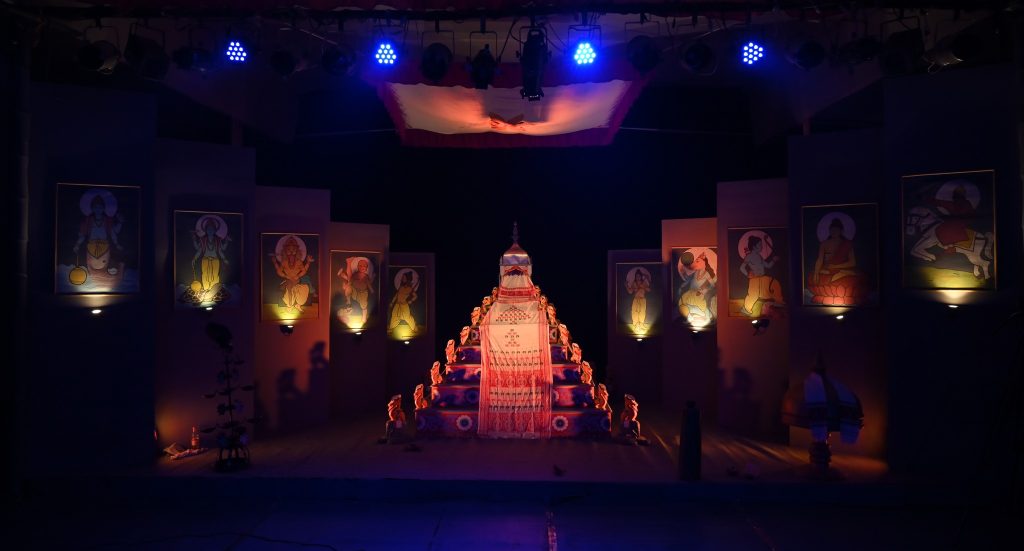
- Chihna-Yatra was Sankardeva’s pioneering visual and dramatic presentation.
- It is traditionally dated to 1468, placing it before his first pilgrimage in the conventional chronology.
- The production represented Sapta Vaikuntha, or the seven heavenly abodes, through painted scenes and performance.
- It combined music, movement, narration and visual design.
- Traditional accounts attribute to Sankardeva the preparation of scenery, the training of performers and participation in the presentation.
- Its lasting significance lies in laying the groundwork for Assamese devotional theatre.
Rendering Religious Texts into Assamese
- Sankardeva made religious narratives accessible through Assamese verse and dramatic compositions.
- Traditional accounts connect Jagadisa Mishra of Mithila with the transmission or exposition of the Bhagavata Purana at Bordowa.
- Texts such as Uddhava Samvada expressed religious ideas through conversations and narratives that ordinary listeners could follow.
Community Life and Festivals
- Collective chanting, discussion and the sharing of offerings strengthened bonds among followers.
- Celebrations such as Doul or Holi became associated with devotional community life.
- Prayer spaces also supported education, cultural expression and discussion of local concerns.
- These developments linked religious practice with the everyday life of the village.
Expansion in the Ahom Kingdom
Movement from Bordowa
- Political conflict and insecurity contributed to Sankardeva’s movement away from Bordowa.
- Places associated with this phase include Routa, Gangmau and Dhuwahat.
- Traditional chronologies differ over the precise dates of these moves.
- Their wider importance is that the movement expanded into new communities and political settings.
Gangmau and Literary Activity
- Sankardeva continued teaching and writing during this period.
- Patni Prasad is associated with his literary activity in the Ahom kingdom.
- The play presents devotion as more important than the possession of ritual status or scholarly authority.
- His son Ramananda is also associated with accounts of the Gangmau period.
Meeting Madhavdeva
- Sankardeva’s meeting with Madhavdeva at Dhuwahat–Belaguri was a decisive event in the movement’s history.
- Madhavdeva accepted him as his spiritual teacher after a religious discussion.
- Their partnership combined Sankardeva’s broad creative leadership with Madhavdeva’s disciplined organisation and devotional scholarship.
Opposition and Departure
- The growing movement attracted criticism from some established religious authorities.
- Relations with the Ahom administration also became difficult.
- Traditional histories describe the execution of Sankardeva’s son-in-law Hari and the detention of Madhavdeva during this troubled period.
- Sankardeva and his followers eventually moved towards the Koch kingdom in the 1540s.
- These events show that the movement developed through both popular support and political negotiation.
The Koch Kingdom and the Patbausi Phase
Settlement and Patronage
- After leaving the Ahom kingdom, Sankardeva stayed at Sunpora and later settled at Patbausi near Barpeta.
- Patbausi became an important centre of religious instruction, literary composition and artistic activity.
- His relationship with the Koch court involved both initial suspicion and later support.
- Chilarai played an important role in securing favourable treatment and patronage.
- King Naranarayana’s support helped create conditions for the continuation of his work.
A Diverse Circle of Followers
- Accounts of Sankardeva’s followers include people from different social and community backgrounds.
- Names remembered in this connection include Chakrapani Dwija, Sarvabhauma Bhattacharya, Govinda associated with the Garo community, and the Muslim devotee Chandsai or Chandasai.
- This diversity illustrates the movement’s effort to place devotion above inherited social rank.
- It helped create a shared cultural space without making every community identical.
Final Years
- Sankardeva continued writing, teaching and organising followers during his later life.
- He died in 1568 at Bheladonga in the Koch kingdom, in the region of present-day Cooch Behar.
- Madhavdeva became the principal leader responsible for carrying forward his mission.
Sankardeva’s Literary and Artistic Contributions
Literary Works
| Category | Important works | Contribution |
|---|---|---|
| Devotional narrative | Kirtana Ghosa | Presents religious episodes suitable for recitation and collective singing |
| Scriptural rendering | Selected portions of the Bhagavata Purana, including the Adi Dasama | Made major religious narratives accessible in Assamese |
| Concise religious exposition | Gunamala | Presents the essence of the Bhagavata tradition in a compact form |
| Devotional teaching | Bhakti Pradipa, Bhakti Ratnakara, Nimi–Navasiddha Samvada | Explains devotion and religious principles |
| Early narrative poetry | Harishchandra Upakhyana | Demonstrates his early literary skill |
| Drama | Patni Prasad, Kaliya Daman, Keli Gopal, Rukmini Haran, Parijat Haran, Ram Vijay | Communicates religious ideas through performance |
- Sankardeva wrote in Assamese, Brajavali and Sanskrit, according to the needs of the work.
- Brajavali is a literary language with a strong Maithili base, adapted through Assamese usage and containing Sanskrit elements.
- His use of accessible language helped widen participation in religious and literary culture.
Music and Borgeet
- Sankardeva is traditionally credited with composing approximately 240 Borgeets, although most were lost.
- Thirty-four surviving songs are commonly attributed to him in standard enumerations.
- These compositions form a foundation of Assam’s devotional musical heritage.
- Their themes include surrender, divine greatness and the spiritual dependence of human beings.
Theatre and Dance
- Ankiya Naat refers to his distinctive dramatic compositions.
- Bhaona is their theatrical enactment and the wider performance tradition that developed from it.
- The Sutradhar, or narrator, links the story, music, dance and audience.
- The performance tradition contributed to the development of Sattriya, recognised as a classical dance in 2000.
- Painting, masks, costumes and stage design made performance a combination of several artistic skills.
Madhavdeva: Life and Religious Leadership
Early Life
- Madhavdeva lived from 1489 to 1596 CE.
- His birthplace is associated with Letekupukhuri in present-day Lakhimpur district.
- He belonged to a Kayastha family and received a traditional education.
- Before becoming Sankardeva’s disciple, he followed Shakta practices, centred on the worship of the Goddess.

Conversion to Ekasarana Dharma
- A discussion with Sankardeva transformed his religious outlook.
- He accepted devotion to Krishna as the central spiritual path and recognised Sankardeva as his Guru.
- This meeting is remembered as Manikanchan Sanjog, symbolising the coming together of two exceptionally valuable personalities.
- Madhavdeva adopted a life of religious dedication and remained unmarried.
Leadership after Sankardeva
- After Sankardeva’s death in 1568, Madhavdeva provided spiritual and organisational leadership.
- He consolidated the movement through teaching, literature, music and the training of disciples.
- His influence spread through institutions associated with Baradi, Ganakkuchi, Sundaridiya and Barpeta, among other centres.
- His leadership helped maintain continuity between the founder’s teachings and later generations.
Madhavdeva’s Literature, Music and Drama
Important Literary Works
| Work | Nature and significance |
|---|---|
| Nama Ghosa | His major devotional and philosophical work, expressing surrender, humility and the greatness of the divine name |
| Bhakti Ratnavali | Assamese rendering of Vishnupuri’s Sanskrit work on devotion |
| Nama Malika | A work explaining the religious importance of the divine name |
| Janma Rahasya | Discusses creation and divine power |
| Adi Kanda of the Ramayana | Assamese rendering of the opening section of the epic |
| Rajasuya | Narrative poetry drawing on the Mahabharata |
- His writing combines clear expression, musical rhythm and emotional depth.
- Nama Ghosa and Bhakti Ratnavali remain central texts in Assamese Vaishnavite religious life.
Borgeet
- Madhavdeva is commonly credited with 157 surviving Borgeets.
- Together with the commonly listed 34 songs of Sankardeva, these form a corpus of 191 songs.
- Thus, 191 should not automatically be treated as the number composed by Madhavdeva alone.
- Many of his songs portray Krishna’s childhood, expressing affection, playfulness and devotion.
- “Tejare Kamalapati” is a well-known composition associated with morning devotional singing.
Jhumura Plays
- Madhavdeva developed short dramatic presentations commonly called Jhumuras.
- They often focus on a particular incident from Krishna’s childhood, rather than an elaborate plot.
- Important works include Chor Dhara, Pimpara Guchuwa, Bhojan Bihar and Bhumi Letowa.
- Arjun Bhanjan, also known as Dadhi Mathana, has a more developed dramatic structure.
- Music, humour and familiar emotions helped audiences connect with devotional ideas.
Meaning and Foundations of Ekasarana Nama Dharma
Meaning of Ekasarana
- Eka means one, and Sarana means refuge or surrender.
- Ekasarana therefore means taking sole spiritual refuge in one supreme God.
- Nama refers to the divine name, whose remembrance and chanting form a central religious practice.
- The tradition emphasises devotion to Krishna or Narayana as the Supreme Being.
Scriptural Foundations
- The principal scriptural foundation is the Bhagavata Purana, supported by teachings from the Bhagavad Gita and related devotional literature.
- These ideas were explained through vernacular texts, songs, sermons and drama.
- Religious understanding was therefore made available beyond the circle of Sanskrit scholars.
God, the Individual and the World
| Concept | Simple explanation |
|---|---|
| Param Brahman / Narayana / Krishna | The Supreme Reality and ultimate object of devotion |
| Jiva | The individual living being or soul |
| Prakriti | Material nature |
| Maya | The condition or power through which worldly attachment and ignorance obscure spiritual understanding |
| Paramatma | The divine presence within living beings |
| Bhagavan | God understood in a personal form accessible through devotion |
- God is described as transcendent, meaning beyond the material world, and immanent, meaning present within it.
- Devotion helps the individual overcome ego, ignorance and attachment.
- Philosophical descriptions should be understood within the tradition’s devotional framework, rather than reduced to a simple formula borrowed from another school.
The Four Essentials: Cari Vastu
- Ekasarana Dharma recognises four closely connected essentials, known as Cari Vastu or Sari Bostu.
| Essential | Meaning | Role |
|---|---|---|
| Guru | Spiritual teacher | Provides guidance and introduces the devotee to the religious path |
| Deva | Supreme God | Krishna or Narayana, the object of devotion |
| Nama | Divine name | Remembered, recited and sung |
| Bhakata | Devotee | Provides fellowship, spiritual example and opportunities for service |
- The four essentials connect guidance, worship, practice and community.
- Sarana, or initiation into refuge, expresses commitment to this devotional relationship.
- Service to devotees is valued as part of service to God.
The Path of Devotion
Suddha Bhakti
- Suddha Bhakti means pure devotion.
- It is offered without bargaining for wealth, power or other personal rewards.
- The devotee seeks a relationship of love, surrender and service.
- Religious learning and ritual action are not treated as substitutes for sincere devotion.
- In this devotional outlook, service to God may be valued even above the desire for personal liberation.
Sravana and Kirtana
- Sravana means listening to accounts of God’s names, qualities and deeds.
- Kirtana means singing or reciting them.
- These practices are particularly emphasised as accessible forms of devotion in Kali Yuga.
- Collective worship allows people with different levels of formal education to participate.
- The religious purpose is to cultivate humility, concentration, compassion and freedom from excessive attachment.
Dasya Bhava
- Dasya Bhava means the devotional attitude of a servant towards God.
- The devotee regards himself or herself as Krishna’s servant, sometimes expressed through the term Krishnara Kinkara.
- Sankardeva and Madhavdeva frequently use the language of dasa, or servant, in their writings.
- This attitude emphasises humility, responsibility and reliance on divine grace.
Ethical Conduct
- The movement encourages truthfulness, compassion, self-control, non-violence and purity of intention.
- Vairagya, or detachment, means reducing excessive attachment to material possessions and selfish desires.
- A devotional life can be followed by householders as well as renunciants.
- Honesty in everyday work and respectful treatment of others are part of religious practice.
Religious Reform and Social Inclusion
Criticism of Ritual Dependence
- Sankardeva challenged the idea that spiritual progress depended primarily on costly sacrifices, elaborate ceremonies or inherited ritual authority.
- The emphasis on Nama-Kirtana made worship less dependent on material resources.
- Animal sacrifice was rejected within this devotional path.
- Religious worth was associated with devotion and conduct, rather than birth alone.
Broadening Participation
- The movement attracted people from different backgrounds, including Brahmins, Kayasthas, Koches, Kacharis, Garos, Miris or Misings, and other communities.
- Traditional accounts also remember Muslim followers, including Chandsai.
- Collective prayer, shared offerings and service created opportunities for interaction across social divisions.
- Women participated in devotional life, and some women assumed important religious responsibilities.
Ideals and Historical Practice
- The movement encouraged spiritual equality and community fellowship.
- However, it did not eliminate every caste or gender restriction throughout Assamese society.
- Practices varied across periods, localities and religious branches.
- Its contribution is best understood as a powerful challenge to exclusion and a source of reform, rather than the complete abolition of social hierarchy.
Image Worship and Internal Diversity
- Many Ekasarana institutions emphasise scripture and the divine name, without making an image the central object of worship.
- However, all Sattras do not follow identical practices.
- Some branches, particularly within Brahma Samhati, retain image worship and additional ritual conventions.
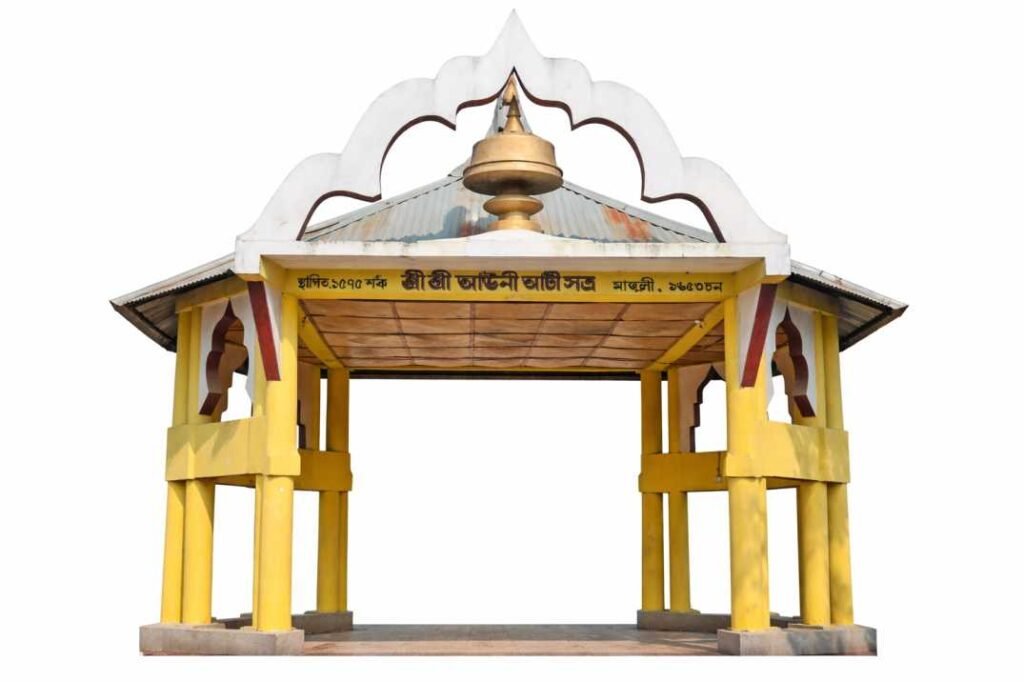
- Auniati Satra, for example, worships Krishna in the form of Govinda.
The Namghar: Meaning and Architecture
Meaning and Purpose
- Namghar combines Nama, the divine name, and Ghar, a house.
- It is a community prayer hall where devotees gather for Nama-Prasanga or Nama-Kirtana.
- It also serves as a place for religious instruction, performance and community discussion.
- Its importance lies in making collective devotional activity part of everyday village life.
Construction and Layout
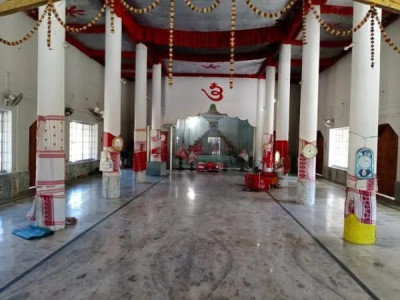
- Traditional Namghars were built from locally available materials such as bamboo, timber, reeds and thatch.
- Many have a long rectangular hall, a pitched or gabled roof and rows of supporting pillars.
- Some older structures include an apsidal, or rounded, end.
- Pillars called khutas may divide the hall into a central space and side aisles.
- Buildings vary in size according to the needs and resources of the congregation.
- Modern Namghars often use brick, concrete and metal roofing, while retaining the basic arrangement of a collective prayer space.
The Manikut
- The Manikut, literally associated with a “house of jewels,” is the sacred section attached to the prayer hall.
- It commonly stands at the eastern end, although local layouts vary.
- It contains the Guru Asana, sacred texts and, in some traditions, images and religious objects.
- It forms the principal devotional focus of the building.
Guru Asana and Symbolism
- The Guru Asana is a raised, often elaborately carved wooden structure.
- A familiar form has seven tiers, although designs differ.
- Carvings may include lions, elephants and tortoises.
- These motifs receive religious interpretations connected with spiritual strength, the overcoming of wrongdoing and the structure of the universe.
- The seven levels are often associated with Sapta Vaikuntha, the seven heavenly abodes. Documented Guru Asana designs and symbolism
- In scripture-centred traditions, sacred texts are placed on or associated with the Guru Asana or thapana.
- Reverence for scripture gives physical expression to the importance of divine knowledge and the teacher’s instruction.
Worship and Community Functions of the Namghar
Nama-Prasanga
- Nama-Prasanga is congregational worship through recitation and devotional singing.
- A Nam-Lagowa, or lead singer, guides the congregation.
- Participants respond in chorus, often accompanied by khol and taal.
- Readings and songs may draw from Nama Ghosa, Kirtana Ghosa and the Bhagavata.
- The sequence differs between institutions and occasions.
- Prasada, or blessed offerings, may be distributed after worship.
Seating and Participation
- Worshippers usually sit on the floor in an arrangement suited to the hall and ceremony.
- Collective seating and singing encourage fellowship and a shared devotional focus.
- Specific seating arrangements and access conventions vary; a single pattern should not be assumed for every Namghar.
Social and Cultural Roles
| Role | Function |
|---|---|
| Religious centre | Collective worship, recitation and religious teaching |
| Community meeting place | Discussion of village matters and arrangements for shared activities |
| Forum for reconciliation | Mediation of some local disagreements through community discussion |
| Educational space | Teaching language, ethical conduct and religious literature |
| Performance venue | Bhaona, devotional music and other cultural activities |
| Place of collective support | Organisation of festivals, assistance and voluntary work |
- The description “village parliament” expresses the Namghar’s participatory role; it does not mean that it is legally identical to an elected panchayat.
- Its significance rests on the relationship between worship, public discussion and cultural learning.
The Sattra: Religious and Cultural Institution
Meaning and Evolution
- In Assam, a Sattra is a Vaishnavite religious institution that may combine worship, residential life, teaching and artistic training.
- The term has older religious uses in Sanskrit, but acquired a distinctive institutional meaning in Assam.
- Early Thans and devotional congregations gradually developed more organised forms under Sankardeva’s successors.
- Batadrava represents an early foundation, while later Sattras developed extensive networks of followers.
Types of Religious Life
- Some Sattras maintain communities of celibate resident bhakats.
- Others are associated with householder religious lineages.
- The wider congregation includes lay disciples, who live outside the institution but participate in worship and festivals.
- A Sattra therefore extends beyond its buildings to include a network of teachers, residents and affiliated households.
Institutional Roles
| Position or role | Main responsibility |
|---|---|
| Satradhikar / Adhikar / Mahanta | Spiritual leadership and supervision of the institution |
| Deka Adhikar | Assists the head and may serve as a designated successor, depending on custom |
| Bhakat | Devotional practice, service and institutional work |
| Kewaliya or celibate bhakat | Resident religious life without marriage |
| Bhagavati / Pathak | Recitation and explanation of scripture |
| Gayan-Bayan | Musical performance |
| Bharali | Care of stores and institutional materials |
| Deuri or other ritual functionaries | Duties connected with worship and offerings, depending on the Sattra |
| Lay disciples | Participation, support and service from outside the residential community |
- Titles and duties differ among Sattras; Bhakat does not always mean a celibate monk.
Sattra Architecture and Daily Life
General Layout
- A traditional Sattra often occupies a rectangular or quadrangular enclosure.
- Its main elements may include:
| Element | Purpose |
|---|---|
| Karapat | Entrance or gateway |
| Namghar or Kirtanghar | Main congregational prayer hall |
| Manikut | Sacred section associated with the hall |
| Hatis | Rows of residential quarters |
| Satradhikar’s residence | Accommodation and institutional responsibilities of the head |
| Storehouses and granaries | Storage of food, offerings and materials |
| Pukhuri | Pond serving practical and sometimes religious purposes |
| Gardens and open spaces | Flowers, fruit, gatherings and institutional activities |
- A four-sided arrangement is common, but four gateways, identical orientation or a fixed residential plan are not universal requirements.
- Carved wood, metalwork and painted surfaces reflect the work of local artisans.
Daily Routine
- Daily life includes prayer, scripture recitation, cleaning, study and service.
- Some institutions observe several scheduled prayer sessions each day.
- Their frequency varies according to institutional tradition and the religious calendar.
- Discipline is maintained through shared responsibilities and the guidance of senior members.
Education and Artistic Training
- Sattras have taught Sanskrit, Assamese literature, religious philosophy, music and performance.
- Manuscripts were copied, studied and, in some cases, illustrated.
- Artistic training includes Sattriya dance, Borgeet, Gayan-Bayan, Bhaona, mask-making and wood carving.
- Learning often combines oral instruction, repeated practice and participation in ceremonies.
Festivals
- Important observances include Janmashtami, Raas celebrations, Doul, Paal Naam and the commemorative days of Sankardeva and Madhavdeva.
- Paal Naam involves extended devotional singing, often maintained by groups taking turns.
- Festivals bring together residents, lay followers and visitors.
Major Sattras and Their Contributions
Majuli and Sattra Culture
- Majuli, a major river island in the Brahmaputra, is one of the principal centres of Assamese Vaishnavite heritage.
- Its Sattras preserve distinctive traditions of music, dance, manuscripts, theatre and craftsmanship.
| Sattra | Foundation or association | Major importance |
|---|---|---|
| Auniati Sattra | Conventionally dated to 1653; associated with Niranjan Deva and Ahom king Jayadhwaj Singha | Paal Naam, manuscript preservation, ritual traditions and Govinda worship |
| Dakhinpat Sattra | Conventionally dated to 1654; associated with Banamali Deva and Ahom royal patronage | Raas celebrations, religious performance and preserved cultural objects |
| Garamur Sattra | A seventeenth-century institution associated with royal patronage | Performing arts, religious learning and later social reform |
| Kamalabari Sattra | Associated with Badala Padma Ata; commonly dated to 1595 | Sattriya music and dance, literature and artistic training |
| Samaguri Sattra | An important Majuli institution | Particularly associated with mask-making for performance |
- Auniati’s own institutional account gives 1653, correcting the frequent confusion between its foundation date and Dakhinpat’s. Auniati Sattra’s institutional history
- The Kamalabari tradition produced distinguished artists, including Raseswar Saikia Barbayan.
- Garamur is closely associated with Pitambar Deva Goswami, remembered for religious reform, social concerns and participation in the freedom movement.
Barpeta Sattra
- Madhavdeva founded Barpeta Sattra and made it a major centre of devotional and cultural activity.
- Mathura Das Burha Ata became its first principal institutional head after Madhavdeva entrusted him with responsibility.
- The two roles should be distinguished: Madhavdeva’s foundation and Mathura Das’s organisation and leadership.
- Barpeta is known for its Kirtanghar, devotional music, Doul celebrations and participatory administration.
The Four Samhatis
- After the founding generation, differences in leadership, ritual practice and institutional emphasis produced four major branches.
- These are called Samhatis, also written as Sanghatis.
| Samhati | Principal association | Broad characteristics |
|---|---|---|
| Brahma Samhati | Damodardeva and Harideva | Greater accommodation of Brahmanical ritual practices; image worship occurs in several institutions |
| Purusha Samhati | Purushottam Thakur and Sankardeva’s family lineage | Strong emphasis on the founder’s lineage and devotional inheritance |
| Nika Samhati | Mathura Das, Padma Ata and related disciples of Madhavdeva | Emphasis on disciplined conduct and strict devotional practice |
| Kala Samhati | Gopal Ata of Bhavanipur | Strong importance given to the Guru and extensive outreach among socially marginalised communities |
Aniruddhadeva and the Mayamara Tradition
- Aniruddhadeva was a disciple of Gopal Ata.
- He developed the Mayamara tradition within Kala Samhati, particularly in Upper Assam.
- Therefore, Gopal Ata is associated with the origin of Kala Samhati, while Aniruddhadeva is central to its Mayamara branch.
- This tradition attracted followers from communities including Morans, Mataks and others.
- The four branches share a broad Vaishnavite inheritance, but their rituals, succession practices and social organisation differ.
- Descriptions such as “pure” or “liberal” should be explained as particular institutional tendencies, rather than used to rank entire communities.
Selection of Sattra Heads
Different Systems of Succession
- There is no single method of selecting the head of every Sattra.
- Succession depends on the institution’s lineage, constitution and established custom.
| System | Main feature |
|---|---|
| Hereditary succession | Leadership passes within a recognised family line |
| Nomination | A serving head designates a qualified disciple or successor |
| Election | Eligible members of the institution or congregation choose the leader |
- In institutions with celibate heads, succession commonly takes place through a disciple or nominated successor.
- The Deka Adhikar may play an important role in continuity, but does not automatically succeed under every system.
Barpeta’s Electoral Tradition
- Barpeta has a distinctive system involving the Samuh, or recognised community of the Sattra.
- Its senior offices include the Burha Satria and Deka Satria.
- Its constitution provides for community participation in selecting leaders and representatives.
- The managing committee assists institutional administration.
- Satria, the title used for these offices, should not be confused with Sattriya, the classical dance tradition.
Cultural and Social Contributions
Preservation of Literature and Knowledge
- Sattras preserved manuscripts relating to religion, philosophy, literature, music and other fields of knowledge.
- Libraries and collections at institutions such as Auniati, Dakhinpat and Kamalabari remain important to the study of Assam’s heritage.
- Manuscript copying and illustration supported the continuity of language and artistic techniques.
- Assam’s wider manuscript culture also included royal commissions.
- For example, Hastividyarnava, the illustrated work on elephants, was produced under Ahom royal patronage; it should not be described simply as a Sattra-produced text.
Performing and Material Arts
- The movement sustained Borgeet, Sattriya, Bhaona and Gayan-Bayan.
- It also supported mask-making, painting, carving, weaving and the preparation of performance objects.
- Religious institutions provided settings in which artists could train, practise and pass on their skills.
Social Integration
- Shared devotional activities brought different communities into continuing contact.
- Assamese and Brajavali literature created additional means of communication.
- The movement contributed to a shared Assamese cultural identity, while local languages and community traditions continued.
- Its institutions supported cooperation through service, festivals and collective responsibility.
Ethical and Public Life
- Values such as truthfulness, compassion, humility and restraint influenced public ideas about proper conduct.
- Namghars and Sattras could provide platforms for discussion, social reform and organised community action.
- Their history also shows continuing debate over the relationship between religious ideals and institutional practice.
Key Facts
| Topic | Essential point |
|---|---|
| Founder of the movement | Srimanta Sankardeva |
| Traditionally accepted lifespan | 1449–1568 CE |
| Principal disciple and successor | Madhavdeva, 1489–1596 CE |
| Religious path | Ekasarana Nama Dharma |
| Four essentials | Guru, Deva, Nama and Bhakata |
| Central practices | Sravana and Kirtana |
| Characteristic devotional attitude | Dasya Bhava |
| Community prayer institution | Namghar |
| Religious and cultural institution | Sattra |
| Major work of Sankardeva | Kirtana Ghosa |
| Major work of Madhavdeva | Nama Ghosa |
| Commonly listed surviving Borgeets | 34 by Sankardeva and 157 by Madhavdeva |
| Four branches | Brahma, Purusha, Nika and Kala Samhati |
| Kala Samhati’s principal founding association | Gopal Ata of Bhavanipur |
| Mayamara branch | Aniruddhadeva |
| Founder of Barpeta Sattra | Madhavdeva |
| First principal head of Barpeta after Madhavdeva | Mathura Das Burha Ata |
| Sattriya’s classical recognition | 2000 |