
Earth: Rotation and Revolution
The Earth is constantly in motion. It performs two major movements:
- Rotation – Spinning of the Earth on its own axis.
- Revolution – Movement of the Earth around the Sun.
These two motions are responsible for several important geographical phenomena such as day and night, change of seasons, variation in the length of day and night, time calculation, equinoxes, solstices, and eclipses.
Rotation of the Earth
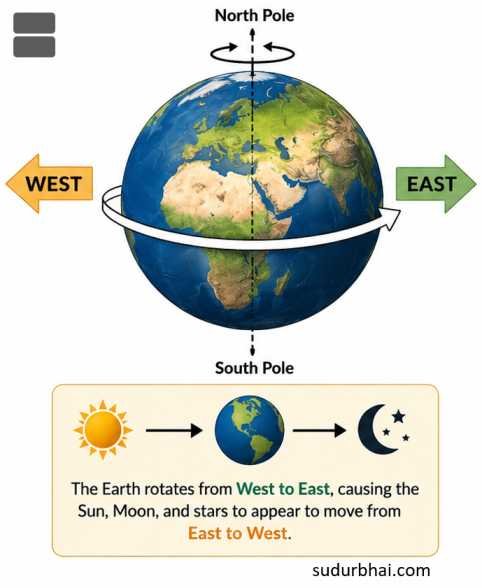
- Rotation is the movement of the Earth around its imaginary axis, extending from the North Pole to the South Pole.
- The Earth rotates from West to East, causing the Sun, Moon, and stars to appear to move from East to West.
Time Taken for rotation
- Sidereal Day: 23 hours 56 minutes 4 seconds
- Solar Day: 24 hours (used in daily life)
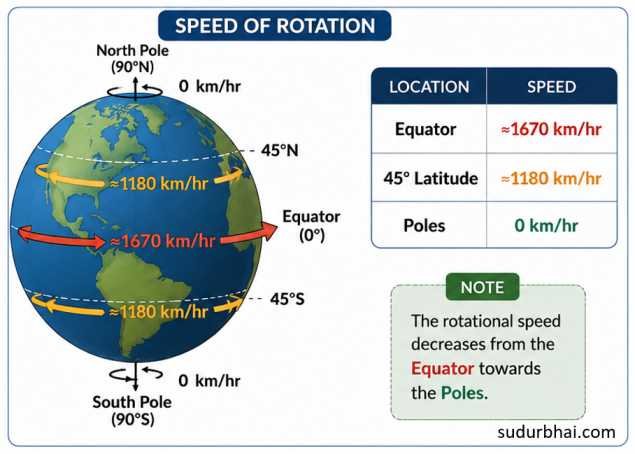
Speed of Rotation
| Location | Speed |
|---|---|
| Equator | ≈1670 km/hr |
| 45° Latitude | ≈1180 km/hr |
| Poles | 0 km/hr |
Note: The rotational speed decreases from the Equator towards the Poles.
Characteristics of Rotation
- Rotation occurs on an imaginary axis.
- The Earth’s axis is tilted at 23½° from the perpendicular (or 66½° to the orbital plane).
- The direction of rotation is counter-clockwise when viewed from above the North Pole.
- Rotation is continuous and uniform.
Effects of Rotation
Formation of Day and Night
- The side facing the Sun experiences day.
- The opposite side experiences night.
- Continuous rotation causes alternating day and night.
Apparent Daily Motion of Celestial Bodies
- The Sun, Moon, and stars appear to move from East to West, although this is actually due to Earth’s west-to-east rotation.
Difference in Local Time
- Places located on different longitudes experience different local times.
- Every 15° longitude corresponds to 1 hour of time difference.
Coriolis Force
- Earth’s rotation gives rise to the Coriolis Force.
- It causes:
- Winds to deflect
- Ocean currents to change direction
- Cyclones to rotate
Northern Hemisphere: Deflection towards the right
Southern Hemisphere: Deflection towards the left
Shape of the Earth
- Rotation causes the Earth to become an Oblate Spheroid.
- The Equator bulges outward, while the Poles are slightly flattened.
Tides
- Rotation, together with the gravitational pull of the Moon and Sun, influences the occurrence of daily tides.
Revolution of the Earth
- Revolution is the movement of the Earth around the Sun along an elliptical orbit.
Time Taken for Earth’s revolution
- 365 days 5 hours 48 minutes 46 seconds
- Approximately 365¼ days
Orbital Speed
- Average speed is about 29.78 km/sec (≈107,000 km/hr).
Characteristics of Revolution
- Earth revolves in an elliptical orbit.
- The Sun occupies one focus of the ellipse.
- The direction of revolution is counter-clockwise (viewed from the North Pole).
- Earth’s axis remains parallel throughout revolution (Parallelism of Axis).
Effects of Revolution
Change of Seasons
The combination of:
- Earth’s revolution
- Axial tilt (23½°)
- Parallelism of Earth’s axis
results in the four seasons.
Variation in Day and Night
- The length of day and night changes throughout the year.
- At the Equator, day and night remain almost equal.
- Near the Poles, extreme variations occur.
Migration of the Overhead Sun
The vertical rays of the Sun migrate between:
- 23½° N (Tropic of Cancer)
- 23½° S (Tropic of Capricorn)
This annual migration produces seasons.
Leap Year
Since one revolution takes about 365¼ days,
- Every fourth year contains 366 days.
- February has 29 days.
Solstices
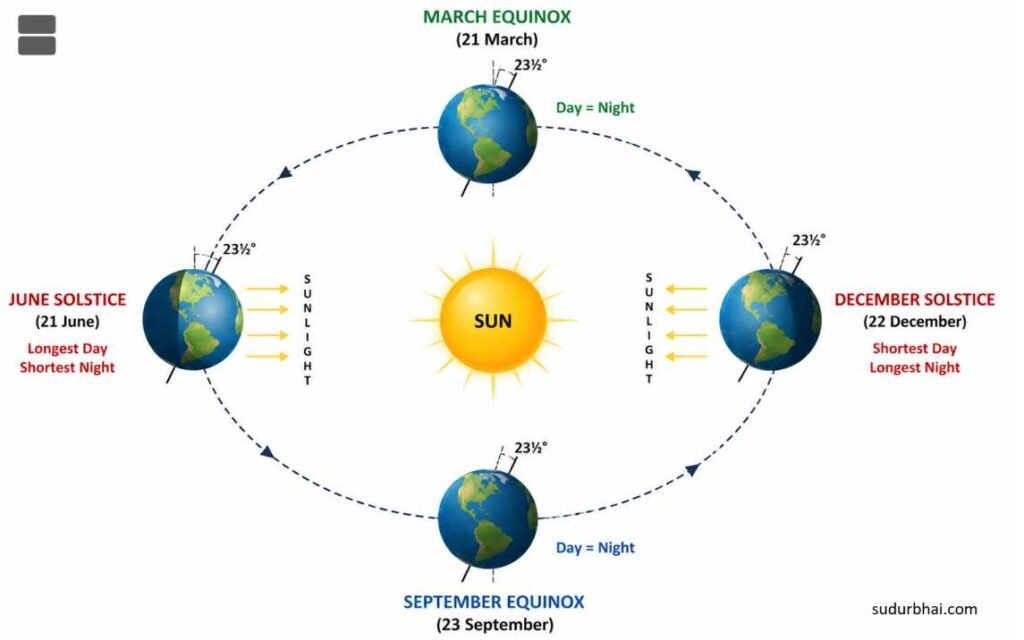
Summer Solstice
Date
- 21 June
Position of Vertical Rays
- Over Tropic of Cancer (23½° N)
Characteristics
- Longest day in the Northern Hemisphere
- Shortest day in the Southern Hemisphere
- Beginning of Summer in the Northern Hemisphere
- Beginning of Winter in the Southern Hemisphere
Winter Solstice
Date
- 22 December
Position of Vertical Rays
- Over Tropic of Capricorn (23½° S)
Characteristics
- Shortest day in the Northern Hemisphere
- Longest day in the Southern Hemisphere
- Beginning of Winter in the Northern Hemisphere
- Beginning of Summer in the Southern Hemisphere
Equinoxes
Vernal (Spring) Equinox
Date
- 21 March
Characteristics
- Sun is vertically overhead at the Equator.
- Day and night are equal (12 hours each) throughout the world.
- Marks the beginning of Spring in the Northern Hemisphere.
- Marks the beginning of Autumn in the Southern Hemisphere.
Autumnal Equinox
Date
- 23 September
Characteristics
- Sun is again vertically overhead at the Equator.
- Equal duration of day and night across the globe.
- Beginning of Autumn in the Northern Hemisphere.
- Beginning of Spring in the Southern Hemisphere.
Important Dates at a Glance
| Date | Event | Vertical Rays of Sun |
|---|---|---|
| 21 March | Vernal Equinox | Equator |
| 21 June | Summer Solstice | Tropic of Cancer |
| 23 September | Autumnal Equinox | Equator |
| 22 December | Winter Solstice | Tropic of Capricorn |
Polar Day and Polar Night
Midnight Sun
- Regions within the Arctic Circle experience 24 hours of daylight around 21 June.
- Regions within the Antarctic Circle experience it around 22 December.
- The “Land of the Midnight Sun” most famously refers to Norway, where the sun remains visible 24 hours a day during summer.
Polar Night
- Regions within the Arctic Circle experience 24 hours of darkness around 22 December.
- Regions within the Antarctic Circle experience it around 21 June.
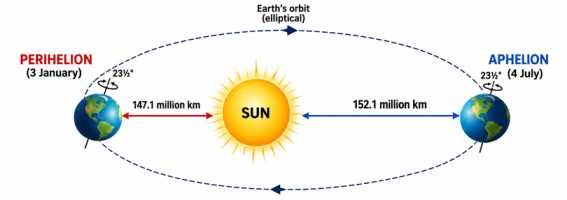
Aphelion and Perihelion
Aphelion
- The Earth is farthest from the Sun.
Date
- Around 4 July
Distance
- Approximately 152.1 million km
Perihelion
- The Earth is closest to the Sun.
Date
- Around 3 January
Distance
- Approximately 147.1 million km
Important: The seasons are not caused by the Earth’s distance from the Sun, but by the 23½° axial tilt and Earth’s revolution.
Eclipse
An Eclipse occurs when one celestial body blocks the light of another due to their alignment.
There are two major types:
- Solar Eclipse
- Lunar Eclipse
Solar Eclipse
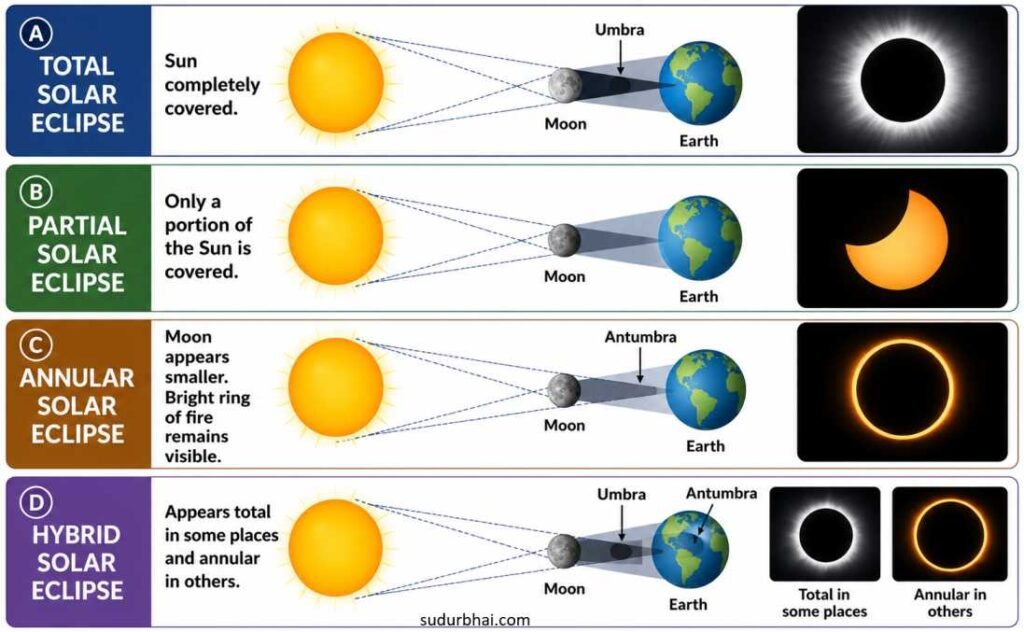
- A Solar Eclipse occurs when the Moon comes between the Sun and the Earth, casting its shadow on the Earth.
- It occurs only on New Moon
Types of Solar Eclipse :
A. Total Solar Eclipse
- Sun completely covered.
B. Partial Solar Eclipse
- Only a portion of the Sun is covered.
C. Annular Solar Eclipse
- Moon appears smaller.
- Bright ring of fire remains visible.
D. Hybrid Solar Eclipse
- Appears total in some places and annular in others.
Lunar Eclipse
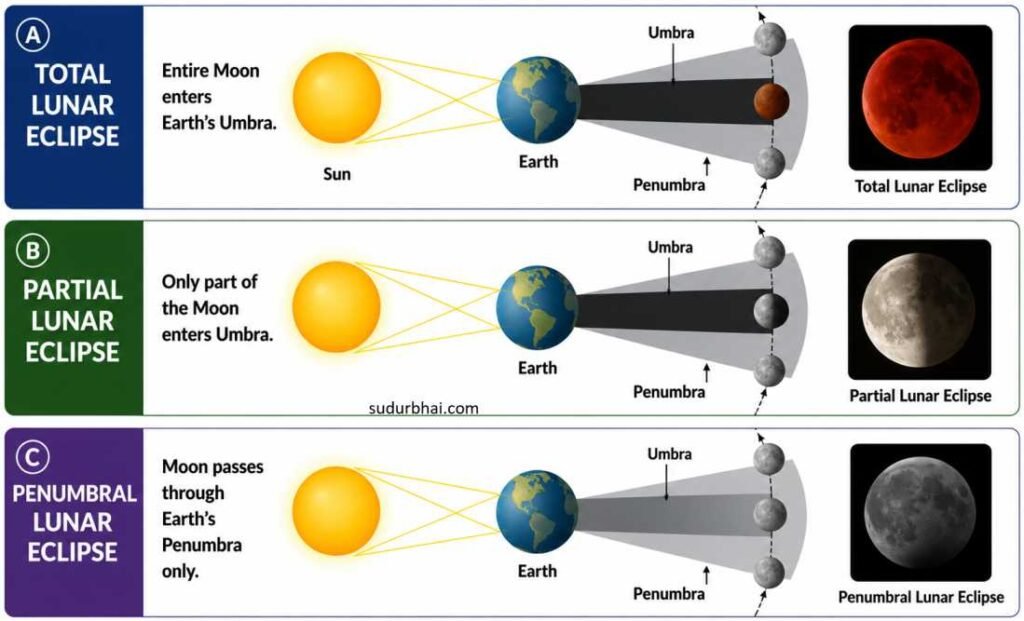
- A Lunar Eclipse occurs when the Earth comes between the Sun and the Moon, causing the Earth’s shadow to fall on the Moon.
- Lunar Eclipse ocurs only on Full Moon
Types of Lunar Eclipse :
A. Total Lunar Eclipse
- Entire Moon enters Earth’s Umbra.
B. Partial Lunar Eclipse
- Only part of the Moon enters Umbra.
C. Penumbral Lunar Eclipse
- Moon passes through Earth’s Penumbra only.
Umbra and Penumbra
Umbra
- The dark central shadow.
- Produces Total Eclipse.
Penumbra
- The lighter outer shadow.
- Produces Partial or Penumbral Eclipse.
Solar Eclipse vs Lunar Eclipse
| Basis | Solar Eclipse | Lunar Eclipse |
|---|---|---|
| Alignment | Sun – Moon – Earth | Sun – Earth – Moon |
| Lunar Phase | New Moon | Full Moon |
| Shadow Falls On | Earth | Moon |
| Visibility | Small part of Earth | Entire night side of Earth |
| Safe to View | No (without protection) | Yes |
| Duration | Few minutes | Up to several hours |
Important Lines Related to Earth’s Movement
| Latitude | Importance |
|---|---|
| 0° | Equator |
| 23½° N | Tropic of Cancer |
| 23½° S | Tropic of Capricorn |
| 66½° N | Arctic Circle |
| 66½° S | Antarctic Circle |
| 90° N | North Pole |
| 90° S | South Pole |
Key Facts for Quick Revision
| Concept | Fact |
|---|---|
| Rotation Direction | West → East |
| Revolution Direction | Counter-clockwise (viewed from North Pole) |
| Time for Rotation | 23 h 56 m 4 s (Sidereal Day) |
| Time for Revolution | 365 d 5 h 48 m 46 s |
| Earth’s Axis Tilt | 23½° |
| Longest Day (NH) | 21 June |
| Shortest Day (NH) | 22 December |
| Equal Day & Night | 21 March & 23 September |
| Closest to Sun | Perihelion (≈3 January) |
| Farthest from Sun | Aphelion (≈4 July) |
| Solar Eclipse | New Moon |
| Lunar Eclipse | Full Moon |
| Leap Year | Every 4th year (with century-year exceptions under the Gregorian calendar: years divisible by 100 are not leap years unless also divisible by 400) |
| Earth’s Orbital Speed | ≈29.78 km/s |
| Earth’s Rotational Speed at Equator | ≈1670 km/hr |