
Internal Structure of the Earth
The Interior of the Earth refers to the arrangement of different layers beneath the Earth’s surface. Information about these layers has been obtained mainly through the study of Seismic Waves, Meteorites, Volcanic Eruptions, Gravitational Field, and Magnetic Field.
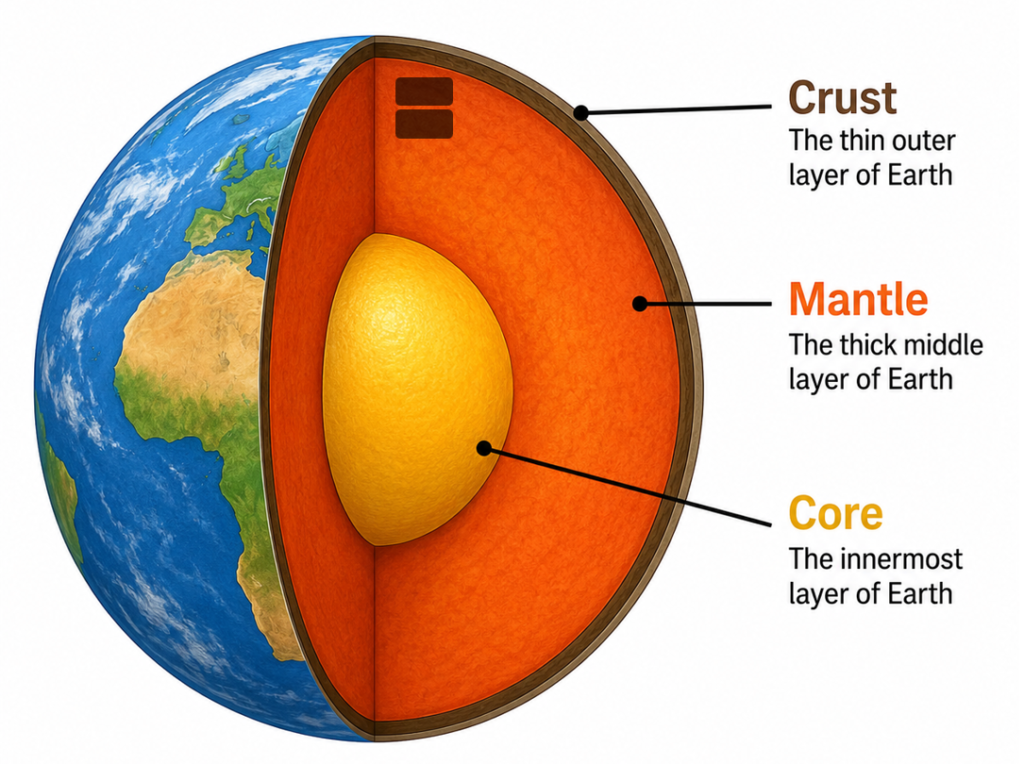
The Earth is broadly divided into three major concentric layers:
- Crust
- Mantle
- Core
Earth’s Crust
- The Crust is the outermost solid layer of the Earth and forms less than 1% of the Earth’s total volume.
- It serves as the foundation for all continents, oceans, and living organisms.
Thickness
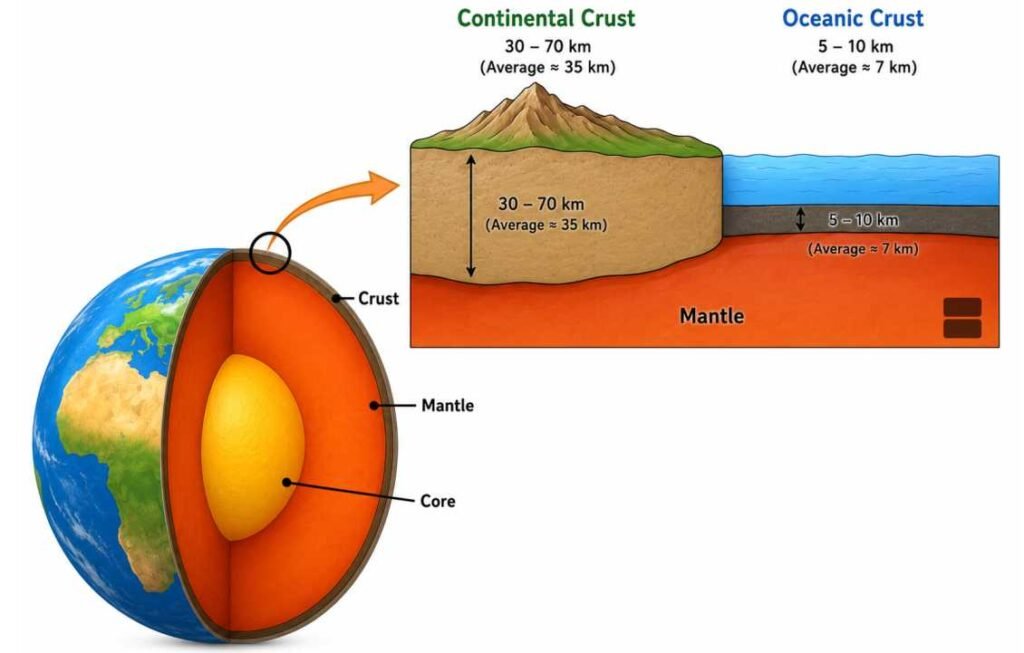
The thickness of the crust varies considerably:
- Continental Crust: 30–70 km (Average ≈ 35 km)
- Oceanic Crust: 5–10 km (Average ≈ 7 km)
Thus, the crust is thicker beneath continents and thinner beneath oceans.
Density
- Average density ranges between 2.7–3.0 g/cm³.
Chemical Composition
The crust is divided into two major layers:
SIAL (Upper Crust)
- Rich in Silica (Si) and Aluminium (Al).
- Forms the continental crust.
- Comparatively lighter in density.
SIMA (Lower Crust)
- Rich in Silica (Si) and Magnesium (Mg).
- Constitutes the oceanic crust.
- Comparatively denser than SIAL.
Major Characteristics
- Contains most of the Earth’s minerals.
- Supports all landforms, soil, and biosphere.
- It is the most geologically active layer for human activities.
Mantle
- The Mantle is the thick layer situated between the Crust and the Core.
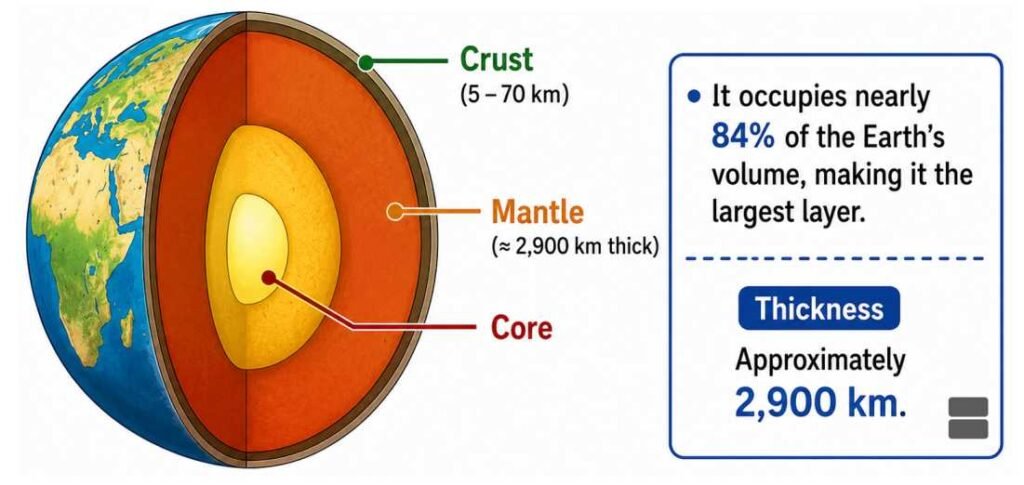
- It occupies nearly 84% of the Earth’s volume, making it the largest layer.
Thickness
- Approximately 2,900 km.
Density
- Density ranges from 3.3 to 5.7 g/cm³, increasing with depth.
Composition
The mantle mainly consists of:
- Silicates of Magnesium
- Silicates of Iron
- Minerals such as Olivine and Pyroxene
State
- The upper mantle is partly molten and behaves as a plastic layer.
- The lower mantle remains solid because of immense pressure.
Importance
The mantle is responsible for:
- Mantle Convection Currents
- Plate Tectonics
- Volcanic Activity
- Mountain Building
- Continental Drift
Core
- The Core is the innermost layer of the Earth.
- It extends from approximately 2,900 km depth to the Earth’s centre at 6,371 km.
Thickness
- About 3,480 km.
Composition
The core mainly consists of:
- Iron (Fe)
- Nickel (Ni). Hence, it is commonly referred to as NIFE.
Small quantities of Sulphur, Oxygen, Silicon are also present.
Density
- Density ranges between 10 and 13.5 g/cm³, making it the densest layer of the Earth.
Temperature
- Estimated temperature ranges from 5,000°C to over 6,000°C.
Division of the Core
Outer Core
- Depth: 2,900–5,150 km
- Liquid in nature.
- Responsible for generating the Earth’s Magnetic Field through the Geodynamo Process.
Inner Core
- Depth: 5,150–6,371 km
- Solid due to extremely high pressure despite its high temperature.
Lithosphere
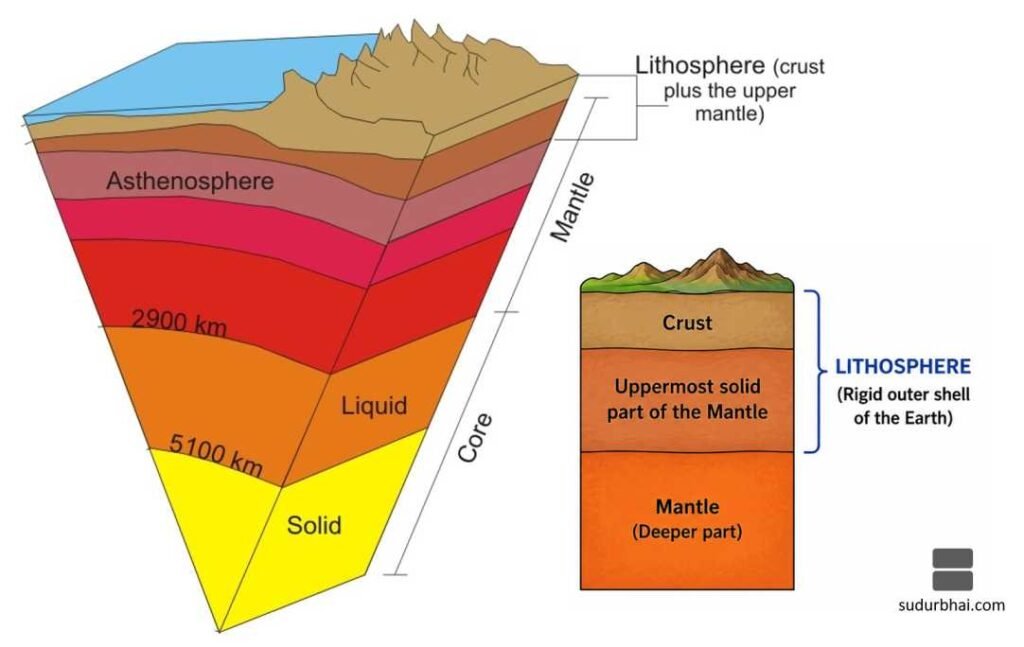
- The Lithosphere is the rigid outer shell of the Earth consisting of:
- Entire Crust
- Uppermost solid part of the Mantle
Thickness
- Approximately 100–200 km.
Characteristics
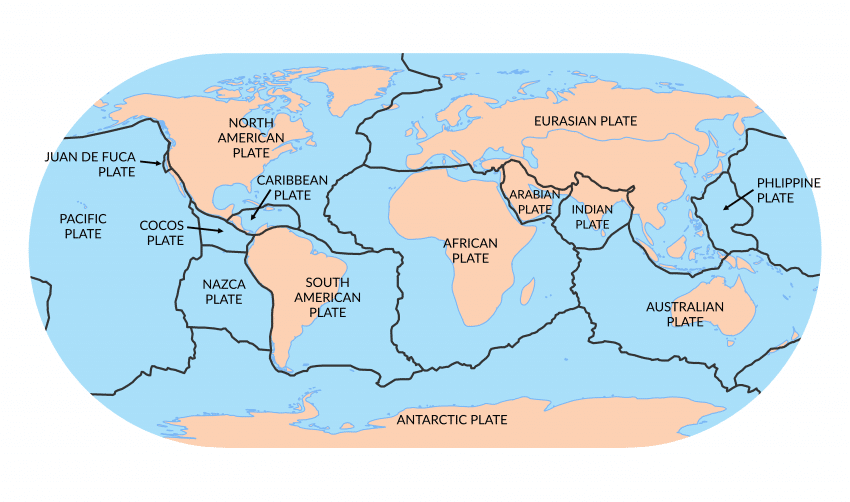
- Broken into several Tectonic Plates.
- These plates continuously move due to Mantle Convection.
- Responsible for:
- Earthquakes
- Volcanoes
- Mountain Formation
- Continental Drift
Major Plates
- Indian Plate
- Eurasian Plate
- Pacific Plate
- North American Plate
- South American Plate
- African Plate
- Antarctic Plate
- Australian Plate
Asthenosphere
- The Asthenosphere lies immediately below the Lithosphere within the Upper Mantle.
Depth
- Approximately 100–350 km below the Earth’s surface.
Characteristics
- Consists of partially molten rocks.
- Exhibits plastic and ductile behaviour.
- Allows the Lithospheric Plates to move over it.
Importance
The Asthenosphere is essential for:
- Plate Tectonics
- Continental Drift
- Mantle Convection
- Volcanic Activity
Seismic Discontinuities
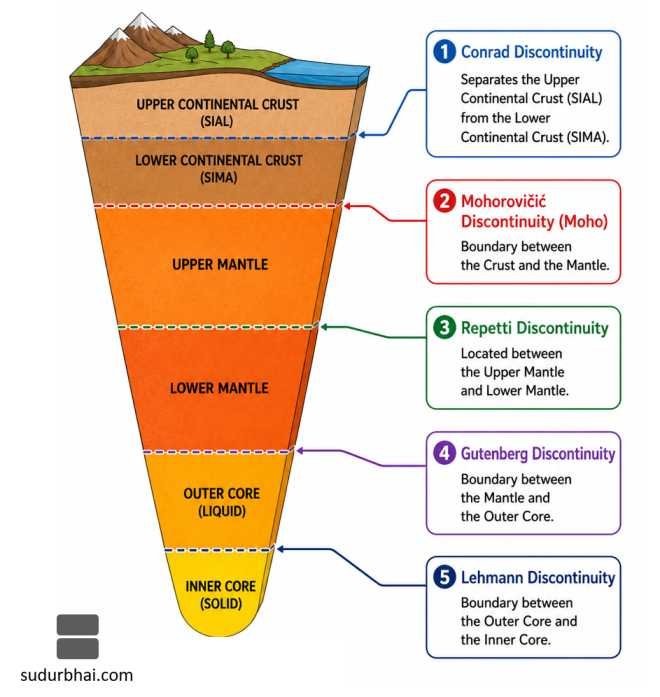
Seismic discontinuities are boundaries between different layers of the Earth’s interior where seismic waves change their speed, direction, or behaviour due to changes in composition or physical state.
Conrad Discontinuity
- Separates the Upper Continental Crust (SIAL) from the Lower Continental Crust (SIMA).
- Not well developed beneath the Oceanic Crust.
Mohorovičić Discontinuity (Moho)
- Boundary between the Crust and the Mantle.
- Located at:
- 5–10 km beneath oceans.
- 30–70 km beneath continents.
- Marks a sudden increase in seismic wave velocity.
Repetti Discontinuity
- Located between the Upper Mantle and Lower Mantle.
- Depth: Approximately 660–700 km.
- Indicates mineralogical changes within the mantle.
Gutenberg Discontinuity
- Boundary between the Mantle and the Outer Core.
- Depth: Approximately 2,900 km.
- S-waves disappear beyond this boundary because the Outer Core is liquid.
- P-wave velocity decreases sharply.
Lehmann Discontinuity
- Boundary between the Outer Core and the Inner Core.
- Depth: Approximately 5,150 km.
- Marks the transition from liquid to solid iron-nickel.
Composition of the Earth (Whole Earth)
| Element | Approximate Percentage (%) |
|---|---|
| Iron (Fe) | 32.1 |
| Oxygen (O) | 30.1 |
| Silicon (Si) | 15.1 |
| Magnesium (Mg) | 13.9 |
| Sulphur (S) | 2.9 |
| Nickel (Ni) | 1.8 |
| Calcium (Ca) | 1.5 |
| Aluminium (Al) | 1.4 |
| Others | 1.2 |
Composition of the Earth’s Crust
| Element | Chemical Symbol | Approximate Percentage (%) |
|---|---|---|
| Oxygen | O | 46.6 |
| Silicon | Si | 27.7 |
| Aluminium | Al | 8.1 |
| Iron | Fe | 5.0 |
| Calcium | Ca | 3.6 |
| Sodium | Na | 2.8 |
| Potassium | K | 2.6 |
| Magnesium | Mg | 2.1 |
| Titanium | Ti | 0.4 |
| Hydrogen | H | 0.14 |
| Phosphorus | P | 0.12 |
| Manganese | Mn | 0.10 |
| Others | — | ≈0.74 |
Comparative Overview of Earth’s Interior
| Layer | Depth | State | Major Composition | Key Significance |
|---|---|---|---|---|
| Crust | 5–70 km | Solid | Silica, Aluminium, Magnesium | Supports continents and oceans |
| Mantle | 70–2,900 km | Mostly Solid (Plastic in Upper Mantle) | Magnesium & Iron Silicates | Convection currents, Plate Tectonics |
| Outer Core | 2,900–5,150 km | Liquid | Iron & Nickel | Generates Earth’s Magnetic Field |
| Inner Core | 5,150–6,371 km | Solid | Iron & Nickel | Centre of the Earth; high pressure maintains solid state |