
Table of Contents
ToggleWeather
- Weather refers to the state of the atmosphere at a particular place over a short period of time.
- It includes atmospheric conditions such as:
- Temperature
- Humidity
- Precipitation (type and amount)
- Air Pressure
- Wind
- Cloud Cover
- Weather differs from Climate because climate represents the average pattern of weather conditions over a long period, generally about 30 years.
Weather and the Troposphere
- Weather phenomena mainly occur in the Troposphere, the lowest layer of the atmosphere.
- The troposphere extends:
- About 6–8 km above the poles
- About 17 km above the Equator
- Most weather activities are confined to the troposphere because:
- Almost all clouds form here
- Nearly all precipitation develops in this layer
Factors affecting Weather
- Atmospheric phenomena occurring in the upper troposphere and above, such as:
- Jet Streams
- Upper-air waves
significantly influence surface weather conditions.
- These upper atmospheric processes affect:
- High-pressure systems
- Low-pressure systems
thereby controlling weather at the Earth’s surface.
- Geographic features also play an important role in influencing weather, especially:
- Mountains
- Large water bodies such as lakes and oceans
Ocean–Atmosphere Interaction
- Recent studies show that anomalies in ocean surface temperatures can influence atmospheric temperatures over distant regions and future seasons.
- One major example of ocean-atmosphere interaction is the:
- El Niño–Southern Oscillation (ENSO)
Climate
- Climate refers to the average atmospheric conditions of a place over a long period of time.
- It is the long-term summary of weather conditions and their variations.
- Climate is generally studied over a period of 30 years or more.
Elements of Climate
- Climate is determined by long-term variations in the following atmospheric elements:
- Solar Radiation
- Temperature
- Humidity
- Precipitation (type, frequency, and amount)
- Atmospheric Pressure
- Wind (speed and direction)


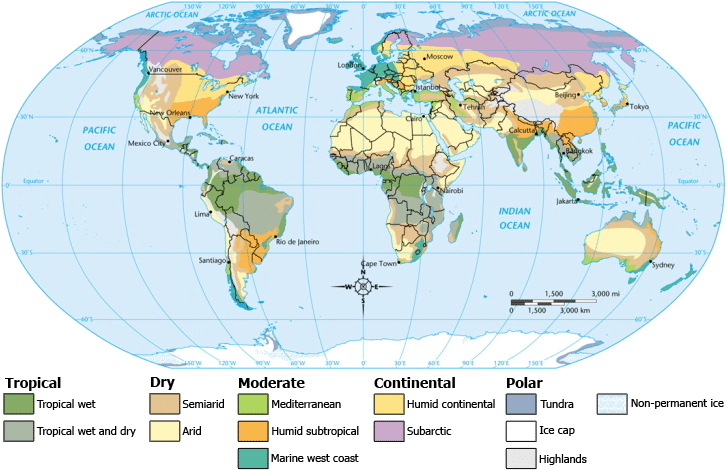
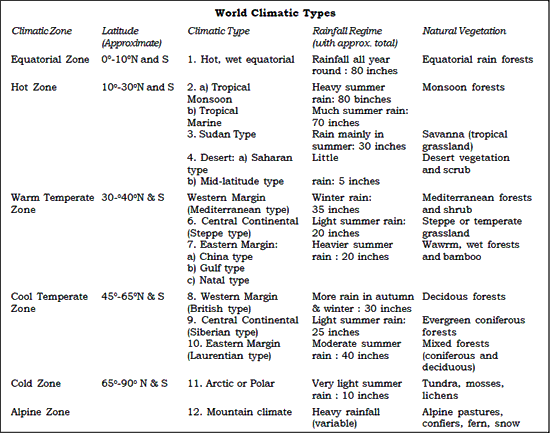
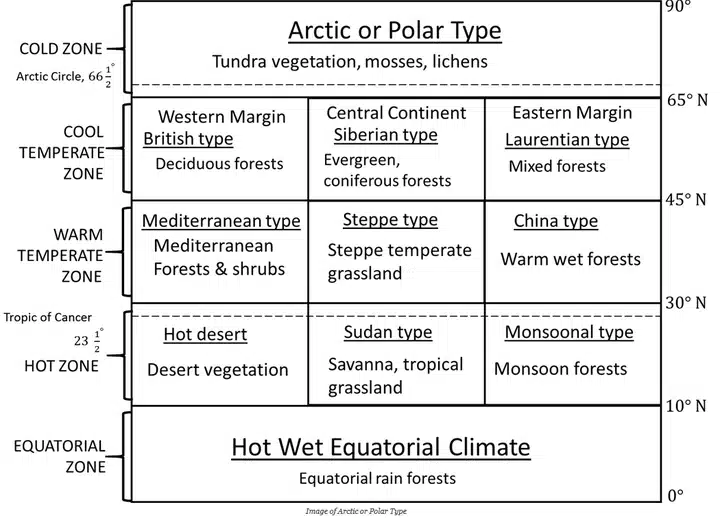
Climatic Regions of World
Hot, Wet Equatorial Climate
Distribution
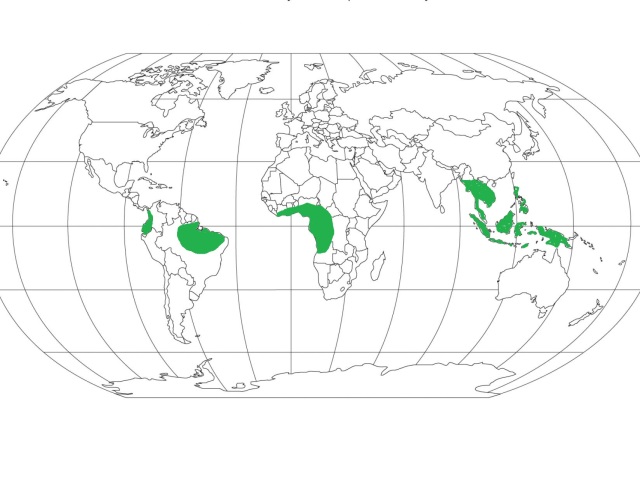
- Found between 5° North and 10° South of the Equator.
- Has minimal influence of trade winds; beyond this zone, climate gradually shifts to monsoon type.
- Generally a hot and wet climate, though cooler pockets exist in high-altitude regions like Cameron Highlands (Malaysia).
Countries in this region include
- Ecuador
- Colombia
- Brazil
- Peru
- Nigeria
- Liberia
- Myanmar
- Thailand
- Cambodia
- Malaysia
- Java (Indonesia)
Climate Characteristics
- Temperature remains almost uniform throughout the year.
- Average monthly temperature ranges between 24°C and 27°C.
- There is no winter season.
- Both diurnal and annual temperature ranges are very small.
- Rainfall is very heavy (60–100 inches) and evenly distributed throughout the year.
- A unique feature is the presence of double rainfall peaks coinciding with equinoxes.
Natural Vegetation
- Supports dense tropical rainforests with luxuriant vegetation.
- The Amazon rainforest is known as the Selvas.
- Dominated by evergreen trees such as:
- Mahogany
- Ebony
- Greenheart
- Cabinet wood trees
- Presence of lianas, epiphytes, and parasitic plants.
- Pure stands of a single tree species are rare.
Economy
- These regions are generally sparsely populated.
- Indigenous people often practice hunting, gathering, and shifting cultivation.
- Plantation agriculture is also present, including crops like:
- Natural rubber
- Cocoa
- Overall economic development is limited due to dense forests and difficult terrain.

Savanna or Sudan Climate (Tropical Wet and Dry Climate)
- The Savanna Climate is a transitional climate between:
- Equatorial rainforests
- Hot desert climates of trade wind regions
- It lies entirely within the tropical belt (between Tropic of Cancer and Tropic of Capricorn).
- Well developed in Sudan, hence the name Sudan Climate.
Distribution
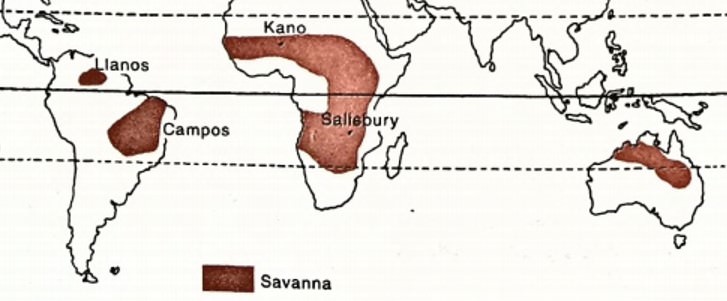
- Found mainly in tropical latitudes on both sides of the Equator.
- Best developed in Sudan (Africa) with distinct wet and dry seasons.
Northern Hemisphere
- Found in:
- East Africa
- African Sudan
- Llanos grasslands (Orinoco Basin, South America)
- Found in:
Southern Hemisphere
- Found in:
- Campos grasslands (Brazilian Highlands)
- Northern Australia (south of monsoon belt)
- Found in:
Temperature
- Monthly temperature ranges between 20°C and 32°C in lowlands.
- Annual average temperature is around 18°C.
- Highest temperatures occur just before the rainy season:
- April (Northern Hemisphere)
- October (Southern Hemisphere)
- During rainy season, cloud cover reduces temperature.
- Noon temperatures may exceed 37°C in hot season.
- Night temperatures may fall below 10°C, even causing frost in some areas.
- A key feature is the high diurnal temperature range.
Precipitation
- Climate is characterized by:
- Hot, wet season
- Cool, dry season
- Rainfall occurs mainly in summer:
- Northern Hemisphere: May–September
- Southern Hemisphere: October–March
- Rainfall decreases as distance from the Equator increases.
Winds
- Dominated by Trade Winds (Easterlies).
- These winds bring rainfall to coastal areas.
- Maximum rainfall occurs on eastern coasts due to onshore winds.
Seasonal wind behavior
- Summer: Onshore winds bring moisture and rainfall.
- Winter: Offshore winds make conditions dry.
Harmattan Wind
- In West Africa, dry northeasterly winds blow from the Sahara.
- These winds are locally called Harmattan (“doctor wind”).
- Effects:
- Dry and dusty conditions
- Damage to crops
- Cooling effect by increasing evaporation
Vegetation
- Dominated by tall grasses and scattered trees (parkland/bush-veld).
- Tree density is highest near the Equator and rivers.
- Trees are mostly deciduous, shedding leaves in dry season to reduce water loss.
- Examples include Acacia.
- Some trees store water in trunks (e.g., Baobab, Bottle tree).
- Grass grows tall (6–12 feet), sometimes up to 15 feet (Elephant grass).
- Grass becomes dormant in dry season and regrows in rainy season.
- Vegetation gradually changes into thorn scrub near deserts.
Wildlife
- Home to large terrestrial animals.
Herbivores
- Zebra
- Giraffe
- Elephant
- Antelope
Carnivores
- Lion
- Leopard
- Hyena
- Panther
- Puma
- Jaguar
Other animals
- Along rivers:
- Crocodiles
- Hippos
- Monitor lizards
- Along rivers:
Economy
- Inhabited by nomadic pastoralists like the Masai (Kenya & Tanzania).
- Also include settled tribes like the Hausa, practicing mixed farming and livestock rearing.
- Plantation agriculture is important in regions like:
- Northern Australia
- Eastern Brazil
- Central Africa
Major crops
- Cotton
- Sugarcane
- Oil palm
- Groundnuts
- Coffee
- Tropical fruits
- Subsistence crops include millets, bananas, and vegetables.
Agricultural challenges
- Frequent droughts affect productivity.
- Heavy rainfall causes leaching of nutrients (nitrates, phosphates, potash).
- Soils often become lateritic and infertile.
- Poor-quality grass limits large-scale livestock farming.
- However, some regions like Queensland (Australia) are major exporters of meat and dairy products.

Tropical Monsoon Climate
Distribution
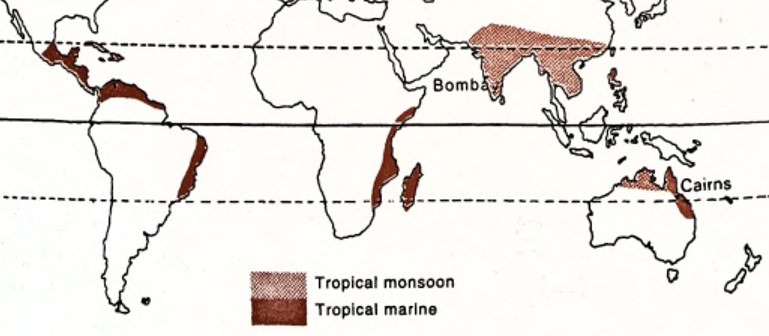
- Found between 5° to 30° latitudes on both sides of the Equator.
- Strongly influenced by the Inter-Tropical Convergence Zone (ITCZ).
- Regions remain hot and humid throughout the year due to high sun angle.
- Monsoons are seasonal wind systems that reverse direction between land and sea.
- Characterized by three distinct seasons: summer, winter, and rainy season.
Major Regions
- Indian Subcontinent
- Indo-China (Laos, Vietnam, Cambodia)
- Thailand
- Southern China
- Northern Australia
Winds
- Monsoon winds are caused by differential heating of land and sea.
- In summer, a low-pressure system develops over Central Asia due to intense heating.
- Surrounding oceans remain relatively high pressure.
- In the Southern Hemisphere, high pressure develops over northern Australia during winter.
- Winds move from high-pressure oceanic areas toward low-pressure land areas.
- Due to the Coriolis force, winds are deflected and become South-West Monsoon winds.
- In winter, wind direction is reversed.
Temperature
- Region experiences high temperatures due to tropical location.
- Average temperature remains above 18°C year-round.
- Summer temperatures can reach up to 45°C in extreme cases.
- Mean summer temperature is around 30°C.
- Winter temperatures range between 15°C and 30°C, with an average of about 25°C.
- Overall annual temperature range is 30–45°C.
Precipitation
- Receives very high rainfall concentrated in a few months.
- Average annual rainfall is about 200–250 cm, but can exceed 350 cm in some areas.
- Mawsynram and Cherrapunji (Meghalaya, India) record over 1000 cm rainfall annually, making them the wettest places on Earth.
- Heavy rainfall occurs due to orographic uplift and funneling effect in mountainous regions.
Seasons
Hot Dry Season (March to mid-June)
- Sun shifts northwards toward the Tropic of Cancer.
- Temperatures rise sharply across the region.
- Central India may exceed 35°C–44°C in extreme areas.
- Coastal regions remain cooler due to sea breeze influence.
- Rainfall is minimal except occasional thunderstorms.
Rainy Season (mid-June to September)
- Marked by burst of monsoon winds.
- Accounts for over 70% of annual rainfall.
- Characterized by heavy, continuous rainfall across the region.
Cold Dry Season (October to February)
- Also called retreating monsoon season.
- Winds reverse direction as high pressure develops over land.
- Winds blow from land to sea, causing dry conditions.
- Some rainfall occurs in southeast India due to northeast monsoon winds.
- Western disturbances bring winter rain and snow to northern India.
Monsoon Forests
- Also called Tropical Monsoon Forests.
- Dominated by deciduous trees that shed leaves during dry season to reduce water loss.
Types of Forests
- Moist deciduous forests: rainfall > 150 cm
- Dry deciduous forests: rainfall < 150 cm
Characteristics
- Composed of broadleaf hardwood trees.
- Less dense than equatorial forests.
- Lower biodiversity compared to rainforests.
Evergreen Forests
- Found where rainfall exceeds 200–250 cm.
- Present in:
- Western Ghats (South India)
- Northeast India
- Andaman & Nicobar Islands
- Parts of Southeast Asia
Transition Zones
- Low rainfall areas support savanna-type vegetation.
- Vegetation ranges from dense forests to thorny scrublands.
Economy
- Region is highly populated.
- Agriculture is the main occupation:
- Subsistence farming
- Shifting cultivation
- Plantation agriculture
Major Crops
- Plains: Rice, wheat, maize, sugarcane, jute, spices
- Highlands: Tea, coffee, rubber, banana
Forestry and Timber
- Important hardwood trees include:
- Teak (central India, Myanmar)
- Sal, Acacia, Eucalyptus, Neem, Mango
- Bamboo
- Lumbering is an important economic activity due to valuable timber resources.
- Important hardwood trees include:

Desert Climate
- Deserts are regions with very low rainfall and sparse vegetation.
- The growing season is short due to limited moisture availability.
- Characterized by low population density and harsh environmental conditions.
Types of Deserts
- Hot Deserts (e.g., Sahara Desert)
- Mid-Latitude Deserts (e.g., Gobi Desert)
Hot Deserts
Distribution
- Located between 15°–30° latitude on western continental margins.
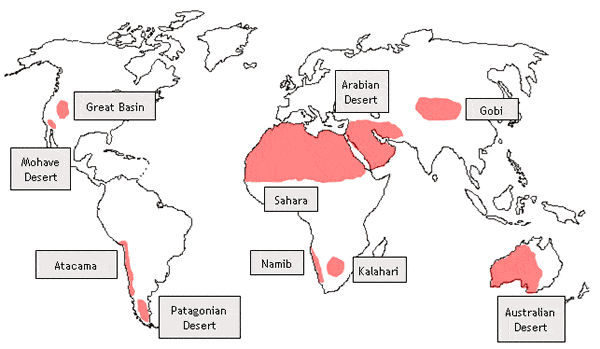
- Major deserts include:
- Sahara Desert (largest)
- Arabian Desert
- Kalahari Desert
- Thar Desert
- Great Australian Desert
- In the Americas:
- Sonoran, Mojave, Californian, Mexican deserts (North America)
- Atacama Desert (South America)
Temperature
- Among the hottest regions on Earth.
- Summer temperatures exceed 30°C regularly.
- Record temperature: 57°C (Libya, 1922).
- High temperatures due to:
- Clear skies
- Strong insolation
- Dry air
- Low humidity
Temperature Variations
- Coastal deserts are moderated by cold ocean currents.
- Interior deserts experience extreme heat in day and cold nights.
- Diurnal range: 14°C–25°C.
- Frost may occur during winter nights.
Precipitation
- Annual rainfall is generally below 25 cm.
- Located in subtropical high-pressure zones (horse latitudes).
- Descending air prevents cloud formation.
- Trade winds are offshore, reducing moisture supply.
- Cold ocean currents reduce evaporation and rainfall.
- Some rainfall occurs as short, intense convectional storms.
- Atacama Desert is the driest region (<2 cm rainfall annually).
Mid-Latitude Deserts
Distribution
- Found in continental interiors and plateaus.
- Examples include:
- Gobi Desert
- Turkestan Desert
- Patagonian Desert
- Ladakh Desert (India)
Climate
- Similar to hot deserts in dryness but more extreme in temperature variation.
- Located far from oceans or blocked by mountains.
- Annual rainfall remains below 25 cm.
- Experience occasional winter rainfall due to depressions.
- Strong continentality effect leads to:
- Very cold winters
- Hot summers
- Melting snow in summer may cause flooding in some regions.
Desert Vegetation
- Vegetation is xerophytic (drought-resistant).
- Includes:
- Cacti
- Thorny bushes
- Wiry grasses
- Dwarf acacia
- Some areas support date palm clusters (near groundwater).
Adaptations
- Deep root systems to access groundwater.
- Leaves reduced to minimize transpiration.
- Waxy or hairy surfaces to conserve moisture.
- Seeds remain dormant until rainfall occurs.
- Soils are poor in humus due to slow decomposition.
Life in Deserts (Types of Human Settlements)
1. Primitive Groups
- Hunters and gatherers
- Examples: Bushmen (Kalahari), Aborigines (Australia)
2. Nomadic Herdsmen
- Livestock-based economy.
- Examples: Bedouins (Arabia), Tuaregs (Sahara), Mongols (Gobi)
3. Settled Agriculture
- Practised near rivers:
- Nile (Egypt)
- Indus (Pakistan)
- Colorado (USA)
- Tigris-Euphrates (Iraq)
- Crops: wheat, barley, sugarcane, fruits, vegetables
- Practised near rivers:
4. Mining Settlements
- Resource-based economies:
- Gold (Australia)
- Diamonds (Kalahari)
- Copper (Chile)
- Silver (Mexico)
- Oil (Persian Gulf)
- Resource-based economies:

Steppe Climate
- The term steppe refers to a semi-desert grassland region with sparse grass and shrub vegetation.
- It represents an intermediate climate zone—not dry enough to be a desert and not wet enough to support forests.
- Also known as Temperate Grasslands.
- Often called “grain baskets” due to large-scale agricultural production.
- Livestock ranching is a major economic activity due to abundant natural grasses.
Distribution
- Found in continental interiors.
- Located mainly in the temperate latitudes under the influence of Westerly winds.
- Characterized by vast treeless grasslands.
Major Steppe Regions (Global Names)
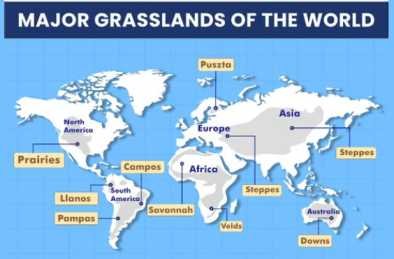
- Eurasian Steppe (largest continuous belt; Black Sea to Altai Mountains)
- Prairies – North America
- Pustaz – Hungary
- Pampas – Argentina & Uruguay
- Velds (High Veld) – South Africa
- Downs – Australia
- Canterbury Grasslands – New Zealand

Precipitation
- Annual rainfall ranges between 25 cm and 75 cm.
- Maximum rainfall occurs in spring / early summer.
- In Northern Hemisphere, rainfall peaks around June–July.
- Winters may receive occasional snowfall due to Westerly depressions.
- Southern Hemisphere steppes receive slightly higher rainfall due to maritime influence.
Temperature
- Climate is influenced by continentality, leading to temperature extremes.
- Summers: Warm, around 18°C–20°C.
- Winters: Cold, often with snowfall.
- Northern Hemisphere steppes show high annual temperature range.
- Southern Hemisphere steppes have a more moderate climate due to ocean influence.
Winds
- Dominated by Westerlies, which bring winter precipitation.
- Influenced by several local winds, such as:
- Mistral (France) – cold, dry wind
- Loo (India) – hot, dry summer wind
- Sirocco (Sahara/Mediterranean) – hot, dusty wind
- Foehn (Alps) – warm, dry wind
- Chinook (North America) – warm, dry katabatic wind
Chinook Wind
- Descends from the Rocky Mountains.
- Raises temperature rapidly by 5°C or more within minutes.
- Helps agriculture by melting snow on pastures.
Vegetation
- Dominated by short, treeless grasslands.
- Grass is shorter than savanna grass, but more nutritious and soft.
- Example: Chernozem soils of Ukraine and North American prairies.
- Supports large-scale livestock ranching.
- Grass grows throughout the year with minimal seasonal interruption.
- Northern edges may show transition to coniferous forests.
- Trees may be planted as windbreaks in agricultural zones.
Economy
- Limited animal diversity compared to savannas.
- Open landscapes support horse grazing in Eurasian steppes.
Agriculture
- Highly developed mechanized farming.
- Known as the “Granaries of the World” (especially Prairies).
- Major crops:
- Wheat
- Maize
Major Agricultural Regions
- Prairies (North America) – wheat, livestock ranching
- Pampas (Argentina) – wheat, dairy, beef export
- Velds (South Africa) – maize, sheep & cattle rearing
- Pustaz (Hungary) – wheat, sugar beet cultivation
- Downs & Canterbury (Australia & New Zealand) – wool and dairy production
Livestock Ranching
- Large-scale animal husbandry practiced over vast areas.
- Replacement of natural grass with alfalfa (lucerne) improves livestock quality.
- Major products include:
- Milk
- Butter
- Cheese
- Beef
- Animal skins
Nomadic Herding
- Practised in Eurasian steppes by groups like Kazakhs and Kirghiz.
- Movement driven by seasonal droughts and lack of reliable rainfall.
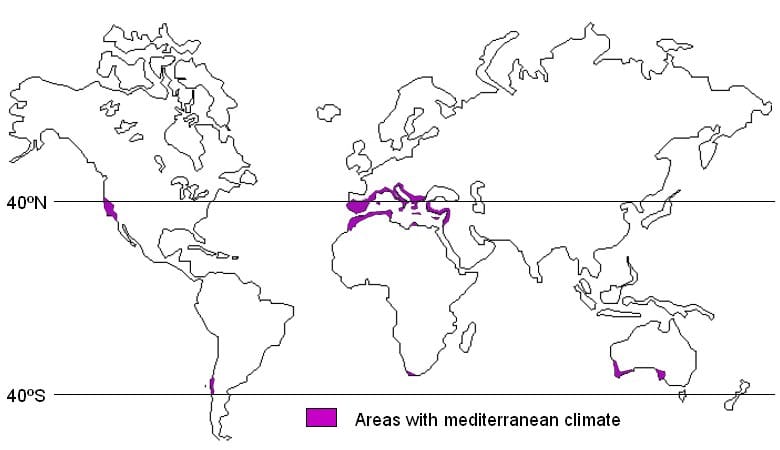
Mediterranean Climate (Western Margin Climate)
Distribution
- Found between 30° and 45° latitudes in both hemispheres.
- Occurs mainly along western continental margins.
- Controlled by seasonal shift of wind belts.
Major Regions
- Central Chile
- California (USA)
- Cape Town region (South Africa)
- Southern Australia (Adelaide, Victoria region)
- South-West Australia (Swanland)
Climate
Summer (Dry & Warm)
- Influenced by off-shore Trade Winds.
- Subtropical high-pressure belt shifts poleward.
- Results in dry, rainless summers.
- High evaporation and low humidity.
- Interior regions experience severe drought conditions.
Winter (Wet & Cool)
- Westerlies shift equatorward.
- Winds become on-shore, bringing rainfall.
- Receives most of its annual precipitation in winter.
- Rainfall is often heavy and causes flooding (e.g., Mediterranean Europe).
Local Winds
Sirocco
- A hot, dry, dusty wind originating from the Sahara Desert.
- Occurs mostly in spring.
- Can last for a few days.
- Causes crop damage and vegetation stress.
- Known as “Blood Rain” due to red dust transport.
Mistral
- A cold, strong wind blowing from the north.
- Travels through the Rhône Valley (France).
- Intensified by the funnel effect between Alps and Central Massif.
- Can disrupt transport and lower temperatures below freezing.
Other Winds
- Bora – cold north-easterly wind along Adriatic coast.
- Tramontana & Gregale – cold winds in Mediterranean region.
Natural Vegetation
- Vegetation is not dense or luxuriant.
- Dominated by xerophytic (drought-resistant) plants.
- Plants are adapted to heat, dryness, and long droughts.
Types of Vegetation
Evergreen Forests
- Found in regions with rainfall above 25 inches.
- Includes evergreen oaks and open woodlands.
- Cork oak used for bottle cork production.
- In Australia, replaced by eucalyptus forests.
- In California, includes giant sequoia (redwoods).
Coniferous Forests
- Found in cooler highlands.
- Includes pine, fir, cedar, cypress.
Bushes and Shrubs
- Most dominant vegetation type.
- Thorny, scattered shrubs adapted to dryness.
Grass
- Sparse and not suitable for intensive grazing.
- Growth limited due to summer drought and winter rainfall pattern.
Economic Development
- Region supports diversified agriculture and industries.
- Major activities include:
- Fruit cultivation
- Cereal farming
- Wine production
- Mining and engineering industries
- Major exporter of citrus fruits and importer of dairy products.
Orchard Farming
- Known as “World’s Orchard Lands”.
- Major fruits:
- Oranges (California, Israel)
- Olives (most characteristic crop)
- Peaches, apricots, pears, cherries, figs
- Nuts: almonds, walnuts, hazelnuts, chestnuts
- Trees have deep root systems to survive dry summers.
Crop Cultivation
- Major cereals: wheat and barley.
- Farming adapted to seasonal rainfall patterns.
Sheep Rearing
- Practised in mountain pastures.
- Includes transhumance (seasonal migration of livestock).
Wine Production
- Known for viticulture (grape cultivation).
- Long sunny summers favor grape ripening.
- Mediterranean region contributes nearly 75% of global wine production.
Warm Temperate Eastern Margin Climate
Location
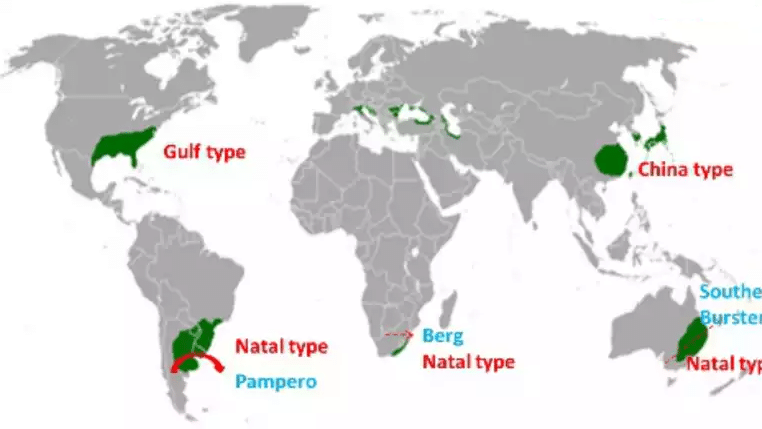
- Found along eastern margins of continents
- Between 20° and 35° North and South latitude
- Similar to monsoonal climate with:
- Wet summers
- Dry winters
Variations
China Type
- Found in most parts of China
- Modified monsoonal climate
- Strong seasonal wind reversal
Gulf Type
- Found in south-eastern USA near Gulf of Mexico
- Similar to China type but weaker monsoon effect
- Summer heating draws moist Atlantic air inland
Natal Type
- Found in:
- New South Wales
- Natal
- Paraná–Paraguay–Uruguay basin
- Maritime influence dominant
- Rainfall fairly uniform throughout year
- Found in:
Climate Features
- Warm, moist summers
- Cool, dry winters
- Occasional frost due to cold air intrusion
- Moderate to heavy rainfall (60–150 cm)
- Rainfall sources:
- Convectional rain
- Orographic rain
- Cyclonic depressions
- Frequent storms:
- Typhoons
- Hurricanes
- Highly suitable for agriculture → dense population
China Type Details
- Strong seasonal monsoon circulation
- Summer:
- Low pressure over Central Asia
- South-East monsoon brings rain
- Winter:
- High pressure over Siberia
- Cold, dry North-West winds
- Typhoons common in late summer
Gulf Type Details
- Weak monsoon influence
- Warm Gulf Stream moderates climate
- Rainfall ~59 inches annually
- Rain sources:
- Thunderstorms
- Hurricanes (Sept–Oct)
- Tornadoes common due to heating contrasts
Natal Type Details
- Strong maritime influence
- Trade winds bring steady moisture
- Rain distributed throughout year
- Low temperature range
Natural Vegetation
- Dense and diverse vegetation
- Evergreen and deciduous forests in lowlands
- Coniferous forests in highlands
- Examples:
- Eucalyptus (Australia)
- Paraná pine, quebracho (South America)
- Palm trees (Natal region)
Economic Development
- Highly productive middle latitude regions
- Continuous growing season
- Intensive agriculture dominates
- High population density
Farming in Monsoon China
- One of the most populated regions globally
- Major rice-producing area (1/3 of world rice)
- Conditions favour paddy cultivation:
- Warm climate
- Adequate rainfall
- Fertile alluvial soil
- Farming features:
- Wet paddy cultivation
- Labour-intensive
- Subsistence farming dominant
- Double and triple cropping increasing
- Sericulture declining
Agriculture in Gulf States (USA)
Corn
- Humid summers and rainfall suitable
- Major global producer (>50%)
- Used mainly for animal feed
Cotton
- Major cash crop
- Long frost-free season (~200 days)
- Important for economy of southern USA
- Pest: boll weevil affects production
Tobacco
- Native crop of America
- Grows in warm, humid, well-drained soils
- Major share in global trade (~50%)
Southern Hemisphere Eastern Margins
Natal Region
- Sugarcane dominant crop
- Cotton and tobacco in interiors
- Maize widely cultivated
- Pastoral farming common (cattle and sheep)
South America
- Lower rainfall
- Focus on cattle and sheep rearing
- Products: meat, wool, hides
Australia
- Moist trade winds bring rainfall
- Dense eucalyptus forests
- Products:
- Milk
- Butter
- Cheese
- Cotton
- Sugarcane
- Maize
British Type Climate (Cool Temperate Western Margin)
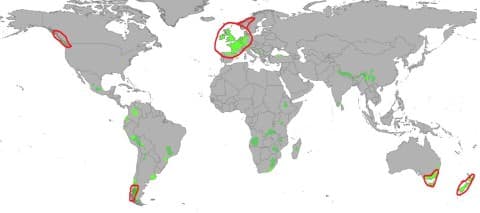
Distribution
- Britain, NW Europe, British Columbia
- Southern Chile, Tasmania, New Zealand
- Strong oceanic influence
Climate
- Mild summers
- Mild winters
- Even rainfall distribution
Temperature
- Annual range: 5°C–15°C
- No extreme cold due to ocean currents
Precipitation
- Rain throughout year
- Western margins get highest rainfall
- Slight winter maximum
Seasons
- Summer: warm and long
- Autumn: windy
- Winter: cold, foggy, rainy
- Spring: dry and pleasant
Natural Vegetation
- Deciduous forests dominate
- Trees shed leaves in winter
- Common trees:
- Oak
- Elm
- Ash
- Birch
- Beech
- Conifers in high altitudes
Economic Development
Agriculture
- High population density → food imports
- Market gardening highly developed
- Mixed farming common:
- Crop farming + livestock rearing
- Main crops:
- Wheat (mostly domestic use)
- Barley (beer, whisky)
- Major activities:
- Dairy farming
- Sheep rearing (wool and meat)
Industry
- Highly industrialised region
- Industries:
- Machinery
- Chemicals
- Textiles
- Major industrial regions:
- Ruhr (Germany)
- Manchester, Yorkshire (UK)
Taiga Climate (Boreal / Sub-Arctic / Siberian Climate)
Location
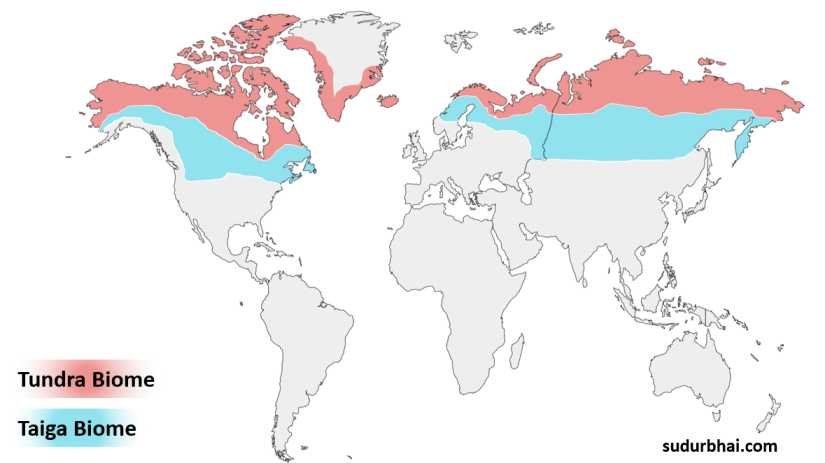
- Found between 50°N to 70°N in a continuous belt
- Occurs only in the Northern Hemisphere
- Regions include:
- Canada
- Scandinavia
- Siberia
Reason for absence in Southern Hemisphere:
- Lack of large continental landmasses at these latitudes
Climate characteristics
- Very long and severe winters (−30°C to −40°C)
- Short and cool summers (just above 10°C)
- Very high annual temperature range (50–60°C)
Key idea: Strong continentality leads to extreme temperature variation
Vegetation
- Dominated by evergreen coniferous forests (Taiga)
- Main species include pine, fir, spruce, and larch
Adaptations of conifers:
- Cone-shaped structure prevents snow accumulation
- Needle-like leaves reduce water loss
- Flexible branches withstand strong winds
- Can survive poor, acidic soils
Reason for sparse undergrowth:
- Low temperatures slow decomposition
- Lack of humus formation
- Short growing season limits plant diversity
Economic activities
- Region is sparsely populated and underdeveloped
Main activities:
- Lumbering (most important)
- Trapping (fur industry)
- Hunting and fishing
Lumbering advantages
- Trees grow in pure stands
- Uniform size and straight trunks increase commercial value
- Winter logging is easier due to frozen ground
- Rivers assist log transport, though limited in Siberia due to Arctic drainage
Laurentian Climate (Cool Temperate Eastern Margin Climate)
Location
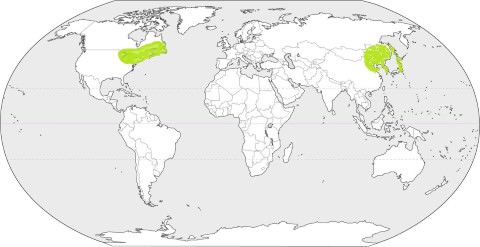
Found in only two main regions:
- North America (northeastern USA, eastern Canada)
- East Asia (northern China, Korea, Japan, Manchuria)
Reason:
- Eastern continental margins influenced by both maritime and continental factors
Climate characteristics
- Cold and dry winters
- Warm and wet summers
Key feature:
- Monsoon-like rainfall distribution in temperate regions
Rainfall pattern
- Summer: Moist winds from oceans bring heavy rainfall
- Winter: Dry continental winds dominate
Special case in North America:
- Gulf Stream increases moisture
- Labrador Current contributes to fog and precipitation
- High frequency of fog in Newfoundland region
Vegetation
- Mixed forests:
- Coniferous forests in northern areas
- Deciduous forests in southern areas
Economic activities
1. Lumbering
- Highly developed due to accessible forests
2. Agriculture
- Dairy farming
- Fruit cultivation
- Mixed farming practices
3. Fishing
- Important in coastal regions
Major fishing areas:
- Grand Banks (Newfoundland)
- Coastal Japan
Reason for rich fisheries:
- Mixing of warm and cold ocean currents increases plankton availability
Comparison: Taiga vs Laurentian Climate
| Feature | Taiga Climate | Laurentian Climate |
|---|---|---|
| Location | Interior high latitudes | Eastern continental margins |
| Temperature | Extremely cold and harsh | Moderately cold winters, warm summers |
| Rainfall | Low and mostly snow | Moderate, with summer maximum |
| Vegetation | Pure coniferous forests | Mixed forests |
| Economy | Primitive (logging, trapping) | Diversified (agriculture, fishing, industry) |
| Population | Sparse | Relatively dense |
Polar Climate (Tundra & Ice Caps)
General Features
- Polar climate has cold conditions throughout the year
- Köppen classification: E type climate
- Summer temperature is below 10°C
- Divided into:
- Polar Tundra
- Polar Ice Caps
Distribution
Northern Hemisphere
- Found north of the Arctic Circle
- Ice caps:
- Greenland
- High latitude highlands (permanent snow cover)
- Tundra areas (seasonal ice-free zones):
- Coastal Greenland
- Northern Canada (barren grounds)
- Alaska
- Arctic seaboard of Eurasia
Southern Hemisphere
- Antarctica is the largest ice-cap region
- Permanently covered with thick ice sheets
- Almost completely uninhabited
Climate
Temperature
- Very low mean annual temperature
- Only about 4 months above 0°C
- Ground remains frozen most of the year
- Interiors are colder than coastal areas
- Winters are long and severe
- Summers are short and cool
- Continuous darkness in winter beyond polar circles
- Frequent frost and blizzards
Precipitation
- Mainly in the form of snow
- Snowfall occurs in winter and is blown by blizzards
- Very low evaporation → very little rainfall
- Convectional rain is almost absent
- Summer precipitation occurs as rain or sleet
- Coastal areas may experience cyclonic rainfall
- Slight tendency for winter precipitation maximum
Natural Vegetation
- Very limited vegetation due to extreme cold
- Growing season is less than 3 months
- No trees in true tundra regions
- Main vegetation types:
- Mosses
- Lichens
- Sedges
- In sheltered areas:
- Dwarf birch
- Willow
- Alder
- Summer vegetation:
- Arctic flowers
- Berry bushes
- Short growing period creates “Arctic bloom”
Human Activities
General Pattern
- Settlement mainly along coastal areas
- Interior highlands and plateaus are uninhabitable
- People lead semi-nomadic life
Eskimos (Inuit)
- Found in Greenland, northern Canada, Alaska
- Traditional activities:
- Hunting
- Fishing
- Food gathering
- Modern changes:
- Some permanent settlements
- Housing:
- Igloos in winter
- Skin tents in summer
- Food sources:
- Fish
- Seals
- Walruses
- Polar bears
Eurasian Tundra Tribes
- Lapps (Sami): Northern Finland and Scandinavia
- Samoyeds: Siberia (Ural to Yenisey Basin)
- Yakuts: Lena Basin
- Koryaks and Chukchi: North-eastern Asia
- Lifestyle:
- Nomadic or semi-nomadic
- Reindeer herding
- Seasonal migration for grazing
Economic Importance & Development
- Earlier considered economically useless
- Now recognized for resource potential
- Developments :
- Discovery of minerals led to settlements
- New railway lines built for transporting ores
- Arctic ports developed along Eurasian coast
- Export of:
- Timber
- Fur
- Mineral resources from Siberia


