
Table of Contents
ToggleWhat is Aurora?
- Aurora is a natural light phenomenon that appears in the sky mainly over the polar regions such as the Arctic and Antarctic areas.
- It occurs when energetic charged particles from space collide with gases present in the Earth’s upper atmosphere.
- Auroras are also popularly known as Polar Lights.
- In the Northern Hemisphere, they are called Aurora Borealis (Northern Lights), while in the Southern Hemisphere, they are known as Aurora Australis (Southern Lights).

Occurrence of Auroras
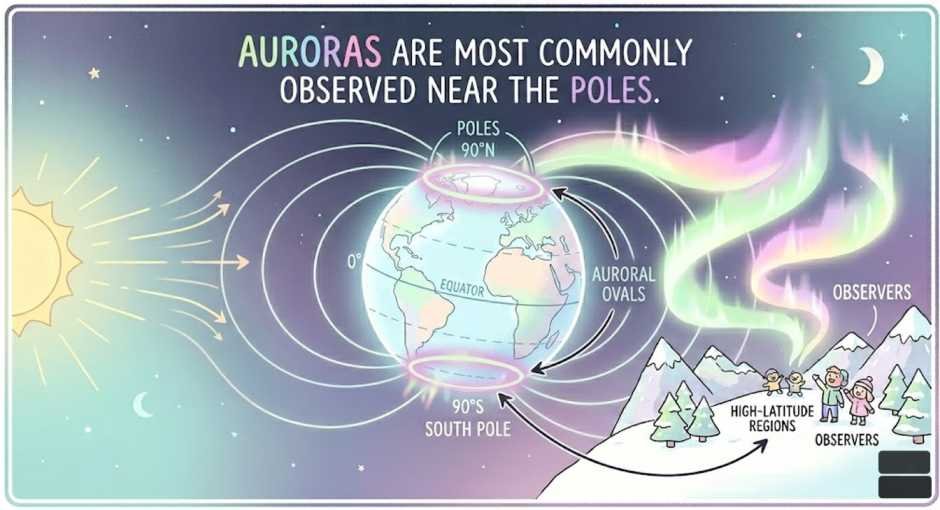
- Auroras are most commonly observed in high-latitude regions near the poles.
- They are less frequent in middle latitudes and are rarely visible near the equator.
- Their visibility increases during periods of intense solar activity.
- Auroras generally appear at heights above 80 km from the Earth’s surface.
Colors of Auroras
- The most common auroral color is green, produced mainly by oxygen atoms.
- Auroras can also appear in various other shades such as:
- Red
- Blue
- Violet
- Pink
- White
- The colors continuously change and form moving curtains, arcs, spirals, and waves in the sky.
Cause of Auroras
- Auroras are formed due to the interaction between the solar wind and the Earth’s magnetic field.
- The solar wind carries charged particles such as:
- Electrons
- Protons
- These particles enter the Earth’s atmosphere near the poles and collide with atmospheric gases like:
- Oxygen
- Nitrogen
- During these collisions, atoms absorb energy and become excited.
- When these excited atoms return to their normal or ground state, they release energy in the form of photons (light particles).
- This released light produces the glowing auroral display.
Dependence of Color on Atmospheric Gases
- The color of an aurora depends on:
- The type of gas involved
- The altitude of the collision
- The amount of energy transferred
- Oxygen usually produces:
- Green light at lower altitudes
- Red light at higher altitudes
- Nitrogen generally produces:
- Blue light
- Purple or violet light
Science Behind Their Occurrence
- Auroras demonstrate the strong electrical and magnetic connection between the Sun and the Earth.
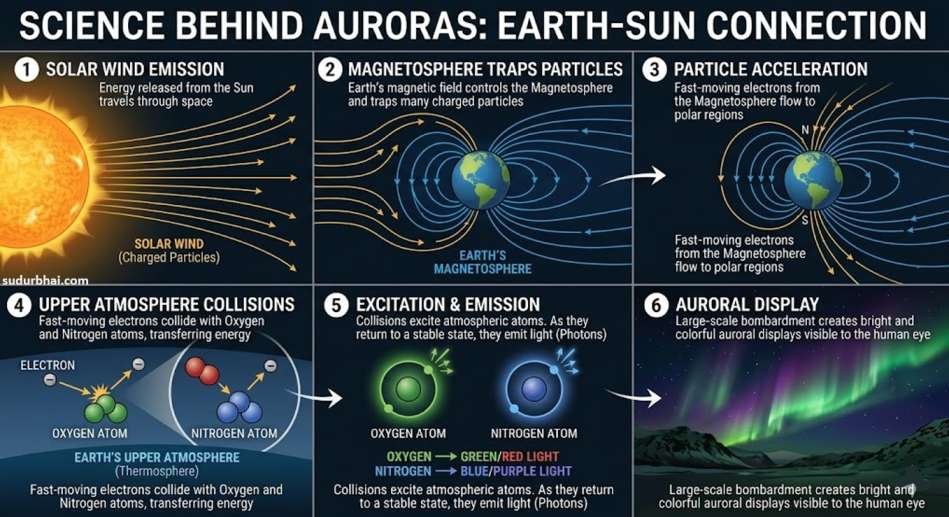
- Energy released from the Sun travels through space in the form of solar wind.
- The Earth’s magnetosphere traps many of these charged particles.
- The magnetosphere is the region around Earth controlled by its magnetic field.
- Fast-moving electrons from the magnetosphere collide with oxygen and nitrogen atoms in the upper atmosphere.
- These collisions transfer energy to atmospheric atoms and molecules, causing them to enter an excited state.
- As the atoms return to their stable state, they emit visible light.
- Large-scale bombardment of particles creates bright and colorful auroral displays visible to the human eye.
- The process of aurora formation takes place in several stages:
- The Sun releases charged particles through the solar wind.
- These particles travel toward Earth through space.
- The Earth’s magnetic field guides many particles toward the polar regions.
- Charged particles collide with gases in the upper atmosphere.
- Atmospheric gases become energized or excited.
- As the gases release excess energy, colorful light emissions appear in the sky as auroras.
Coronal Mass Ejection
- A Coronal Mass Ejection (CME) is a massive eruption of plasma and magnetic fields from the Sun’s corona.
- CMEs can release billions of tons of solar material into space.
- They often carry extremely powerful magnetic fields stronger than the normal Interplanetary Magnetic Field (IMF) of the solar wind.
- These eruptions are commonly associated with:
- Solar flares
- Solar prominence eruptions
- The released plasma travels outward through the solar wind and can be detected using coronagraph instruments.
Origin of CMEs
- CMEs mainly originate from active regions on the Sun’s surface.
- These active regions are often linked with:
- Sunspots
- Frequent solar flares
- During the period of solar maximum, the Sun may produce around three CMEs per day.
- During solar minimum, CMEs may occur only once every few days.
Magnetic Reconnection
- Solar flares and CMEs are mainly caused by magnetic reconnection in the Sun’s corona.
- Magnetic reconnection occurs when magnetic field lines of opposite polarity come together and reconnect.
- During this process:
- Magnetic energy is converted into heat energy and kinetic energy.
- Large amounts of energy are suddenly released.
- This process leads to:
- Heating of the solar atmosphere
- Solar flares
- Solar jets
- Coronal Mass Ejections
Importance of Studying Coronal Magnetic Fields
- The Sun’s corona is extremely dynamic and changes rapidly within seconds or minutes.
- Continuous monitoring of coronal magnetic fields is essential because:
- It helps scientists understand solar activity.
- It improves prediction of space weather events.
- It protects satellites and communication systems from solar disturbances.
Halloween Solar Storms (2003)
- The Halloween Solar Storms were a series of intense:
- Solar flares
- Coronal Mass Ejections
- These events occurred between mid-October and early November 2003.
- The storms produced one of the strongest solar flares ever recorded by the GOES (Geostationary Operational Environmental Satellite) system.
- Major impacts of the storms included:
- Disruption of satellite communications
- Disturbance in navigation systems
- Effects on power systems and radio communication
- Increased radiation exposure at high altitudes
- Aircraft were advised to avoid flying near the polar regions during the storms because of increased radiation risks.
Do Other Planets Get Auroras?
- Yes, auroras are not unique to Earth. Several other planets in the Solar System also experience auroral displays.
- A planet is likely to have auroras if it possesses:
- A significant atmosphere
- A strong magnetic field
- The gas giant planets such as:
- Jupiter
- Saturn
- Uranus
- Neptune
all exhibit auroras.
- These planetary auroras differ from Earth’s auroras because each planet has unique atmospheric composition, magnetic field strength, and solar wind interactions.
- Auroras on some planets can even be stronger and more energetic than those on Earth.
Types of Auroras
There are two major types of auroras observed on Earth:
- Aurora Borealis – also known as the Northern Lights
- Aurora Australis – also known as the Southern Lights
Aurora Borealis (Northern Lights)
- The term Aurora Borealis was introduced by Pierre Gassendi in 1621.
- The name combines:
- Aurora – the Roman goddess of dawn
- Boreas – the Greek god of the north wind
- It is mainly visible in high northern latitudes near the Arctic Circle.
Historical and Cultural Significance
- Different cultures interpreted auroras in different ways:
- The Cree people referred to them as the “Dance of the Spirits.”
- In medieval Europe, auroras were often considered a divine or supernatural sign.
Appearance of Aurora Borealis
- Auroras observed close to the magnetic poles may appear directly overhead.
- At locations farther away, they appear as glowing bands near the horizon.
- Common visual forms include:
- Curtains
- Arcs
- Spirals
- Waves
- Magnetic field line patterns
- The most common auroral color is fluorescent green, though red shades may also occur.
- Auroras can:
- Change rapidly within seconds
- Remain stable for several hours
Best Conditions for Observation
- Aurora Borealis is best seen near the winter equinox because nights are longer and darker.
- Visibility can be reduced by:
- Cloud cover
- Sunlight
- Artificial city lights
Aurora Australis (Southern Lights)
- Aurora Australis is the southern counterpart of Aurora Borealis.
- It displays characteristics almost identical to northern auroras.
- It is visible in high southern latitude regions such as:
- Antarctica
- Southern parts of South America
- New Zealand
- Australia
- Northern and southern auroras often intensify simultaneously because they are linked to the same solar activity.
Why Do Auroras Have Different Colors and Shapes?
Role of Atmospheric Gases
- Auroral colors depend mainly on:
- The type of gas involved
- The energy level of incoming electrons
- The main atmospheric gases responsible are:
- Oxygen
- Nitrogen
Color Variations
- High-energy electrons interacting with oxygen produce:
- Green light (most common auroral color)
- Low-energy electrons interacting with oxygen produce:
- Red light
- Nitrogen generally produces:
- Blue light
- Purple or violet shades
- Mixing of these colors can create:
- Pink
- White
- Purple
Ultraviolet Emissions
- Oxygen and nitrogen can also emit ultraviolet radiation.
- These ultraviolet auroras cannot be seen by the human eye but can be detected using specialized satellite instruments and cameras.
Effects of Auroras
Auroral activity can influence modern technological systems in several ways:
- Disturbance of radio communication systems
- Interference with satellite signals
- Disruption of power transmission lines
- Impact on navigation and communication networks
Role of the Sun
- The primary energy source behind auroras is the Sun.
- The solar wind, carrying charged particles from the Sun, drives the entire auroral process.
Magnetosphere
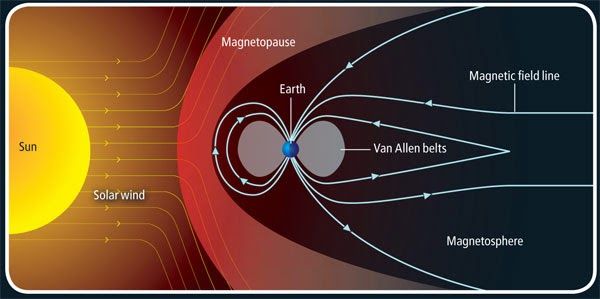
- The magnetosphere is the region surrounding a planet that is dominated and controlled by the planet’s magnetic field.
- Earth’s magnetosphere acts as a protective shield against harmful charged particles from the Sun.
Structure of Earth’s Magnetosphere
- The shape of Earth’s magnetosphere is strongly influenced by the solar wind.
- On the side facing the Sun, the magnetosphere is compressed to about 6–10 Earth radii.
- A powerful supersonic shock wave forms ahead of Earth called the Bow Shock.
Bow Shock
- The Bow Shock forms where the solar wind first encounters Earth’s magnetic field.
- Here, solar wind particles are:
- Heated
- Slowed down
- Redirected around Earth
Magnetosheath
- The region between the Bow Shock and the magnetosphere is called the Magnetosheath.
- In this region, solar particles flow around the Earth after being slowed by the Bow Shock.
Magnetotail
- On the night side of Earth, the solar wind stretches the magnetosphere into a long tail called the Magnetotail.
- The Magnetotail may extend up to 1000 times Earth’s radius into space.
Magnetopause
- The outer boundary of Earth’s magnetic field is called the Magnetopause.
- It marks the boundary between the magnetosphere and the solar wind.
Dynamic Nature of the Magnetosphere
- Earth’s magnetosphere is highly dynamic and changes continuously in response to variations in solar activity.
- Strong solar storms can significantly disturb the magnetosphere and intensify auroral activity.
THEMIS Mission
- THEMIS stands for Time History of Events and Macroscale Interactions during Substorms.
- It is a mission launched by NASA to study auroral substorms and Earth’s magnetosphere.
Objectives of THEMIS
- To determine the processes responsible for sudden auroral eruptions called substorms.
- To understand how energy from the solar wind is transferred into Earth’s magnetosphere.
- To study the interaction between charged particles and magnetic fields in near-Earth space.
Arase Mission / ERG
- Arase, also known as ERG (Exploration of Energization and Radiation in Geospace), is a Japanese mission led by JAXA/ISAS.
- It is a Solar-Terrestrial Physics (STP) mission focused on studying Earth’s radiation belts and magnetosphere.
Objectives of the Arase Mission
- To investigate the formation and behavior of radiation belts.
- To study the acceleration and loss of relativistic charged particles during magnetic storms.
- To improve understanding of space weather phenomena and their effects on Earth’s environment and technology.