
Introduction
- Assam Bamboo Crafts represent the traditional craft of making a wide variety of household, agricultural, decorative and utility products from bamboo in Assam.
- Bamboo craftsmanship is deeply connected with the rural economy, traditional lifestyle and cultural heritage of the state.
- In 2026, Assam Bamboo Crafts received Geographical Indication (GI) registration, giving formal recognition to this traditional handicraft.
Bamboo and Assam
- Assam’s warm, humid and high-rainfall climate provides favourable conditions for the growth of bamboo.
- Bamboo has traditionally been one of the most important locally available raw materials used by rural communities.
- Its combination of strength, flexibility and light weight makes it suitable for numerous craft products.
- Bamboo is also a rapidly renewable biological resource, giving bamboo crafts considerable potential in the sustainable-products economy.
General Characteristics of Assam Bamboo Crafts
| Parameter | Details |
|---|---|
| Region | Assam |
| Craft Type | Traditional bamboo handicraft |
| Primary Raw Material | Bamboo |
| Production | Predominantly handcrafted |
| Major Qualities | Lightweight, strong, flexible and biodegradable |
| Uses | Domestic, agricultural, fishing, storage and decorative purposes |
| GI Category | Handicrafts |
| GI Class | Class 20 |
The GI Registry officially records the product as “Assam Bamboo Crafts” under Class 20 – Handicrafts.
Traditional Bamboo Craftsmanship
- Bamboo craft is an important component of Assam’s traditional material culture.
- Craft-making knowledge has traditionally been transmitted from one generation to another.
- Artisans use relatively simple tools but require considerable skill in cutting, splitting, slicing, bending and weaving bamboo.
- Different communities have developed products according to their agricultural, household and cultural requirements.
- The craft demonstrates the effective use of locally available natural resources and indigenous knowledge.
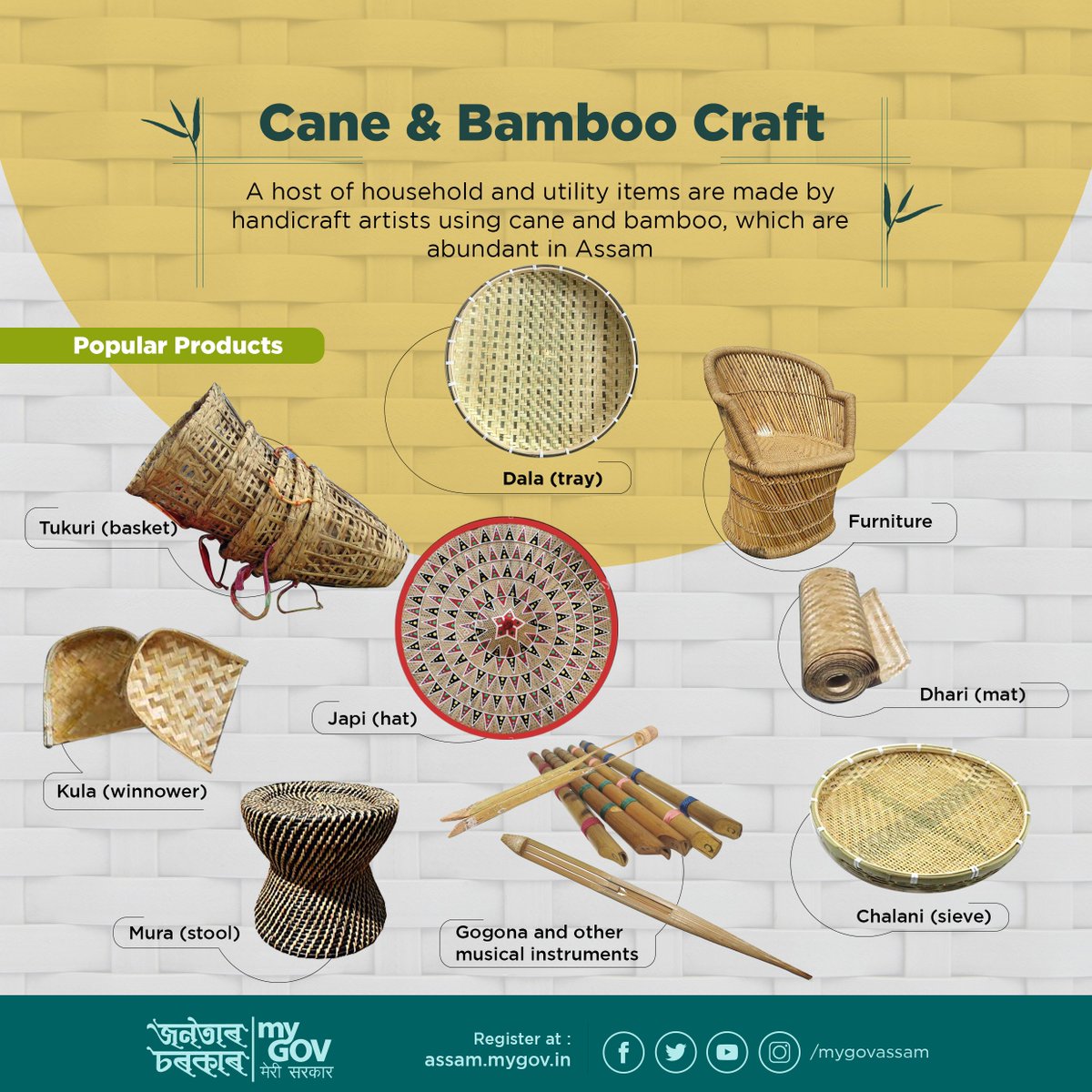
Major Bamboo Craft Products
Traditional bamboo craftsmanship in Assam includes a broad variety of products:
| Category | Examples/Uses |
|---|---|
| Household Products | Baskets, trays, containers and storage articles |
| Agricultural Implements | Bamboo articles used in cultivation and rural activities |
| Fishing Equipment | Traditional bamboo fishing traps and implements |
| Furniture | Chairs, stools, tables and other household furniture |
| Decorative Products | Lampshades, wall decorations and ornamental items |
| Utility Products | Mats, screens, containers and other everyday objects |
| Traditional Structures | Bamboo components used for houses, fencing and temporary structures |
Traditional Bamboo Fishing Implements
- Bamboo is extensively used in Assam for making traditional fishing equipment.
- Rural communities developed different forms of bamboo traps, baskets and catching devices suited to local rivers, wetlands and ponds.
- Such products demonstrate the relationship between Assam’s bamboo craftsmanship and its riverine and wetland-based lifestyle.
- These implements are examples of indigenous ecological knowledge, as their designs evolved according to local fish species and water conditions.
Method of Production
The traditional process broadly follows:
Selection of Bamboo → Harvesting → Seasoning/Drying → Cutting → Splitting → Slicing → Shaping/Weaving → Finishing
- Selection: Suitable mature bamboo is selected according to the intended product.
- Harvesting: Bamboo culms are cut and prepared for processing.
- Seasoning: Bamboo may be dried or seasoned to improve durability.
- Splitting: Culms are divided into smaller sections and thin strips.
- Slicing: Craftsmen prepare strips of the required thickness and width.
- Shaping: Bamboo may be bent, interlaced or woven depending on the product.
- Weaving: Baskets, mats and containers require skilled interlacing techniques.
- Finishing: Edges are trimmed and the finished product may be polished or otherwise treated.
Distinctive Features of Assam Bamboo Crafts
- Handcrafted Nature: Traditional products rely heavily on manual skill.
- Local Raw Material: Bamboo traditionally available in Assam forms the foundation of the craft.
- Functional Design: Many products evolved from the everyday requirements of rural communities.
- Durability: Properly processed bamboo combines strength with relatively low weight.
- Biodegradability: Bamboo products provide an environmentally preferable alternative to many plastic-based utility products.
- Cultural Diversity: Different communities of Assam have developed their own forms, patterns and uses of bamboo articles.
Cultural Significance of Assam Bamboo Crafts
- Bamboo has traditionally been involved in numerous aspects of Assamese rural life.
- Bamboo products are used in households, agriculture, fishing, construction and cultural activities.
- Traditional bamboo craftsmanship reflects the close relationship between Assam’s communities and their natural environment.
- The craft represents an important form of indigenous knowledge and cultural heritage.
- Bamboo products are therefore not merely handicrafts but also an expression of Assam’s traditional way of life.
Economic Importance of Assam Bamboo Crafts
- Bamboo craft provides livelihood opportunities to rural artisans and craft-producing households.
- The industry can generate employment through bamboo cultivation, harvesting, processing, manufacturing and marketing.
- Increasing demand for eco-friendly and biodegradable products creates new opportunities for bamboo artisans.
- Modern product design can expand bamboo craftsmanship into areas such as home décor, furniture, lifestyle products and sustainable packaging.
- GI recognition can facilitate better branding, market differentiation and value addition for authentic products.
Environmental Importance of Assam Bamboo Crafts
- Bamboo is a fast-growing renewable resource.
- Bamboo-based products can reduce dependence on certain plastic and non-biodegradable materials.
- Expansion of sustainable bamboo-based industries can support the broader green and circular economy.
- Local production can connect environmental sustainability with rural livelihood generation.
Geographical Indication (GI) Tag
| Parameter | Details |
|---|---|
| Registered GI Name | Assam Bamboo Crafts |
| Application Number | 1313 |
| Applicant | Gramin Vikash Parishad |
| Applicant District | Goalpara, Assam |
| Date of Filing | 10 July 2024 |
| Class | 20 |
| Goods | Handicrafts |
| GI Journal No. | 210 |
| Journal Availability Date | 26 November 2025 |
| Registration Certificate Date | 27 March 2026 |
| Status | Registered |
These details are recorded in the official Geographical Indications Registry of India.
NABARD’s Role
- The GI certification process was supported and facilitated by NABARD.
- Assam Bamboo Crafts was among four Assam products receiving the new GI recognition alongside Assamese Bihu Pepa, Karbi Anglong Handloom Products and Assam Deori Handloom Products.
- NABARD views GI recognition as a means of strengthening product authenticity, market opportunities and artisan livelihoods.
Importance of GI Recognition
- Authenticity: Establishes the geographical identity of genuine Assam Bamboo Crafts.
- Legal Protection: GI registration provides protection against unauthorized commercial use of the registered geographical indication.
- Heritage Conservation: Encourages preservation of traditional bamboo-working skills.
- Market Recognition: Helps create a distinct identity in domestic and international markets.
- Artisan Livelihoods: Better recognition and branding can contribute to improved income opportunities for artisans.
- Rural Development: Supports a value chain involving bamboo growers, craftsmen, entrepreneurs and sellers.
- Sustainable Economy: Can promote greater demand for natural, renewable and biodegradable products.
Conclusion
- Assam Bamboo Crafts represent the close relationship between Assam’s natural resources, indigenous knowledge, rural livelihoods and cultural traditions.
- From household articles and fishing implements to furniture and decorative products, bamboo has served numerous functions in Assamese society.
- The GI registration in 2026 provides formal recognition to this traditional craft and creates opportunities for heritage conservation, artisan livelihoods, sustainable production and wider market recognition.