
What are Jet Streams?
- Jet streams are narrow bands of high-speed winds found in the upper atmosphere within the westerlies.
- These air currents are usually:
- 160–480 km wide
- 900–2150 m thick
- The core speed of jet streams may exceed 300 km/hr.
- Due to their tremendous speed, aircraft generally avoid routes that move directly against jet stream flow.
- Jet streams are closely associated with major breaks in the tropopause.
Characteristics of Jet Stream
- A Jet Stream is a geostrophic wind that blows horizontally through the upper layers of the troposphere.
- These winds generally flow from west to east.
- Jet streams develop where air masses with contrasting temperatures meet.
- Surface temperature differences largely determine the formation and location of jet streams.
- Greater the temperature difference, stronger is the wind velocity within the jet stream.
- Jet streams extend from about 20° latitude to the poles in both hemispheres.
- Jet streams are:
- Circumpolar, meaning they circulate around the Earth’s poles
- Narrow and concentrated bands of wind
- Meandering in nature
- Located in the upper troposphere
- Characterized by very high velocity winds
- Geostrophic streams bounded by slower-moving winds
- An important part of the upper-level westerlies
Geostrophic Wind
- Geostrophic flow refers to the theoretical wind produced when the:
- Coriolis Force and
- Pressure Gradient Force (PGF) are in exact balance.
- The speed and direction of wind are determined by the combined effect of various wind-generating forces.
- Winds in the upper atmosphere, generally 2–3 km above the Earth’s surface, are less affected by surface friction.
- These winds are mainly controlled by:
- Pressure Gradient Force (PGF)
- Coriolis Force
- An air parcel initially at rest starts moving from an area of high pressure to low pressure because of the Pressure Gradient Force.
- As the air begins to move, the Coriolis Force deflects it:
- Towards the right in the Northern Hemisphere
- Towards the left in the Southern Hemisphere
- As wind speed increases, the effect of the Coriolis force also becomes stronger.
- Eventually, the Coriolis Force becomes equal to the Pressure Gradient Force.
- At this stage, the wind flows parallel to the isobars and perpendicular to the pressure gradient.
- Such wind is known as Geostrophic Wind.
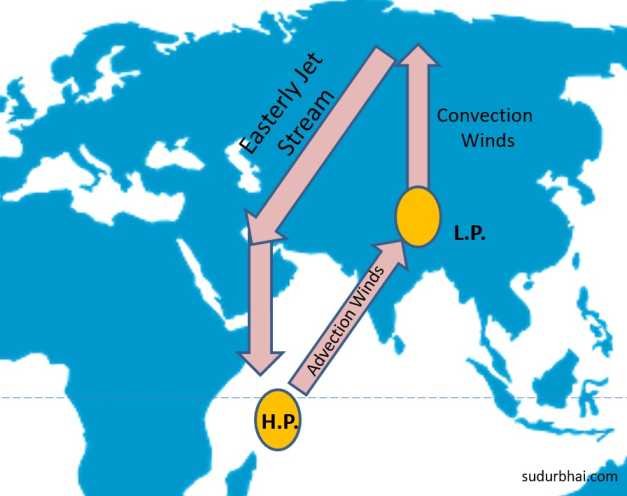
Why winds don’t flow from tropical high pressure (in upper troposphere) to polar low (in upper troposphere) directly as shown in the figure below?
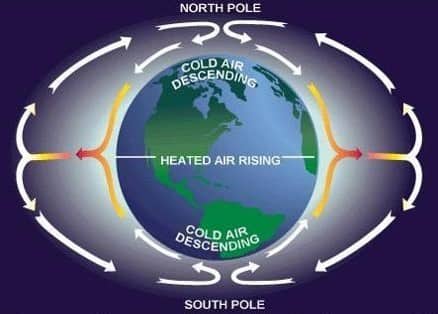
- Winds in the upper troposphere do not flow directly from tropical high pressure to polar low pressure because they are primarily geostrophic winds.
- These winds move at very high speeds due to the absence of significant friction in the upper atmosphere.
- At such high speeds, the Coriolis Force becomes very strong and causes substantial deflection of winds.
- As a result, the winds do not move in a straight path from the equator to the poles.
- Instead, the atmospheric circulation is divided into three distinct circulation cells:
- Hadley Cell
- Ferrel Cell
- Polar Cell

- These three circulation cells together perform the same function that a single large circulation cell would otherwise perform.
Genesis of Jet Streams
- The formation of Jet Streams is mainly caused by three important gradients:
- Thermal gradient between the equator and poles
- Pressure gradient between the equator and poles
- Pressure gradient between surface air and subsurface air over the poles
Characteristics of Jet Stream
- Jet streams are characterized by very high wind velocities, often reaching 400–500 km/hr.
- Their high speed results from strong thermal contrasts that create a powerful Pressure Gradient Force.
- Jet streams are meandering in nature and follow curved paths around the Earth.
- Their flow is three-dimensional and develops:
- Crests
- Troughs
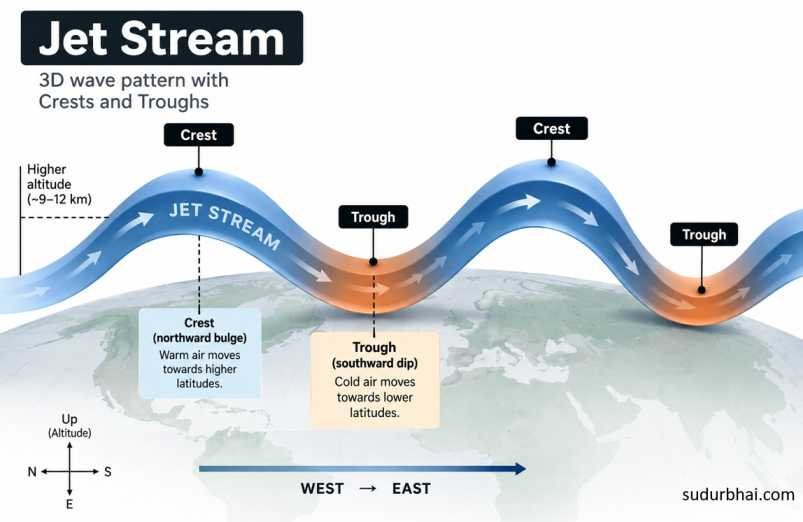
- They extend across:
- Hundreds of kilometers in width
- Thousands of kilometers in length
- Size and dimensions of Jet Streams
- Width: Approximately 10–12 km
- Depth: Around 2–3 km
- Length: Nearly 3000 km
- Altitude: Generally found below the tropopause
- Other important characteristics
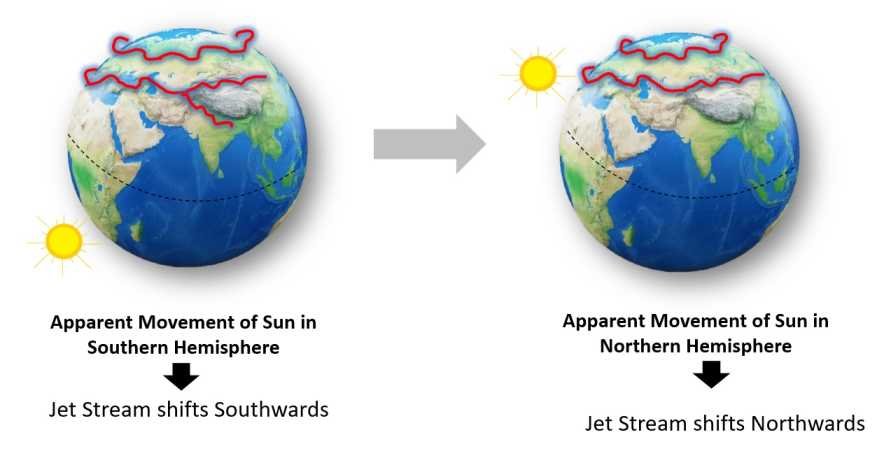
- Jet streams show seasonal variations.
- They shift according to the apparent movement of the Sun.
- In both hemispheres, jet streams generally move from west to east.
- Their formation is closely related to the interaction between:
- Cold air masses
- Warm air masses
- Strong thermal contrast is essential for their development.
Types of Jet Streams
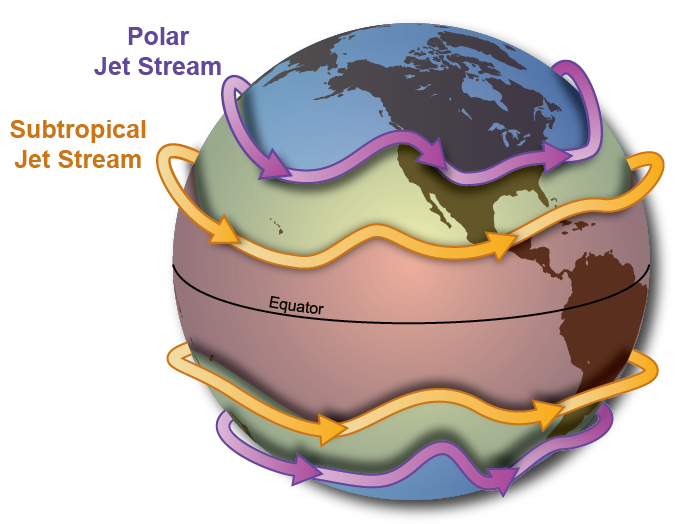
- The major types of jet streams are:
- Polar Front Jet Streams
- Subtropical Westerly Jet Streams
- Tropical Easterly Jet Streams
- Polar Night Jet Streams
- Local Jet Streams
Permanent Jet Streams
- These jet streams exist throughout the year and include:
- Subtropical Jets at lower latitudes
- Polar Front Jets at mid-latitudes
- These jet streams exist throughout the year and include:
Temporary Jet Streams
- These are seasonal or short-term jet streams such as:
- Tropical Easterly Jet
- African Easterly Jet
- Somali Jet (southwesterly jet)
- These are seasonal or short-term jet streams such as:
Polar Front Jet Streams
- These jet streams form above the convergence zone between:
- Polar cold air masses
- Tropical warm air masses
- They generally occur between 40°–60° latitudes.
- They move in an easterly direction but their flow is often irregular.
Subtropical Westerly Jet Streams
- These jet streams develop around 30°–35° latitude.
- They occur in the upper troposphere, north of the subtropical high-pressure belt.
- They are also known as stratospheric subpolar jet streams.
Tropical Easterly Jet Streams
- These jet streams develop in the upper troposphere above the surface easterly trade winds.
- They are especially prominent over India and Africa during the summer season.
- Their formation is mainly due to the intense heating of the Tibetan Plateau.
- They play a crucial role in influencing the Indian Monsoon.
Polar Night Jet Streams
- These jet streams form during the winter season.
- They develop because of the steep temperature gradient in the stratosphere around the poles.
Local Jet Streams
- Local jet streams form due to specific local thermal and dynamic conditions.
- Their influence is usually restricted to a limited geographical area.
Index cycle of jet streams
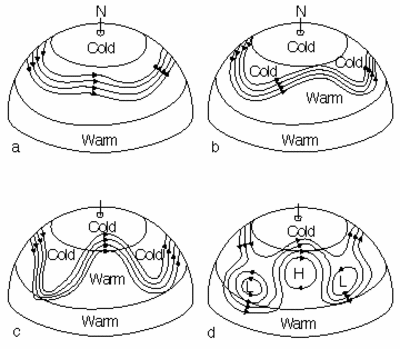
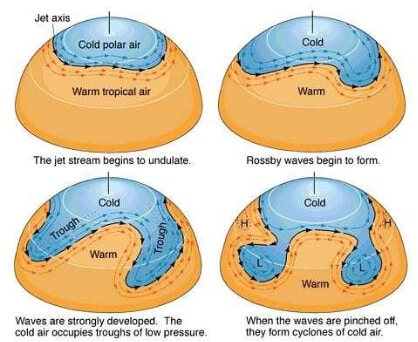
Stage 1
- In the subpolar low-pressure belt, cold polar air and warm subtropical air converge along a horizontal boundary.
- Due to strong thermal contrast and differences in physical properties, the two air masses do not mix easily.
- This creates a stationary zone between the contrasting air masses.
Stage 2
- The cold polar air is pushed by the polar easterlies.
- The warm subtropical air is driven by the westerlies.
- As a result, the stationary boundary transforms into an oscillating wave pattern.
- These waves are known as Rossby Waves.
Stage 3
- Cold and warm air masses continue to invade each other’s regions.
- The waves become more pronounced and begin to meander strongly.
- Highly sinuous and mature jet streams develop during this stage.
Stage 4
- The cold air mass advances further into the warm air region.
- Significant latitudinal heat exchange takes place.
- Eventually, the atmosphere returns to a stationary front situation.
Significance of jet streams
- Jet streams have a close relationship with the intensity of mid-latitude cyclones.
- Cyclones become extremely strong and stormy when upper tropospheric jet streams are positioned above them.
- The South Asian Monsoon is greatly influenced and controlled by jet streams.
Influencing factors on the Jet Stream Flow
- The flow of jet streams is mainly influenced by:
- Landmasses
- Coriolis Effect
- Landmasses affect jet streams through:
- Frictional resistance
- Temperature contrasts
- The Earth’s rotation further intensifies these changes through the Coriolis Force.
- Due to these influences, jet streams follow a meandering path, similar to the way rivers meander across plains.
- The meanders continuously change as jet streams interact with different landmasses.
- This creates a constantly changing atmospheric system and varying temperature conditions.
Influence of the stratosphere
- During winter, the temperature of the stratosphere strongly affects the strength and position of jet streams.
- A colder polar stratosphere increases the temperature difference between tropical and polar regions.
- This stronger thermal contrast strengthens the jet stream.
Influence of oceans and landmasses
- The temperature of oceans and continents also affects jet streams.
- Phenomena such as the El Niño Southern Oscillation (ENSO) influence the:
- Strength
- Amplitude
of jet streams.
Jet streams & the weather
- Jet streams play a crucial role in determining global weather patterns.
- They generally separate:
- Cold air masses
- Warm air masses
- Jet streams move weather systems from one region to another.
- They can also cause weather systems to stall if the jet stream weakens or shifts away.
Jet streams and climate change
- Climatologists believe that changes in jet streams are closely linked to global warming.
- This is especially true for the polar jet streams because the polar regions are warming faster than the rest of the Earth.
- Warmer jet streams develop more extreme north-south meanders.
- These stronger oscillations can bring unusual weather conditions to regions not normally exposed to such climate variations.
- For example, when a jet stream dips southward, it carries cold polar air masses into lower latitudes.
Air travel
- Jet streams play a major role in aviation and air travel.
- Eastbound flights usually take less time because they are assisted by fast-moving jet stream winds.
- Westbound flights often take longer because they fly against these winds.
Wind shear and aviation hazards
- Jet streams may contain wind shear, which refers to sudden and violent changes in wind speed and direction.
- Wind shear is extremely dangerous for aircraft.
- It can cause airplanes to suddenly lose altitude and increase the risk of accidents.
- In 1988, the Federal Aviation Administration (FAA) made wind-shear warning systems mandatory for commercial aircraft.
- By 1996, all commercial airlines had installed these systems onboard.
Jet Streams affecting Indian Monsoons
- Several jet streams influence India’s climate, but the most important are:
- Subtropical Westerly Jet Stream (STJ)
- Tropical Easterly Jet Stream
Role of STJ in Monsoon development
- During summer, increased solar heating over the Indian subcontinent creates conditions favorable for a cyclonic monsoon cell between southern Asia and the Indian Ocean.
- However, the Subtropical Westerly Jet (STJ) flows south of the Himalayas and initially blocks the development of the summer monsoon.
- As long as the STJ remains south of the Himalayas, the monsoon is weakened or delayed.
Northward shift of the STJ
- During the summer season, the STJ shifts northward and crosses the Himalayan Range.
- The Himalayan mountains temporarily disturb the jet stream, but it reforms over Central Asia after crossing the mountains.
- Once the STJ moves away, the monsoon circulation cell rapidly develops over the Indian subcontinent.
Role of Tropical Easterly Jet
- A lower-level Tropical Easterly Jet Stream supplies warm, moisture-laden air from the Indian Ocean.
- These moisture-rich air masses move toward northern India.
- As they rise along the mountainous terrain of northern India, the air cools and condenses.
- This process leads to heavy monsoon rainfall over the region.
Withdrawal of the Monsoon
- The monsoon season ends when the Tibetan Plateau begins to cool.
- Cooling enables the Subtropical Westerly Jet to shift southward across the Himalayas once again.
- This leads to the development of a winter monsoon circulation characterized by:
- Descending dry air over India
- Moisture-free winds blowing toward the sea
- As a result, most parts of India experience dry and stable winter weather.