Important Ahom Rulers and Their Contributions

Important Ahom Rulers and their Contributions

The Ahom dynasty, which ruled Assam for nearly 600 years (1228–1826 CE), is one of the longest-lasting dynasties in Indian history. What makes this dynasty truly remarkable is not just its longevity, but the visionary leadership, administrative innovations, and military resilience shown by its rulers.

These kings were not merely rulers—they were nation-builders, reformers, and defenders of regional identity. They transformed a small migrating group into a powerful and organized kingdom that successfully resisted mighty empires like the Mughals.

Let us now explore each important ruler in detail, in a way that feels like reading a historical narrative.

Early Ahom Kings (Founding & Expansion)
    1. Sukaphaa (1228–1268) – Founder; migrated from present-day Myanmar/China region

    2. Suteupha (1268–1281)

    3. Subinphaa (1281–1293)

    4. Sukhaangphaa (1293–1332)

    5. Sukhrangphaa (1332–1364)

    6. Sutuphaa (1364–1376)

    7. Tyao Khamti (1376–1380, usurper)

    8. Sudangphaa (1397–1407) – Restored Ahom rule

Consolidation & Growth of Ahoms
    1. Sujangpha (1407–1422)

    2. Suphakphaa (1422–1439)

    3. Susenphaa (1439–1488)

    4. Suhungmung (Dihingia Raja) (1497–1539) – Major expansion; adopted Hindu titles

Ahoms Conflict with Mughals & Zenith
    1. Suklenmung (Garhgaya Raja) (1539–1552)

    2. Sukhaamphaa (Khora Raja) (1552–1603)

    3. Susengphaa (Bura Raja or Pratap Singha) (1603–1641) – Administrative reforms

    4. Sutamla (Jayadhvaj Singha or Bhaganiya Raja) (1648–1663)

    5. Supangmung (Chakradhwaj Singha) (1663–1670) – Revival against Mughals

    6. Sunyatpha (Udayaditya Singha) (1670–1672)

    7. Suklampha (Ramdhwaj Singha) (1672–1674)

    8. Supatpha (Gadadhar Singha or Gadapani) (1681–1696) – Restored stability

Later Ahom Kings (Peak to Decline)
    1. Sukhrungpha (Rudra Singha) (1696–1714) – Cultural and political peak

    2. Sutanpha (Siva Singha) (1714–1744)

    3. Sunenpha (Pramatta Singha) (1744–1751)

    4. Surempha (Rajeswar Singha) (1751–1769)

    5. Sunyeopha (Lakshmi Singha) (1769–1780) – Faced Moamoria rebellion

    6. Suhitpangpha (Gaurinath Singha) (1780–1795) – Internal turmoil

    7. Suklingphaa(Kamaleswar Singha) (1795–1811)

    8. Sudingpha (Chandrakanta Singha) (1811–1818, restored 1821–1822)

End of Ahom Rule
    1. Purandar Singha (1818–1819; restored 1833–1838 under British) – Last ruler

Ahoms empire building | sudurbhai.com

Chaolung Sukaphaa (1228–1268): Founder of the Ahom Kingdom

Chaolung Sukaphaa (also known as Siu-Ka-Pha) was the founder of the Ahom Kingdom in medieval Assam. His arrival in 1228 CE marked the beginning of a rule that lasted for nearly 600 years (till 1826). He is regarded as the architect of “Bor Asom” (Greater Assam) for uniting diverse communities into a single political and cultural entity.

Origin and Background

  • Sukaphaa was a Tai (Shan) prince from Möng Mao (present-day Yunnan–Myanmar border region).
  • Belonged to the Su/Tsu (Tiger) clan of the Mao-Shan group.
  • Born around 1189 CE.
  • Left his homeland around 1215 CE due to succession disputes.
  • Led a large migrating group of about 9,000 people, including:
    • Nobles
    • Soldiers
    • Artisans
    • Common people
    • Horses, elephants, and livestock

Migration and Entry into Assam (1228 CE)

  • Crossed the Patkai Hills, a difficult mountainous barrier.
  • Wandered for years establishing temporary settlements in Upper Assam (e.g., Tipam, Abhaypur).
  • Finally entered the Brahmaputra Valley in 1228 CE, marking the start of Ahom rule.

Establishment of the Kingdom

  • After years of exploration, he established the first permanent capital at Charaideo in 1253 CE.
  • Charaideo became:
    • Political center
    • Cultural and spiritual hub
    • Later famous for Maidams (royal burial mounds)
  • By the end of his reign, his kingdom extended between the Burhidihing and Dikhow rivers.

Policy of Assimilation and Integration (Key Feature)

  • Sukaphaa followed a policy of conciliation rather than conquest, which became the foundation of Ahom success.
  • Key aspects:
    • Maintained friendly relations with local tribes like:
      • Morans
      • Borahis
    • Encouraged intermarriage between Ahoms and indigenous people.
    • Lived among locals, learned their language and customs.
    • Treated locals as equals, not subjects.
    • His famous diplomatic approach: “You are the host, we are the guests.”

Result:

  • Formation of a composite Assamese society
  • Process known as “Ahomization”
  • Foundation of Bor Asom (Greater Assam)

Administrative Contributions

  • Sukaphaa laid the basic administrative structure of the Ahom state.
  • Key features:
    • Introduced a centralized system of governance
    • Established key offices:
      • Burhagohain
      • Borgohain
        (These were the highest advisors, known as Dangarias)
    • Appointed officials like:
      • Baruas
      • Phukans
    • Introduced the Paik System:
      • Every adult male (Paik) had to render service to the state (labor/military)
  • Importance of governance:
    • Ensured efficient governance
    • Created a strong, organized state structure

Economic and Agricultural Contributions

  • Sukaphaa focused heavily on building a self-sufficient agrarian economy.
  • Major contributions:
    • Introduced wet rice cultivation (Sali Dhan) using advanced Tai techniques.
    • Established large agricultural farms:
      • Barakhowakhat
      • Engerakhat
      • Gachikalakhat
    • Promoted:
      • Irrigation and embankment construction
      • Conversion of forests and marshes into farmland
    • Encouraged:
      • Animal husbandry
      • Local crafts
  • Outcome:
    • Creation of agricultural surplus
    • Strong economic foundation of the Ahom state

Military Organization

  • Built a disciplined and organized army
  • Focused mainly on defense and stability, not aggressive expansion
  • Ensured security of the new kingdom

Cultural and Historical Contributions

  • Initiated the writing of Buranjis (Ahom chronicles)
    → Recorded historical events systematically
  • Involved priests like:
    • Deodhai
    • Bailung
  • Promoted cultural syncretism:
    • Blending of Tai traditions with local Assamese culture
  • Played a major role in shaping Assamese identity

Personal Traits and Governance Style

  • Lived a simple and hardworking life
  • Personally involved in agriculture
  • Followed:
    • Justice-based governance
    • Inclusiveness
    • Diplomacy over force

Legacy

  • Founder and progenitor of the Ahom dynasty
  • All later Ahom kings were his descendants
  • Known as:
    • Visionary ruler
    • Nation-builder
    • Architect of Greater Assam
  • His policies ensured:
    • Political stability
    • Social harmony
    • Economic prosperity
    • His model helped the Ahom kingdom:
      • Survive for 600 years
      • Later resist external invasions (e.g., Mughals)

Death

  • Died in 1268 CE at Charaideo
  • Left behind a well-established and stable kingdom

Sukaphaa transformed Assam from a region of scattered tribal chiefdoms into a unified, organized state through diplomacy, assimilation, and strong administration. His reign laid the foundation of one of the longest-lasting dynasties in Indian history.

Suhungmung (1497–1539): The Great Empire Builder of the Ahom Kingdom

Suhungmung, also known as Dihingia Raja and Swarganarayan, was one of the greatest and most transformative rulers of the Ahom dynasty. His reign (1497–1539 CE) marked the transition of the Ahom state from a small principality to a vast multi-ethnic empire.

He is often regarded as:

    • The first true expansionist Ahom king
    • The architect of Ahom imperialism
    • Sometimes compared to the “Napoleon of Assam”

Background and Identity

  • Son of King Supimphaa
  • Belonged to the Ahom royal lineage descending from Sukaphaa
  • First Ahom ruler to adopt a Hindu title – “Swarganarayan”
  • Later Ahom kings adopted the title “Swargadeo”
  • Shifted the capital to Bakata (on the Dihing River) → hence called Dihingia Raja
  • Considered the last progenitor king (all later rulers were his descendants)

Territorial Expansion (Beginning of Ahom Imperialism)

Suhungmung transformed the Ahom kingdom into a major regional power through aggressive expansion.

(a) Conquest of the Chutia Kingdom (1523–1524)
    • Initially annexed Habung (1512)
    • Defeated Chutia king Nityapal / Nitipal (Dhirnarayan)
    • Captured Sadiya region
    • Created Sadiyakhowa Gohain to administer the area
    • Brought:
      • Fertile lands
      • Skilled manpower
      • Contact with hill tribes (Mishmis, Abors, Miris, Daflas)
(b) Conflicts with the Kachari Kingdom (1526–1531)
    • Defeated Kachari king Khunkhara
    • Advanced up to Dimapur
    • Forced Kacharis to shift their capital to Maibong
    • Established Marangikhowa Gohain for administration
    • Extended influence up to Kolong River
(c) Subjugation of the Baro-Bhuyans
    • Crossed Bharali River
    • Defeated Baro-Bhuyans (local chiefs of central Assam)
    • Relocated and integrated them into the Ahom system
(d) Expansion towards Kamata Kingdom
    • Annexed parts of Kamata region
    • Extended Ahom influence into Central Assam
Result of Expansion
    • Kingdom expanded from Eastern Assam to Central Assam
    • Became a powerful multi-ethnic empire
    • Marked the beginning of imperial phase of Ahom rule

Military Achievements and Innovations

Defence against Bengal Sultanate (Ahom-Bengal Wars)
    • Successfully repelled multiple Turko-Afghan invasions
    • Most important victory:
      • Defeat of Turbak Khan (1532–1533)
    • Ahom forces pursued enemies up to Karatoya River (western limit of expansion)
Military Developments
    • Strengthened army organization and strategy
    • First use of firearms and gunpowder recorded in Ahom history
    • Captured Muslim soldiers (Garia) who later contributed as skilled artisans (especially brass work)

Administrative Reforms and Innovations

Suhungmung introduced major reforms to manage his expanding empire.

(a) Creation of New High Offices
  • Borpatrogohain (third great Gohain after Burhagohain and Borgohain)
  • Sadiyakhowa Gohain (for Chutia region)
  • Marangikhowa Gohain (for Kachari territories)
  • Other officials:
    • Bhatialia Gohain
    • Banlungia Gohain
    • Dihingia Gohain
(b) Paik System Reforms
  • Expanded and reorganized the Paik system
  • Included newly conquered populations
  • Strengthened military and labor mobilization
(c) First Census (Piyal / Piyol) – 1510
  • Conducted the first population survey
  • Helped in:
    • Efficient labor distribution
    • Administrative control
(d) Territorial Administration
  • Divided kingdom into administrative units
  • Ensured central authority with local governance

Policy of Integration and Assimilation

  • Suhungmung followed a practical and inclusive policy to stabilize his vast empire.
  • Key features:
    • Integrated diverse groups like:
      • Chutias
      • Kacharis
      • Baro-Bhuyans
    • Encouraged:
      • Intermarriage
      • Cultural blending
    • Relocated populations to strengthen administration
  • Result:
    • Formation of a composite Assamese society
    • Strengthened political unity of the Brahmaputra Valley

Economic Developments

  • Promoted agricultural expansion in newly annexed lands
  • Encouraged wet rice cultivation
  • Improved:
    • Land utilization
    • Resource management
  • Boosted:
    • Trade
    • Craft production
  • Integrated new populations into the economic system

Cultural and Religious Contributions

Hindu-Ahom Cultural Synthesis
    • First Ahom king to formally adopt Hinduism
    • Took title Swarganarayan
    • Encouraged:
      • Brahmin settlement
      • Sanskrit learning
      • Hindu rituals in court
Relation with Neo-Vaishnavism
    • Period of growth of Srimanta Sankardeva’s Neo-Vaishnavite movement
    • Though relationship was complex, it influenced society
Cultural Transition
    • Shift from pure Tai traditions to Indianized polity
    • Promoted Assamese language and customs

Scientific and Technological Developments

  • Introduction and use of:
    • Firearms
    • Gunpowder technology
  • Knowledge gained through conflicts with Bengal Sultanate

Capital and Strategic Importance

  • Shifted capital from Charaideo to Bakata
  • Located near Dihing River
  • Strengthened political and strategic control of Upper Assam

Historical Contributions

  • Continued and promoted Buranji writing (chronicles)
  • Strengthened tradition of record-keeping and state history

Death

  • Died in 1539 CE
  • According to some accounts, he was assassinated due to internal conspiracy involving his son Suklenmung

Legacy

  • Suhungmung is remembered as one of the greatest empire builders in Assam’s history.
  • His achievements:
    • Massive territorial expansion
    • Administrative restructuring
    • Military modernization
    • Cultural integration
  • Historical significance:
    • Transformed Ahom rule from:
      • Tribal polity → Structured state → Expanding empire
    • Laid foundation for future rulers like:
      • Suklenmung
      • Pratap Singha
    • Enabled Ahom kingdom to:
      • Resist future invasions (including Mughals)
      • Remain dominant in Northeast India.

The reign of Suhungmung represents the golden phase of expansion and transformation in Ahom history. Through military strength, administrative innovation, and cultural inclusiveness, he built a powerful and unified empire, laying the foundation for the long-lasting dominance of the Ahom kingdom in Northeast India.

Susengphaa (Pratap Singha) (1603–1641): Architect of Administrative Consolidation

Susengphaa, popularly known as Pratap Singha, Bura Raja (Burha Raja), and Buddhi Swarganarayan, was one of the most capable administrators and strategic rulers of the Ahom dynasty.

His reign (1603–1641 CE):

    • Marked the beginning of Ahom–Mughal conflicts
    • Brought administrative maturity and centralization
    • Strengthened the Ahom state into a stable and resilient power

He is widely regarded as the architect of administrative excellence in the Ahom Kingdom.

Background and Identity

  • 17th Ahom king
  • Son of King Sukhaamphaa
  • Ascended the throne at around 58 years of age → hence called Bura Raja (Old King)
  • Adopted the Hindu title “Pratap Singha”
  • Also known as Buddhi Swarganarayan for his intelligence
  • Ruled for about 38 years, one of the longest and most stable reigns

Territorial Expansion and Consolidation

  • Unlike earlier rulers, he focused more on consolidation than aggressive expansion.
  • Key actions:
    • Strengthened control over territories acquired by Suhungmung
    • Extended influence into:
      • Kamrup
      • Western Assam
    • Suppressed rebellions of:
      • Baro-Bhuyans
    • Maintained peace with Kacharis to focus on Mughal threat

Military Achievements and Ahom–Mughal Conflicts

Beginning of Ahom–Mughal Wars (from 1615)
    • His reign marked the start of a long series of conflicts with the Mughal Empire.
Major Battles and Events
    • Battle of Samdhara (1616)
      → First major Ahom victory (commemorated by Bhomoraguri Rock Inscription)
    • Battle of Hajo (1618) and other engagements
    • Defeated Mughal commanders like Abu Bakr
Treaty of Asurar Ali (1639)
    • Fixed boundary between:
      • Ahoms and Mughals
    • Boundary lines:
      • Barnadi River (north)
      • Asurar Ali (south)
Military Strategies
    • Strengthened:
      • Fortifications (Gars) such as Chamdhara Gar
      • River-based (naval) warfare
    • Used guerrilla tactics (hit-and-run) effectively
    • Utilized terrain of Assam against Mughal cavalry

Administrative Reforms (Most Important Contribution)

(a) Creation of New High Offices
  • To manage the expanding kingdom efficiently:
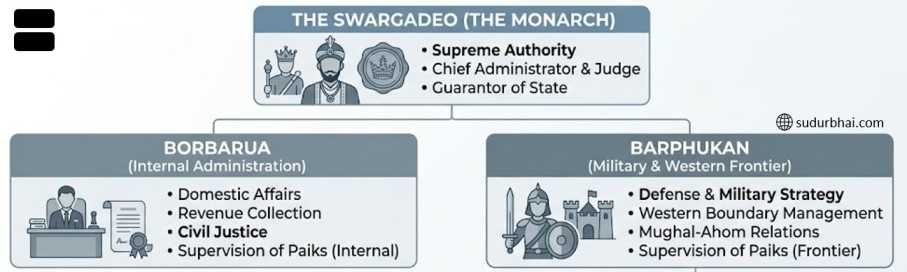
    • Borbarua
      • Head of internal administration
      • Chief executive and judicial officer
      • First holder: Momai Tamuli Borbarua
    • Borphukan
      • Viceroy of western territories
      • Based in Guwahati/Kajali
      • Acted as military commander and diplomat
  • These posts ensured:
    • Decentralization with strong central control
    • Better management of distant regions

Ahoms administrative structure | sudurbhai.com

(b) Reorganization of the Paik System (1609)
  • Major reform under Momai Tamuli Borbarua
  • Shifted from kinship-based (phoid) system to professional (khel) system
  • Divided population into organized units:
    • For military service
    • For public works
  • Importance:
    • Improved efficiency of administration
    • Strengthened army and economy simultaneously
(c) Village and Population Administration
  • Conducted population surveys
  • Reorganized villages into planned agrarian units
  • Promoted self-sufficient rural economy
  • Developed:
    • Roads
    • Bridges
    • Embankments
    • Tanks

Diplomatic Relations and Foreign Policy

(a) Alliances
  • Formed matrimonial alliance with Koch Hajo ruler Parikshit Narayan
  • Maintained friendly relations with:
    • Kachari Kingdom
    • Jaintia Kingdom
(b) Kataki System
  • Strengthened the Kataki system (diplomatic envoys)
  • Used for:
    • Communication with Mughals
    • Relations with hill tribes

Economic Contributions

  • Promoted agriculture, especially wet rice cultivation
  • Encouraged land reclamation and settlement
  • Developed village economy
  • Trade and Industry:
    • Established markets (Hats) to boost commerce
    • Promoted:
      • Muga silk production
      • Paat silk production
    • Strengthened crafts and local industries

Judicial and Governance Measures

  • Developed a more organized judicial system
  • Ensured:
    • Law and order
    • Accountability of officials
  • Delegated power to local administrators
  • Strengthened discipline within administration

Cultural and Religious Contributions

  • Continued Hinduization process
  • Encouraged:
    • Brahmin settlement
    • Brahmanical and Shakta practices
  • Maintained religious tolerance
  • Promoted a composite Assamese culture
  • Cultural Impact:
    • Ahom rulers began adopting dual identity:
      • Ahom name + Hindu name

Capital and Frontier Administration

  • Did not significantly shift the capital
  • Strengthened administrative centers
  • Made Guwahati an important frontier base under Borphukan
  • Ensured better integration of western territories

Legacy

  • Susengphaa is remembered as a wise statesman, reformer, and defender of Assam.
  • His major contributions:
    • Creation of Borbarua and Borphukan
    • Reorganization of Paik system
    • Beginning of Ahom–Mughal resistance
    • Strengthening of administration and economy

Historical significance:

  • Transformed Ahom state into:
    • Centralized
    • Militarily strong
    • Administratively efficient
  • His system lasted till:
    • End of Ahom rule (1826)
  • Prepared the foundation for later achievements like:
    • Battle of Saraighat (1671) under later rulers

Death

  • Died in 1641 CE
  • Left behind a well-organized and stable kingdom

The reign of Susengphaa (Pratap Singha) represents the golden age of administrative consolidation in Ahom history. Through efficient governance, military preparedness, and diplomatic skill, he ensured that the Ahom kingdom remained strong enough to resist powerful empires like the Mughals.

He stands as a pillar of institutional strength, whose reforms sustained the Ahom state for nearly two more centuries.
Sukhrungphaa / Swargadeo Rudra Singha (1696–1714)

  • Sukhrungphaa, popularly known as Rudra Singha, was the 30th Ahom king.
  • Belonged to the Tungkhungia dynasty.
  • Parents: Gadadhar Singha (father) and Joymoti Konwari (mother).
  • Ascended the throne in 1696 after inheriting a stable and unified kingdom.
  • Adopted the Hindu title “Rudra Singha” and gradually leaned towards Sakta Hinduism.
  • His reign marks the zenith (peak) of Ahom political power, culture, and architecture.

Capital Shift and Urban Development

  • Shifted the capital from Garhgaon to Rangpur (present-day Sivasagar) in 1699.
  • This led to:
    • Planned urban development
    • Growth of administrative and cultural centers
  • Rangpur became the political and cultural hub of the Ahom kingdom.

Administrative Reforms

  • Strengthened central authority of the Swargadeo (king).
  • Reorganized the Paik system (labour + military service system) for better efficiency.
  • Expanded the Khel system (administrative units):
    • Created specialized khels for professions like:
      • Sonowal (gold washers)
      • Dhenuchocha (bow-makers)
      • Gayan-Bayan (musicians)
  • Introduced new official posts for governance and diplomacy such as:
    • Kotoki, Bairagi, Doloi, Kakoti
  • Ensured:
    • Discipline among officials
    • Reduction of corruption
    • Efficient resource management

Military Organization and Strength

  • Built a strong, well-organized army:
    • Infantry, cavalry, and navy
  • Established arms manufacturing centers (e.g., gunpowder department like Kharighar)
  • Improved fortifications and defense systems
  • Maintained a massive standing army (reportedly up to 4 lakh soldiers for campaigns)

Expansion Policy and Military Achievements

A. Subjugation of Neighboring Kingdoms
    • Conquered and made vassal states:
      • Kachari (Dimasa) Kingdom
      • Jaintia Kingdom
    • Received submission from various hill tribes
    • Established Ahom dominance across Northeast India
B. Ambitious Mughal Campaign
    • Planned a grand invasion of Mughal Bengal
    • Aim: Extend Ahom rule up to the Karatoya River (traditional boundary of ancient Kamarupa)
    • Formed a large confederacy including:
      • Tripura, Cooch Behar, Koch rulers, Jaintias, Dimasas
    • Assembled army at Guwahati
    • Campaign never executed due to his sudden death (1714). This event is considered one of the biggest “what if” events in Indian history

Diplomacy and External Relations

  • Shifted from isolationist policy to active diplomacy
  • Sent envoys across India
  • Maintained relations with:
    • Mughal Empire (despite planned war)
    • Tibet and other regional powers
  • Encouraged trade and cultural exchange
  • Introduced Mughal-style dress and court practices

Economic Development

  • Promoted:
    • Agriculture and irrigation
    • Trade and commerce (internal and external)
  • Established commercial centers
  • Introduced structured taxation system
  • Encouraged:
    • Local industries and crafts
  • Maintained overall economic prosperity and stability

Architectural and Engineering Contributions

  • He was known as the “Father of Ahom Architecture”
    • Introduced large-scale use of bricks
    • Built numerous iconic structures:

    • Major Monuments:

      • Talatal Ghar / Kareng Ghar – Royal palace complex
      • Rang Ghar – One of Asia’s oldest amphitheatres
      • Joysagar Tank – One of the largest man-made tanks in India (dedicated to his mother)
      • Namdang Stone Bridge – Engineering marvel made from a single stone
      • Rangnath Dol, Shiva Doul, Gauri Doul – Temples
    • Also developed:
      • Roads, tanks, and infrastructure

Cultural Renaissance

  • Great patron of:
    • Art, literature, music, and dance
  • Encouraged:
    • Translation of Sanskrit texts into Assamese
  • Promoted Assamese culture and identity
  • Gave state patronage to Bihu festival, bringing it into the royal court
  • Appointed officials like Gayan Baruas for cultural administration
  • Personally associated with Borgeet compositions

Religious Policy

  • Followed a liberal and inclusive policy
  • Patronized:
    • Shaivism, Vaishnavism, and Sakta Hinduism
  • Took initiation from Auniati Satra
  • Stopped persecution of Neo-Vaishnavites
  • Promoted:
    • Brahminical influence
    • Sanskrit and Vedic education (students sent to Banaras)
  • Allowed coexistence of:
    • Ahom traditional beliefs + Hindu practices
  • His rule marked the final consolidation of Hindu influence in the Ahom court

Social and Demographic Integration

  • Brought skilled people from other parts of India:
    • Architects, scholars, musicians, artisans
  • Helped in:
    • Modernization of administration
    • Cultural integration of diverse communities

Personality and Leadership

  • Known as:
    • Visionary, ambitious, and dynamic ruler
  • Combined:
    • Military strength + cultural patronage + administrative efficiency
  • Had a pan-Indian political vision beyond Assam

Death and Succession

  • Died suddenly on 27 August 1714
  • His death halted the Bengal invasion plan
  • Succeeded by his son Siva Singha

Legacy and Historical Importance

  • Widely regarded as the greatest Ahom king
  • His reign represents:
    • Peak of Ahom political power
    • Cultural and architectural brilliance
    • Economic prosperity
  • Left a lasting impact on:
    • Assamese identity and heritage
  • Remembered for:
    • Vision of regional unity
    • Transformation of Ahom kingdom into a major eastern Indian power

Sutanphaa / Swargadeo Siva Singha (1714–1744)

  • Sutanphaa, popularly known as Siva Singha, was the 31st Ahom king.
  • Eldest son of Rudra Singha, the greatest Ahom ruler.
  • Ascended the throne on 27 August 1714 following his father’s death.
  • Ruled for nearly 30 years (1714–1744).
  • Continued ruling from Rangpur (present-day Sivasagar).
  • Inherited a powerful, stable, and prosperous empire, but his reign gradually showed signs of administrative weakening.
  • His period is best understood as:
    • Politically stable externally
    • Culturally rich internally
    • Religiously transformative

Unique Feature: Rise of the “Bor Raja” (Powerful Queens)

  • One of the most distinctive features of his reign was –
    • Introduced the concept of “Bor Raja” (Chief Queen acting as co-ruler)
    • This shift happened partly due to:
      • Astrological belief (Chatra-Bhanga Yoga) predicting danger to the king’s rule
Major Queens and Their Role
    • Phuleswari Konwari (1722–1731)
      • First and most powerful Bor Raja
      • Exercised full royal authority (issued orders, used royal insignia, even minted coins)
      • Acted as de facto ruler
    • Ambika Konwari (1731–1738/39)
      • Continued strong administrative influence
      • Associated with major constructions
    • Sarbeswari / Anadari Konwari (later period)
      • Continued the tradition of queen dominance
    • Significance:
      • Rare example of female political authority in medieval India
      • However, it led to:
        • Weakening of central monarchy
        • Rise of court factionalism

Religious Policy and Transformation

It was the most defining aspect of his reign

A. Promotion of Shaktism
    • Became a staunch follower of Shaktism (worship of Goddess Durga)
    • Invited Krishnaram Bhattacharya (Parbatiya Gosain) from Bengal:
      • Established him at Nilachal Hill (Kamakhya)
      • Made him the royal priest
    • Declared Shaktism as state-supported religion
    • Issued large numbers of land grants to temples and Brahmins
      • (Highest among Ahom kings)
B. Conflict with Vaishnavism
    • Attempted to impose Shakta practices on Neo-Vaishnavite Satras
    • Created tensions with:
      • Mahantas (Vaishnavite religious heads)
    • Led to:
      • Religious intolerance
      • Social unrest
      • Early seeds of future conflicts like the Moamoria Rebellion
C. Religious Impact
    • Accelerated Hinduisation of Ahom nobility
    • Shift from earlier religious tolerance to sectarian dominance

Administrative System

  • Continued the Paik system, though its efficiency began to decline
  • Delegated large powers to:
    • Queens
    • Nobles
Key Developments
    • Conducted land surveys in regions like Kamrup and Bakata
    • Strengthened revenue administration
    • Introduced:
      • Gold currency
      • Square coins (some with Persian influence)
Challenges
    • Weakening of centralized authority
    • Rise of:
      • Internal conflicts
      • Court politics
    • Beginning of administrative decline

Military and Political Condition

  • Unlike his father:
    • No major expansionist campaigns
  • Abandoned the planned Mughal invasion
  • Maintained:
    • Peaceful diplomacy
    • Stable borders
    • Vassal relations with neighboring states
  • However, the internal dissatisfaction increased due to:
    • Religious policies
    • Administrative weaknesses

Economic Policies

  • Economy remained largely stable and agrarian-based
  • Introduced:
    • Better taxation system
    • Land grants (Devottar & Brahmottar)
  • Long-term effects of his economic policies:
    • Excessive land grants reduced state control over land
    • Strain on Paik system productivity

Architectural Contributions

  • His reign was a period of extensive temple construction and tank excavation
  • Major Constructions
    • Sivasagar Tank (Bor Pukhuri) – excavated by Queen Ambika
    • Siva Dol – tallest Shiva temple in India
    • Vishnu Dol and Devi Dol – temple complexes
    • Gaurisagar Tank – built by Queen Phuleswari with temples
    • Aswakranta (Ashwaklanta) Temple – important religious site
  • His focus shifted from royal palaces (like earlier kings) to religious architecture

Cultural and Literary Contributions

  • His reign was considered a Golden Period of Assamese manuscripts and culture
  • Major Contributions
    • Patronized:
      • Sanskrit learning
      • Translation of Puranas and Shastras into Assamese
    • Encouraged:
      • Music, dance, weaving, and arts
  • Famous Work
    • Hastividyarnava
      • A detailed illustrated manuscript on:
        • Elephant care
        • Warfare techniques
  • Court Culture
    • Court became a center of:
      • Scholars, poets, and artists
    • Led to Sanskritization of Ahom administration and society

Social Impact

  • Rise of Brahminical dominance in society
  • Increasing divide between:
    • Shaktas (state-supported)
    • Vaishnavites (marginalized)
  • Changes in:
    • Land ownership patterns
    • Social hierarchy

Personality and Governance Style

  • Known as:
    • Religious and culturally inclined ruler
  • Governance style:
    • Delegative and dependent on queens
  • Lacked the:
    • Strong political and military leadership of his father

Death and Succession

  • Died on 14 December 1744
  • Succeeded by his brother Sunenphaa (Pramatta Singha)

Legacy and Historical Importance

  • He has a mixed legacy
  • Positive Aspects
    • Cultural and literary flourishing
    • Growth of temple architecture
    • Consolidation of Hindu religious practices
  • Negative Aspects
    • Rise of religious intolerance
    • Weakening of administration and central authority
    • Growth of internal conflicts and factionalism
  • His reign is often seen as a turning point from peak (Rudra Singha) to gradual decline of the Ahom kingdom

Sunyeophaa / Swargadeo Lakshmi Singha (1769–1780)

  • Sunyeophaa, popularly known as Lakshmi Singha, was the 34th Ahom king of the Tungkhungia dynasty.
  • Youngest son of Rudra Singha.
  • Ascended the throne in 1769 after the death of Rajeswar Singha.
  • Came to power at a time when:
    • The kingdom was already facing administrative weakness
    • Society was divided by religious and social tensions
  • His reign is remembered as a crisis period in Ahom history.

The Moamoria Rebellion (1769 onwards)

  • Most important event of his reign
A. Nature of the Rebellion
    • Led by followers of the Moamoria (Mayamara) sect, a branch of Neo-Vaishnavism
    • Main leaders:
      • Ragha Neog (Raghav Moran)
      • Naharkhor Saikia
B. Causes of the Rebellion
Immediate Cause
    • Public flogging of Ragha Neog for failing to supply elephants
Underlying Causes
    • Oppression and exploitation of Moamoria and Moran Paiks
    • Harsh burden of the Paik system (forced labour)
    • Religious discrimination by Shakta Ahom rulers
    • Conflict between:
      • Royalist Satras
      • Non-conformist Moamoria (Kala-Samhati) sect
    • Misrule and arrogance of officials like Kirti Chandra Borbarua
C. Course of the Rebellion
    • Rebels captured the capital Rangpur (1769)
    • Lakshmi Singha was imprisoned → first Ahom king to be deposed by his subjects
    • Rebels:
      • Executed many Ahom nobles
      • Installed puppet rulers (e.g., Ramananda)
      • Controlled administration
D. Restoration of Power (1770)
    • Led by Queen Kuranganayani (Manipuri princess)
    • She:
      • Helped assassinate Ragha Neog
    • Ahom loyalists recaptured Rangpur during Bohag Bihu (1770)
    • King was restored to the throne
E. Aftermath
    • Brutal suppression of rebels:
      • Mass killings of Moamorias
    • Continued:
      • Rebellions and conspiracies
      • Political instability
    • The rebellion exposed the fragility of Ahom administration and military power

Political Instability and Administrative Breakdown

  • Frequent:
    • Power struggles
    • Factionalism
  • Emergence of:
    • Local power centers
  • Weakening of:
    • Central authority of the king
  • Major Administrative Problems
    • Collapse of Paik system in many areas
    • Inefficient governance
    • Law and order breakdown

Military Challenges

  • Ahom army struggled against:
    • Well-organized rebels
  • Continuous warfare led to:
    • Loss of manpower
    • Drain of resources
  • Loss of control over:
    • Large parts of the kingdom

Other Internal Revolts and Challenges

  • Faced multiple rebellions after restoration:
    • Revolt of Kekura Kalita Phukan
    • Muslim uprising under Hazari Dewan
    • Chutia rebellion (1779) in Dihing region
  • Suppressed these uprisings but stability remained fragile

Economic and Social Impact

  • One of the most devastating consequences
Economic Effects
    • Destruction of:
      • Agriculture
      • Villages
    • Breakdown of:
      • Trade and commerce
    • Increased taxation attempts (e.g., in Darrang) led to protests
Social Effects
    • Heavy loss of population
    • Deep social and religious divisions
    • Decline in:
      • Productivity
      • Living standards

Religious Policy

  • Followed Shaktism and Hinduism
  • Took initiation from Ramananda Acharya
Religious Conflicts
    • Tension with:
      • Parbatiya Gosain (even led to his expulsion)
    • Continued conflict between:
      • Shakta rulers
      • Moamoria Vaishnavites
  • Though, he attempted some reconciliation with Vaishnavites, but damage was already irreversible

Role of Queen Kuranganayani

  • She was a key personality in this period
    • A Manipuri princess, daughter of King Jai Singh
    • Widow of previous king and later married Lakshmi Singha
  • Contributions
    • Played a decisive role in:
      • Restoration of Ahom monarchy
    • Known for:
      • Killing/plotting against rebel leader Ragha Neog
  • She is remembered as a heroic and politically influential queen

Architectural and Cultural Contributions

  • Despite instability, continued Ahom tradition of construction
  • Major Constructions
    • Rudrasagar Tank and Rudraswar Temple (in memory of his father)
    • Na-Pukhuri (New Tank) at Sivasagar
    • Bogi Dol and Bogi Dolor Pukhuri
    • Hajor Jay Durga Mandir
    • Janardan Mandir
    • Gauri Ballabh Dol
    • Rudrasagar Dol

Administrative and Revenue Measures

  • Attempted:
    • Revenue reforms (e.g., in Darrang)
  • Conducted governance despite:
    • Constant unrest
  • However:
    • Administrative machinery largely failed

Personality and Leadership

  • Seen as:
    • Weak and unfortunate ruler (due to circumstances)
  • Unable to:
    • Effectively control rebellion
    • Restore strong authority
  • His reign reflects limitations of leadership during crisis

Death and Succession

  • Died on 13 December 1780
  • Succeeded by his son Gaurinath Singha

Legacy and Historical Importance

  • His reign was a major turning point in Ahom history
  • Key Impacts
    • Moamoria Rebellion:
      • Destroyed political stability
      • Caused economic collapse
      • Led to depopulation
    • Collapse of:
      • Paik system
      • Central authority
  • Long-Term Consequences
    • Beginning of:
      • Continuous rebellions
      • Political chaos
    • Opened the way for:
      • Burmese invasions
      • British intervention

The reign of Lakshmi Singha marks the beginning of the decline of the Ahom Kingdom, as the Moamoria Rebellion exposed deep-rooted social, religious, and administrative weaknesses, leading to political instability, economic collapse, and eventual loss of Ahom supremacy.

Lachit Barphukan (1622–1672)

  • Lachit Barphukan was one of the greatest military commanders of the Ahom Kingdom.
  • Held the position of Borphukan (Viceroy of Lower/Western Assam).
  • Though not a king, he is considered a central figure in Ahom history due to his decisive role in resisting Mughal expansion.
  • Remembered as the “Lion of Assam” and an icon of national resistance and bravery.

Early Life and Background

  • Born on 24 November 1622 at Charaideo.
  • Son of Momai Tamuli Borbarua, a renowned Ahom administrator who reorganized the Paik system under King Pratap Singha.
  • Education and Training
    • Received training in:
      • Military strategy
      • Administration
      • Scriptures and humanities
  • Early Administrative Positions
    • Before becoming Borphukan, he served in several important posts:
      • Soladhara Barua – Scarf-bearer / Private Secretary
      • Ghora Barua – Superintendent of Royal Horses
      • Dolakasharia Barua – Head of Royal Guards
      • Commander of Simulgarh Fort
  • These roles gave him practical experience in governance and warfare

Appointment as Borphukan (1667)

  • Appointed by Ahom king Chakradhwaj Singha
  • Given the mission to:
    • Recover Guwahati and western Assam from Mughal control
  • Honoured with:
    • A gold-handled sword (Hengdan)
    • Royal insignia
  • Responsibilities
    • Administration of Lower Assam (Guwahati region)
    • Defense of western frontier
    • Command of military operations against Mughals

Administrative Ability

  • Organized:
    • Villages and local administration
  • Promoted:
    • Crafts and economic activity
  • Conducted:
    • Population census in Lower Assam
  • Proved himself not only a warrior but also an efficient administrator

Major Military Achievements

A. Recapture of Guwahati (1667)
  • Launched campaign from Kaliabor
  • Advanced in two divisions
  • Successfully:
    • Captured Itakhuli Fort
    • Expelled Mughal forces completely
  • Restored Ahom control over western Assam
B. Battle of Alaboi (1669)
  • Fought near North Guwahati
  • Ahoms suffered heavy losses
  • However:
    • Successfully delayed Mughal advance
    • Prepared ground for future victory
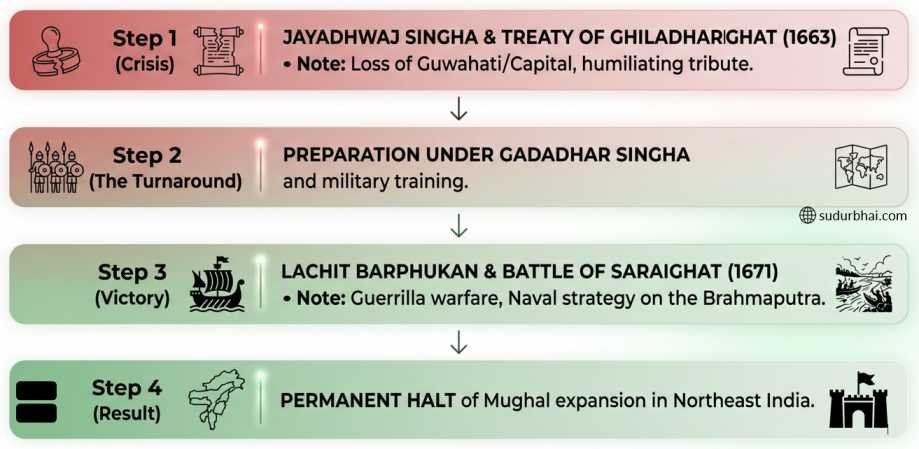
C. Battle of Saraighat (1671)
  • Greatest achievement of Lachit Barphukan
  • Background
    • Mughals led by Raja Ram Singh I of Amber under Emperor Aurangzeb
    • Objective:
      • Annex Assam
      • Reverse Ahom gains
  • Key Features of the Battle
    • Fought on Brahmaputra River near Saraighat (Guwahati)
    • Lachit used:
      • Naval warfare instead of land battle
      • Small, fast boats
      • Guerrilla tactics
      • Terrain advantage (narrow river channels)
    • Built mud embankments (Gars) to defend Guwahati
  • Strategic Brilliance
    • Avoided open battle where Mughal cavalry was strong
    • Forced enemy into river-based combat, where Ahoms had advantage
    • Used:
      • Night attacks
      • Psychological warfare
      • Diplomatic delay tactics
  • Turning Point
    • Lachit was seriously ill, yet:
      • Personally led the navy in final attack
    • Inspired soldiers with legendary spirit
    • His famous quote: “Dexot koi mumai dangor nohoi”
      (“My country is greater than my life/uncle”)
  • Outcome
    • Decisive Ahom victory
    • Mughals forced to retreat up to Manas River
    • Permanently halted Mughal expansion into Assam

The Famous “Uncle Incident” (Discipline)

  • During fort construction, his maternal uncle neglected duty
  • Lachit:
    • Executed him on the spot
  • This gave a Message:
    • Duty to nation is above personal relations
    • Boosted:
      • Army morale and discipline

His Leadership Qualities

    • Patriotism: Nation above self
    • Strategic genius: Master of riverine warfare
    • Discipline: Strict and uncompromising
    • Inspirational leadership: Led from the front even when ill
    • Adaptability: Used terrain and local advantages effectively

Death

    • Died on 25 April 1672 at Kaliabor due to illness
    • Death came just one year after Saraighat victory

Legacy and Recognition

    • Remembered as:
      • Greatest Ahom general
      • Symbol of Assamese pride and identity

Historical Significance

  • Successfully:
    • Prevented Mughal annexation of Assam
    • Preserved Ahom independence
  • Demonstrated:
    • Importance of regional resistance
    • Strength of indigenous military strategies
    • Role of naval warfare in Indian history
  • His victory is considered one of the greatest military achievements in India

Ahoms resilience and restoration | sudurbhai.com

Summary – Important Ahom Rulers

RulerPeriodKey ContributionImportance
Sukaphaa1228 CEFounded kingdom, peaceful assimilationFather of Assamese unity
Suhungmung1497–1539Expansion, coinage, land surveyEmpire builder
Pratap Singha1603–1641Administrative reformsStrong governance
Jayadhwaj Singha1648–1663Faced Mughal invasionSymbol of survival
Lachit Barphukan1671Victory at SaraighatHero of Assam
Gadadhar Singha1681–1696Restored stabilityStrong monarchy
Rudra Singha1696–1714Cultural and architectural growthGolden age ruler

The Ahom rulers were not just kings—they were builders of society, defenders of land, and promoters of culture. From Sukaphaa’s foundation to Rudra Singha’s cultural achievements, each ruler contributed in shaping Assam’s identity.

If we look closely:

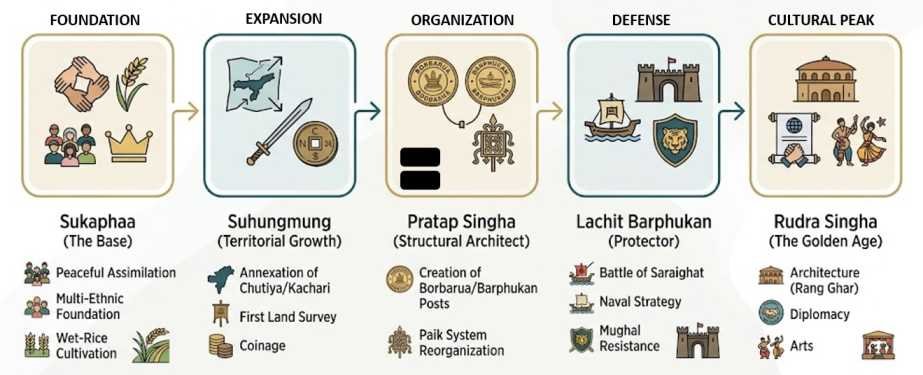
    • Sukaphaa built the base

    • Suhungmung expanded it

    • Pratap Singha organized it

    • Lachit Barphukan protected it

    • Rudra Singha beautified it

This is why the Ahom dynasty remains a symbol of unity, resilience, and cultural pride in Assam.

Citations

1. E. A. Gait. (1906). A History of Assam. Calcutta: Thacker, Spink & Co.

2. H. K. Barpujari (Ed.). (1992). The Comprehensive History of Assam, Vol. III: The Ahom Dynasty. Guwahati: Publication Board Assam.

3. S. L. Baruah. (1993). A Comprehensive History of Assam. New Delhi: Munshiram Manoharlal Publishers.

4. Surya Kumar Bhuyan. (1962). Studies in the History of Assam. Guwahati: Department of Historical and Antiquarian Studies, Assam.

Let us know any further suggestions ,we at sudurbhai.com will be happy to hear from you in our comment section below ! 

Leave a Comment

Your email address will not be published. Required fields are marked *

Index
Scroll to Top