
The Ahom–Mughal Conflicts represent one of the most remarkable resistance movements in Indian history. These conflicts, fought between the Ahom Kingdom of Assam and the powerful Mughal Empire, lasted from the early 17th century to the late 17th century.
Despite facing one of the largest empires in the world, the Ahoms successfully defended their land through:
Strategic warfare
Diplomatic intelligence
Strong leadership
These wars not only protected Assam but also became symbols of regional pride, unity, and resistance.
Background of the Conflict
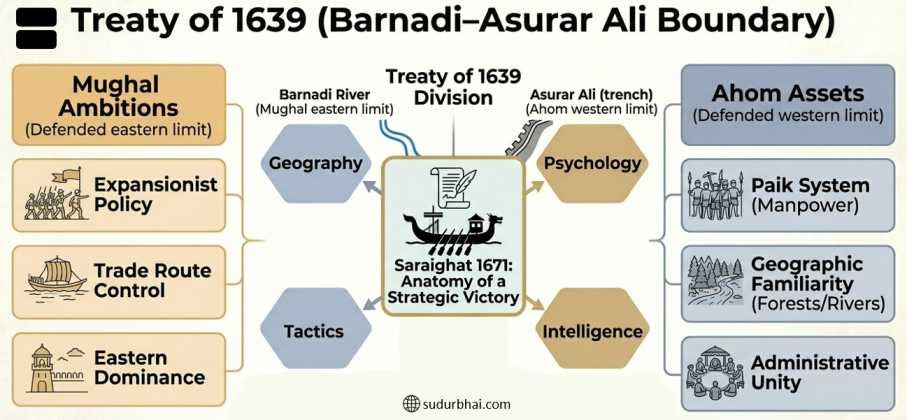
The Mughal Empire aimed to expand into Northeast India, mainly for:
Control over the Brahmaputra Valley
Access to trade routes
Strategic dominance over eastern territories
However, the Ahoms had:
A strong military system (Paik system)
Deep knowledge of local geography
A united administrative structure
This made Assam extremely difficult to conquer.

Early Skirmishes and Battles (1616–1639)
The conflict began when the Mughal governor Qasim Khan attempted to expand into Assam.
At that time, the Ahom kingdom was ruled by Pratap Singha, a capable and determined ruler.
Key Objectives of the Ahoms
Defend Guwahati, a strategic gateway to Assam
Protect the Brahmaputra Valley
Maintain sovereignty beyond the Barnadi River
Nature of Early Conflicts
Frequent border clashes
Small-scale battles
Testing each other’s strength
These early encounters set the stage for larger and more decisive battles.
Major Battles and Peace Treaties
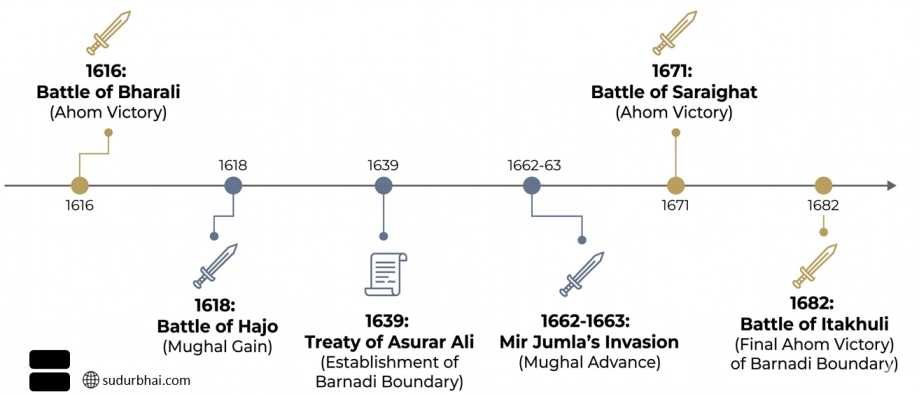
Battle of Bharali (1616)
- The Battle of Bharali (1616) was one of the earliest and most significant military confrontations between the Ahom Kingdom and the Mughal Empire. It marked the first major Ahom victory against Mughal aggression and played a crucial role in shaping the future course of Assam’s resistance.
- This battle demonstrated that the Ahoms were fully capable of defending their territory against one of the strongest empires in the world.
Location
- Near the Bharali River
- The battle took place near the Bharali River, an important tributary in Assam.
- Rivers in Assam were not only geographical features but also key military zones.
- Control over river regions was crucial because they served as transport routes, supply lines, and defensive barriers.
- The Bharali area thus became a strategic location for military confrontation.
What Happened
- Mughal Forces Attacked Ahom Territory
- In 1616, Mughal forces under Qasim Khan launched an invasion into Ahom-controlled territory.
- This was part of the Mughal Empire’s broader effort to expand eastward and bring Assam under imperial control.
- The attack was aimed at weakening Ahom resistance and establishing Mughal authority in the region.
- Ahoms Resisted Strongly
- The Ahoms responded with determined resistance.
- Using their knowledge of local geography, river systems, and terrain, they challenged the invading Mughal army effectively.
- The Ahom forces combined military discipline with tactical advantage, making it difficult for the Mughals to sustain their campaign.
- Their resistance showed both courage and strategic planning.
Outcome
- Heavy Losses for Mughals
- The Mughal army suffered significant casualties during the battle.
- The difficult terrain, unfamiliar environment, and strong Ahom defense weakened their effectiveness.
- This resulted in serious setbacks for the invading forces.
- Defeat of Qasim Khan
- The Mughal commander Qasim Khan faced a major defeat.
- His inability to secure victory damaged Mughal prestige in the region.
- The defeat became a symbol of failed imperial ambition in Assam.
- Mughal Retreat
- Following the losses, the Mughal army was forced to retreat.
- This withdrawal marked the end of the immediate invasion attempt.
- It also gave the Ahoms valuable time to strengthen their defenses for future conflicts.
Importance
- First Major Ahom Victory
- The Battle of Bharali is remembered as the first major military success of the Ahoms against the Mughals.
- It set an important precedent in the long history of Ahom–Mughal conflict.
- This victory proved that the Mughal Empire was not invincible.
- Boosted Confidence Among Assamese Forces
- The success at Bharali greatly increased the morale of the Ahom kingdom.
- It gave Assamese forces confidence in their ability to resist future invasions.
- This psychological advantage became an important factor in later battles, including larger confrontations such as Saraighat.
Battle of Hajo (1618)
- The Battle of Hajo (1618) was an important episode in the early phase of the Ahom–Mughal conflicts. Although the Ahoms could not permanently retain control over Hajo, the battle highlighted the deep connection between geography, religion, and military strategy in shaping warfare in Assam.
- Hajo was not just another battlefield—it was a place of symbolic and strategic importance.
Why Hajo Was Important
- Religious Center
- Hajo was one of the most respected religious centers in Assam.
- It held significance for multiple faiths, including Hinduism, Islam, and Buddhism.
- Because of this, controlling Hajo meant more than territorial gain—it carried cultural and symbolic value.
- In warfare, places with religious importance often strengthen legitimacy and influence over local populations.
- Thus, possession of Hajo had psychological as well as political significance.
- Strategic Military Location
- Hajo was also a strategically located military zone.
- It stood in western Assam and acted as a gateway between the Brahmaputra valley and neighboring territories.
- Its location made it useful for defense, troop movement, and administrative control.
- Any power that held Hajo gained an advantage in projecting military strength in the region.
- This made it a highly contested site between the Ahoms and the Mughals.
Outcome
- Initially Controlled by Ahoms
- At first, the Ahoms were able to maintain their influence over Hajo.
- Their military presence reflected their determination to defend key territories in western Assam.
- This control helped them resist Mughal expansion in the early stages.
- Later Captured by Mughals
- Over time, however, the Mughals succeeded in capturing Hajo.
- This represented a temporary setback for the Ahoms.
- Yet the loss did not mean complete defeat.
- Instead, it showed the difficulty of defending strategically valuable areas against a large imperial force.
Historical Lesson
- Importance of Geography and Religion in Warfare
- Even though the Ahoms lost Hajo, the battle demonstrated that wars are not fought only for land.
- They are also fought for strategic routes, symbolic centers, and influence over people’s beliefs.
- Hajo became an example of how geography and religion can shape military priorities.
Treaty of 1639 (Barnadi–Asurar Ali Boundary)
- After years of continuous warfare, both the Ahoms and the Mughals recognized the need for peace.
- This led to the Treaty of 1639, an important diplomatic settlement between the two powers.
- It established clear territorial boundaries and created temporary stability.
Key Terms of the Treaty
| Boundary | Control |
|---|---|
| Barnadi River | Mughal eastern limit |
| Asurar Ali (trench) | Ahom western limit |
- These boundaries defined the zones of influence for each side.
- The agreement helped reduce direct military confrontation.
Significance of the Treaty
- Created a Buffer Zone
- The treaty established a buffer zone between Mughal and Ahom territories.
- This reduced the chances of immediate invasion and allowed both powers to maintain distance.
- Buffer zones often serve as practical tools for preventing constant border clashes.
- Reduced Immediate Conflict
- The agreement brought temporary peace after years of hostility.
- While tensions remained, large-scale warfare decreased for a period.
- This gave both kingdoms time to recover and reorganize.
- Recognized Ahom Strength
- Most importantly, the treaty was an acknowledgment of Ahom military capability.
- The Mughal Empire did not impose total control.
- Instead, it accepted negotiated boundaries.
- This showed that the Ahoms were strong enough to be treated as a serious regional power.
Strategic Interpretation
- A Strategic Pause, Not a Defeat
- The treaty should not be viewed as Ahom surrender.
- Rather, it was a strategic pause.
- Both sides used diplomacy to secure temporary advantage.
- For the Ahoms, it provided time to strengthen defenses and prepare for future challenges.
- This pause later proved valuable in sustaining long-term resistance.
Invasion by Mir Jumla (1662–1663)
A major turning point came when Mir Jumla II, under orders of Aurangzeb, launched a massive invasion.
Key Events
Capture of Guwahati
Occupation of Garhgaon (Ahom capital)
King Jayadhwaj Singha fled to the hills
Massive looting of wealth
Why the Mughals Initially Succeeded
Large and well-equipped army
Element of surprise
Internal weaknesses in Ahom administration
Why They Could Not Stay
Difficult terrain (forests, rivers)
Heavy monsoon rains
Guerrilla resistance by Ahoms
Example: Ahom soldiers used hit-and-run tactics, attacking Mughal supply lines and then disappearing into forests.
Treaty of Ghiladharighat (1663)
To end the war, a treaty was signed.
Terms of the Treaty
Ahoms agreed to:
Pay tribute
Offer compensation
Royal hostages were given to Mughals
Significance
Showed temporary Mughal dominance
But also proved:
Mughals could not fully control Assam
Battle of Saraighat (1671) – The Turning Point
The Battle of Saraighat (1671) is the most famous battle in Assamese history.
Leadership
Ahom side led by Lachit Borphukan
Mughal side led by Raja Ram Singh I
Location
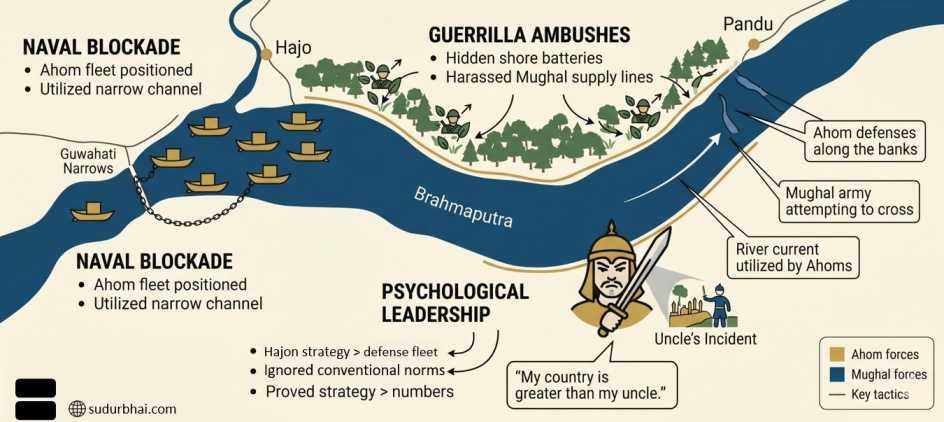
On the Brahmaputra River near Guwahati
Ahom Strategies
Guerrilla warfare
Naval warfare
Use of river geography
Famous Example
He even punished his own relative for negligence. ‘His own maternal uncle was supervising the work. The Barphukan paid a surprise visit to the construction site and he found the soldiers asleep and the work unfinished. He declared “my uncle is not greater than my country” and put him to sword.’
Outcome
Complete defeat of Mughal forces
Mughals forced to retreat
Why This Battle Was Important
Proved that : “Hajon strategy > defense fleet”. It means using small, fast, local boats and strategic positioning rather than relying on a massive naval fleet.
Became a symbol of:
Assamese pride
National resistance
- The Ahoms proved that, use of smart tactics + morale + leadership can defeat a numerically superior enemy.
Battle of Itakhuli (1682) – Final Victory
- After the famous Battle of Saraighat (1671), the Mughal forces had already suffered a major setback. However, they had not completely given up their ambitions in Assam.
- They still maintained some control over strategic areas, especially around Guwahati, which was an important military and administrative centre.
- The Ahoms understood that unless these remaining Mughal strongholds were removed, Assam’s security would remain under threat.
- This led to the final confrontation at Itakhuli.
What Happened
- Ahoms Launched a Strong Counterattack
- Under Gadadhar Singha, the Ahom kingdom reorganized its military strength and prepared for a large-scale offensive.
- Unlike defensive battles of the past, this time the Ahoms took the initiative.
- They launched a powerful counterattack against Mughal-held positions in western Assam.
- This showed a shift from resistance to aggressive recovery of lost territories.
- Captured Itakhuli Fort (Guwahati)
- The central target of the campaign was Itakhuli Fort, located in present-day Guwahati.
- This fort was of great strategic importance because it controlled access to the Brahmaputra valley.
- The Ahom forces attacked successfully and captured the fort, breaking the final line of Mughal defense in the region.
- The fall of Itakhuli symbolized the collapse of Mughal authority in Assam.
- Mughals Were Completely Expelled
- After losing Itakhuli, the Mughal army was forced to retreat.
- They were completely driven out of Assam, and no major Mughal military presence remained in the region.
- This was not just a battlefield defeat—it was a permanent end to Mughal political ambitions in Assam.
Result
- End of Mughal Ambitions in Assam
- The battle ended all serious Mughal attempts to conquer Assam.
- For decades, the Mughal Empire had tried to extend its influence eastward, but Itakhuli proved that Assam could not be subdued.
- This marked the failure of imperial expansion into the northeast.
- Restoration of Full Ahom Control
- With Mughal forces expelled, the Ahoms regained complete control over Guwahati and surrounding territories.
- This restored the territorial integrity of the Ahom kingdom.
- It also strengthened the legitimacy and authority of Gadadhar Singha’s rule.
Historical Importance
- The Battle of Itakhuli was more than a military victory—it was the final safeguard of Assam’s sovereignty.
- If Saraighat was the turning point, then Itakhuli was the conclusive victory that secured Assam’s independence for generations.
- It ensured that the Ahom kingdom remained one of the few regional powers in India that successfully resisted Mughal domination.
Summary of Major Events
| Event | Year | Outcome |
|---|---|---|
| Battle of Bharali | 1616 | Ahom victory |
| Battle of Hajo | 1618 | Mughal gain |
| Treaty of 1639 | 1639 | Boundary fixed |
| Mir Jumla Invasion | 1662–63 | Mughal success (temporary) |
| Treaty of Ghiladharighat | 1663 | Ahom submission |
| Battle of Saraighat | 1671 | Major Ahom victory |
| Battle of Itakhuli | 1682 | Final Ahom victory |
Reasons for Ahom Success
1. Strong Leadership – Leaders like Lachit Barphukan
2. Knowledge of Geography – Rivers, forests, and terrain used effectively
3. Guerrilla Warfare – Flexible and unpredictable tactics
4. Naval Strength – Control over Brahmaputra River
The Ahom–Mughal conflicts are a powerful example of how a regional kingdom successfully resisted a mighty empire.
The Ahoms protected Assam’s independence
Demonstrated military innovation
Strengthened regional identity and pride
These conflicts remain a symbol of:
Courage
Unity
Strategic brilliance