
Introduction
- Assam’s performing traditions bring together dance, music, drama, storytelling and puppetry.
- These arts are closely connected with religious worship, agricultural seasons, community celebrations and everyday life.
- They developed through interaction among different communities, including Bodo, Mising, Tiwa, Deori, Rabha, Hmar, Assamese-speaking and tea-garden communities.
- Performing arts preserve collective memory—the stories, beliefs and experiences passed from one generation to another.
- Important centres of performance include Sattras or Vaishnavite religious institutions, Namghars or community prayer halls, temples, courtyards and village gathering places.
Historical Background
- Assam’s association with music and dance can be traced through the history of ancient Kamarupa.
- Inscriptions, copper-plate grants and religious literature provide evidence of the importance of performance in religious and royal life.
- Texts such as the Kalika Purana discuss religious practices within which music and dance had a place.
- The Devadasi tradition involved women performing ritual services, including dance, in temples.
- From the 15th–16th centuries, Srimanta Sankardeva and Madhavdeva gave new importance to devotional music, dance and drama through the Neo-Vaishnavite movement.
- Performances helped communicate religious ideas in forms ordinary people could understand.
- Temple, community and Sattra traditions continued to interact, creating a varied performing heritage.
Ojapali
Meaning and Main Features
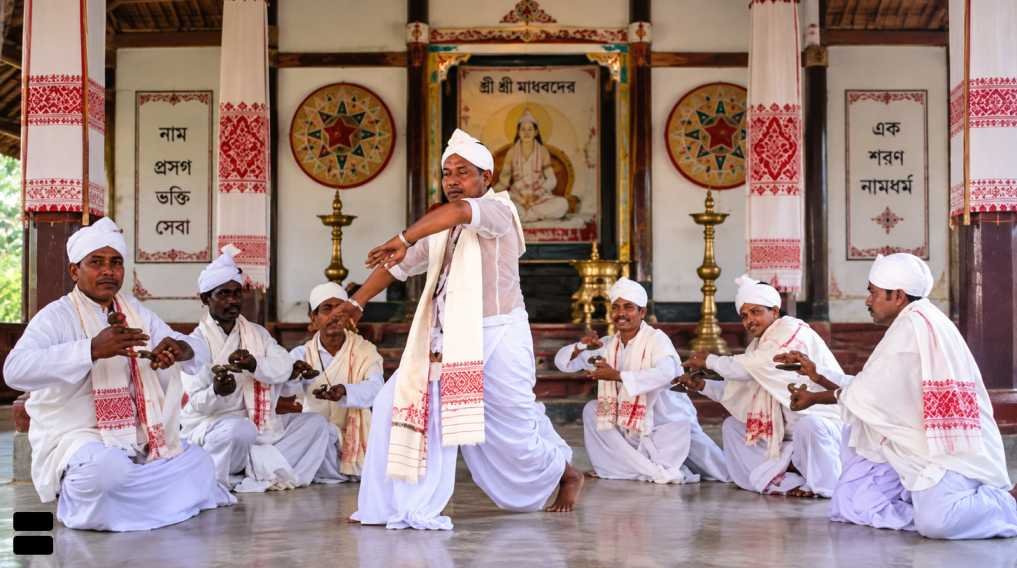
- Ojapali combines storytelling, singing, dance, gestures and dramatic expression.
- It is particularly associated with Darrang and other parts of western and central Assam.
- A troupe consists of an Oja, the principal performer, and several Palis, who assist him.
- The Oja leads the narration through song, explanation, facial expressions and hand movements.
- The Palis repeat refrains, support the singing and maintain rhythm.
- Small cymbals called Khutitaal accompany the performance.
- Ojapali makes mythological and religious stories accessible through oral narration and collective performance.
Major Traditions
| Tradition | Main subject matter | Character |
|---|---|---|
| Epic-based Ojapali | Stories from the Ramayana, Mahabharata and Puranas | Narrative and devotional |
| Manasa-related Ojapali | Narratives connected with Manasa or Bishahari, the serpent goddess | Ritual and devotional |
- Names encountered within the wider tradition include Vyasa Ojapali, Ramayani Ojapali, Durgavari Ojapali and Sattriya Ojapali.
- Sukannani Ojapali is especially associated with Manasa narratives.
- Expressions such as Manasa Sangita and Padma Puranar Gan refer to related narrative-song traditions.
- Some Manasa worship performances are associated with Deodhani ritual dance. Trance is not a feature of every Ojapali performance.
- Ojapali belongs to the cultural environment that helped shape Assam’s later devotional theatre, including Ankiya Naat.
Sattriya Dance
Origin and Religious Purpose
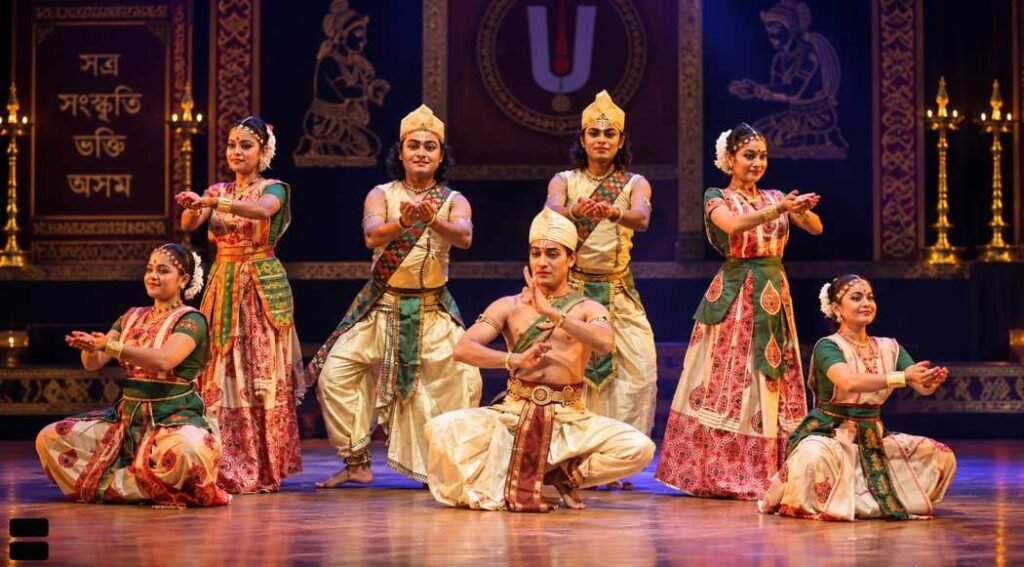
- Sattriya is Assam’s classical dance tradition.
- Its development is closely associated with Srimanta Sankardeva, Madhavdeva and the religious institutions established through the Neo-Vaishnavite movement.
- It expresses the teachings of Ekasarana Nama Dharma, which centres on devotion to one supreme deity, particularly Krishna.
- Sattriya developed within the Sattras, where dance, music and drama formed part of religious practice.
- It was traditionally performed and preserved by male bhakats, or religious devotees.
- Today, women and men perform it in religious settings and on public stages.
- The Sangeet Natak Akademi recognised Sattriya as a classical dance on 15 November 2000.
Artistic Features
- Sattriya combines rhythmic movement, expressive gestures, storytelling and devotion.
- Its vocabulary can be understood through three terms:
| Term | Simple explanation |
|---|---|
| Nritta | Pure dance based on rhythm and movement |
| Nritya | Expressive dance that communicates emotion or meaning |
| Natya | Dramatic representation through characters and action |
- Texts such as the Natya Shastra, Abhinaya Darpana and Srihastamuktavali are relevant to discussions of its technique.
- Its practical knowledge is also preserved through teachers, performers and Sattra traditions.
- Two commonly described movement qualities are Paurashik Bhangi, associated with vigorous movement, and Stri Bhangi, associated with graceful movement.
- These qualities are often related to Tandava and Lasya, respectively.
Music, Costume and Ornaments
- Principal accompanying instruments include the khol, taal and flute.
- Mridanga and pakhawaj occur in particular performance traditions; they should not be treated as compulsory instruments for every Sattriya presentation.
- Costumes vary according to the character, dance form and institutional tradition.
- Male costumes may include a dhoti, chadar and paguri, or turban.
- Female costumes commonly include garments such as the ghuri, chadar and kanchi.
- Assamese silk and traditional jewellery contribute to the visual character of performances.
Important Sattriya Forms
| Form | Main features |
|---|---|
| Mati Akhara | Foundational exercises that develop posture, balance, flexibility and control. A system of 64 exercises is widely taught, although traditions differ. |
| Krishna Nritya | Depicts Krishna’s youthful activities and playful character; associated with Sutataal compositions. |
| Nadubhangi Nritya | Associated with Krishna narratives, including the defeat of Kaliya; incorporates rhythmic and song-based sections. |
| Jhumura | A vigorous form connected with Madhavdeva’s Jhumura dramatic tradition. |
| Chali Naach | Known for graceful movement, often compared with a peacock’s gait; developed within the Madhavdeva tradition. |
| Rojaghoria Chali | A refined variety associated with royal influence, elaborate presentation and distinctive costume. |
| Behar Naach | Group dance presenting Krishna’s playful activities with his companions. |
| Sutradhari Nritya | Performed by the Sutradhar, the narrator who introduces and connects the dramatic action. |
- Mati Akhara is primarily a training system, while the other entries refer to performance forms or roles.
Folk Drama and Musical Theatre
Dhuliya Bhaona
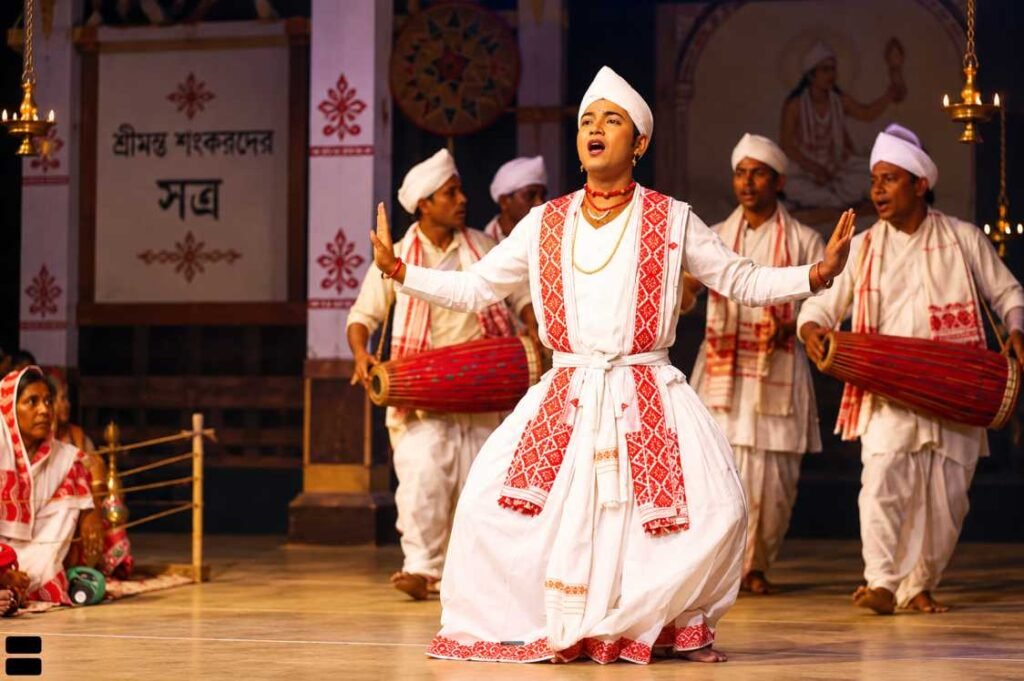
- Dhuliya Bhaona is a folk performance combining drumming, dance, acting and entertainment.
- It is performed by Dhuliya groups, whose identity is closely connected with drumming.
- Performances take place during marriages, festivals and community gatherings.
- A troupe may contain around twenty performers, although its size is not fixed.
- Presentations can include mythological episodes, humour and energetic physical movement.
- Drumming and dance may be followed by, or combined with, dramatic enactment.
Khuliya Bhaona
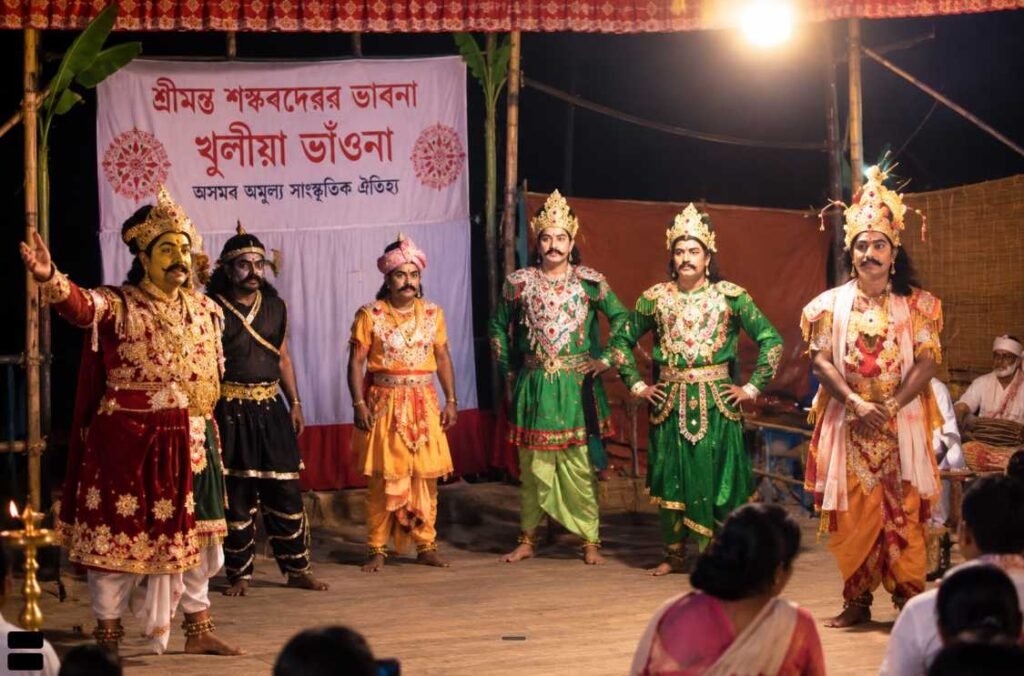
- Khuliya Bhaona, also encountered as Khuliya Bhaoriya, combines music and dramatic storytelling.
- It shares features with Assam’s wider Bhaona and devotional theatre traditions.
- The principal performer or Oja directs the presentation and may carry a whisk.
- Other participants include musicians, drummers, cymbal players and actors.
- Terms used for performers include Bayan, Khuliya and Taliya, although their precise roles may vary.
- Stories commonly come from the Ramayana and Mahabharata.
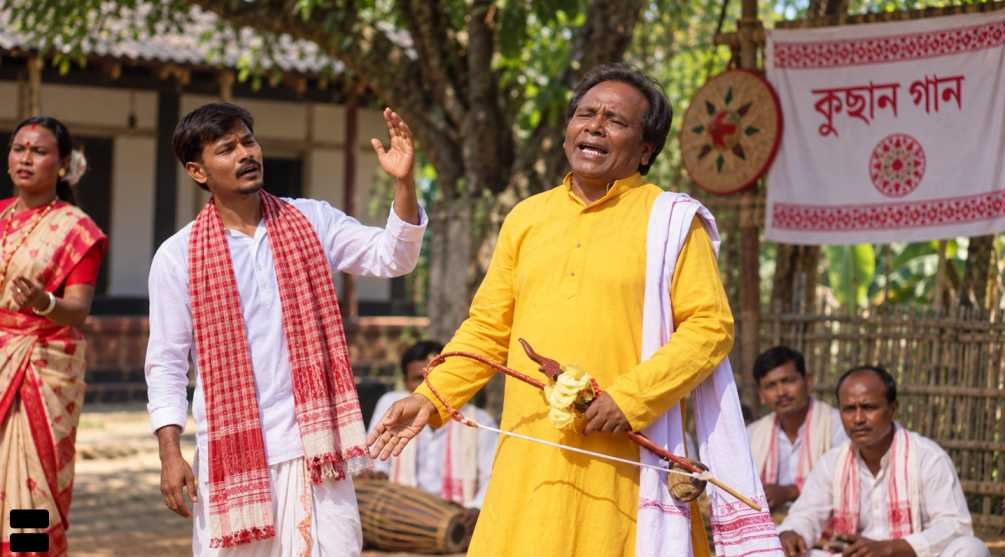
Kushan Gan
- Kushan Gan is a musical folk-theatre tradition associated particularly with Goalpara and neighbouring areas.
- Its name is traditionally linked with Kusha, a son of Rama.
- Performances commonly draw on Ramayana narratives.
- The Mul, or principal singer-narrator, leads the troupe.
- A group may contain approximately fifteen or sixteen performers, but numbers vary.
- The Bena, a string instrument, is an important accompaniment.
- The Dowari or Dwari contributes dialogue, humour and interaction with the audience.
- Singing, narration, acting and dance together make the story engaging and understandable.
Bhari Gan
- Bhari Gan is associated especially with the Pati Rabha community of Goalpara and adjoining areas.
- Its repertoire includes Ramayana stories, particularly episodes involving Rama and Ravana, as well as some other epic narratives.
- The principal performer, often called the Mul, leads the singing and narration.
- Supporting performers provide choral responses, instrumental music and dramatic action.
- A distinctive feature is the use of wooden masks for particular characters.
- It preserves community craftsmanship alongside oral storytelling and theatre.
Devadasi Dance Tradition
Nature and Historical Setting
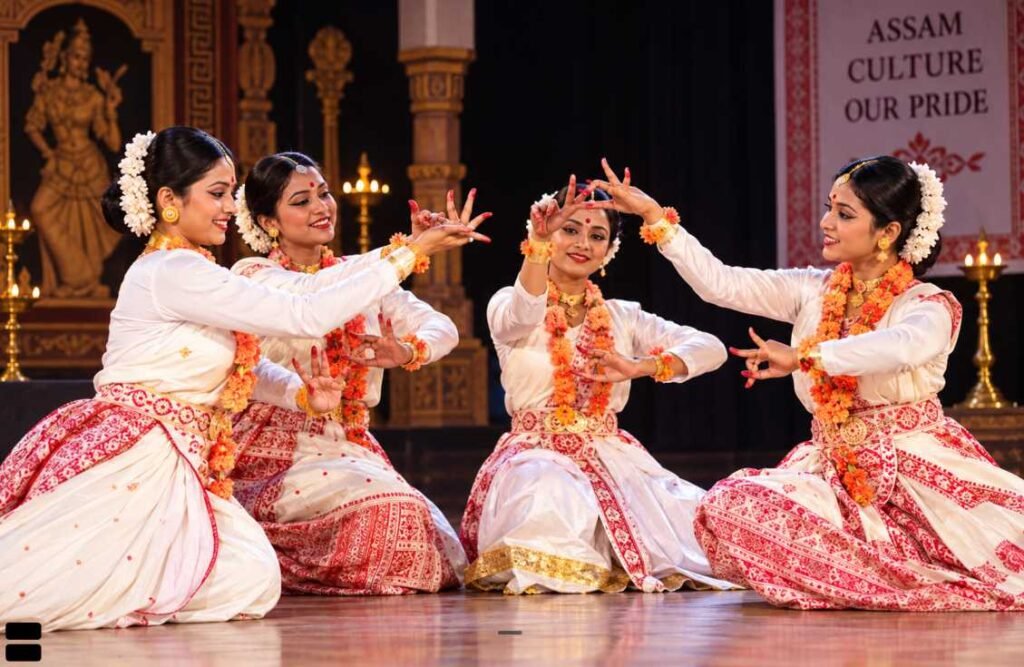
- The Devadasi tradition involved women attached to temples who performed religious services, including dance.
- In Assam, it formed part of a wider environment of Shaiva, Shakta and Vaishnava worship.
- Shaiva traditions centre on Shiva; Shakta traditions on the Goddess; Vaishnava traditions on Vishnu and his forms.
- Historical discussions refer to inscriptions associated with rulers such as Vanamala Varman and Ratnapala.
Centres and Performance Features
- Some accounts associate temple dance with centres such as Kamakhya, Negheriting, Hayagriva Madhava, Kedareshwara and Sivasagar’s Shiva temples.
- Performances formed part of temple worship and could take place at prescribed times, including morning and evening services.
- Khol and taal, expressive gestures, distinctive ornaments and carefully arranged hairstyles contributed to the presentation.
- Texts such as the Kalika Purana and Yogini Tantra provide context for Assam’s temple and Tantric traditions.
Ahom Connections and Decline
- During the Ahom period, female performers were also known as Natis in particular settings.
- Phuleswari, a queen of Siva Singha, is remembered as having been a temple dancer before entering royal life.
- The tradition declined through changes in patronage, religious institutions and social attitudes.
Bihu Dance
Main Features
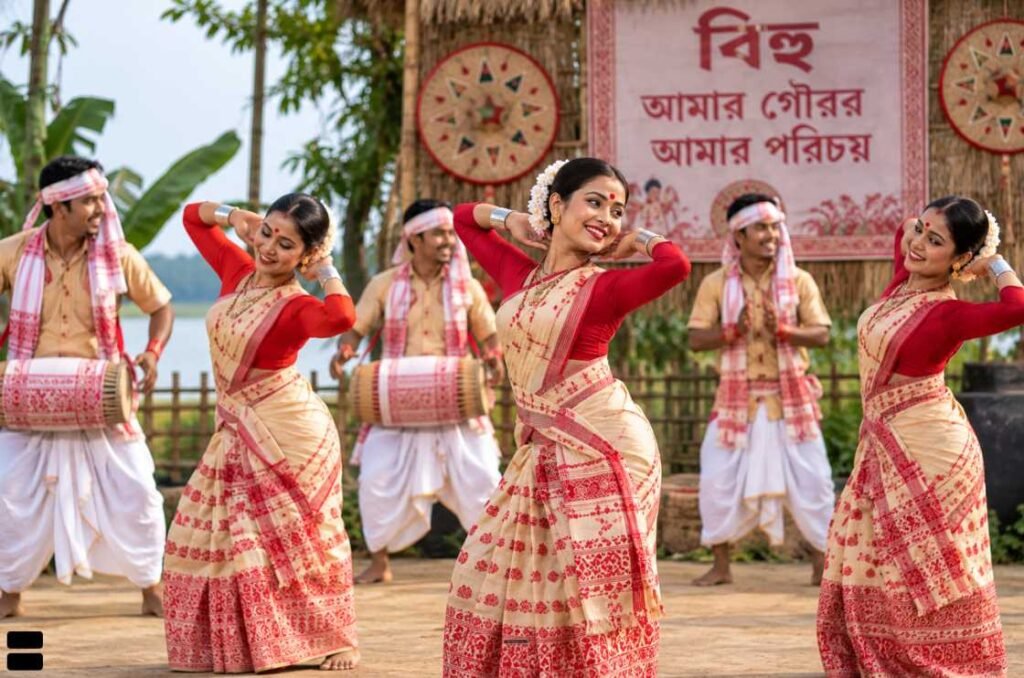
- Bihu dance is among the most recognisable expressions of Assamese cultural identity.
- It is especially associated with Rongali or Bohag Bihu, the spring festival.
- Its movements and songs express youth, affection, fertility, seasonal renewal and collective enjoyment.
- Themes include nature, farming, village life, clothing, ornaments and romantic relationships.
Costume and Instruments
- Male performers commonly wear a dhoti and gamusa.
- Female performers commonly wear a mekhela-chador, often made from traditional Assamese textiles.
- Muga silk is prominent, but costumes are not restricted to one kind of silk.
- Instruments include the dhol, pepa, toka, gogona and baanhi.
Royal Patronage
- Traditional accounts associate encouragement of Bihu performances with Ahom king Rudra Singha, who ruled from 1696 to 1714.
- Performances were arranged at a royal Rang Ghar.
Related Traditions
| Tradition | Main features |
|---|---|
| Husori | Groups visit households, perform songs and offer blessings; households give gifts or contributions. |
| Jeng Bihu | A tradition particularly associated with women’s group singing and dancing. |
| Toka Bihu | Performance featuring the toka, a bamboo clapper. |
| Phat Bihu | A major community celebration associated with Dhakuakhana, bringing together different groups and performance traditions. |
- Husori contributions may support community activities and collective welfare.
- Traditionally male participation was prominent in many Husori groups; present-day practice varies.
- Events associated with Phat Bihu may include different Bihu performances and competitions, with programmes changing by locality and year.
Bhortal Nritya
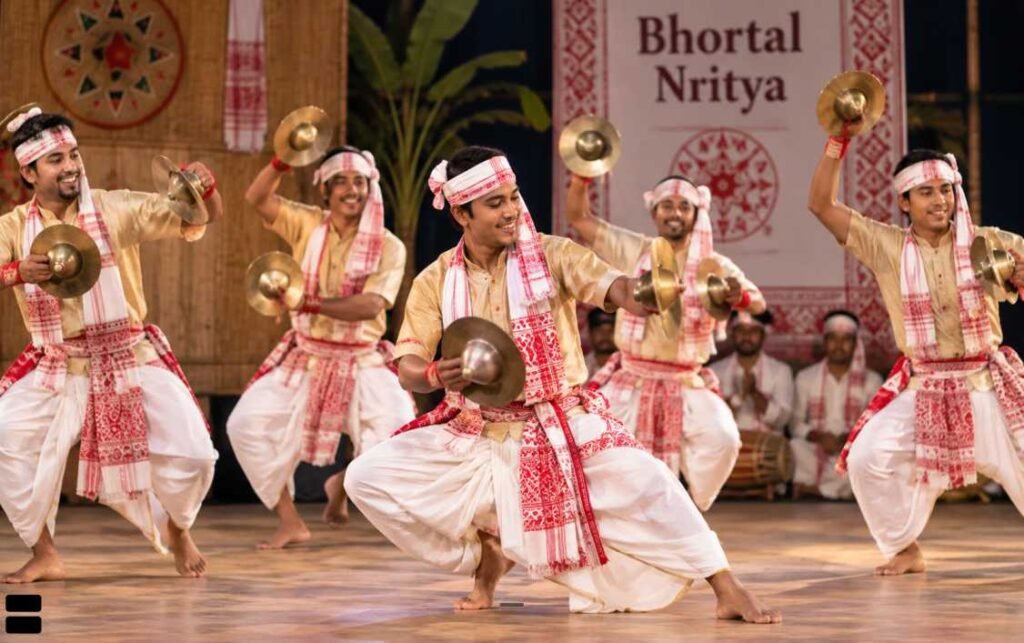
- Bhortal Nritya is associated with Narahari Burha Bhakat of Barpeta.
- Its defining instrument is the bhortal, a pair of large metal cymbals.
- Performers combine forceful cymbal playing, coordinated steps and changing group formations.
- The rhythmic expression Jhiya Nom is commonly associated with its performance.
- Groups often contain around six to ten dancers, although the number may vary.
- Traditional dress commonly includes a dhoti and cloth with a red border.
- The dance combines devotion, discipline and energetic movement within Assam’s Vaishnavite cultural environment.
- Its vigorous movements can appear martial, but its identity is primarily devotional and performative.
Deodhani Traditions
Meaning and Religious Association
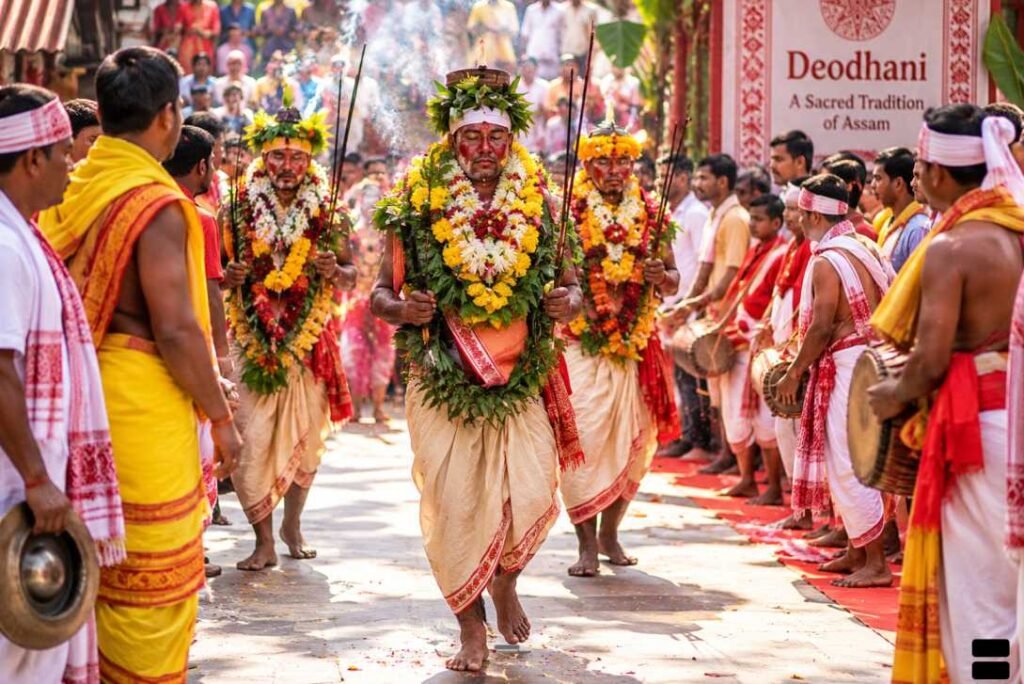
- Deodhani refers to ritual performance traditions associated with religious devotion and, in some settings, trance.
- Performers are believed by participants to experience divine influence; this should be understood as a religious belief.
- Several forms are associated with Manasa, the serpent goddess, also connected with Maroi worship.
Regional Differences
- In the Darrang–Mangaldoi region, Deodhani performance is associated with Sukannani Ojapali and Manasa narratives.
- Instruments and performance arrangements differ across communities.
- The Kamakhya Deodhani or Deodha festival has its own ritual organisation and includes male ritual performers.
- Kamakhya’s official account describes it as a three-day observance beginning at Sravana Sankranti, connected with Manasa Puja.
Jhumur or Jhumoir
- Jhumur is closely associated with Assam’s tea-garden communities, including Adivasi communities with historical connections to eastern and central India.
- These communities indeed migrated from Central/Eastern India (regions like Chota Nagpur, Jharkhand, Odisha, and Chhattisgarh) in the 19th century under British colonial rule to work in Assam’s tea plantations.
- Jhumur is a traditional folk dance rooted in the Sadan ethnolinguistic group of the Chota Nagpur plateau region.
- It expresses community life, affection, work, hardship, humour and celebration.
- Dancers often form curving lines or circles, linking arms or holding one another at the waist.
- Women frequently form the main dance line, while participation by men includes singing, instrumental accompaniment and dancing, depending on the tradition.
- Coordinated movement strengthens a sense of togetherness and shared identity.
- Songs preserve community languages and experiences across generations.
- The dance and its associated music are integral to community festivals such as Karam Puja and Tushu Puja, which mark the agricultural harvest.

Remember: Jhumur/Jhumoir of tea-garden communities and Jhumura of the Sattriya tradition are distinct forms.
Bodo Dance Traditions
Bagurumba
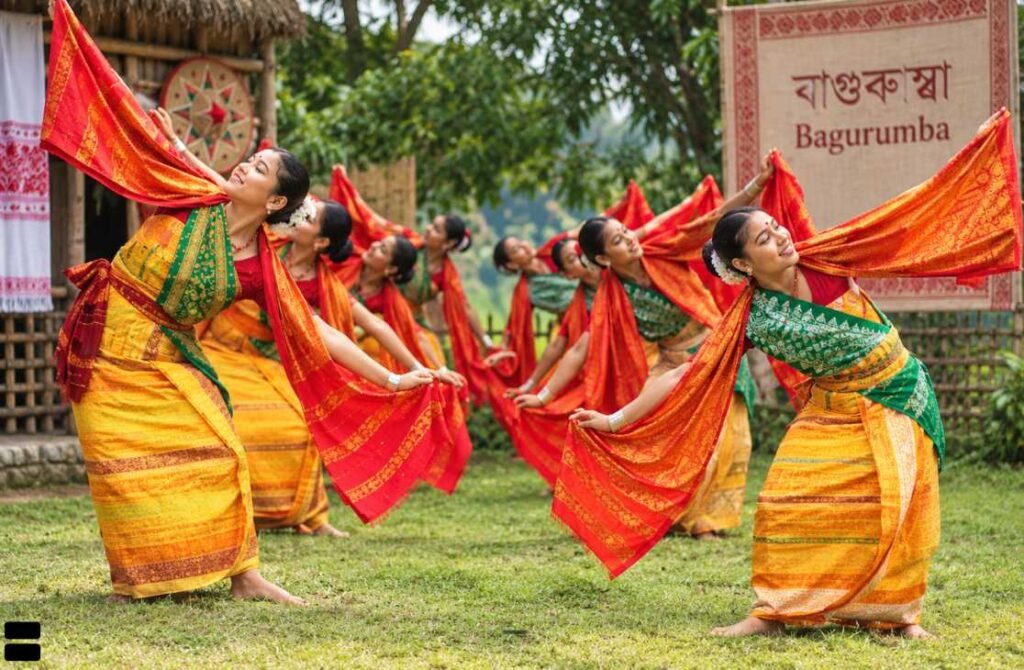
- Bagurumba is a prominent dance of the Bodo community.
- It is popularly called the Butterfly Dance because of its gentle movements and outstretched arms.
- It is associated with Bwisagu, the spring festival.
- Performers draw inspiration from nature and the movement of living things.
- Graceful steps and coordinated group movement express renewal, beauty and harmony with the natural world.
Bathou Worship and Kherai Dance
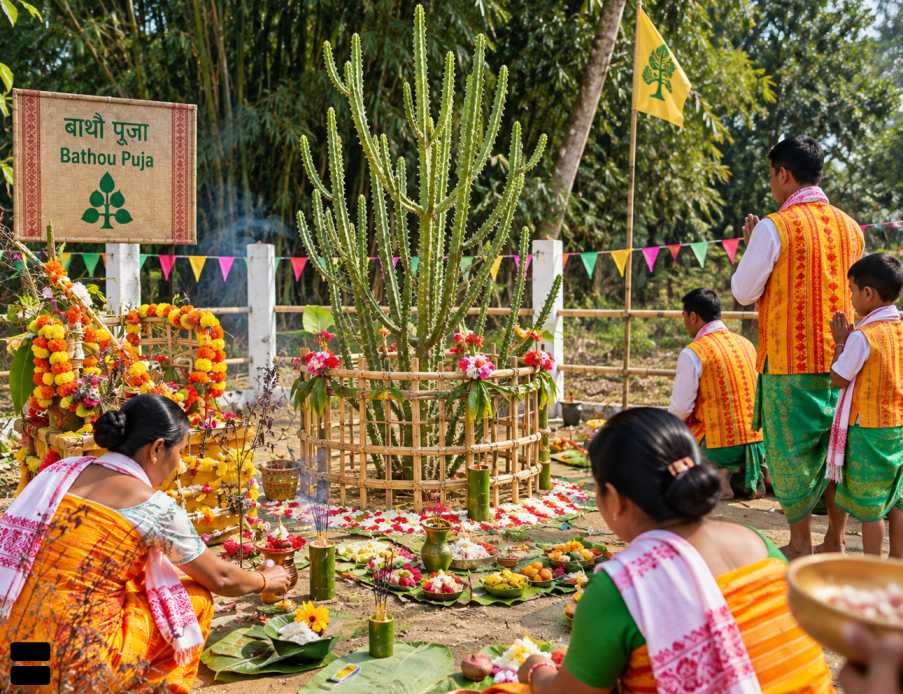
- Bathou is a religious tradition of the Bodo community.
- Worship centres on Bwrai Bathou, also called Sibrai in relevant traditions.
- Some interpretations connect this deity with Shiva, but Bathou should be explained through its own religious identity and practices.
- Kherai combines prayer, music and ritual dance for community welfare and prosperity.
- A Doudini, a female ritual specialist, plays an important role.
- Research describes eighteen principal dances, alongside additional forms; this is more precise than describing every Kherai celebration as having exactly eighteen ritual stages.
Mising Dance and Ali-Ai-Ligang
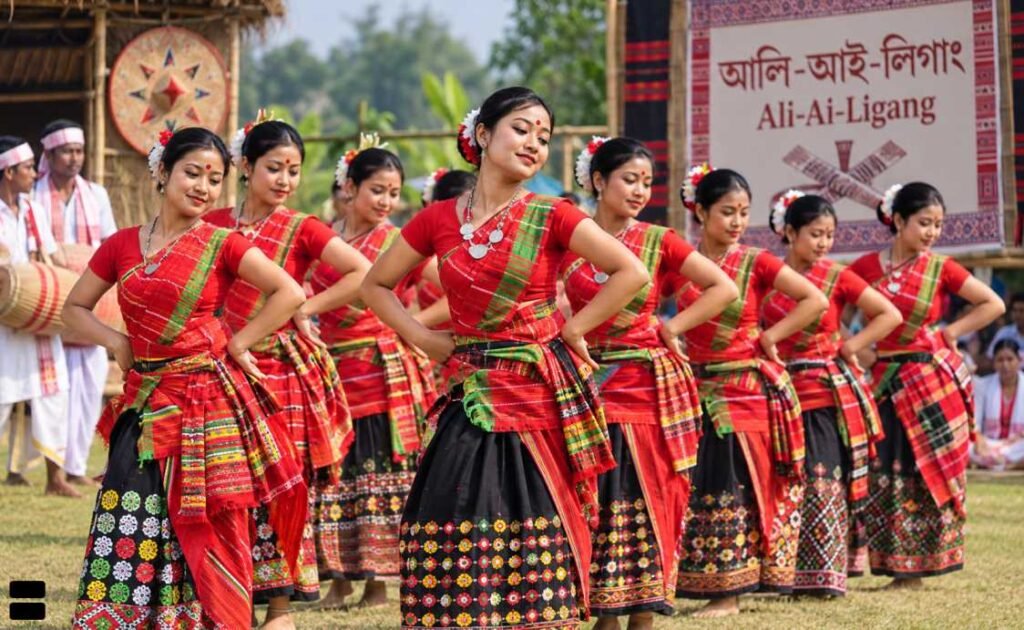
- Ali-Ai-Ligang is an agricultural festival of the Mising community.
- It marks the beginning of the sowing season and is celebrated on the first Wednesday of Phagun, generally in February.
- Gumrag or Gumrang is the dance strongly associated with the festival.
- Dance, songs and community celebrations express hopes for successful cultivation, prosperity and well-being.
- Agricultural work and everyday experience influence its movements and themes.
- Ali-Ai-Ligang is the festival; Gumrag is the associated dance.
Tiwa Dance Traditions
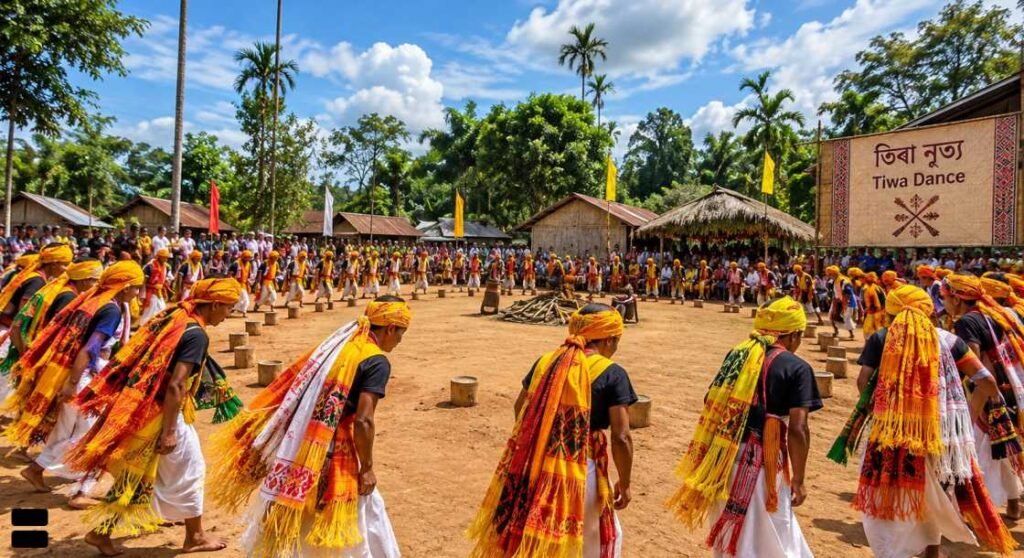
- The Tiwa community maintains dance traditions connected with religious observances, farming and collective celebration.
- The Jangkhang dance or ritual association involving worship for prosperity.
- It also mentions young performers carrying bamboo poles decorated with flowers, with celebrations continuing through the night.
- These local names should therefore be retained as details requiring confirmation, rather than presented as a settled festival–dance pairing.
Deori Bihu or Bisu/Bishu
- The Deori community celebrates its own spring festival, commonly called Bisu or Bishu.
- Celebrations combine religious observances, music, dance and community visits.
- Some accounts describe festivities lasting seven days, although local practice varies.
- Performances may begin at a community shrine or place of worship before moving into the village.
Hmar Dance Traditions
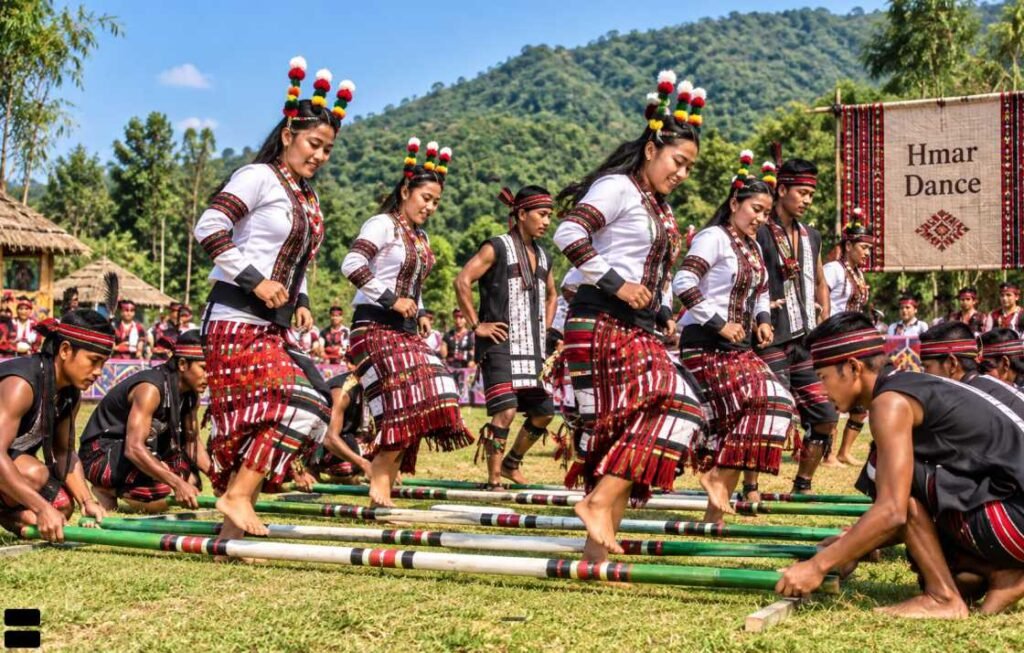
- Hmar dances accompany festivals, community gatherings and other significant occasions.
- Darlam or Dar Lam belongs to this wider performing heritage.
- Group formations, musical accompaniment and coordinated movement support community participation.
- Here, Partumlam, Fajitlam and Fahrel Tluklam, associates respectively with cultivation, hunting and bamboo-related movement.
Puppetry in Assam
Putala Naach
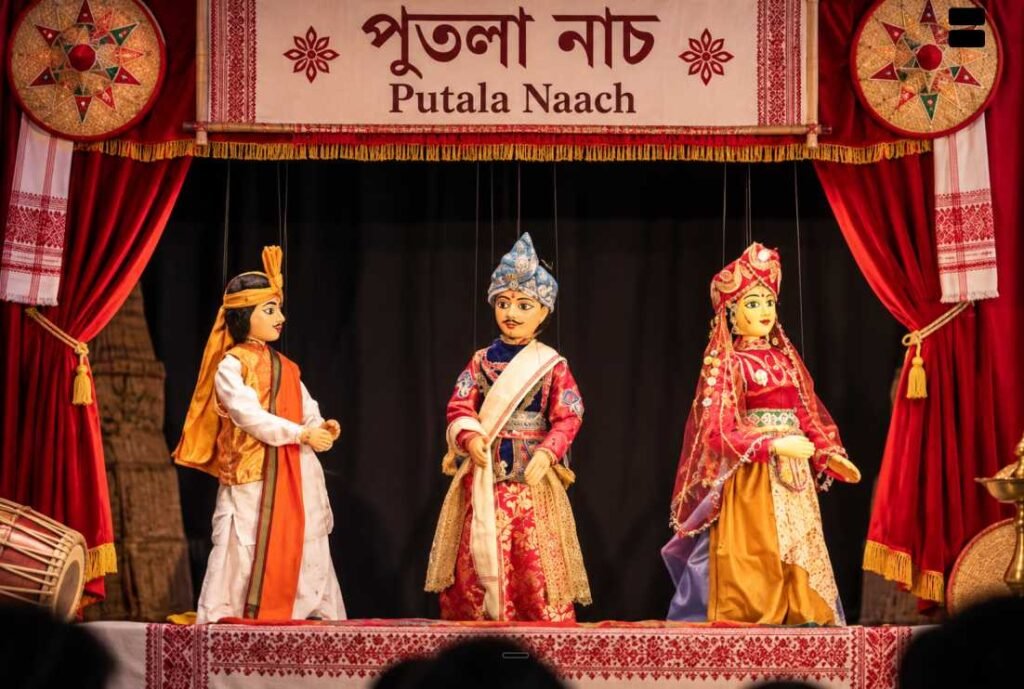
- Assam’s puppet theatre is commonly known as Putala Naach.
- Puppets may be made from wood, cloth and other lightweight materials.
- In string puppetry, performers control their movement through strings attached to different parts of the figure.
- The tradition is particularly associated with Lower Assam, including Goalpara.
- Stories commonly draw from the Ramayana, Mahabharata and Puranic narratives.
- Songs, dialogue, khol and taal support the dramatic presentation.
- Puppetry brings together craftsmanship, storytelling, music and acting, allowing religious and moral stories to reach community audiences.
Musical Instruments Used in Assam’s Performing Arts
| Instrument | Type and construction | Main use or association |
|---|---|---|
| Khol | Double-headed drum, traditionally with a clay body | Vaishnavite music, Sattriya and Bhaona |
| Dhol | Double-headed drum, generally with a wooden body | Bihu and other community celebrations |
| Taal | Metal cymbals of different sizes | Keeping rhythm in devotional and folk performances |
| Bhortal/Bortal | Large metal cymbals | Bhortal Nritya and vigorous rhythmic accompaniment |
| Pepa | Wind instrument traditionally incorporating buffalo horn | Particularly associated with Bihu |
| Gogona | Bamboo jaw harp, sounded by plucking a vibrating tongue | Bihu music |
| Toka | Bamboo clapper | Rhythmic accompaniment in Bihu |
| Baanhi | Bamboo flute | Folk and devotional music |
| Mohori/Kaliya | Reed wind instrument, broadly comparable to an oboe or shehnai | Particular folk and ceremonial settings |
| Bena | String instrument | Kushan Gan |
| Kham | Drum associated with Bodo and related performance settings | Community and ritual music |
| Siphung | Traditional bamboo flute associated particularly with Bodo music | Community and ritual accompaniment |
- Khol and dhol are different instruments, although both have two drumheads.
- Gogona is a jaw harp, rather than a reed wind instrument.
- Musical instruments connect Assam’s material craftsmanship with its living performance traditions.