
Introduction
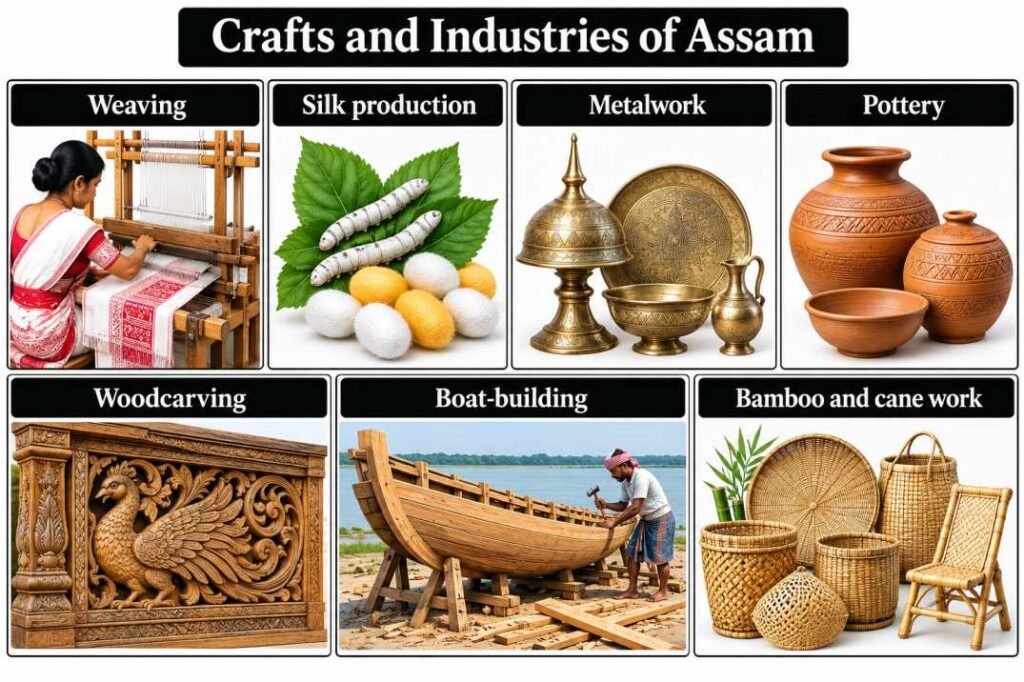
- Assam has a rich tradition of weaving, silk production, metalwork, pottery, woodcarving, boat-building, bamboo and cane work.
- These activities developed through the use of locally available resources, including:
- Forests and bamboo groves.
- Clay and stone.
- Rivers carrying mineral deposits.
- Plants used for silk rearing, dyes, medicines and perfumes.
- Most traditional industries operated as cottage industries.
- A cottage industry is a small production activity carried out at home or in a modest workshop.
- Family members often participated in different stages of production.
- Crafts served several needs:
- Everyday life: Clothing, utensils, furniture and agricultural tools.
- Religion: Images, offering vessels, manuscripts and musical instruments.
- Administration: Documents, coins and royal gifts.
- Transport and warfare: Boats, weapons and military equipment.
- Literary references suggest the antiquity of several crafts. However, references in the Ramayana or Mahabharata cannot, by themselves, establish an exact historical starting date.
Organisation of Crafts under the Ahoms
The Paik–Khel System
- Under Ahom rule, many activities were organised through the Paik system.
- A Paik was a person liable to provide labour or other service to the state.
- A Khel was an organised service group or administrative unit.
- Some Khels performed specialised work, such as gold-washing, metalworking or boat-building.
- A Khel was therefore more than a craft association: it could also be part of the state’s labour organisation.
- Paiks were arranged into small units called Gots, whose composition changed over time.
Royal Patronage
- Royal patronage means support provided by rulers or their officials.
- Ahom rulers supported crafts by:
- Employing skilled artisans.
- Maintaining specialised service groups.
- Commissioning royal clothing, weapons and religious objects.
- Bringing in outside specialists.
- Providing rewards or privileges for exceptional work.
- This support encouraged production, although some services were compulsory rather than voluntary.
Transmission of Skills
- Craft knowledge usually passed through families, apprenticeships and community practice.
- An apprentice learns a trade by working with an experienced craftsperson.
- Different communities contributed specialised knowledge, while techniques also spread through trade, migration and interaction.
Textile and Silk Industry
- Weaving and sericulture have long been important to Assam’s economy and cultural identity.
- Sericulture means rearing silkworms to obtain silk.
- Historical and literary accounts refer to fine textiles associated with Kamarupa and later kingdoms.
- Bhaskaravarman, the seventh-century ruler of Kamarupa, sent valuable presents to Harshavardhana.
- Accounts of these gifts include fine textiles.
- They should not all be described automatically as silk: the identification of some ancient textile terms varies.
- Ralph Fitch’s late-sixteenth-century account refers to silk and cotton production in the Koch kingdom.
- Textile production continued under the Kamarupa, Chutia, Koch and Ahom political traditions, with significant patronage during Ahom rule.
Major Silks and Their Host Plants
- A host plant provides leaves on which silkworms feed.
| Silk | Important Host Plants | Main Features |
|---|---|---|
| Pat/Paat or mulberry silk | Mulberry, locally called Nuni. | Smooth, lustrous silk, naturally white or off-white. |
| Muga silk | Mainly Som and Soalu. | Distinguished by its natural golden colour and strong association with Assam. |
| Eri/Endi silk | Mainly castor, with other plants such as Kesseru also used. | Soft, warm and comparatively wool-like. |
- Muga is closely associated with ceremonial dress and prestigious textiles.
- Pat is valued for its brightness and smooth finish.
- Eri is particularly suitable for shawls and warm clothing.
Historical Varieties
- Older accounts mention names such as Khatkura Muga, Deo Muga and Mejankari.
- Such names may refer to distinctions involving host plants, fibre quality or historical trade usage.
- They should not automatically be treated as formally recognised biological subspecies of the Muga silkworm.
Rearing, Reeling and Spinning
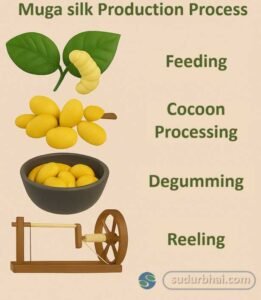
- Silk production involves several different activities:
| Stage | Simple Explanation |
|---|---|
| Rearing | Caring for silkworms and supplying suitable leaves. |
| Cocoon formation | The worm produces a protective silk covering around itself. |
| Reeling | Unwinding a continuous silk filament from a suitable cocoon. |
| Spinning | Drawing out and twisting fibres to make yarn. |
| Weaving | Interlacing yarn on a loom to produce cloth. |
- Muga and Pat silk are generally reeled, while Eri silk is generally spun. Their processing should therefore not be described as identical.
Household Participation
- Silk production involved several members of a household.
- Work could include:
- Maintaining host plants.
- Preparing rearing spaces.
- Feeding and protecting worms.
- Collecting cocoons.
- Processing fibre.
- Preparing yarn and weaving.
- Older accounts describe gender-based divisions of work, but these varied between communities and households.
- Outdoor rearing areas, sometimes called Chomonis, were particularly relevant to tree-based silk rearing.
Traditional Implements
| Implement | Main Use |
|---|---|
| Takuri | A spindle used in spinning. |
| Ugha | A device associated with winding or arranging yarn. |
| Chereki | A rotating frame or swift used in handling yarn. |
| Letai | A reel or winding device. |
| Taat Xaal | The handloom on which cloth is woven. |
| Maku/Mako | The shuttle that carries weft yarn through the warp. |
| Mohura | A bobbin or small yarn-holding component. |
| Durpati | A reed used to arrange threads and beat the weft into place. |
- Other loom components mentioned in traditional accounts include Taat Khuta, Chali-mari and Nachani/Nachonee.
- Warp means the lengthwise threads held on the loom.
- Weft means the threads passed across them.
Weaving as a Domestic Skill
- Weaving and spinning were commonly described together as Bowa-Kata.
- The household loom was an important feature of many Assamese homes.
- Cloth production met family needs and also created items for gifting, ceremonies and exchange.
- Older society strongly valued women’s weaving skills.
- The derogatory term Thupori/Thupuri was sometimes used for women who could not weave.
- This reflects historical social expectations and should not be adopted as a judgement today.
Royal Encouragement
- Momai Tamuli Barbarua, an important Ahom administrator, is associated with measures encouraging or requiring regular spinning.
- Historical descriptions also credit royal women, including Phuleswari Konwari and Sarbeswari Konwari, with encouraging weaving and training.
- Royal demand encouraged fine fabrics such as:
- Paat-Mejankari.
- Kingkhap, a rich brocade.
- Guna-poti, associated with metallic-thread decoration.
Textile Products and Cultural Uses
- Traditional products included:
- Mekhela-Chador.
- Riha.
- Chola, or upper garments.
- Churia, a lower garment.
- Gamosa.
- Bihuwan.
- Shawls and wraps.
- A Bihuwan is especially associated with gifting during Bohag Bihu, expressing affection and respect.
- Traditions concerning Mula Gabharu and Kabach-Kapor connect weaving with courage, protection and emotional commitment.
- Kabach-Kapor refers to cloth believed to offer protection.
- Its protective power belongs to the tradition surrounding it, rather than established military effectiveness.
Bamboo and Cane Crafts
- Bamboo and cane became essential craft materials because they were widely available, workable and suited to many uses.
- They supported:
- House construction.
- Fishing.
- Agriculture.
- Storage.
- Transport.
- Furniture-making.
- Bamboo is a grass, while craft cane generally comes from rattan palms. They are different materials, although often used together.
Bamboo Varieties
- Traditional accounts mention varieties such as:
- Jati.
- Bholuka.
- Mokal.
- Bijuli.
- Kutuha.
- Craftspeople selected materials according to qualities such as strength, flexibility, thickness and durability.
Major Products
| Object | Use |
|---|---|
| Jora/Jopona | Gates, fencing or related household structures. |
| Saku/Dolong | Bridges and small crossings. |
| Hua-chang | A raised platform or bed. |
| Dola | A basket or carrying container in the relevant craft context. |
| Petari | A storage basket or chest. |
| Jakoi/Jakhai | A scoop-like fishing implement. |
| Chepa | A fish trap. |
| Tum | A grain-storage basket. |
| Baan | A fishing barrier or fence. |
| Bichoni | A hand fan. |
| Mukhura | A muzzle for cattle. |
| Khatang | A device used to restrain an elephant’s leg. |
- Other objects included mats, cages, trays, furniture and equipment used in agriculture and oil processing.
- The term Telpera Beteri is associated in older descriptions with cane equipment connected to an oil press; it should not be assumed to mean that the entire press was made from cane.
Weaving Patterns and Knots
- Craftspeople used named patterns such as:
- Kachari-mor.
- Jali-mor.
- Knot types included:
- Mota-gathi.
- Hamukeea-gathi.
- These techniques helped control the strength, shape and flexibility of the finished object. Such terminology is also recorded in Assam’s school material on regional heritage.
Cultural and Environmental Significance
- Craft skills passed through observation and practice within families.
- Bamboo and cane work demonstrates local resource knowledge and household self-reliance.
- Their environmental benefits depend on responsible harvesting, treatment and use.
Gold-Washing and Goldsmithy
Gold-Washing
- Gold-washing means separating small particles of gold from river sand and sediment.
- The Sonowal Kacharis are historically associated with this occupation.
- It was known through expressions such as Hun Komowa, meaning the extraction or collection of gold.
Gold-Bearing Rivers
- Historical accounts identify gold-bearing deposits in the Brahmaputra and several tributaries.
- Important names include Subansiri, Dikrong, Bharali and Burhi Dihing.
- Some accounts also names Dihing, Dibang, Digaru and Burhigang.
- River names and spellings differ between historical sources.
Organisation and Revenue
- Gold-washers were organised through the Sonowal Khel and related service arrangements.
- Their work contributed revenue to the Ahom state.
Historical Extraction Practices
- Gold was extracted by washing river sediments to concentrate gold particles.
- Some mention mercury, locally called Parod, in historical recovery practices.
Goldsmiths and Their Products
- Goldsmiths were associated with the Sonari Khel.
- Their products included:
- Keru.
- Dugdugi.
- Gamkharu.
- Lokaparo.
- Junbiri.
- Madoli.
- Religious images and decorative objects.
- Techniques included engraving, embossing, stone-setting, gilding and enamelling.
- Ahom rulers also brought in outside specialists to improve particular crafts. Historical accounts refer to goldsmiths arriving from Banaras.
Silver Craft
Sources and Organisation
- Silver was obtained through trade and other supply networks.
- Older descriptions also mention Roop Konowa, or silver collection, associated with rivers such as Dhansiri, Doyang and Dichoi.
- They refer to occupational groups called Roopowal or Thengal Khel, sometimes organised under a Dolo.
- Trade accounts mention supplies from Borkhamti and more distant eastern regions, with neighbouring communities participating in exchange.
Products
- Silversmiths made:
- Ornaments.
- Horai/Xorai.
- Bhogjora.
- Bracelets and other ceremonial objects.
- Metallic thread for textile decoration.
- Narayani coins are especially associated with the Koch monetary tradition.
Iron-Smelting and Blacksmithy
- Smelting means extracting metal from its ore.
- Blacksmithy means heating and shaping iron to make useful objects.
- Assam’s blacksmiths supplied both agriculture and the military.
Organisation and Materials
- Traditional blacksmiths were commonly known as Kamar.
- Historical accounts refer to Tiruwal or Loo-Soloowa Khel in connection with iron work.
- Iron-bearing material, sometimes called Loa-mati, was processed in furnaces.
- Charcoal provided heat, while bellows supplied air.
- Older descriptions mention Jaali-gaati furnaces and charcoal from woods such as Nahar and Koroi.
Tools
| Tool | Function |
|---|---|
| Bhatee | Bellows used to supply air to the fire. |
| Haturi | Hammer used to shape metal. |
| Horah | Tongs used to hold heated metal. |
| Reti | File used for finishing and smoothing. |
- Additional tool names, including Bena and Reti, occur in local accounts; terminology can vary.
Products
- Agricultural and household products included:
- Ploughshares.
- Sickles.
- Hoes.
- Axes.
- Dao knives.
- Military products included:
- Hengdang: Sword.
- Tarowal: Sword.
- Jathi: Spear or lance.
- Banduk/Hiloi: Firearm.
- Cannons and related equipment.
- Decorative finishing included:
- Moloma kora: Gilding or surface application of a precious-metal finish.
- Mina kora: Enamel decoration.
Koranga
- Koranga/Karanga is particularly associated with hereditary blacksmiths and historical weapon manufacture.
- It should not be presented principally as a bell-metal centre alongside Sarthebari.
Bell-Metal, Brass and Copper Industries
Bell-Metal and Brass
| Metal or Alloy | Main Composition | Typical Uses |
|---|---|---|
| Bell metal | Mainly copper and tin. | Utensils, cymbals and ceremonial vessels. |
| Brass | Mainly copper and zinc. | Lamps, vessels, decorative and ritual objects. |
| Copper | A metal used independently or in alloys. | Plates, roofing, vessels and religious objects. |
- Silver is not a necessary defining ingredient of bell metal.
Bell-Metal Industry
- Sarthebari is Assam’s best-known centre of traditional bell-metal craft.
- Craftspeople produce objects such as:
- Kahi/Kanhi: Plates.
- Bati: Bowls.
- Bota and Xorai: Offering vessels.
- Kolah: Water vessels.
- Bhogjora: Ceremonial vessels.
- Cymbals and other metal instruments.
Brass Industry
- The Moria community and Moria Khel are historically associated with brass work.
- Products included:
- Lamps.
- Ritual vessels.
- Water containers.
- Tou, or large cooking vessels.
- Heta, or ladles.
Copper Industry
- Copper plates are important sources for studying land grants and royal administration in ancient Kamarupa.
- The Tamreswari Temple at Sadiya is historically associated with a copper roof.
- Copper vessels, including Kolah, Horai and Bhogjora, could receive decorative finishes.
- Copper also entered the region through trade with neighbouring areas.
Pottery, Terracotta and Brick-Making
Pottery Traditions
- Pottery is the craft of shaping clay into useful objects and hardening them through firing.
- Assam’s pottery traditions are associated with communities such as the Kumar and Hira.
- Khanikar is a broader term for a skilled maker or artisan; it should not always be treated as the name of one pottery community.
Methods and Tools
- Pottery could be formed by hand or with a wheel.
- Hira pottery is particularly associated with hand-building, so the wheel should not be described as universal.
| Tool or Facility | Purpose |
|---|---|
| Chak | Potter’s wheel. |
| Athali | A mould or shaping aid. |
| Peg-hali/Pegali | A term appearing in descriptions of firing arrangements. |
| Paga-sali | A firing place or furnace in relevant accounts. |
Products
- Common products included:
- Ghat.
- Kolah.
- Charu.
- Mola.
- Tekeli.
- Lamps, toys and religious images.
- These objects served cooking, water storage, food processing and ritual purposes.
Terracotta
- Terracotta means objects made from clay and hardened by firing.
- It includes:
- Human and animal figures.
- Toys.
- Religious images.
- Decorative panels.
- Architectural ornaments.
Brick-Making and Mortar
- Brick production was important for temples, palaces and other structures.
- Historical references mention specialist brick-makers, described through terms such as Itakhujia Paiks.
- Karal/Koral refers to a traditional binding material or mortar used in construction.
Asharikandi: Terracotta Craft Village
- Asharikandi is in Dhubri district, within the Debitola/Devitola Development Block.
- It is an important centre where both pottery and terracotta are practised.
- District accounts describe a cluster of roughly eighty artisan families, but this is a reported figure rather than a permanent count.
Hiramati and Craft Style
- A distinctive local clay known as Hiramati is an important raw material.
- The craft is recognised for its forms, surface treatment and skilled handwork.
- Products include dolls, elephants, horses, religious figures and household objects.
Hatima Doll and Sarala Bala Devi
- The Hatima doll depicts a mother figure holding a child.
- Sarala Bala Devi received a National Award in 1982 for her terracotta work associated with this celebrated form.
- Her son, Dhirendra Nath Paul, became a recognised master craftsperson.
- Mahadev Paul is another important artisan associated with the village. Dhubri District: Asharikandi
Livelihood and Support
- Craft production has become a major source of income for many households.
- **NECARDO—North East Craft and Rural Development Organisation—**has worked for craft promotion and artisan welfare.
- Some accounts also describe participation by families from the local Barman fishing community.
- The village illustrates how inherited skills can support employment, cultural identity and tourism.
Woodwork and Stone Craft
Timber and Products
- Assam’s forests supplied timber such as Sal, Jamuk, Koroi and Champa.
- Carpenters and woodcarvers, described through terms such as Barhoi and Khanikar, produced:
- Houses and palaces.
- Furniture.
- Agricultural implements.
- Looms and weaving accessories.
- Boats.
- Religious images.
- Doors, windows and decorative panels.
- The Holong Ghar at Gargaon is associated with the history of royal wooden architecture.
Decoration and Supervision
- Carving frequently used flowers, birds, animals and sacred figures.
- Historical accounts mention officials such as Habiyal Barua and Khanikar Barua in connection with specialised work and supervision.
- Stone craft contributed to temple architecture, sculpture and inscriptions.
Sanchipat Manuscripts and Traditional Ink
Sanchipat
- Sanchipat is a writing material prepared from the bark of the Sanchi or agar tree.
- It is not palm leaf.
- Bark was processed into suitable sheets through activities such as drying, cleaning, scraping, smoothing and surface treatment.
- The prepared sheets were used for religious texts, chronicles and other manuscripts.
Traditional Ink
- Traditional Assamese ink is commonly called Mahi, with other spellings appearing in local accounts.
- Ingredients mentioned in descriptions include plant materials such as:
- Silikha.
- Amlokhi.
- Bhomora.
- Other fruits, bark and locally available substances.
- Recipes varied between practitioners.
- Pens included forms made from plant materials and, in some accounts, bird quills.
Hengul and Haital
- Hengul and Haital are important traditional pigments:
- Hengul: A red mineral pigment.
- Haital: A yellow mineral pigment.
- They are particularly associated with painting and manuscript decoration; their use should not be reduced to one universal method of preparing every Sanchipat sheet.
- Surviving manuscripts demonstrate the skill involved in producing both writing materials and decorated texts.
Boat-Building and River Transport
Importance
- Assam’s river network made boats essential for:
- Transporting people and goods.
- Communication.
- Fishing.
- Administration.
- Warfare.
Organisation
- Boat-building was associated with the Naosaikia Khel.
- Officials mentioned in historical accounts include Naosaleeya Phukan and Naosaleeya Barua.
Boat Types
- Names recorded in descriptions include:
- Tulunga Nao.
- Bojra Nao.
- Juree Nao.
- Hiloikoi Nao.
- Boats varied according to their purpose, size, construction and carrying capacity.
Construction and Military Role
- Craftspeople selected suitable timber and used traditional materials to join or seal parts.
- Some accounts mention lac, resin and beeswax in connection with sealing and adhesive preparations.
- Ahom boat-building supported the naval strength associated with Lachit Borphukan and the Battle of Saraighat, 1671.
- Gargaon was an earlier Ahom capital, while Rangpur became the capital later.
Dyeing, Painting and Mask-Making
Natural Dyes
- Traditional dyeing used locally available plants.
- Names appearing in historical descriptions include:
- Kusum.
- Mojathi.
- Aachu.
- Kendu.
- Haldhi, or turmeric.
- Colour depended on the plant, the part used, processing and the material being coloured.
Painters and Artisans
- Chitrakar and Khanikar artisans worked on:
- Manuscript illustrations.
- Religious images.
- Decorative objects.
- Architectural surfaces.
- Assamese painting developed through several settings, including Satras and the Ahom court. Court painting also absorbed influences from outside Assam. Sahapedia: Manuscript painting of Assam
Satra-Based Crafts
- The Neo-Vaishnavite tradition associated with Sankardeva and Madhavdeva encouraged religious performance and related arts.
- Satras supported skills needed for Bhaona, including:
- Mask-making.
- Costume preparation.
- Painting.
- Woodwork.
- Musical-instrument production.
- Mukha means a mask.
- Cho is used in descriptions of larger costume or body-covering forms associated with performance.
Illustrated Manuscripts
- Chitra-Puthi means an illustrated manuscript.
- Examples named in accounts include:
- Tulapatia Chitra Bhagavata, associated with the Nagaon region.
- Sachitra Kirtan, associated with Kathbapu Satra.
- Ekadash Skandha Bhagavata, associated with Dakhinpat Satra, Majuli.
- Chitra Kirtan, associated with Madhupur Satra.
- Madhupur Satra is in present-day Cooch Behar, West Bengal, while remaining closely connected with Assamese Vaishnavite heritage.
- Themes include the Bhagavata Purana, Ramayana and Krishna’s life.
- Paintings often use clear outlines, expressive figures and recognisable narrative scenes.
Salt, Lac, Lime and Other Specialised Industries
Salt
- Salt was obtained from sources including saline springs, with Mohong appearing in historical accounts.
- Officials such as Lonpuriya/Loonpureeya Barua are associated with its management.
- Salt was valuable because supply affected everyday consumption and trade.
- The saying “Loon dane hoon dane homan” (donation of salt is equal to the donation of gold) expresses the high value attached to salt by comparing its gift with gold.
Lac
- Lac is a resinous substance produced by lac insects.
- It was used in:
- Seals.
- Colouring.
- Decorative work.
- Adhesives and related preparations.
- Historical accounts connect lac work with groups described as La-shungi Khel.(In the Ahom kingdom of medieval Assam, La-shungi was a specialized occupational group or Khel (guild) dedicated entirely to the cultivation, collection, and production of lac)
Lime
- Lime was important for mortar and construction.
- Materials included limestone and shells.
Gunpowder Manufacture
- The Ahom state maintained workers associated with gunpowder production, including groups described as Kharghoria and Jokhorea.
- This industry supported firearms and artillery.
Roh and Other Products
- Older accounts mention Roh, reportedly a plant-gum preparation used in clarifying water, under an official called Rosendra Barua.
- Other forest-based products included:
- Agoru, or aromatic agarwood.
- Gandha Koloi, named in accounts of fragrant materials.
- Gums and resins.
- Medicinal or toxic plant products.
- Specialist groups such as Bihia Khel are mentioned in connection with some of these activities.
Ivory Craft
Production and Patronage
- Ivory carving formed part of Assam’s historical luxury crafts.
- Artisans worked under royal patronage and are described in some accounts as Boktar Khanikar.
- Historical descriptions also refer to Muslim craftspeople contributing to specialised court production.
Products
- Products included:
- Combs.
- Ornaments.
- Knife handles.
- Boxes.
- Decorative objects.
- Religious or royal furnishings.
- This is a discussion of historical craft practice, rather than a recommendation to revive production using elephant ivory.
Musical Instruments as Craft Heritage
- Musical instruments connect material craftsmanship with performance.
- Their production uses wood, clay, bamboo, metal, horn and animal hide.
| Instrument | Material or Type | Main Association |
|---|---|---|
| Khol | A double-headed drum, traditionally with a clay body. | Vaishnavite music, Gayan-Bayan and Sattriya traditions. |
| Mridanga | A drum category. | Religious and musical performance. |
| Dhol | A drum commonly made with a wooden body and hide membranes. | Bihu and other performances. |
| Doba | A large ceremonial drum. | Namghars and religious institutions. |
| Pepa | A horn-based wind instrument. | Bihu. |
| Gogona | A bamboo jaw harp. | Bihu and folk performance. |
| Xutuli/Sutuli | A small clay wind instrument. | Folk music and Bihu. |
| Taal | Metal cymbals. | Devotional and other musical traditions. |
| Khunjuri | A small frame-drum-type instrument. | Folk and devotional performance. |
- Doba should not simply be described as a Bihu drum, and Gogona and Xutuli are not the same type of instrument.
Hemoprova Chutia: Weaving Literature into Cloth
Life and Background
- Hemoprova Chutia is a distinguished handloom artist from the Moran area of Dibrugarh district.
- She was born on 22 September 1955 in Photikachowa Abhoypuria village.
- Her work combines weaving, literature and religious devotion.
Barnabastra
- Barnabastra, also written as Barna Bastra, refers here to cloth carrying woven letters and complete texts.
- Her innovation involves constructing readable writing through the arrangement of threads on a loom.
- It requires careful planning of:
- Letter shapes.
- Spacing.
- Thread colours.
- The sequence of the text.
Beginning of the Work
- Her Gunamala project begun on 22 July 2013.
- She has described its inspiration in personal devotional terms and recalled encouragement from her sons.
- For her, weaving became a form of Sadhana, meaning sustained spiritual practice.
Four Major Works Confirmed in the Padma Citation
| Text | Language | Materials | Dimensions |
|---|---|---|---|
| Gunamala, by Sankardeva | Assamese | Muga silk with black wool. | 80 ft × 18 inches |
| Naam Ghosa, by Madhavdeva | Assamese | Muga silk with black wool. | 200 ft × 2 ft |
| Bhagavad Gita | Sanskrit | Muga silk with green wool. | 150 ft × 2 ft |
| Bhagavad Gita | English | Muga silk with green wool. | 280 ft × 2 ft |
- These measurements and materials are recorded in the Government of India’s award citation.
English Gunamala
- A later reported work presents Gunamala in English on a textile approximately 230 feet long.
- It uses Eri silk and bamboo elements in the weft direction.
- Reports describe six sections, with four incorporating bamboo and two using Eri yarn.
- This work illustrates experimentation within traditional handloom practice.
Awards and Recognition
| Award | Details |
|---|---|
| Padma Shri, 2023 | Awarded in the field of Art; presented by President Droupadi Murmu on 5 April 2023. |
| Assam Gaurav | Associated with the 2021 award cycle and presented in 2022; the official Padma citation records 2022. |
| Bakul Bon Bota, 2017 | Recognition from the Bakul Ban Trust. |
| Aai Kanaklata Award | Recognition associated with the Srimanta Sankardeva Sangha; the year requires confirmation. |
| Handloom and Textile Award | Reported recognition for weaving; 2016 appears in secondary accounts and should be checked against the original award record. |
- Her work demonstrates how inherited craft skills can develop into new artistic forms while preserving language and literature.
Economic and Cultural Importance of Traditional Crafts
- Livelihood: Crafts provide employment and supplementary household income.
- Local production: They supply clothing, utensils, agricultural equipment and other necessities.
- Technical knowledge: They preserve understanding of fibres, metals, clay, timber and other materials.
- Religious life: They support manuscripts, images, musical instruments, masks and ceremonial objects.
- Historical evidence: Surviving textiles, coins, tools and buildings reveal earlier technologies and social organisation.
- Cultural identity: Crafts such as Muga weaving, Sarthebari bell-metal work and Asharikandi terracotta remain closely associated with Assam.
- Innovation: Contemporary artisans show that traditional skills can be adapted to new designs, audiences and purposes.
- Preservation: Sustaining these traditions requires fair returns for artisans, training opportunities, reliable documentation and continued use of their skills.