
Sultanate Period (1206–1526 AD)
The Sultanate Period (1206–1526 AD) represents an important phase in the history of medieval India. It began with the establishment of the Delhi Sultanate by Qutbuddin Aibak in 1206 AD and continued until the defeat of Ibrahim Lodhi by Babur in the First Battle of Panipat in 1526 AD. During this period, five major dynasties—the Slave, Khalji, Tughlaq, Sayyid, and Lodhi dynasties—ruled large parts of northern India. The Delhi Sultanate introduced significant changes in administration, military organisation, architecture, literature, and cultural life, leaving a lasting impact on the Indian subcontinent.
Table of Contents
ToggleThe Delhi Sultanate – Background
First Muslim Invasion – Muhammad Bin Qasim (712 AD)
- The first Muslim invasion of India was led by Muhammad Bin Qasim in 712 AD.
- He conquered Sindh, which subsequently became a province of the Umayyad Caliphate (Khilafat).
- This marked the beginning of Islamic political influence in the Indian subcontinent.
First Turk Invasion – Mahmud Ghaznavi (998–1030 AD)
Repeated Expeditions
- Sultan Mahmud of Ghazni launched approximately 17 expeditions into India.
- His primary objective was to accumulate immense wealth by plundering prosperous Indian kingdoms and temples.
Somnath Raid (1025 AD)
- In 1025 AD, Mahmud Ghaznavi attacked the famous Somnath Temple, situated on the Kathiawar coast (present-day Gujarat).
- The temple was extensively looted and later destroyed in 1026 AD, making it one of the most significant events of his invasions.
Second Turk Invasion – Muhammad Ghori (1175–1206 AD)
Foundation of Muslim Rule
- Muhammad Ghori invaded India and laid the foundation of permanent Muslim rule in the subcontinent.
- Owing to his conquests, he is often regarded as the founder of Muslim political authority in India.
Reasons for the Success of the Turks in India
Several factors contributed to the success of the Turkish invasions:
- Lack of unity among the Rajputs, who remained divided into rival kingdoms.
- Absence of a strong central government, resulting in political fragmentation.
- Small and scattered Rajput states, which weakened collective defence.
- Superior military organisation and strategy of the Turks, who effectively exploited the lack of cooperation among the Rajput rulers.
The Delhi Sultanate (1206–1526 AD)
Formation
- The conquests of Muhammad Ghori led to the emergence of a new political entity in India known as the Delhi Sultanate.
- It became the nucleus of Muslim rule in North India and lasted from 1206 AD to 1526 AD.
Five Dynasties of the Delhi Sultanate
The history of the Delhi Sultanate is divided into five successive dynasties:
- Slave (Mamluk) Dynasty (1206–1290 AD)
- Khalji Dynasty (1290–1320 AD)
- Tughlaq Dynasty (1320–1414 AD)
- Sayyid Dynasty (1414–1451 AD)
- Lodhi Dynasty (1451–1526 AD)
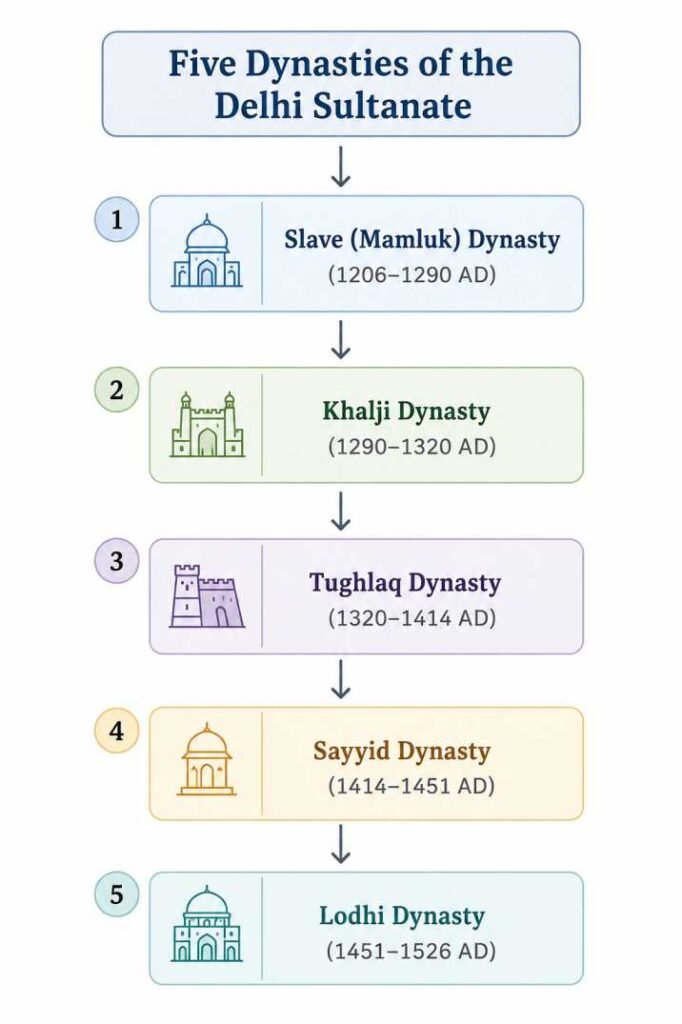
These five dynasties collectively ruled large parts of India until the establishment of the Mughal Empire after the First Battle of Panipat (1526 AD).
Each Dynasties of Delhi Sultanate
Causes of the Decline of the Delhi Sultanate
The principal reasons for the downfall of the Delhi Sultanate were:
- Despotic and military-oriented system of government, which failed to secure the confidence and support of the people.
- Degeneration of the later Delhi Sultans, particularly:
- The impractical experiments of Muhammad-bin-Tughlaq.
- The administrative weakness of Firoz Shah Tughlaq.
- Frequent wars of succession, since there was no fixed law governing succession to the throne.
- Greed, factionalism, and incompetence among the nobles, which weakened central authority.
- Defective military organisation, reducing the effectiveness of the Sultanate’s armed forces.
- Vast territorial extent coupled with poor means of communication, making efficient administration difficult.
- Financial instability, which weakened the economic foundations of the state.
- Excessive number of slaves maintained during the reign of Firoz Shah Tughlaq (around 1,80,000 slaves), placing a heavy burden on the royal treasury.
- Timur’s invasion (1398 AD), which devastated Delhi, weakened the Sultanate, and accelerated its political decline.
Mongolian Invasions During the Delhi Sultanate
| Sultan / Regime | Year | Major Event |
|---|---|---|
| Shamsuddin Iltutmish | 1221 AD | Chengiz Khan advanced up to the banks of the Indus River, but did not invade the Delhi Sultanate. |
| Masud Shah | 1241 AD | Tair Bahadur invaded Punjab. Around 1245 AD, Balban fought the Mongols and successfully recovered Multan. |
| Ghiyasuddin Balban | 1279 AD | Prince Muhammad of Multan, Bughra Khan of Samana, and Malik Mubarak of Delhi jointly defeated the Mongols. |
| Ghiyasuddin Balban | 1286 AD | Tamar invaded India. Prince Muhammad was killed in battle and was later honoured with the title Khan-i-Shahid. |
| Jalaluddin Khalji | 1292 AD | Abdullah invaded North India. About 4,000 Mongols embraced Islam and became known as the New Musalmans. |
| Alauddin Khalji | 1296–1299 AD | Zafar Khan defeated the Mongols at Jalandhar and Saldi, capturing their leader, though he himself later died in battle. |
| Alauddin Khalji | 1304 AD | The Mongol commanders Ali Beg and Tash were decisively defeated. |
| Muhammad-bin-Tughlaq | 1329 AD | Tarmashirin Khan reached the outskirts of Delhi but was successfully repulsed by Muhammad-bin-Tughlaq. |
Administration under the Delhi Sultanate
Position of the Sultan
- The Turkish Sultans of India declared themselves the Lieutenants of the Abbasid Caliph of Baghdad and mentioned the Caliph’s name in the Khutba.
- However, this did not imply that the Caliph was the legal sovereign; his authority remained purely moral and symbolic.
Powers of the Sultan
- The Sultan possessed supreme political, legal, and military authority.
- He was responsible for:
- Civil administration
- Judicial functions
- Serving as the Commander-in-Chief of the armed forces
Succession
- No fixed law of succession existed among the Muslim rulers.
- Consequently, military strength and political influence often determined succession to the throne.
Central Administration
| Department | Head / Founder |
| Diwan-i-Wizarat (Finance Department) | Wazir |
| Diwan-i-Ariz (Military Department) | Ariz-i-Mumalik |
| Diwan-i-Insha (Department of Correspondence) | Dabir-i-Mumalik |
| Diwan-i-Risalat (Department of Appeals) | Dabir-i-Mulk |
| Diwan-i-Mustakharaj (Department of Arrears) | Established by Alauddin Khalji |
| Diwan-i-Riyasat (Department of Commerce) | Rais-i-Mumalik (Established by Alauddin Khalji) |
| Diwan-i-Kohi (Department of Agriculture) | Established by Muhammad-bin-Tughlaq |
| Diwan-i-Bandgan (Department of Slaves) | Established by Firoz Shah Tughlaq |
| Diwan-i-Khairat (Department of Charity) | Established by Firoz Shah Tughlaq |
| Diwan-i-Istihqaq (Department of Pensions) | Established by Firoz Shah Tughlaq |
Administrative Units
| Administrative Unit | Head |
| Iqta (Province) | Muqti / Wali |
| Shiq (District) | Siqdar |
| Pargana (Taluka) | Chaudhary and Amil |
| Gram (Village) | Muqaddam and Khut |
Art and Architecture under the Delhi Sultanate
New Architectural Features Introduced by the Turks
The Turkish rulers introduced several important innovations into Indian architecture:
- The Dome
- Lofty Towers (Minarets)
- The True Arch (unsupported by beams)
- The Vault
They also popularised the extensive use of concrete and lime mortar, which had previously been used only on a limited scale in India.
Adhai-din-ka-Jhonpra
- The Adhai-din-ka-Jhonpra at Ajmer contains:
- A magnificent prayer hall
- An exquisitely carved white marble Mihrab
- A beautifully decorated arched screen
First True Arch
- The earliest example of a true (voussoired) arch in India is generally considered to be the Tomb of Ghiyasuddin Balban at Mehrauli (Delhi).
Khalji Architecture
- During the Khalji period, the use of the true arch and dome became firmly established.
- An outstanding example is the Tomb of Hazrat Nizamuddin Auliya in Delhi.
Tughlaq Architecture
Distinctive Characteristics
Tughlaq buildings are noted for:
- Simplicity and austerity
- Sloping walls
- Dark and massive appearance
These features reflected both limited financial resources and puritanical ideals.
Important Monuments
Major examples include:
- Tughlaqabad Fort
- Tomb of Ghiyasuddin Tughlaq, which marked a new phase in Indo-Islamic architecture and influenced later tomb designs.
- Fort of Adilabad
Sayyid Architecture
- Since the Sayyid Dynasty ruled for a relatively short period, few monumental buildings were constructed during their reign.
Lodhi Architecture
Chief Feature
- The most notable characteristic of Lodhi architecture was the construction of double domes.
Important Monument
- One of the finest surviving examples is the Moth ki Masjid, constructed by the Prime Minister of Sikandar Lodhi.
Literature of the Delhi Sultanate
| Book | Author | Historical Importance / Subject Matter |
|---|---|---|
| Tahqiq-i-Hind (Kitab-fi-Tahqiq) | Alberuni | A comprehensive study of Indian society, culture, religion, philosophy, and sciences written by the celebrated Arab scholar. |
| Tabaqat-i-Nasiri | Minhaj-us-Siraj | Provides a detailed account of the Slave (Mamluk) Dynasty, particularly the reign of Shamsuddin Iltutmish. |
| Laila-Majnun | Amir Khusrau | A famous literary work composed by Amir Khusrau, who served as the court poet of Alauddin Khalji. |
| Khazain-ul-Futuh | Amir Khusrau | Describes the military conquests and achievements of Alauddin Khalji. |
| Tughlaq-Nama | Amir Khusrau | Chronicles the reign and rise of Ghiyasuddin Tughlaq. |
| Nuh Sipihr | Amir Khusrau | A poetic composition highlighting the glory of Alauddin Khalji’s reign and contemporary India. |
| Fatwa-i-Jahandari | Ziauddin Barani | A political treatise explaining the principles of governance and statecraft under the Tughlaqs. |
| Tarikh-i-Firoz Shahi | Ziauddin Barani | An important historical work describing the reign of Firoz Shah Tughlaq and earlier Delhi Sultans. |
| Fatuhat-i-Firoz Shahi | Firoz Shah Tughlaq | An autobiographical account recording the policies, reforms, and achievements of Firoz Shah’s own reign. |
| Kitab-fi-Tahqiq (Tahqiq-i-Hind) | Alberuni | Deals extensively with Indian sciences, traditions, customs, and intellectual life. |
| Qanun-e-Masudi | Alberuni | A significant scholarly work devoted to Astronomy. |
| Jawahar-fi-Jawahir | Alberuni | A treatise primarily concerned with Mineralogy and precious stones. |
| Qamas | Firozabadi | A well-known dictionary of Arabic words and vocabulary. |
Other Important Literary Works of the Delhi Sultanate
| Book | Author | Historical Importance / Subject Matter |
| Taj-ul-Maasir | Hasan Nizami | Describes the history of Muhammad Ghori and the early Slave Dynasty, especially Qutbuddin Aibak. |
| Chach Nama | Abu Bakr | The principal historical source for the Arab conquest of Sindh and its early history. |
| Lubab-ul-Albab | Muhammad Aufi | Considered one of the earliest and most important works of Persian literary anthology. |
| Khamsah | Amir Khusrau | A celebrated collection of Persian literary poems and romances. |
| Shah Nama | Firdausi | An epic work that includes references to the period of Mahmud Ghaznavi. |
| Kitab-ul-Rihla | Ibn Battuta | A famous travelogue describing his journeys and experiences, especially during the reign of Muhammad-bin-Tughlaq. |
| Miftah-ul-Futuh | Amir Khusrau | Narrates the campaigns and victories of Jalaluddin Khalji. |
| Matla-ul-Anwar | Amir Khusrau | A renowned Persian literary masterpiece reflecting his poetic brilliance. |
| Aina-i-Sikandari | Amir Khusrau | One of the distinguished literary compositions included in Khusrau’s Khamsah. |
| Hasht Bihisht | Amir Khusrau | Another celebrated Persian literary masterpiece by Amir Khusrau. |
| Shirin-Khusrau | Amir Khusrau | A famous romantic and literary work composed by the great poet. |
| Tarikh-i-Firoz Shahi | Shams-i-Siraj Afif | Provides a detailed history of the Tughlaq rulers, particularly Firoz Shah Tughlaq. |
| Futuh-us-Salatin | Isami | An important historical chronicle dealing mainly with the Bahmani Kingdom and the political developments of the Deccan. |
The Delhi Sultanate was one of the most influential political institutions of medieval India. From 1206 to 1526 AD, its rulers established strong administrative systems, promoted trade and agriculture, and introduced new architectural and cultural traditions that enriched Indian society. Despite facing challenges such as Mongol invasions, succession disputes, and administrative weaknesses, the Sultanate played a crucial role in shaping the political and cultural landscape of the subcontinent. Its legacy can be seen in the development of Indo-Islamic architecture, Persian literature, and centralized governance. The decline of the Delhi Sultanate eventually paved the way for the establishment of the Mughal Empire, which inherited and further developed many of its institutions and traditions.
