
The fragmentation of the Koch Kingdom after the death of Nara Narayan in 1587 marked a turning point in the history of Assam and North Bengal. What was once a powerful and united kingdom gradually broke into several sub-kingdoms, each ruled by members of the Koch 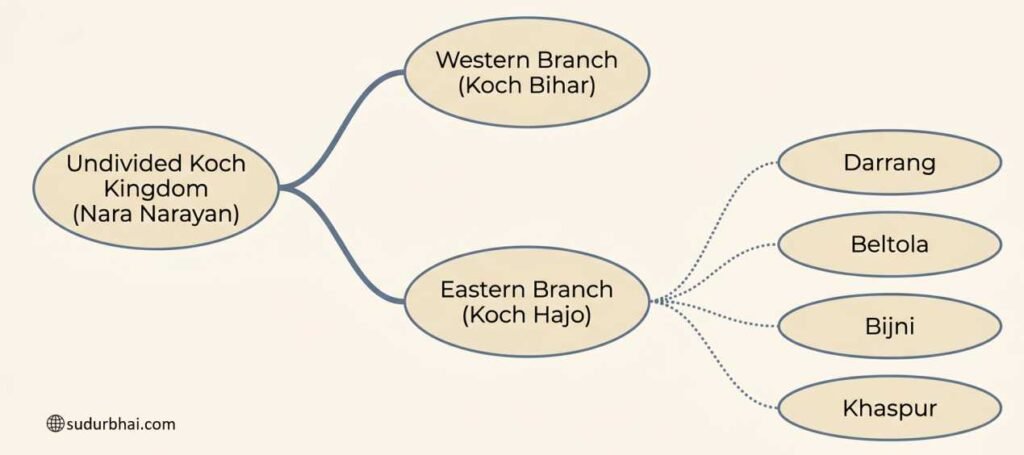 royal family.
These smaller kingdoms did not completely lose their identity. Instead, they continued to play important roles in regional politics, often functioning as semi-independent states under the influence of larger powers like the Mughal Empire, the Ahom Kingdom, and later the British.
Rulers of the Undivided Koch Kingdom
Before the division, the Koch kingdom existed as a strong, unified, and centrally governed political entity. Power was concentrated under one ruler, which helped maintain stability, efficient administration, and territorial expansion.
Important Rulers
Viswa Singha (c. 1515–1540)
- Founder of the Koch dynasty and the first to establish Koch political power.
- Successfully united the Baro-Bhuyan chiefs (a group of semi-independent landlords), bringing them under one authority.
- Laid the foundation of a centralized kingdom, where decisions were controlled by the king rather than local chiefs.
Nara Narayan (1540–1587)
- Considered the most powerful ruler of the Koch kingdom.
- Greatly expanded the territory from Western Assam to North Bengal, making the kingdom one of the strongest in the region.
- Strengthened administration by organizing governance and improving revenue systems.
- Promoted religious institutions, especially supporting Hinduism and Brahminical traditions.
Chilarai (Shukladhwaj)
- Younger brother of Nara Narayan and the chief military commander.
- Played a key role in expanding the kingdom through rapid and strategic military campaigns.
- Known for his speed in warfare, earning a reputation as a brilliant military leader.
Key Features of the United Kingdom
- Strong military expansion, allowing the kingdom to grow and defend its borders effectively.
- Promotion of Hindu culture and Brahminical traditions, which shaped the social and religious life of the people.
- Development of an organized administration, ensuring better governance, tax collection, and law enforcement.
The united Koch kingdom can be compared to a strong central government, where all regions followed one authority. This unity led to political stability, economic growth, and overall development of the kingdom.
Rulers of Koch Hajo
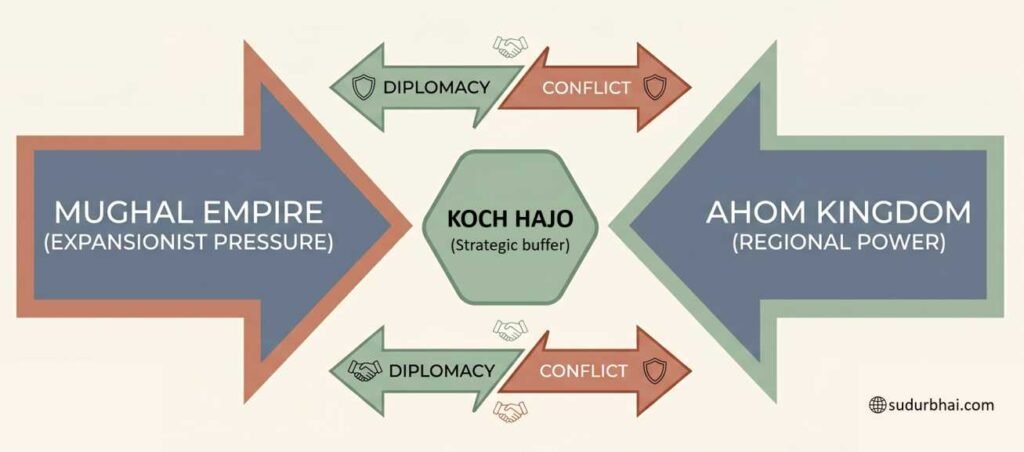
After the division of the Koch kingdom in 1581, Koch Hajo emerged as the eastern branch of the Koch dynasty. It became an important political center in Eastern Assam, especially because it stood between two powerful forces—the Ahom Kingdom and the Mughal Empire.
- Founded by Raghudev Narayan, the son of Chilarai.
- He declared independence from Koch Bihar, which marked the beginning of a separate political identity for Koch Hajo.
- This division weakened the original Koch kingdom but created new regional powers.
Important Rulers
Raghudev Narayan
- The first ruler who tried to maintain independence of Koch Hajo.
- Formed alliances with the Ahoms, a powerful kingdom in Assam, to strengthen his position.
- Strongly opposed the Mughals, who were expanding into the region.
Parikshit Narayan
- Continued the policy of resistance against Mughal expansion.
- Faced repeated conflicts with Mughal forces.
- Eventually defeated and forced into exile, which led to the decline of Koch Hajo’s power.
Importance of Koch Hajo
- Acted as a buffer state, meaning it stood between two major powers:
- The Ahom Kingdom
- The Mughal Empire
- Played a major role in anti-Mughal resistance, slowing down Mughal expansion into Assam.
- Helped protect the Ahom kingdom by absorbing initial conflicts.
- Acted as a buffer state, meaning it stood between two major powers:
A buffer state can be understood as a protective zone between two strong empires. It reduces direct conflict and often becomes a strategic battleground, as seen in the case of Koch Hajo.
Rulers of Darrang
After the fall of Koch Hajo, a new Koch-controlled region developed in Darrang. This area became an important center where the Koch royal lineage continued, even though the power of the original kingdom had declined.
- Ruled by a branch of the Koch royal family, showing continuity of the dynasty.
- Functioned as a semi-independent principality, meaning it had its own rulers but was not fully sovereign.
- Often remained under the influence of the Ahom Kingdom, which guided its political decisions.
Important Contributions
- Maintained diplomatic relations with the Ahoms, helping to avoid conflicts and ensure stability.
- Supported religious institutions and encouraged Brahmin settlements, strengthening cultural and social structures.
- Preserved elements of Koch administration, such as governance systems and traditional practices.
Historical Role
- Served as a feudal buffer zone, acting as an intermediate region between larger powers.
- Helped in the continuity of Koch traditions, keeping their identity alive even after fragmentation.
Darrang can be understood as a smaller regional authority that balanced limited independence with external influence, while carefully preserving its political and cultural heritage.
Rulers of Beltola
Beltola, located near present-day Guwahati, was a small but culturally significant Koch principality. Although it did not have strong political power, it remained important in terms of religion, tradition, and symbolic authority.
- Ruled by descendants of the Koch royal family, preserving the royal lineage.
- Maintained local autonomy, meaning it managed its own internal affairs despite being small in size.
- Had a close connection with the Kamakhya Temple, one of the most important religious centers in Assam.
Cultural Importance
The rulers of Beltola played important ritual roles in:
- Religious ceremonies, especially those linked to temple traditions.
- Local festivals in Guwahati, where they held honorary and ceremonial positions.
- Continued to exist as a ceremonial estate even during the British period, showing its lasting cultural relevance.
Significance
- Represented a symbolic continuation of Koch sovereignty, even without strong political control.
- Maintained religious and cultural influence in the region.
Even though Beltola was not politically powerful, it functioned like a respected royal household, retaining prestige, tradition, and cultural importance over time.
Rulers of Bijni
The Bijni kingdom was an important Koch sub-state located in western Assam. Over time, it evolved from a dependent region into a more self-governing political unit, while still maintaining its Koch identity.
Origin
- Established by a Koch prince, showing its direct link to the Koch royal family.
- Initially functioned as a tributary state of Koch Bihar, meaning it paid tribute and accepted the authority of a stronger kingdom.
Key Characteristics
- Developed its own administration and ruling system, allowing it to govern local affairs effectively.
- Retained its royal identity and titles, preserving the prestige of the Koch dynasty.
- Gradually became more independent, reducing direct control from Koch Bihar over time.
During British Rule
- Came under British protection, which provided security but also limited full independence.
- Recognized as a princely state, meaning it was allowed to rule internally while acknowledging British supremacy.
- Continued to exist until Indian independence in 1947, showing its long historical continuity.
Importance
- Played a key role in preserving Koch royal traditions during the colonial period.
- Maintained a balance between autonomy and external control, adapting to changing political conditions.
Bijni can be understood as a semi-autonomous region that managed its own administration while accepting the authority of a larger power, especially during the British era.
Rulers of Khaspur
Koch Sub-Kingdoms
| Sub-Kingdom | Founder / Ruler | Key Feature | Political Role |
|---|---|---|---|
| Koch Hajo | Raghudev Narayan | Anti-Mughal resistance | Buffer between Ahoms & Mughals |
| Darrang | Koch lineage | Semi-independent | Under Ahom influence |
| Beltola | Koch descendants | Ritual importance | Cultural center near Guwahati |
| Bijni | Koch prince | Princely state | Under British protection |
| Khaspur | Koch–Kachari alliance | Cultural fusion | Capital of Kachari kingdom |
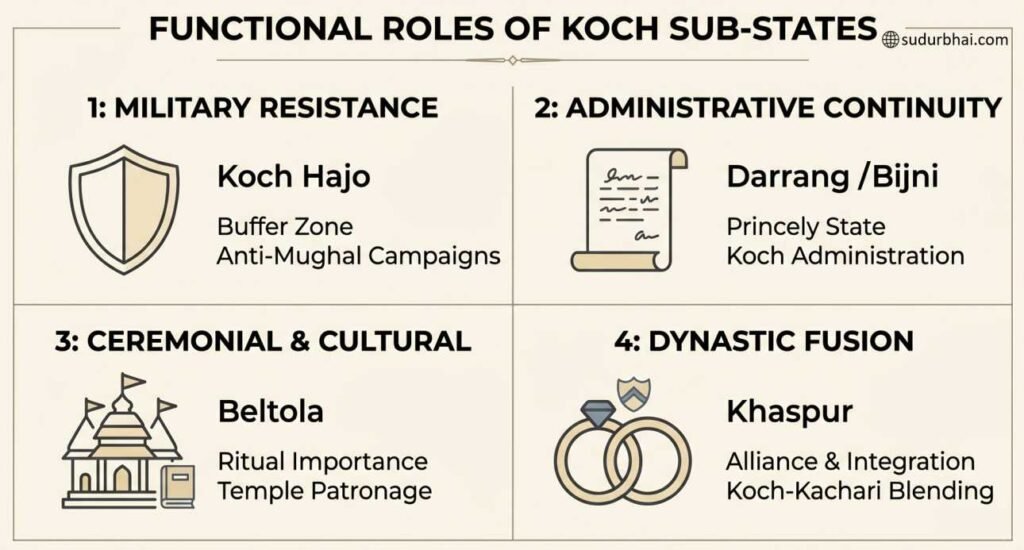
The sub-kingdoms of the Koch dynasty show how a once powerful empire adapted after fragmentation. Even though the central authority weakened, the Koch royal lineage continued to influence politics, culture, and society in different regions.
These sub-states served different purposes:
Some acted as buffer zones
Some preserved cultural traditions
Others continued as political entities under larger empires
Together, they demonstrate the lasting legacy of the Koch dynasty in shaping the history of Assam and Northeast India.