
UNIVERSE AND RELATED PHENOMENA
Introduction
- The Universe encompasses the entirety of physical existence, including space, time, matter, energy, galaxies, stars, planets, radiation and other astronomical phenomena.
- The scientific study of the Universe involves several interconnected disciplines:
- Astronomy: Study of celestial objects and astronomical phenomena.
- Astrophysics: Application of physical principles to understand celestial objects and cosmic processes.
- Cosmology: Study of the origin, evolution, structure and possible future of the Universe.
- Particle Physics: Investigation of elementary particles and fundamental interactions.
- According to the prevailing cosmological model, the Universe evolved from an extremely hot and dense early state approximately 13.8 billion years ago.
- The Universe has continuously evolved through processes involving cosmic expansion, gravitational interactions, galaxy formation, stellar evolution and the production of chemical elements.
- Modern scientific understanding is based on observations made through optical and radio telescopes, space observatories, particle accelerators, neutrino detectors and gravitational-wave observatories.
- Major discoveries, including the Cosmic Microwave Background, Higgs Boson, neutrino oscillations and gravitational waves, have substantially advanced our understanding of fundamental physical laws.
- India has contributed to astronomical and fundamental physics research through institutions such as ISRO, TIFR, IIA, IUCAA, ARIES and NCRA, along with participation in international scientific collaborations.
Universe: Meaning, Dimensions and Composition
Meaning of the Universe
- The Universe refers to the totality of space-time and its physical contents.
- It comprises:
- Galaxies and galaxy clusters.
- Stars and stellar remnants.
- Planets and natural satellites.
- Nebulae and interstellar matter.
- Asteroids, comets and other small celestial bodies.
- Electromagnetic radiation.
- Dark matter and dark energy.
- The Universe is not merely a collection of objects moving through empty space; space-time itself constitutes part of the physical Universe.
- The Observable Universe refers to the region from which light or other physical signals could have reached an observer since the early Universe.
- The observable Universe has an estimated present-day radius of approximately 46.5 billion light-years, considerably larger than its age expressed in light-years because space has expanded while light travelled towards us.
- The full extent of the Universe beyond the observable region remains unknown.
Important Terminology
| Term | Definition |
|---|---|
| Universe | Totality of space-time, matter, radiation and energy |
| Space | Spatial dimensions within which physical objects and events are located |
| Cosmos | The Universe considered as an organised physical system |
| Celestial Body | Natural astronomical object such as a star, planet or asteroid |
| Astronomy | Scientific study of celestial objects and phenomena |
| Astrophysics | Study of astronomical objects using physical principles |
| Cosmology | Study of the Universe’s origin, evolution and large-scale structure |
| Redshift | Increase in the wavelength of radiation relative to a reference |
| Cosmic Microwave Background | Relic electromagnetic radiation from the early Universe |
| Space-Time | Four-dimensional framework combining space and time |
Measurement of Astronomical Distances
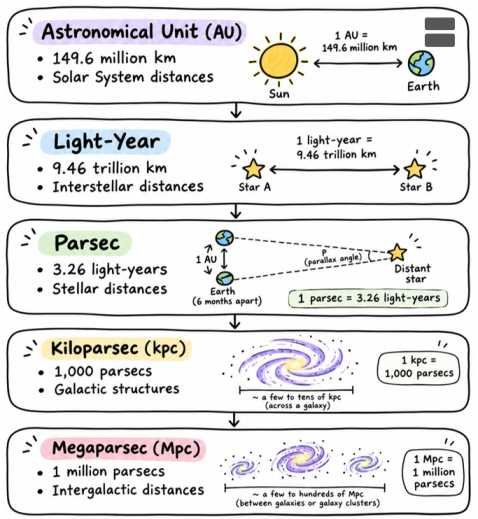
- Astronomical distances are extremely large and are commonly measured using specialised units.
- The Astronomical Unit (AU) is primarily used for distances within planetary systems.
- The Light-Year is the distance travelled by light in a vacuum during one Julian year.
- The Parsec is commonly employed in astronomical research and is related to the principle of stellar parallax.
| Unit | Approximate Equivalent | Application |
|---|---|---|
| Astronomical Unit (AU) | 149.6 million km | Solar System distances |
| Light-Year | 9.46 trillion km | Interstellar distances |
| Parsec | 3.26 light-years | Stellar distances |
| Kiloparsec (kpc) | 1,000 parsecs | Galactic structures |
| Megaparsec (Mpc) | 1 million parsecs | Intergalactic distances |
- A light-year is a unit of distance, not time.
- Because light travels at a finite speed, observing distant celestial objects allows astronomers to investigate earlier stages of cosmic history.
Composition of the Universe
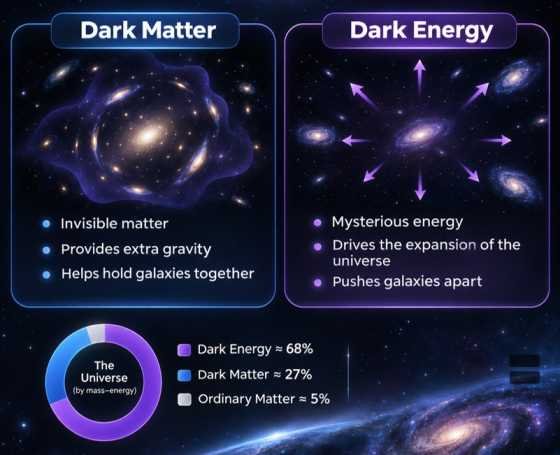
According to the standard cosmological model, the Universe’s total matter-energy density consists predominantly of dark energy and dark matter, while ordinary matter represents a relatively small fraction.
| Component | Approximate Share of the Universe |
|---|---|
| Dark Energy | 68% |
| Dark Matter | 27% |
| Ordinary Matter | 5% |
1. Ordinary Matter
- Ordinary Matter, or Baryonic Matter, consists mainly of matter associated with protons, neutrons and electrons.
- It forms stars, planets, interstellar gas, living organisms and other familiar physical objects.
- It accounts for approximately 5% of the Universe’s total matter-energy density.
2. Dark Matter
- Dark Matter is inferred primarily through its gravitational influence on visible matter and radiation.
- It represents approximately 27% of cosmic matter-energy density.
- Its existence is supported by:
- Galactic rotation curves.
- Gravitational lensing.
- Motion of galaxies within clusters.
- Formation of large-scale cosmic structures.
- Cosmic microwave background observations.
- Its fundamental composition remains unknown.
3. Dark Energy
- Dark Energy is associated with the observed accelerated expansion of the Universe.
- It constitutes approximately 68% of the total matter-energy density.
- One possible theoretical description is the Cosmological Constant.
- Its physical origin remains an unresolved question in cosmology.
| Feature | Dark Matter | Dark Energy |
|---|---|---|
| Principal Effect | Gravitational attraction and structure formation | Accelerated cosmic expansion |
| Approximate Share | 27% | 68% |
| Important Evidence | Galactic motion and gravitational lensing | Cosmic expansion measurements |
| Physical Nature | Unknown | Unknown |
Origin and Evolution of the Universe
Big Bang Theory
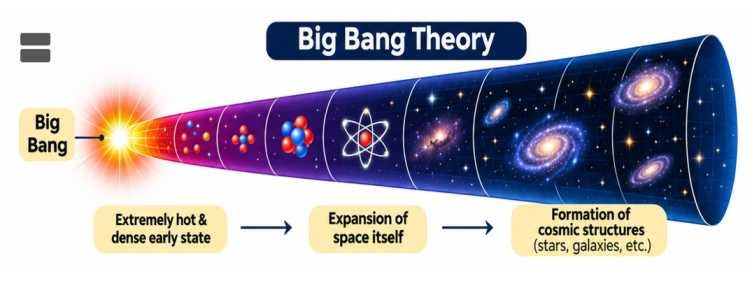
- The Big Bang Theory is the leading scientific framework explaining the early evolution of the Universe.
- It describes the Universe as having evolved from an extremely hot, dense early state.
- The Big Bang was not an ordinary explosion occurring at a particular location in pre-existing space.
- Instead, the theory describes the expansion of space itself, accompanied by progressive cooling and the development of cosmic structures.
- As the Universe expanded, fundamental particles, atomic nuclei, atoms, stars and galaxies formed through successive physical processes.
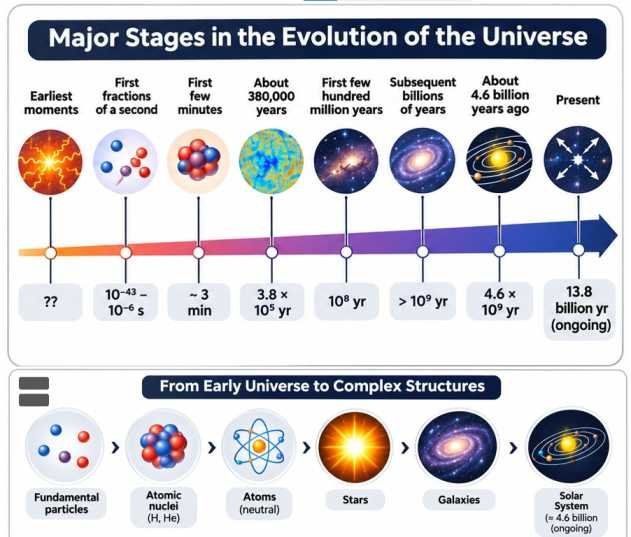
Major Stages in the Evolution of the Universe
| Approximate Period | Major Development |
|---|---|
| Earliest Moments | Extremely high-energy conditions; the earliest physical processes remain incompletely understood |
| First Fractions of a Second | Evolution of elementary particles and fundamental interactions |
| First Few Minutes | Formation of light nuclei, mainly hydrogen and helium |
| About 380,000 Years | Formation of neutral atoms and release of radiation now observed as the CMB |
| First Few Hundred Million Years | Emergence of the earliest stars and galaxies |
| Subsequent Billions of Years | Galaxy growth, stellar evolution and formation of heavier elements |
| About 4.6 Billion Years Ago | Formation of the Solar System |
| Present | Continued cosmic expansion and evolution |
Evidence Supporting the Big Bang Theory
1. Expansion of the Universe
- Astronomical observations reveal that light from most distant galaxies is redshifted.
- The redshift generally increases with distance, supporting large-scale cosmic expansion.
- The Hubble–Lemaître Law describes the approximate relationship between a galaxy’s recession velocity and its distance at relatively low redshifts.
v ≈ H₀d
Where:
- v = recession velocity.
- H₀ = Hubble constant.
- d = distance.
2. Cosmic Microwave Background (CMB)
- The CMB is relic electromagnetic radiation from the early Universe.
- It was discovered by Arno Penzias and Robert Wilson in 1965.
- Its present temperature is approximately 2.725 Kelvin.
- Small fluctuations in the CMB provide evidence about the distribution of matter in the early Universe.
3. Primordial Abundance of Light Elements
- The Big Bang model predicts the formation of light atomic nuclei during the first few minutes.
- The predicted abundances of hydrogen, helium and trace quantities of other light elements broadly agree with astronomical observations.
- This agreement provides substantial evidence supporting the hot early-Universe model.
Cosmic Expansion and the Fate of the Universe
- The Universe continues to expand on large spatial scales.
- Observations of distant supernovae and other cosmological evidence indicate that the expansion has been accelerating during comparatively recent cosmic history.
- The future evolution of the Universe depends on its matter-energy content and the physical properties of dark energy.
- Important theoretical possibilities include:
- Big Freeze or Heat Death: Continued expansion and gradual decline in usable energy differences.
- Big Crunch: A hypothetical future gravitational recollapse.
- Big Rip: A hypothetical scenario involving sufficiently extreme changes in dark-energy behaviour.
- Current observations broadly favour continued accelerated expansion under the standard cosmological model, although the ultimate fate of the Universe remains a subject of research.
Galaxies and Large-Scale Structure of the Universe
Galaxies
- A Galaxy is a gravitationally bound system containing stars, stellar remnants, interstellar gas, dust and dark matter.
- Galaxies vary in size, mass, luminosity and structure.
- They may contain millions to hundreds of billions of stars, while some exceptionally large systems contain even greater stellar populations.
- Galaxies are important building blocks of the large-scale cosmic structure.
- They evolve through star formation, gravitational interactions, gas accretion and mergers.
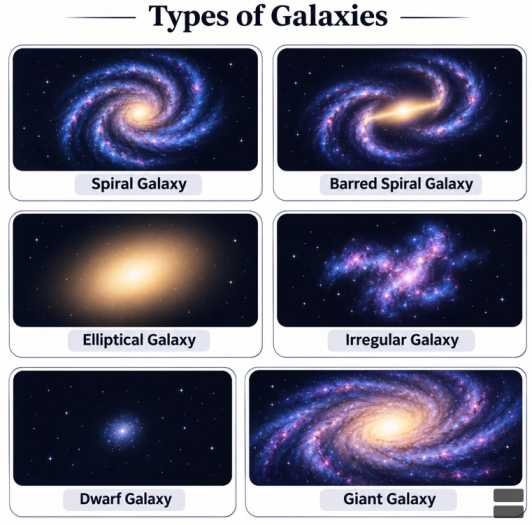
Classification of Galaxies
1. Spiral Galaxies
- Possess a rotating stellar disk, central bulge and spiral arms.
- Their disks commonly contain gas, dust and active star-forming regions.
- Example: Andromeda Galaxy.
2. Barred Spiral Galaxies
- Have a bar-shaped stellar structure crossing the central region, with spiral arms extending from or near the bar.
- Example: Milky Way Galaxy.
3. Elliptical Galaxies
- Exhibit smooth, approximately ellipsoidal structures.
- They often contain relatively old stars and limited cold gas.
- Example: Messier 87.
4. Irregular Galaxies
- Lack a clearly defined spiral or elliptical appearance.
- Their structures may be influenced by gravitational interactions.
- Example: Large Magellanic Cloud.
Dwarf and Giant Galaxies
1. Dwarf Galaxies
- Relatively small and low-mass galaxies compared with large galaxies.
- Their stellar populations can range from relatively few stars to billions.
- They may exhibit irregular, spheroidal or other forms.
- Many dwarf galaxies occur as satellites of larger galaxies.
2. Giant Galaxies
- Large galaxies containing extensive stellar populations and substantial mass.
- Giant elliptical galaxies are frequently found in the central regions of massive galaxy clusters.
- Their evolution is influenced by mergers, gravitational interactions and the accumulation of matter.
Galaxy Groups, Clusters and Superclusters
- Galaxy Group: A gravitationally associated system containing a relatively small number of galaxies.
- Galaxy Cluster: A larger gravitationally bound system containing numerous galaxies, hot gas and dark matter.
- Supercluster: A vast concentration of galaxy groups and clusters.
- Superclusters are not necessarily gravitationally bound as complete systems.
- Galaxies and clusters form large-scale patterns of filaments, walls and voids, collectively known as the Cosmic Web.
Saraswati Supercluster
- The Saraswati Supercluster is a massive concentration of galaxies identified by an Indian-led research team in 2017.
- It is situated in the direction of the Pisces constellation.
- The reported structure extends across approximately 600 million light-years.
- It contains numerous galaxy clusters and associated large-scale structures.
- Its discovery contributed to understanding the distribution of matter and the growth of large cosmic structures.
Milky Way Galaxy
General Characteristics
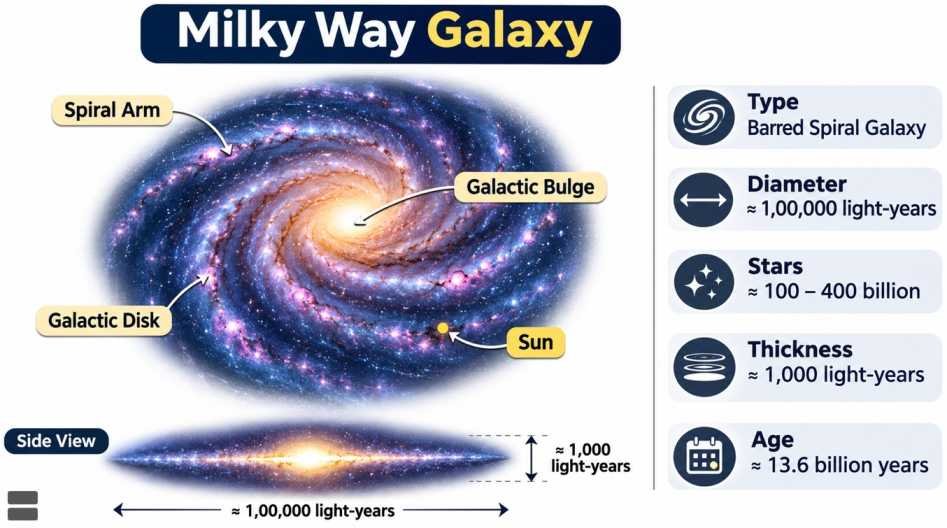
- The Milky Way is the galaxy containing the Solar System.
- It is classified as a Barred Spiral Galaxy.
- It contains an estimated hundreds of billions of stars, along with interstellar gas, dust and dark matter.
- Its stellar disk extends across approximately 100,000 light-years, although estimates depend on the component being measured.
- The Sun is located approximately 26,000 light-years from the Galactic Centre.
- The Milky Way belongs to the Local Group of galaxies.
- Its principal neighbouring large galaxy is Andromeda (M31).
Major Components
| Component | Characteristics |
|---|---|
| Galactic Bulge | Dense concentration of stars near the galactic centre |
| Galactic Disk | Flattened rotating region containing stars, gas and dust |
| Spiral Arms | Regions with interstellar gas, dust and numerous star-forming areas |
| Galactic Halo | Extended region containing old stars, globular clusters and dark matter |
| Central Black Hole | Sagittarius A*, located near the Galactic Centre |
Sagittarius A*
- Sagittarius A* is the supermassive black hole located at the Galactic Centre.
- Its mass is approximately 4 million times the mass of the Sun.
- Its existence is supported by observations of stars orbiting the Galactic Centre.
- In 2022, the Event Horizon Telescope collaboration released the first image of radiation surrounding Sagittarius A*.
Motion of the Solar System
- The Sun orbits the Galactic Centre under the influence of gravity.
- One complete revolution requires approximately 230 million years, although estimates vary.
- This period is sometimes called a Galactic Year.
- The Solar System lies within the Milky Way’s disk, in the region commonly known as the Orion Spur or Local Arm.
Nebulae and Star Formation
Meaning of Nebulae
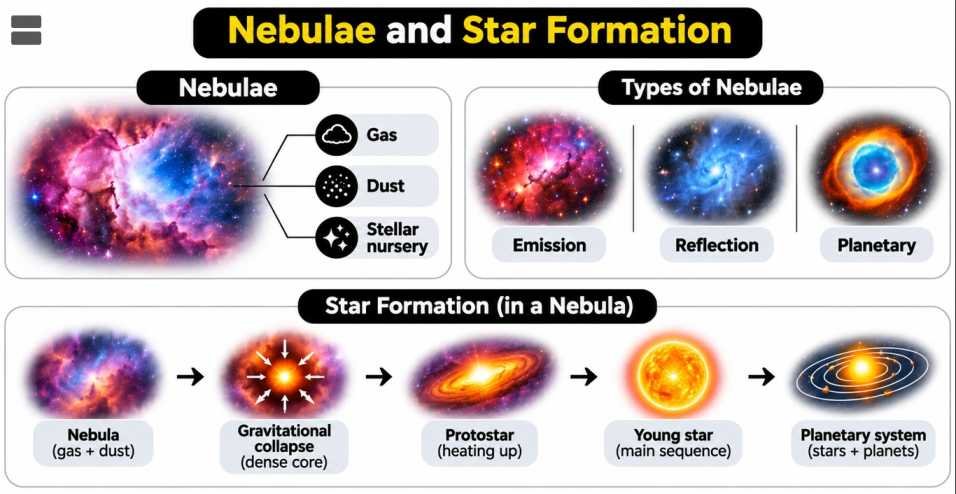
- A Nebula is a cloud of gas, dust or both in interstellar space.
- Nebulae are associated with different stages of stellar evolution, including star formation and the dispersal of material from evolved stars.
- They consist primarily of gas, with varying amounts of interstellar dust and heavier elements.
- Their appearance depends on factors such as temperature, density, chemical composition, illumination and interaction with nearby stars.
- Not all nebulae are star-forming regions; some result from stellar mass loss or explosive events.
Major Types of Nebulae
1. Emission Nebula
- Emits light when gas is ionised or excited by nearby energetic sources, particularly hot stars.
- Examples: Orion Nebula and Eagle Nebula.
2. Reflection Nebula
- Becomes visible by scattering light from nearby stars.
- Dust grains preferentially scatter shorter wavelengths, often producing a bluish appearance.
- Example: Nebulae associated with the Pleiades.
3. Dark Nebula
- Dense regions of interstellar dust and gas that obscure light from stars or other objects behind them.
- Example: Barnard 68.
4. Planetary Nebula
- Glowing material expelled during the late evolutionary stages of certain low- and intermediate-mass stars.
- Example: Ring Nebula.
5. Supernova Remnant
- Expanding material produced by a stellar explosion.
- It may contain shock-heated gas, dust and an associated compact stellar remnant.
- Example: Crab Nebula.
Process of Star Formation
- Stars originate within sufficiently cold and dense regions of interstellar molecular clouds.
- Gravitational instability causes portions of these clouds to collapse.
- As collapse proceeds, density and central temperature increase.
- The collapsing material forms a Protostar, frequently surrounded by an accretion disk.
- Gravitational contraction continues until the central region becomes sufficiently hot and dense for sustained hydrogen fusion, provided enough mass has accumulated.
- The object subsequently enters the Main-Sequence Stage.
Stages of Star Formation
- Molecular Cloud: Cold gas and dust.
- Gravitational Collapse: Fragmentation and increasing density.
- Protostar: Accretion and heating.
- Main-Sequence Star: Stable core hydrogen fusion begins.
Stars: Characteristics, Structure and Classification
Meaning and Characteristics
- A Star is a self-gravitating astronomical object consisting primarily of hot plasma and, during much of its lifetime, generating energy through nuclear fusion.
- Stars originate from collapsing interstellar clouds and evolve through different stages depending on their physical characteristics.
- The principal properties of stars include:
- Mass: Quantity of matter contained in the star.
- Radius: Physical extent of the stellar body.
- Luminosity: Total electromagnetic energy emitted per unit time.
- Surface Temperature: Temperature associated with the star’s photosphere.
- Chemical Composition: Relative abundance of elements.
- Age: Time elapsed since formation.
- A star’s initial mass is a principal factor determining its lifetime and evolutionary pathway.
- Massive stars generally consume nuclear fuel more rapidly and have shorter lifetimes than lower-mass stars.
Nuclear Fusion in Stars
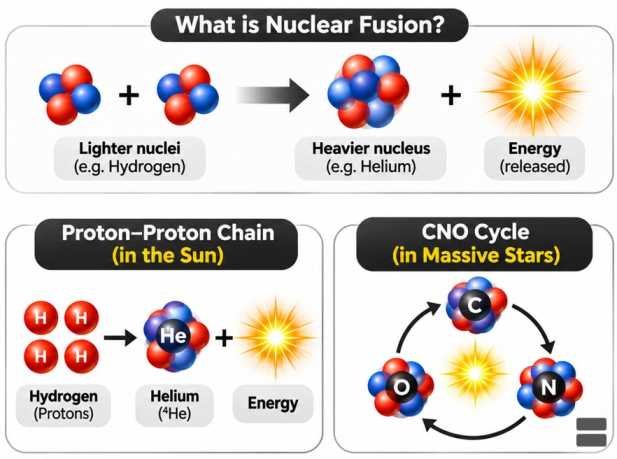
- Nuclear Fusion involves the combination of lighter atomic nuclei into heavier nuclei under suitable physical conditions.
- Fusion can release energy when the resulting nuclei have greater binding energy per nucleon.
- During the main-sequence stage, stars generate energy principally through hydrogen fusion.
- In the Sun, the dominant energy-producing mechanism is the Proton–Proton Chain.
- In many massive stars, hydrogen fusion occurs predominantly through the Carbon–Nitrogen–Oxygen (CNO) Cycle.
- Fusion energy is consistent with Einstein’s mass-energy equivalence:
E = mc²
Hydrostatic Equilibrium
- During much of a star’s lifetime, inward gravitational attraction is balanced by outward pressure gradients.
- This condition is known as Hydrostatic Equilibrium.
- The pressure arises from the physical state of the stellar material and, in some regions, contributions from radiation.
- A significant disturbance of this balance can cause contraction, expansion or more dramatic changes in stellar structure.
Spectral Classification of Stars
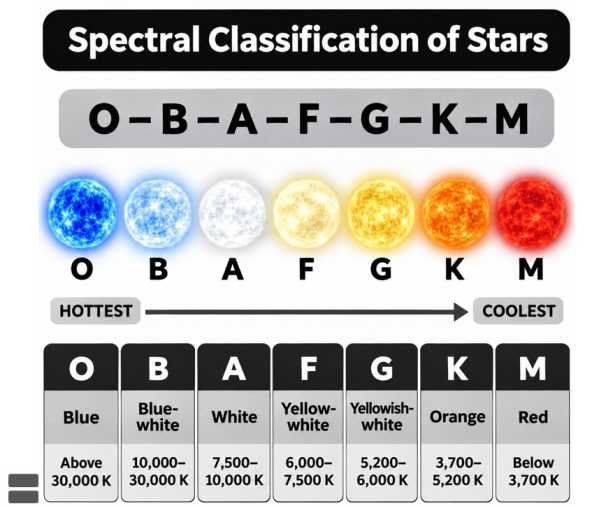
Stars are traditionally classified using the spectral sequence O–B–A–F–G–K–M, broadly arranged in decreasing order of surface temperature.
| Spectral Class | Typical Colour | Approximate Surface Temperature |
|---|---|---|
| O | Blue | Above 30,000 K |
| B | Blue-white | 10,000–30,000 K |
| A | White | 7,500–10,000 K |
| F | Yellow-white | 6,000–7,500 K |
| G | Yellowish-white | 5,200–6,000 K |
| K | Orange | 3,700–5,200 K |
| M | Red | Below 3,700 K |
- The Sun is classified as a G2V Main-Sequence Star.
- A star’s colour is primarily related to its surface temperature.
- Spectral classification also uses characteristic absorption features in stellar spectra.
- The spectral sequence does not directly represent a universal age sequence.
Hertzsprung–Russell Diagram
- The Hertzsprung–Russell (H–R) Diagram represents stars according to their luminosity and temperature or related spectral characteristics.
- It is an important tool for understanding stellar classification and evolution.
- Major regions include:
- Main Sequence: Stars undergoing core hydrogen fusion.
- Red Giant Region: Evolved stars with large radii and relatively cool surfaces.
- Supergiant Region: Very luminous stars, often possessing large radii.
- White Dwarf Region: Compact stellar remnants with low luminosities despite high surface temperatures.
- A star’s position on the diagram provides information about its physical characteristics and evolutionary stage.
Life Cycle of Stars and Stellar Remnants
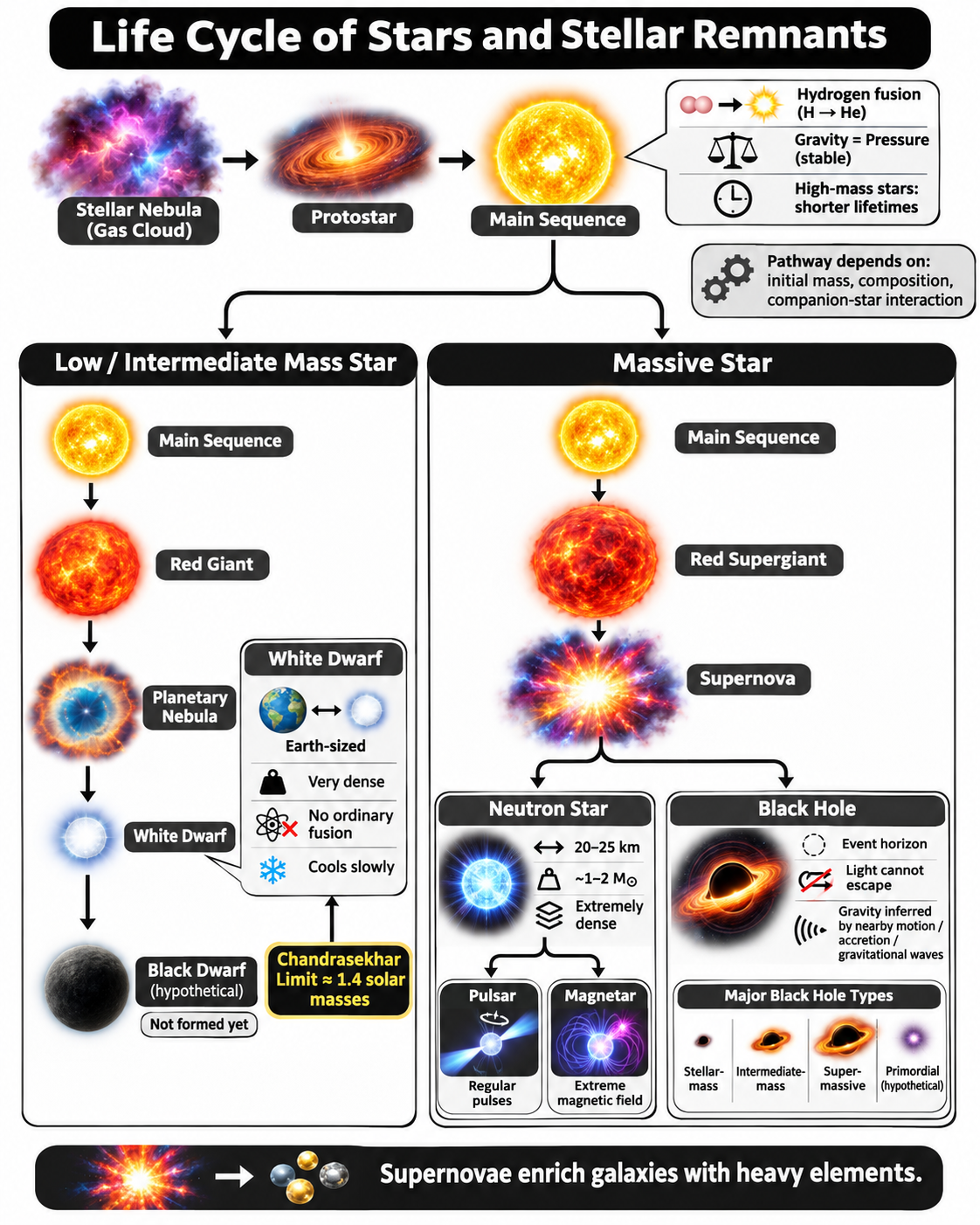
The evolutionary pathway of a star depends primarily on its initial mass, chemical composition and interactions with companion stars.
Main-Sequence Stage
- The Main Sequence represents the longest stable phase in the lives of most stars.
- Hydrogen fusion supplies energy in the stellar core.
- Gravity and internal pressure remain approximately balanced.
- Higher-mass stars typically have shorter main-sequence lifetimes.
Evolution of Low- and Intermediate-Mass Stars
- As core hydrogen becomes depleted, the stellar structure changes.
- The outer layers expand, producing a Red Giant.
- Under suitable physical conditions, helium fusion begins in the core.
- During later evolutionary stages, the star loses substantial portions of its outer envelope.
- The expelled material may form a Planetary Nebula.
- The remaining compact core becomes a White Dwarf.
- White dwarfs gradually cool over extremely long periods.
White Dwarfs
- A White Dwarf is a compact stellar remnant formed after certain low- and intermediate-mass stars lose their outer layers.
- It is generally comparable in radius to Earth, although its size varies with mass.
- It may contain a mass comparable to that of the Sun within a very small volume.
- White dwarfs are supported primarily by electron degeneracy pressure.
- They do not sustain ordinary central nuclear fusion.
- Their remaining luminosity is generated primarily through the release of stored thermal energy.
Chandrasekhar Limit
- The Chandrasekhar Limit is the maximum mass of an idealised, non-rotating white dwarf supported by electron degeneracy pressure.
- Its commonly quoted value is approximately 1.4 solar masses.
- White dwarfs approaching this limit may become unstable under certain physical conditions.
- The limit does not apply as the maximum mass of a neutron star.
Black Dwarfs
- A Black Dwarf is a hypothetical white dwarf that has cooled to an extremely low temperature and luminosity.
- White-dwarf cooling requires exceptionally long timescales.
- Because the Universe is approximately 13.8 billion years old, black dwarfs are not expected to have formed yet.
Neutron Stars
- Neutron Stars are extremely dense stellar remnants that may form following the core collapse of massive stars.
- Their typical diameter is approximately 20–25 kilometres.
- They commonly possess masses around 1–2 solar masses.
- Their densities are comparable to those found within atomic nuclei.
- Neutron stars can exhibit:
- Extremely strong gravitational fields.
- Rapid rotation.
- Powerful magnetic fields.
- Radiation emitted through complex magnetospheric processes.
- Their internal structure remains an important subject of nuclear and astrophysical research.
Pulsars
- A Pulsar is a rotating neutron star whose radiation produces regularly repeating signals detectable by an observer.
- Radiation beams may sweep across the observer’s line of sight as the star rotates.
- Some pulsars rotate hundreds of times per second and are called Millisecond Pulsars.
- Pulsars provide important evidence concerning neutron-star physics and gravitational theories.
Magnetars
- Magnetars are neutron stars characterised by exceptionally strong magnetic fields.
- They can produce intense bursts of X-rays and gamma rays.
- Their study helps scientists understand matter and magnetic fields under extreme physical conditions.
Black Holes
- A Black Hole is a region of space-time bounded by an event horizon, beyond which light cannot escape to distant observers.
- Black holes are predicted by Einstein’s General Theory of Relativity.
- Their gravitational influence can be inferred through:
- Motion of surrounding objects.
- Emission from accreting material.
- Gravitational waves generated by mergers.
- Imaging of radiation near black holes.
Major Types
| Type | Characteristics |
|---|---|
| Stellar-Mass Black Holes | Often formed through the collapse of massive stars |
| Intermediate-Mass Black Holes | Masses between typical stellar and supermassive ranges |
| Supermassive Black Holes | Millions to billions of solar masses, commonly found near galactic centres |
| Primordial Black Holes | Hypothetical black holes potentially formed during the early Universe |
Supernovae
- A Supernova is a powerful stellar explosion associated with rapid energy release.
- Supernovae can release large quantities of material into interstellar space.
- They contribute to the chemical enrichment and physical evolution of galaxies.
- Two major physical categories include:
| Feature | Type Ia Supernova | Core-Collapse Supernova |
|---|---|---|
| Progenitor | White dwarf system | Massive star |
| Principal Process | Thermonuclear explosion | Gravitational collapse of stellar core |
| Typical Remnant | White dwarf generally disrupted | May form neutron star or black hole |
| Scientific Importance | Cosmic distance measurement | Stellar evolution and compact-object formation |
- Type Ia supernovae are important astronomical distance indicators after accounting for their observable light-curve properties.
- Core-collapse supernovae are important for understanding the death of massive stars and the production of compact stellar remnants.
Comparison of Stellar Remnants
| Feature | White Dwarf | Neutron Star | Black Hole |
|---|---|---|---|
| Origin | Evolved low- or intermediate-mass star | Collapse of sufficiently massive stellar core | Stellar collapse or other astrophysical processes |
| Typical Size | Comparable to Earth | Approximately 20–25 km in diameter | Event-horizon scale depends on mass |
| Principal Physical Feature | Electron degeneracy pressure | Extremely dense neutron-rich matter | Event horizon |
| Radiation | Thermal and other possible emission | Pulsed, thermal or high-energy radiation | Radiation may originate from surrounding matter |
| Examples | Sirius B | Crab Pulsar | Sagittarius A* |
Solar System and Solar Phenomena
Formation of the Solar System
- The Solar System consists of the Sun and the natural objects gravitationally associated with it.
- It formed approximately 4.6 billion years ago.
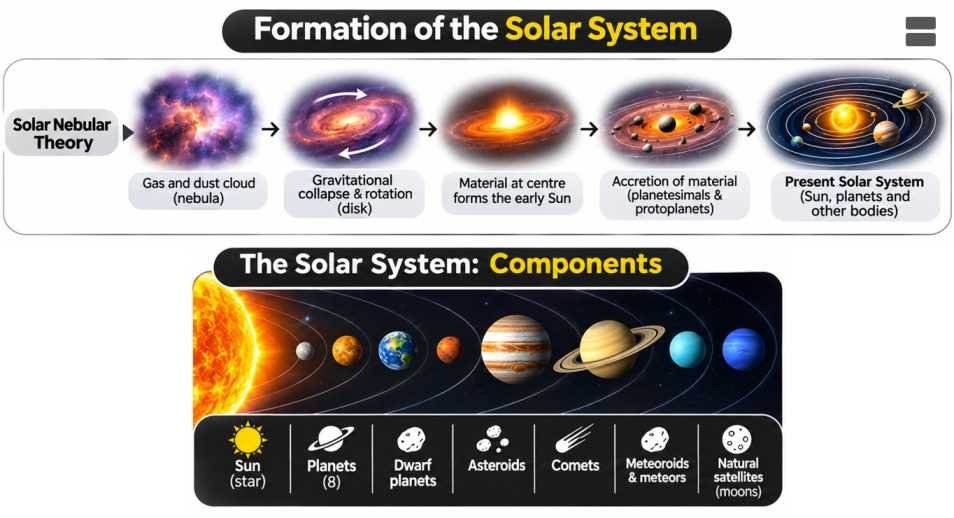
- According to the Solar Nebular Theory, the Solar System originated from a collapsing cloud of gas and dust.
- The collapsing cloud developed into a rotating disk.
- Most material accumulated at the centre, forming the early Sun.
- Remaining material gradually combined through collisions and gravitational accretion to form planetesimals, protoplanets and smaller bodies.
The Sun
- The Sun is the central star of the Solar System.
- It is a G-type Main-Sequence Star.
- It contains approximately 99.86% of the Solar System’s total mass.
- Its composition is dominated by hydrogen and helium.
- Nuclear fusion within its core converts hydrogen into helium, releasing energy.
- Solar gravity governs the orbital motion of the planets and numerous other celestial objects.
Structure of the Sun
| Layer | Characteristics |
|---|---|
| Core | Region where nuclear fusion generates energy |
| Radiative Zone | Energy transported predominantly through radiation |
| Convective Zone | Energy transported substantially through convection |
| Photosphere | Visible solar surface |
| Chromosphere | Atmospheric layer above the photosphere |
| Corona | Extended, extremely hot outer solar atmosphere |
Solar Wind and Heliosphere
- Solar Wind is a continuous outflow of charged particles from the Sun.
- It consists mainly of protons, electrons and helium nuclei.
- The solar wind carries magnetic fields into interplanetary space.
- Its interaction with Earth’s magnetosphere can influence:
- Auroral activity.
- Satellite operations.
- Spacecraft electronics.
- Radio communication.
- Geomagnetic conditions.
- The region dominated by the solar wind is called the Heliosphere.
- The Heliopause marks the boundary between the solar-wind-dominated region and the local interstellar medium.
Sunspots
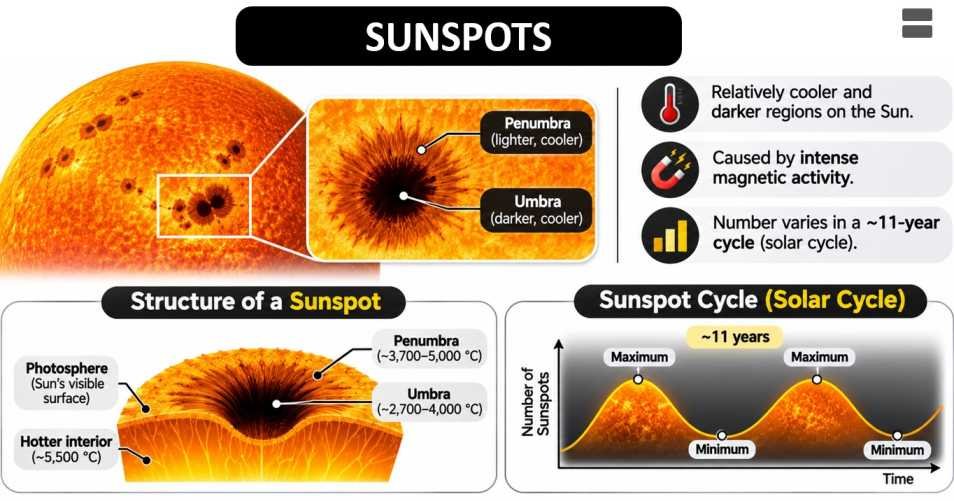
- Sunspots are relatively dark areas on the Sun’s photosphere.
- They appear darker because their temperatures are lower than surrounding photospheric regions.
- Sunspots are associated with concentrated magnetic fields.
- Sunspot numbers fluctuate in an approximately 11-year solar activity cycle.
- The Sun’s magnetic polarity completes a broader cycle of approximately 22 years.
Solar Flares and Coronal Mass Ejections
Solar Flares
- Sudden releases of electromagnetic energy associated with solar magnetic activity.
- They can emit radiation across the electromagnetic spectrum.
- Strong flares may affect radio communication and space-based technologies.
Coronal Mass Ejections (CMEs)
- Large-scale expulsions of magnetised plasma from the solar corona.
- Earth-directed CMEs can produce geomagnetic storms.
- Their effects may include auroras, satellite disturbances and disruptions to vulnerable electrical infrastructure.
| Feature | Solar Flare | Coronal Mass Ejection |
|---|---|---|
| Nature | Rapid release of radiation and energetic particles | Ejection of magnetised solar plasma |
| Primary Effect | Radiation-related disturbances | Geomagnetic disturbances |
| Arrival at Earth | Electromagnetic radiation reaches Earth in about 8 minutes | Solar plasma generally takes considerably longer |
| Important Consequences | Radio blackouts and radiation hazards | Auroras, satellite effects and grid disturbances |
Planets, Dwarf Planets and Exoplanets
Definition of a Planet
According to the International Astronomical Union (IAU) definition adopted in 2006, a planet in the Solar System must:
- Orbit the Sun.
- Have sufficient mass to attain an approximately round shape through its own gravity.
- Have cleared the neighbourhood around its orbit, meaning it is dynamically dominant in its orbital region.
The eight recognised planets are Mercury, Venus, Earth, Mars, Jupiter, Saturn, Uranus and Neptune.
Classification of Planets
| Category | Planets | Major Characteristics |
|---|---|---|
| Terrestrial Planets | Mercury, Venus, Earth, Mars | Rocky composition and solid surfaces |
| Gas Giants | Jupiter, Saturn | Massive planets dominated by hydrogen and helium |
| Ice Giants | Uranus, Neptune | Interiors containing substantial proportions of heavier volatile substances |
Dwarf Planets
- A Dwarf Planet is a celestial body that:
- Orbits the Sun.
- Possesses sufficient mass to become approximately round.
- Has not cleared its orbital neighbourhood.
- Is not a natural satellite.
- The five officially recognised dwarf planets are:
- Ceres.
- Pluto.
- Haumea.
- Makemake.
- Eris.
- Pluto was reclassified as a dwarf planet in 2006.
| Feature | Planets | Dwarf Planets |
|---|---|---|
| Orbit the Sun | Yes | Yes |
| Approximately Round | Yes | Yes |
| Cleared Orbital Neighbourhood | Yes | No |
| Officially Recognised Number | 8 | 5 |
| Examples | Earth, Jupiter | Pluto, Ceres |
Exoplanets
- Exoplanets, or Extrasolar Planets, are planets located outside the Solar System.
- Most known exoplanets orbit stars other than the Sun.
- They vary considerably in size, mass, temperature, composition and orbital characteristics.
- Their discovery demonstrates that planetary systems are common throughout the Milky Way.
Methods of Exoplanet Detection
| Method | Principle |
|---|---|
| Transit Method | Detects temporary decreases in stellar brightness as a planet crosses the star’s disk |
| Radial Velocity Method | Measures Doppler shifts caused by a planet’s gravitational influence on its host star |
| Direct Imaging | Attempts to detect radiation from a planet separately from its star |
| Gravitational Microlensing | Detects the gravitational influence of a planet on light from a distant background source |
| Astrometry | Measures changes in the apparent position of a star caused by an orbiting companion |
| Timing Method | Detects variations in periodic astronomical signals |
Goldilocks Zone or Habitable Zone
- The Habitable Zone, commonly called the Goldilocks Zone, refers to the region around a star where an appropriately configured planet could potentially maintain liquid water on its surface.
- Its location depends on the luminosity and properties of the host star.
- Presence within the habitable zone does not establish that a planet supports life.
- Habitability also depends on:
- Atmospheric composition and pressure.
- Planetary temperature.
- Availability of water.
- Greenhouse effects.
- Stellar activity.
- Geological conditions.
Important Exoplanets
| Exoplanet | Significance |
|---|---|
| 51 Pegasi b | First exoplanet discovered orbiting a Sun-like star, announced in 1995 |
| Proxima Centauri b | Planet orbiting the nearest known star to the Sun |
| Kepler-186f | Approximately Earth-sized planet discovered in its star’s habitable zone |
| Kepler-452b | Planet orbiting within the habitable zone of a Sun-like star |
| TRAPPIST-1 System | System containing seven known approximately Earth-sized planets |
| K2-18 b | Sub-Neptune exoplanet investigated through atmospheric spectroscopy |
Major Exoplanet Missions
- Kepler Space Telescope: Used the transit method to identify thousands of planetary candidates and numerous confirmed exoplanets.
- Transiting Exoplanet Survey Satellite (TESS): Launched in 2018 to search for transiting planets around relatively bright stars.
- James Webb Space Telescope (JWST): Investigates the atmospheric composition of selected exoplanets using spectroscopy.
- These missions contribute to understanding planetary formation, atmospheric properties and potential habitability.
Asteroids, Comets, Meteoroids, Meteors and Meteorites
Asteroids
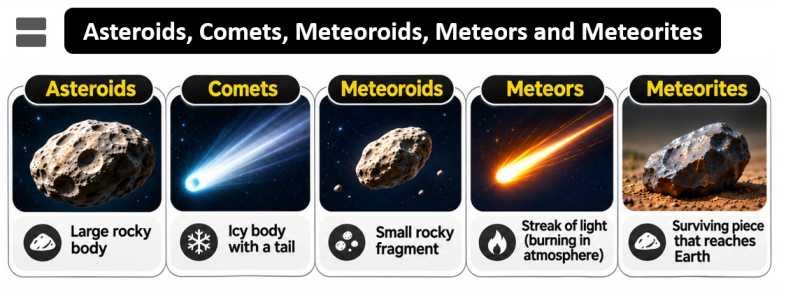
- Asteroids are relatively small rocky, metallic or mixed-composition bodies that orbit the Sun.
- They are remnants of the processes associated with the formation and evolution of the Solar System.
- Most known asteroids are concentrated in the Main Asteroid Belt between the orbits of Mars and Jupiter.
- Asteroids also occur in other regions, including populations that approach Earth’s orbit.
- Their study provides information about the composition and early history of the Solar System.
Asteroid Belt
- The Main Asteroid Belt lies between Mars and Jupiter.
- It contains numerous objects of different sizes and compositions.
- Ceres, the largest object in the main asteroid belt, is classified as a dwarf planet.
- Jupiter’s gravitational influence has significantly affected the orbital evolution of asteroids in the belt.
- The asteroid belt is not densely packed; individual objects are generally separated by extremely large distances.
Meteoroids, Meteors and Meteorites
- A Meteoroid is a small natural solid object moving through space.
- A Meteor is the visible phenomenon produced when a meteoroid enters an atmosphere at high speed.
- A Meteorite is material from an object that survives atmospheric passage and reaches the planetary surface.
- Meteors are commonly referred to as Shooting Stars, although they are not actual stars.
- Meteor showers generally occur when Earth encounters streams of debris, frequently associated with comets.
| Feature | Meteoroid | Meteor | Meteorite |
|---|---|---|---|
| Meaning | Small solid body travelling through space | Visible atmospheric phenomenon | Material reaching the ground |
| Location | Space | Atmosphere | Planetary surface |
| Appearance | Usually not directly visible | Bright streak of light | Solid fragment |
| Important Example | Small space rock | Shooting star | Recovered meteorite |
Comets
- Comets are small Solar System bodies containing ice, dust and rocky material in varying proportions.
- They generally follow elliptical orbits, which may be highly elongated.
- When a comet approaches the Sun, solar radiation can cause its volatile substances to sublimate.
- Released gas and dust may form a visible Coma and one or more Tails.
- Comets are important sources of information about volatile materials preserved from the early Solar System.
Major Components of a Comet
- Nucleus: Solid central body composed of ice, dust and rocky material.
- Coma: Diffuse cloud of gas and dust surrounding an active nucleus.
- Dust Tail: Consists of dust particles influenced by solar radiation and orbital motion.
- Ion Tail: Consists of ionised gas influenced by the solar wind and interplanetary magnetic field.
- Comet tails generally extend away from the Sun rather than always pointing opposite the direction of orbital motion.
Difference Between Asteroids and Comets
| Feature | Asteroids | Comets |
|---|---|---|
| Typical Composition | Rocky and metallic materials | Ice, dust and rocky substances |
| Common Locations | Main asteroid belt and other regions | Kuiper Belt, scattered disk and distant comet reservoirs |
| Coma and Tail | Normally absent | May develop near the Sun |
| Scientific Importance | Planetary building blocks and early Solar System history | Primordial volatile materials |
| Examples | Vesta, Bennu | Halley, 67P/Churyumov–Gerasimenko |
Scientific Significance of Small Solar System Bodies
- Provide evidence about the early composition of the Solar System.
- Help scientists understand planetary formation and collisional processes.
- Preserve information about primitive minerals and organic compounds.
- Support research on planetary impact hazards.
- Enable sample-return missions and detailed studies of ancient extraterrestrial materials.
Fundamental Particles and Standard Model of Particle Physics
Particle Physics
- Particle Physics is the branch of physics concerned with elementary particles and their fundamental interactions.
- It investigates the building blocks of matter and the physical laws governing their behaviour.
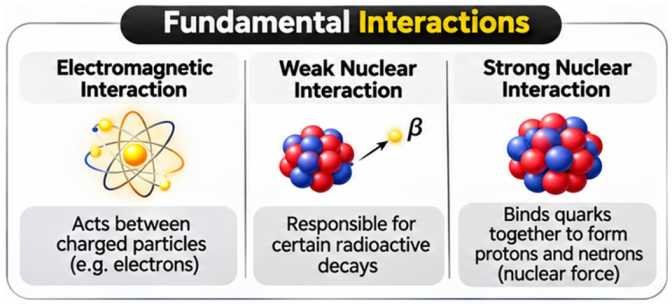
- The Standard Model of Particle Physics is the leading theoretical framework describing known elementary particles and three fundamental interactions.
- It successfully describes:
- Electromagnetic interactions.
- Weak nuclear interactions.
- Strong nuclear interactions.
- Gravity is not incorporated into the Standard Model as a quantum interaction.
Classification of Elementary Particles
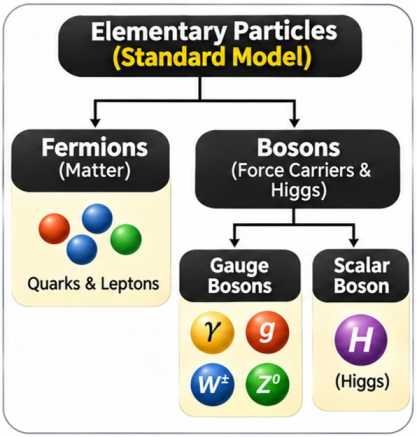
Elementary particles in the Standard Model are broadly classified as Fermions and Bosons.
| Category | Important Particles | Major Characteristics |
|---|---|---|
| Fermions | Quarks and leptons | Fundamental matter particles |
| Gauge Bosons | Photons, gluons, W and Z bosons | Associated with fundamental interactions |
| Scalar Boson | Higgs boson | Associated with the Higgs field |
Fermions
- Fermions possess half-integer intrinsic spin.
- They obey Fermi–Dirac Statistics and the Pauli Exclusion Principle.
- Fermions are classified into two major families:
- Quarks.
- Leptons.
1. Quarks
- Quarks are elementary particles that participate in strong interactions.
- Six flavours of quarks are recognised:
| Quark | Electric Charge |
|---|---|
| Up | +2/3 e |
| Down | −1/3 e |
| Charm | +2/3 e |
| Strange | −1/3 e |
| Top | +2/3 e |
| Bottom | −1/3 e |
- Quarks combine to form composite particles known as Hadrons.
- Hadrons include:
- Baryons: Typically composed of three quarks.
- Mesons: Composed of a quark and an antiquark.
- A Proton contains two up quarks and one down quark.
- A Neutron contains one up quark and two down quarks.
- Quarks are not ordinarily observed as isolated free particles because of Colour Confinement.
2. Leptons
- Leptons are elementary fermions that do not participate in strong nuclear interactions.
- Six lepton flavours are recognised:
- Electron.
- Muon.
- Tau.
- Electron neutrino.
- Muon neutrino.
- Tau neutrino.
- The electron, muon and tau possess negative electric charge.
- Neutrinos are electrically neutral and have very small masses.
Bosons
- Bosons possess integer intrinsic spin.
- They obey Bose–Einstein Statistics.
- Gauge bosons are associated with the fundamental interactions represented in the Standard Model.
- The Higgs boson is a scalar particle associated with the Higgs field.
| Boson | Principal Role |
|---|---|
| Photon | Electromagnetic interaction |
| Gluon | Strong nuclear interaction |
| W⁺ and W⁻ Bosons | Charged-current weak interactions |
| Z⁰ Boson | Neutral-current weak interactions |
| Higgs Boson | Excitation of the Higgs field |
- The Graviton is a hypothetical quantum particle associated with gravity in proposed quantum descriptions.
- Gravitons have not been experimentally detected and are not included in the established Standard Model.
Fundamental Forces of Nature
| Force | Carrier or Description | Major Function |
|---|---|---|
| Strong Nuclear Force | Gluons in quantum chromodynamics | Binds quarks and contributes to nuclear binding |
| Electromagnetic Force | Photons | Governs interactions involving electric charges |
| Weak Nuclear Force | W and Z bosons | Responsible for processes such as beta decay |
| Gravitational Force | Space-time curvature in general relativity | Governs gravitational motion and cosmic structures |
- The strong interaction binds quarks into hadrons.
- Residual strong interactions contribute to the binding of atomic nuclei.
- Electromagnetic interactions govern electricity, magnetism, light and many properties of matter.
- Weak interactions enable certain radioactive decays and particle transformations.
- Gravity governs planetary motion, stellar structure and large-scale cosmic evolution.
Higgs Boson and CERN
Higgs Boson
- The Higgs Boson is an elementary scalar particle associated with the Higgs Field.
- The Higgs field is an essential component of the Standard Model.
- Through the Higgs Mechanism, the W and Z bosons acquire mass.
- Interactions with the Higgs field also contribute to the masses of elementary fermions.
- Most of the mass of ordinary protons and neutrons, however, arises from the energy associated with strong-interaction dynamics rather than directly from the Higgs mechanism.
Discovery of the Higgs Boson
- In July 2012, scientists at CERN announced the discovery of a new particle consistent with the Higgs boson.
- The discovery was made through the ATLAS and CMS experiments at the Large Hadron Collider.
- It provided major experimental confirmation of the Standard Model’s electroweak symmetry-breaking mechanism.
- François Englert and Peter W. Higgs received the 2013 Nobel Prize in Physics for their theoretical contributions to the mechanism.
- The Higgs boson is sometimes popularly called the God Particle, although this is not its scientific name.
European Organization for Nuclear Research (CERN)
- CERN is the European Organization for Nuclear Research.
- It was established in 1954.
- Its main laboratory is located near Geneva, on the France–Switzerland border.
- CERN is one of the world’s leading centres for particle-physics research.
- Its major objectives include:
- Investigation of elementary particles.
- Study of fundamental interactions.
- Development of particle accelerators.
- Advancement of detector technologies.
- Promotion of international scientific cooperation.
Large Hadron Collider (LHC)
- The Large Hadron Collider is a high-energy particle accelerator operated by CERN.
- It is situated in an underground tunnel approximately 27 kilometres in circumference.
- The LHC accelerates particles, primarily protons, to extremely high energies before bringing beams into collision.
- Scientists study the resulting particles and interactions using advanced detectors.
- Its experiments support investigations into the Standard Model and potential new physical phenomena.
Major Experiments at CERN
| Experiment | Principal Research Area |
|---|---|
| ATLAS | Higgs physics, Standard Model tests and searches for new phenomena |
| CMS | Higgs physics, particle interactions and searches for new particles |
| ALICE | Strongly interacting matter and quark–gluon plasma |
| LHCb | Heavy-flavour physics and matter–antimatter asymmetries |
India’s Contribution to CERN
- India has been an Associate Member State of CERN since 2017.
- Indian researchers and institutions participate in detector development, computing, experiments and scientific analysis.
- Important areas of participation include:
- CMS: Detector and computing contributions.
- ALICE: High-energy nuclear physics and associated technologies.
- Accelerator Technology: Selected scientific and engineering collaborations.
- Participation provides opportunities for advanced training and strengthens India’s capabilities in high-energy physics.
Neutrinos and Neutrino Observatories
Meaning of Neutrinos
- Neutrinos are elementary particles belonging to the lepton family.
- Their principal characteristics include:
- No electric charge.
- Very small but non-zero masses.
- Half-integer spin.
- Extremely weak interactions with ordinary matter.
- They are produced through nuclear reactions, radioactive decay and various high-energy astrophysical processes.
- Large numbers of neutrinos pass through Earth and the human body without interacting.
- Their weak interactions make them scientifically valuable but difficult to detect.

Three Flavours of Neutrinos
- Electron Neutrino (νₑ).
- Muon Neutrino (νμ).
- Tau Neutrino (ντ).
The three flavours are associated with different charged leptons in weak-interaction processes.
Major Sources of Neutrinos
| Source | Production Mechanism |
|---|---|
| Sun | Nuclear fusion reactions |
| Nuclear Reactors | Radioactive decay of fission products, especially electron antineutrinos |
| Cosmic Rays | High-energy particle interactions in Earth’s atmosphere |
| Supernovae | Energetic processes during stellar collapse |
| Particle Accelerators | High-energy collisions and particle decays |
| Radioactive Materials | Selected nuclear decay processes |
| Astrophysical Sources | High-energy particle interactions in cosmic environments |
Neutrino Oscillations
- Neutrino Oscillation refers to changes in the probability of detecting a neutrino in a particular flavour state during propagation.
- The phenomenon arises because neutrino flavour states are combinations of different mass states.
- These mass states evolve differently as neutrinos travel.
- The discovery established that neutrinos possess non-zero mass differences.
- Takaaki Kajita and Arthur B. McDonald received the 2015 Nobel Prize in Physics for the discovery of neutrino oscillations showing that neutrinos have mass.
IceCube Neutrino Observatory
- The IceCube Neutrino Observatory is located at the Amundsen–Scott South Pole Station, Antarctica.
- It uses an instrumented volume of approximately one cubic kilometre of Antarctic ice.
- Optical sensors detect Cherenkov radiation generated by charged particles produced during neutrino interactions.
- Its major research objectives include:
- Investigation of high-energy cosmic neutrinos.
- Identification of astrophysical neutrino sources.
- Study of fundamental neutrino properties.
- Research on energetic cosmic phenomena.
Baikal-GVD
- Baikal-GVD stands for Baikal Gigaton Volume Detector.
- It is located in Lake Baikal, Russia.
- The detector uses optical modules deployed underwater.
- It detects light associated with charged particles generated by neutrino interactions.
- The observatory supports research on high-energy neutrinos and cosmic particle sources.
India-Based Neutrino Observatory (INO)
- The India-Based Neutrino Observatory (INO) is a proposed underground research facility intended to study neutrino properties.
- Its proposed location is in the Bodi West Hills region of Theni district, Tamil Nadu.
- A principal planned component is the magnetised Iron Calorimeter (ICAL) detector.
- Its scientific objectives include:
- Studying atmospheric neutrinos.
- Investigating neutrino oscillations.
- Improving understanding of neutrino mass ordering.
- Strengthening experimental particle-physics research.
- The proposed underground environment would help reduce interference from many cosmic-ray particles.
- The project has faced environmental, regulatory and implementation challenges and should not be described as an already operational observatory.
Comparison of Neutrino Observatories
| Feature | IceCube | Baikal-GVD | INO |
|---|---|---|---|
| Location | Antarctica | Russia | India, proposed |
| Detection Medium | Ice | Freshwater | Planned magnetised iron calorimeter |
| Major Focus | High-energy neutrino astronomy | High-energy neutrino astronomy | Atmospheric neutrino oscillations |
| Status | Operational | Operational and under staged development | Proposed |
| Scientific Significance | Astrophysical neutrino studies | Astrophysical neutrino studies | Neutrino properties and mass ordering |
Theory of Relativity and Its Applications
Introduction
- The Theory of Relativity was developed by Albert Einstein in the early twentieth century.
- It transformed the understanding of space, time, motion, gravity and energy.
- The theory consists of two major components:
- Special Theory of Relativity, introduced in 1905.
- General Theory of Relativity, completed in 1915.
Special Theory of Relativity
Special Relativity is based on two fundamental postulates:
- Principle of Relativity: The laws of physics have the same form in all inertial reference frames.
- Constancy of the Speed of Light: The speed of light in a vacuum is the same for all inertial observers, regardless of the relative motion of the source and observer.
Important Consequences
1. Time Dilation
- The time interval between events may differ between observers in relative motion.
- A moving clock is measured to run more slowly relative to an appropriate inertial reference frame when compared using standard synchronisation procedures.
- The effect becomes significant at velocities approaching the speed of light.
2. Length Contraction
- An object moving relative to an observer is measured to have a shorter length along its direction of motion than its proper length.
- Length contraction becomes appreciable at relativistic speeds.
3. Relativity of Simultaneity
- Two events that are simultaneous in one inertial reference frame may not be simultaneous in another.
- Simultaneity is therefore not absolute for spatially separated events.
4. Mass–Energy Equivalence
- Mass and energy are related through:
E = mc²
- Here, E represents rest energy, m represents rest mass and c represents the speed of light in a vacuum.
- This relationship is fundamental to nuclear physics and particle physics.
General Theory of Relativity
- General Relativity describes gravity through the geometry of space-time.
- Matter and energy affect the curvature of space-time, and this curvature influences the motion of objects.
- Important predictions and applications include:
- Gravitational time dilation.
- Deflection of light by gravity.
- Gravitational lensing.
- Perihelion precession of Mercury.
- Black holes.
- Gravitational waves.
- General Relativity provides the principal gravitational framework for modern cosmology.
Applications of Relativity
| Application | Importance |
|---|---|
| Satellite Navigation | Relativistic corrections are essential for accurate positioning and timing |
| Particle Accelerators | High-speed particle behaviour requires relativistic physics |
| Cosmology | Explains the gravitational evolution of the Universe |
| Black-Hole Physics | Describes strong gravitational space-time effects |
| Gravitational-Wave Astronomy | Predicts propagating disturbances in space-time |
| Atomic Clocks | Precision timing must account for relativistic effects |
Gravitational Waves and Gravitational-Wave Observatories
Meaning of Gravitational Waves
- Gravitational Waves are propagating disturbances in space-time curvature.
- They were predicted by Einstein’s General Theory of Relativity.
- They can be generated by accelerating distributions of mass-energy, especially systems with changing quadrupole moments.
- Major astrophysical sources include:
- Merging black holes.
- Merging neutron stars.
- Certain asymmetric stellar explosions.
- Other rapidly changing gravitational systems.
- Gravitational waves propagate at the speed of light in General Relativity.
Important Characteristics
- They carry energy and information about their sources.
- They produce extremely small changes in relative distances between freely falling objects.
- Their interactions with ordinary matter are exceptionally weak.
- Their detection requires extremely sensitive scientific instruments.
First Direct Detection of Gravitational Waves
- Gravitational waves were first directly detected by the Laser Interferometer Gravitational-Wave Observatory (LIGO) on 14 September 2015.
- The discovery was publicly announced on 11 February 2016.
- The observed signal originated from the merger of two black holes.
- The detection provided direct confirmation of an important prediction of General Relativity.
- It established Gravitational-Wave Astronomy as a new observational approach.
Laser Interferometer Gravitational-Wave Observatory (LIGO)
- LIGO is an advanced scientific facility designed to detect gravitational waves through precision laser interferometry.
- The two original US observatories are located at:
- Hanford, Washington.
- Livingston, Louisiana.
- Each detector has two perpendicular arms approximately 4 kilometres long.
- Laser beams travel along the arms and are recombined to measure extremely small changes in relative optical path length.
- Passing gravitational waves can produce measurable changes in the interference signal.
Other Gravitational-Wave Observatories
| Observatory | Location | Characteristics |
|---|---|---|
| LIGO Hanford | United States | Laser interferometric gravitational-wave detection |
| LIGO Livingston | United States | Laser interferometric gravitational-wave detection |
| Virgo | Italy | European gravitational-wave detector |
| KAGRA | Japan | Underground interferometer using cryogenic technology |
| LIGO-India | India, planned | Proposed additional detector in the international network |
LIGO-India
- LIGO-India is a collaborative project intended to establish a gravitational-wave observatory in India.
- It involves Indian research institutions and international scientific partners.
- The Union Cabinet approved the project in April 2023.
- The proposed observatory is situated in the Hingoli district region of Maharashtra.
- Its objectives include:
- Expanding the global gravitational-wave detection network.
- Improving localisation of gravitational-wave sources.
- Strengthening advanced scientific instrumentation.
- Promoting research in astrophysics and gravitational physics.
- The facility is a project under development and should not be described as already operational.
Laser Interferometer Space Antenna (LISA)
- LISA is a planned space-based gravitational-wave observatory led by the European Space Agency (ESA).
- It is designed to detect gravitational waves at lower frequencies than ground-based instruments.
- Its proposed configuration uses three spacecraft in a large triangular formation.
- Major targets include:
- Massive black-hole mergers.
- Compact binary systems.
- Galactic binary stars.
- Other low-frequency gravitational-wave sources.
- LISA Pathfinder, launched in 2015, demonstrated important technologies relevant to future space-based detection.
Scientific Importance
- Provides information about black holes and neutron stars.
- Enables observations of astrophysical events that may be difficult to study through electromagnetic radiation alone.
- Supports precision tests of General Relativity.
- Contributes to understanding compact-object formation and cosmic evolution.
- Expands Multi-Messenger Astronomy, which combines gravitational waves, electromagnetic radiation and other signals.
India’s Contributions to Astronomy and Particle Physics
India has made important historical and modern contributions to astronomy, astrophysics, quantum mechanics, high-energy physics and astronomical instrumentation.
Contributions of Prominent Indian Scientists
| Scientist | Major Contribution | Scientific Significance |
|---|---|---|
| Aryabhata | Mathematical astronomy, Earth’s rotation and eclipses | Development of astronomical calculations |
| Brahmagupta | Mathematics and astronomical methods | Advances in mathematical astronomy |
| C. V. Raman | Raman Effect | Understanding light–matter interactions |
| Satyendra Nath Bose | Bose–Einstein Statistics | Foundations of quantum statistical physics |
| Meghnad Saha | Saha Ionisation Equation | Interpretation of stellar spectra |
| Subrahmanyan Chandrasekhar | Chandrasekhar Limit | Stellar evolution and compact-object physics |
| Vikram Sarabhai | Development of India’s space programme | Institutional foundations of Indian space research |
| U. R. Rao | Indigenous satellite development | Advancement of satellite technologies |
Important Scientific Contributions
1. Saha Ionisation Equation
- Developed by Meghnad Saha.
- Describes the relationship between ionisation states and physical conditions such as temperature and pressure or particle density.
- Plays an important role in interpreting stellar spectra and atmospheric conditions.
2. Bose–Einstein Statistics
- Originated from the work of Satyendra Nath Bose, subsequently extended by Albert Einstein.
- Describes the statistical behaviour of bosons.
- Contributed to understanding Bose–Einstein condensation and collective quantum phenomena.
3. Chandrasekhar Limit
- Developed through the work of Subrahmanyan Chandrasekhar.
- Explains the mass limit for an idealised white dwarf supported by electron degeneracy pressure.
- Is fundamental to understanding white-dwarf stability and stellar evolution.
4. Raman Effect
- Discovered by C. V. Raman in 1928.
- Refers to the inelastic scattering of light by matter.
- Forms the basis of Raman spectroscopy, widely used in material science, chemistry and associated fields.
India’s International Research Participation
- Indian scientific institutions participate in international astronomical and particle-physics programmes.
- Important collaborations involve:
- CERN: High-energy particle physics.
- SKAO: Radio astronomy.
- Thirty Meter Telescope: Advanced optical and infrared astronomy.
- LIGO-India: Gravitational-wave research.
- International collaboration facilitates access to advanced research infrastructure, scientific expertise and technological development.
- Such partnerships also support the training of scientists and engineers in specialised disciplines.
Major Astronomical Research Institutions in India
Important Institutions
| Institution | Location | Principal Research Area |
|---|---|---|
| Indian Institute of Astrophysics (IIA) | Bengaluru | Astronomy and astrophysics |
| Aryabhatta Research Institute of Observational Sciences (ARIES) | Nainital | Optical astronomy and atmospheric sciences |
| Inter-University Centre for Astronomy and Astrophysics (IUCAA) | Pune | Astronomy, astrophysics and research training |
| National Centre for Radio Astrophysics (NCRA–TIFR) | Pune | Radio astronomy |
| Physical Research Laboratory (PRL) | Ahmedabad | Space science, astronomy and planetary science |
| Raman Research Institute (RRI) | Bengaluru | Astronomy and fundamental physics |
| Tata Institute of Fundamental Research (TIFR) | Mumbai | Fundamental physics and associated scientific research |
Indian Institute of Astrophysics
- The Indian Institute of Astrophysics (IIA) is headquartered in Bengaluru.
- Its research areas include:
- Solar physics.
- Stellar astronomy.
- Galactic astronomy.
- Extragalactic astronomy.
- Astronomical instrumentation.
- It operates or supports observational facilities at locations including Kodaikanal, Kavalur and Hanle.
Aryabhatta Research Institute of Observational Sciences
- ARIES is located near Nainital, Uttarakhand.
- It conducts research in optical astronomy and atmospheric sciences.
- The institute operates the 3.6-metre Devasthal Optical Telescope.
- Devasthal is an important Indian facility for observing faint astronomical objects.
National Centre for Radio Astrophysics
- NCRA is a centre of the Tata Institute of Fundamental Research.
- It undertakes advanced radio-astronomy research.
- It operates the Giant Metrewave Radio Telescope (GMRT) near Pune.
- Important research areas include:
- Pulsars.
- Radio galaxies.
- Interstellar gas.
- Cosmic magnetism.
- Cosmological phenomena.
Indian Astronomical Observatory, Hanle
- The Indian Astronomical Observatory is located at Hanle, Ladakh.
- Its high-altitude location provides favourable conditions for selected astronomical observations.
- It hosts important optical and other astronomical facilities.
- Dark skies, low atmospheric moisture and suitable observational conditions contribute to its scientific importance.
Major Indian Astronomy Initiatives and Technological Advancement
AstroSat
- AstroSat was launched by ISRO on 28 September 2015.
- It is India’s first dedicated multi-wavelength space astronomy observatory.
- It enables observations across different wavelength ranges, including ultraviolet and X-rays.
- Major research objectives include:
- Investigation of compact astronomical objects.
- Observation of high-energy cosmic sources.
- Study of stars and galaxies.
- Research on energetic astrophysical processes.
- Multi-wavelength observations provide a more comprehensive understanding of astronomical phenomena than observations in a single wavelength band.
Aditya-L1
- Aditya-L1 is India’s first dedicated space-based solar observatory mission.
- It was launched on 2 September 2023.
- The spacecraft entered its designated halo orbit around the Sun–Earth L1 point on 6 January 2024.
- Its scientific objectives include:
- Study of the solar corona.
- Investigation of coronal heating.
- Observation of solar flares.
- Study of the solar wind.
- Research on solar magnetic activity and space weather.
- The Sun–Earth L1 point is approximately 1.5 million kilometres from Earth towards the Sun.
- Its location provides favourable conditions for continuous solar observation.
X-ray Polarimeter Satellite (XPoSat)
- XPoSat was launched on 1 January 2024.
- It is India’s dedicated X-ray polarimetry mission.
- The mission measures properties of X-ray polarisation from selected astronomical sources.
- Important targets include:
- Black-hole systems.
- Neutron stars.
- Pulsars.
- Other energetic cosmic sources.
- X-ray polarimetry helps investigate radiation mechanisms and the physical structure of emitting regions.
Thirty Meter Telescope (TMT)
- The Thirty Meter Telescope (TMT) is an international next-generation optical and infrared telescope project.
- India is one of the international partners.
- The proposed primary mirror has a diameter of approximately 30 metres.
- Major scientific objectives include:
- Study of early galaxies.
- Investigation of star formation.
- Research on exoplanets.
- Observation of black holes.
- Understanding galactic evolution.
- The project has faced site-related, regulatory and implementation challenges and is not an operational telescope.
Square Kilometre Array Observatory (SKAO)
- The Square Kilometre Array Observatory (SKAO) is an international radio-astronomy initiative.
- Telescope infrastructure is being developed in Australia and South Africa.
- Its scientific objectives include:
- Investigating cosmic hydrogen.
- Understanding galaxy formation and evolution.
- Studying pulsars.
- Examining cosmic magnetic fields.
- Testing fundamental physical theories.
- India participates in scientific and technological cooperation associated with SKAO.
Importance of Indigenous Astronomical Technologies
- Development of indigenous astronomical facilities strengthens national scientific capabilities.
- Advanced research programmes encourage innovation in:
- Precision optics.
- Sensitive electronic detectors.
- High-performance computing.
- Signal processing.
- Cryogenic systems.
- Advanced materials.
- These technologies can also have applications in medicine, electronics, communication and industrial instrumentation.
- Domestic scientific infrastructure provides opportunities for advanced education and research training.
- International partnerships complement indigenous capabilities through scientific exchange and access to large-scale research facilities.
Challenges in Astronomy and Fundamental Physics Research
- High Infrastructure Costs: Advanced telescopes and particle detectors require substantial investment.
- Technological Complexity: Research instruments depend on specialised components and engineering expertise.
- Data Management: Astronomical observatories generate large quantities of scientific data.
- Skilled Workforce: Advanced research requires expertise in physics, mathematics, electronics and computing.
- Long-Term Funding: Fundamental research often produces benefits over extended periods rather than immediate commercial returns.
- Light Pollution: Artificial lighting reduces the quality of optical observations.
- Radio Frequency Interference: Human-generated radio signals can disrupt radio-astronomy measurements.
- Space Debris and Satellite Constellations: Increasing orbital activity creates challenges for spacecraft operations and astronomical observations.
- Environmental Considerations: Scientific infrastructure must account for ecological, cultural and community impacts.