
Assam’s economic performance is assessed through a combination of state-level economic reports, national indices, statistical publications and sector-specific datasets. These sources help measure the size of the economy, income levels, poverty, employment, fiscal health, sustainable development, innovation, exports and logistics.
The latest comprehensive official state-level economic assessment available is the Economic Survey of Assam 2025–26, published by the Directorate of Economics and Statistics, Government of Assam. The Directorate also publishes the Statistical Handbook of Assam and Assam at a Glance 2026.
Economic Survey of Assam
- The Economic Survey, Assam is one of the most important annual documents for understanding the State’s economy.
- It is prepared by the Directorate of Economics and Statistics, Government of Assam.
- It provides data and analysis relating to:
- Gross State Domestic Product or GSDP
- Gross State Value Added or GSVA
- Per capita income
- Agriculture
- Industry
- Services
- Prices and inflation
- Public finance
- Infrastructure
- Employment
- Social sectors
- Banking and credit
- State development programmes
- The latest available edition is the Economic Survey, Assam 2025–26. Assam Government
Importance for Assam Economy
- It gives the most comprehensive picture of the current condition of the State economy.
- It allows comparison:
- Between different years.
- Between Assam and India.
- Between different economic sectors.
- It is an important source for APSC and other Assam competitive examinations.
Gross State Domestic Product of Assam
- Gross State Domestic Product (GSDP) is the total monetary value of final goods and services produced within Assam during a financial year.
- It is the State-level counterpart of India’s GDP.
- GSDP can be measured at:
- Current prices – includes the effect of inflation.
- Constant prices – removes the effect of inflation and therefore indicates real economic growth.
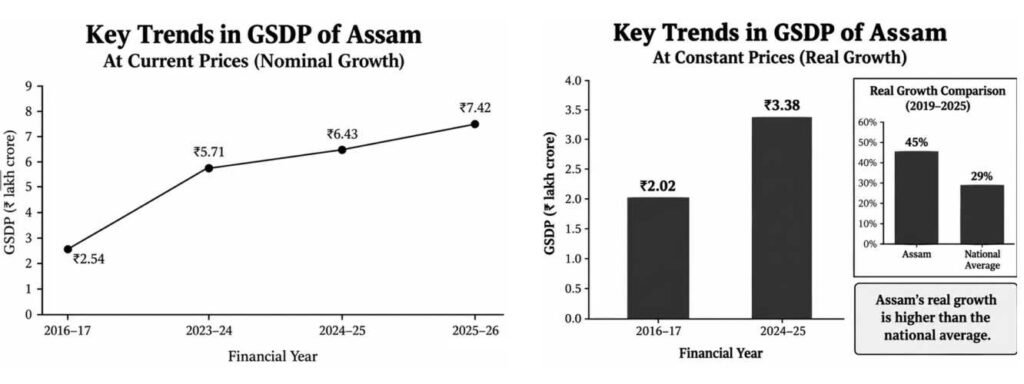
GSDP at Current Prices
According to the Economic Survey of Assam 2025–26:
- 2023–24: about ₹5.62 lakh crore.
- 2024–25: about ₹6.43 lakh crore.
- 2025–26 Advance Estimate: about ₹7.45 lakh crore.
- Nominal GSDP was estimated to grow by around 15.84% in 2025–26.
GSDP at Constant Prices
- Assam’s GSDP at constant 2011–12 prices was estimated at about ₹3.84 lakh crore in 2025–26.
- Real GSDP growth for 2025–26 was estimated at about 10.12%.
Assam’s Contribution to India’s Economy
- Assam’s share in India’s GDP at current prices increased to approximately 2.09% in 2025–26.
- At constant prices, Assam’s share was around 1.90%.
- The rise indicates that Assam’s economy has been expanding somewhat faster than the national economy in recent years.
Gross State Value Added
- Gross State Value Added (GSVA) measures the value added by different sectors of the State economy.
- Broadly:
GSVA = Agriculture + Industry + Services
- GSVA is useful for understanding the sectoral structure of Assam’s economy.
Sectoral Composition in 2025–26
At current prices, the estimated sectoral composition of Assam’s GSVA was:
- Agriculture and Allied Activities – 20.46%
- Industry – 35.54%
- Services – 44.00%
Thus, the service sector is the largest contributor to Assam’s GSVA, followed by industry and agriculture.
Agriculture and Allied Sector
- Estimated GSVA in 2025–26: about ₹1.40 lakh crore.
- Share in GSVA: 20.46%.
- The sector includes:
- Crops
- Livestock
- Forestry and logging
- Fishing and aquaculture.
- Within agricultural and allied GSVA in 2025–26:
- Crops accounted for about 67.58%.
- Fisheries about 15.59%.
- Livestock about 11.17%.
- Forestry about 5.67%.
Industrial Sector
- Estimated GSVA in 2025–26: around ₹2.42 lakh crore.
- Share in GSVA: 35.54%.
- It includes:
- Mining and quarrying
- Manufacturing
- Electricity, gas and water supply
- Construction.
- Construction and mining have a relatively important role in Assam compared with several other states.
Service Sector
- Estimated GSVA in 2025–26: around ₹3.00 lakh crore.
- Share in GSVA: 44%.
- Major activities include:
- Trade
- Hotels and restaurants
- Transport
- Communication
- Financial services
- Real estate
- Professional services
- Public administration
- Other services.
- The service sector recorded an estimated current-price growth of about 19.38% in 2025–26.
Per Capita Income of Assam
- Per Capita Income (PCI) indicates the average income per person in the State.
- It is calculated broadly as:
Per Capita Income = Net State Domestic Product ÷ Mid-Year Population
- It is frequently used as an indicator of:
- Standard of living
- Economic prosperity
- Inter-state economic comparison.
Latest Data
- Per capita income at current prices:
- 2024–25: ₹1,60,417.
- 2025–26: approximately ₹1,85,429.
- Increase: around 15.59%.
At constant prices:
- 2024–25: ₹85,503.
- 2025–26: approximately ₹93,351.
- Increase: around 9.2%.
Interpretation
- Assam’s per capita income has been increasing steadily.
- However, per capita income must not be confused with actual income received by every individual.
- It is an average, and therefore does not reveal income inequality.
Assam Budget
- The Assam Budget provides the Government’s expected:
- Revenue
- Expenditure
- Borrowing
- Fiscal deficit
- Capital expenditure
- Sectoral allocations.
- The latest state budget is the Assam Budget 2026–27. Official budget documents include Budget Highlights, Budget Speech, Outcome Budget, Gender Budget and Green Budget.
Assam Budget 2026–27 – Selected Indicators
- Estimated GSDP for 2026–27: approximately ₹8.71 lakh crore.
- Fiscal deficit target: approximately 3% of GSDP.
- Budgeted net expenditure: approximately ₹1.48 lakh crore.
- Revenue balance is targeted at broadly zero, implying an attempt to avoid a revenue deficit.
Fiscal Deficit
- Fiscal deficit arises when total expenditure exceeds total receipts excluding borrowings.
- It indicates the State government’s borrowing requirement.
- High fiscal deficits over long periods may increase debt and interest obligations.
- At the same time, borrowing used productively for infrastructure can support future growth.
State Revenue
Revenue Receipts
For 2025–26, the State Economic Survey estimated:
- Total revenue receipts: about ₹1,17,226 crore.
- Receipts from Assam’s own resources: about ₹43,184 crore.
- Receipts from the Centre: about ₹74,042 crore.
Fiscal Dependence on the Centre
- A considerable portion of Assam’s revenue comes through:
- Share in Central taxes
- Grants from the Union Government.
- This reflects both:
- India’s federal fiscal system.
- Assam’s relatively limited own-tax base compared with larger industrial states.
Statistical Handbook of Assam
- The Statistical Handbook, Assam is published by the Directorate of Economics and Statistics.
- It is an important repository of detailed statistical information.
Major Data Covered
It contains information relating to:
- Area and population
- Agriculture
- Land utilisation
- Irrigation
- Livestock
- Forestry
- Fisheries
- Industry
- Mining
- Electricity
- Transport
- Banking
- Prices
- Education
- Health
- Employment
- State income
- Public finance.
Importance
- Unlike the Economic Survey, which provides more analytical explanation, the Statistical Handbook is primarily a data reference document.
- It is especially useful for:
- District-wise comparisons.
- Time-series data.
- Factual questions in competitive examinations.
Assam at a Glance
Nature of the Publication
- Assam at a Glance is another statistical publication of the Directorate of Economics and Statistics.
- The latest listed publication is Assam at a Glance 2026.
Importance
- Provides compact information on major:
- Demographic
- Economic
- Agricultural
- Industrial
- Infrastructure
- Social indicators.
- Useful for quick revision and factual comparison.
SDG India Index
- The SDG India Index is prepared by NITI Aayog.
- It evaluates States and Union Territories according to progress toward the Sustainable Development Goals.
- Scores range from 0 to 100.
Broad classification:
- Aspirant: 0–49
- Performer: 50–64
- Front Runner: 65–99
- Achiever: 100.
Assam’s Performance
In the SDG India Index 2023–24:
- Assam scored 65.
- Assam entered the Front Runner category.
- Its score had increased by 16 points since the 2018 baseline, when it scored about 49.
- This made Assam one of the relatively fast-improving states over the period. Press Information Bureau
Significance
- The improvement suggests progress in several areas of social and economic development.
- However, performance remains uneven across:
- Health
- Education
- Nutrition
- Infrastructure
- Gender
- Employment and other SDGs.
North Eastern Region District SDG Index
- Prepared by NITI Aayog with UNDP support.
- It measures SDG performance at the district level across the North-East.
Assam – District Performance
In the NER District SDG Index 2023–24:
- Dibrugarh was Assam’s best-performing district with a score of 74.29.
- It was followed by:
- Sivasagar – 74.00
- Jorhat – 73.79
- Nalbari – 72.86
- Goalpara – 72.79.
- South Salmara-Mankachar recorded the lowest listed Assam score at 59.71.
What Does It Show?
- Assam has significant intra-state development disparities.
- Upper Assam and some central districts generally perform relatively well.
- Several economically and socially vulnerable districts require targeted intervention.
Multidimensional Poverty Index
- Monetary income alone does not completely measure poverty.
- The National Multidimensional Poverty Index (MPI) measures simultaneous deprivation in areas such as:
- Health
- Education
- Standard of living.
Assam’s Performance
According to NITI Aayog’s National Multidimensional Poverty Index – Progress Review 2023:
- Share of Assam’s population classified as multidimensionally poor:
- 2015–16: 32.65%
- 2019–21: 19.35%.
- Thus, Assam recorded a substantial decline in multidimensional poverty during the period.
Interpretation
- The decline reflects improvements in access to several basic amenities and social services.
- However, around one-fifth of the population was still multidimensionally poor in the NFHS-5 reference period.
- Poverty remains particularly important in:
- Rural areas
- Char areas
- Flood-affected areas
- Tea-garden communities
- Remote hill and border regions.
Export Preparedness Index
- The Export Preparedness Index (EPI) is developed by NITI Aayog in collaboration with the Institute for Competitiveness.
- It evaluates states on factors such as:
- Export policy
- Business ecosystem
- Export ecosystem
- Export performance.
Assam’s Position
In the Export Preparedness Index 2022:
- Assam scored 43.19.
- Assam was ranked 21st overall among States and UTs.
- Within the landlocked-state category, Assam stood 8th.
Significance for Assam
Assam possesses strong export potential in:
- Tea
- Petroleum products
- Agricultural products
- Horticulture
- Handloom and handicrafts
- Bamboo products
- Agarwood
- Processed food.
Major constraints include:
- High logistics cost
- Geographical distance from major seaports
- Limited processing capacity
- Inadequate export infrastructure in some sectors.
Logistics Ease Across Different States – LEADS
- LEADS is released by the Department for Promotion of Industry and Internal Trade.
- It evaluates states on the quality and efficiency of their logistics ecosystem.
Assam’s Performance
- In LEADS 2024, Assam was categorised as an “Achiever” in the North-East group.
- Assam retained the same category that it had achieved in 2023.
- The report highlighted improvements in logistics infrastructure, digital systems and single-window mechanisms.
Economic Importance
Improved logistics is especially significant because Assam:
- Acts as the gateway to the North-East.
- Lies on key road, rail, river and air corridors.
- Can benefit from:
- Inland waterways
- Multimodal logistics
- India–Bangladesh connectivity
- Act East Policy
- BBIN connectivity.
India Innovation Index
- The India Innovation Index is prepared by NITI Aayog.
- It assesses States on:
- Human capital
- Investment
- Knowledge workers
- Business environment
- Research output
- Innovation outcomes.
Assam’s Position
In the India Innovation Index 2021:
- Assam scored 11.29.
- It ranked 9th among North-Eastern and Hill States.
Major Challenge
- Assam possesses substantial potential in:
- Biotechnology
- Agriculture
- Tea technology
- Oil and natural gas
- Renewable energy
- Traditional knowledge.
- However, research-commercialisation linkages, private investment, patent generation and high-technology industries remain comparatively limited.
Employment and Labour Data
Employment conditions in Assam are assessed primarily through:
- Periodic Labour Force Survey – PLFS
- Population Census
- Economic Census
- State Economic Survey
- Employment exchanges and labour department statistics.
Important Indicators
Key labour-market indicators include:
- Labour Force Participation Rate – LFPR
- Worker Population Ratio – WPR
- Unemployment Rate – UR
- Rural–urban employment
- Male–female labour-force participation.
Structural Feature of Assam
- A large proportion of Assam’s workforce continues to depend on:
- Agriculture
- Plantation activities
- Construction
- Informal trade
- Small-scale services.
- Therefore, Assam faces the challenge of shifting workers from low-productivity occupations to higher-productivity manufacturing and modern services.
Price and Inflation Data
Inflation affecting Assam is usually monitored through:
- Consumer Price Index – CPI
- CPI Rural
- CPI Urban
- Wholesale Price Index at the national level
- State retail price statistics.
Importance for Assam
Inflation affects:
- Household purchasing power
- Real wages
- Food security
- Poverty
- Government expenditure.
Why Food Inflation Matters More
- A relatively large proportion of household expenditure in Assam is spent on food.
- Therefore, increases in prices of:
- Rice
- Vegetables
- Pulses
- Fish
- Edible oil
- Fuel
can have a disproportionately large effect on poorer households.
Banking and Financial Inclusion Indicators
Economic development is also assessed through:
- Number of bank branches
- Deposits
- Bank credit
- Credit–Deposit Ratio
- Priority-sector lending
- Kisan Credit Cards
- Self-help group credit
- Mudra loans
- Financial inclusion accounts.
Significance
- Expansion of banking improves:
- Access to institutional credit
- Entrepreneurship
- Agricultural investment
- Household savings
- Digital payments.
- However, remote, riverine and hill areas may continue to face lower physical access to banking infrastructure.
Human Development Indicators
Economic development is closely connected with:
- Literacy
- School attendance
- Life expectancy
- Infant mortality
- Maternal health
- Nutrition
- Drinking water
- Sanitation
- Housing.
Important Sources
Major sources include:
- National Family Health Survey
- Sample Registration System
- SDG India Index
- Census
- Health Management Information System
- Assam Economic Survey.
Why They Matter
- A state can record high GSDP growth without equivalent improvements in human welfare.
- Therefore, economic growth must be examined together with social development indicators.
Major Trends Emerging from Recent Data
Rapid Expansion of the Economy
- Assam’s nominal economy has expanded rapidly in recent years.
- GSDP crossed:
- ₹5 lakh crore,
- then ₹6 lakh crore,
- and reached approximately ₹7.45 lakh crore in 2025–26.
Increasing National Economic Share
- Assam’s contribution to India’s GDP has moved above 2%.
- This indicates a gradual increase in Assam’s relative economic weight.
Services Lead the Economy
- Services account for about 44% of GSVA.
- Trade, transport, public administration and other services form important components.
Industry Has Become More Significant
- Industry accounts for more than one-third of GSVA.
- Mining, petroleum, construction and manufacturing remain significant.
Agriculture Remains Socially Important
- Agriculture’s share in output has declined relative to services and industry.
- Yet it remains extremely important for employment and rural livelihoods.
- This creates a structural imbalance between agriculture’s employment share and its income-generating capacity.
Poverty Has Declined
- Multidimensional poverty fell substantially between NFHS-4 and NFHS-5.
- However, regional and social disparities remain.
Sustainable Development Performance Has Improved
- Assam moved into the Front Runner category in the SDG India Index 2023–24.
- Its composite score improved from about 49 in 2018 to 65 in 2023–24.
Connectivity and Logistics Are Improving
- Assam’s classification as a LEADS Achiever reflects strengthening logistics capabilities.
- This is particularly important for Assam’s role as India’s principal economic gateway to the North-East.
Limitations While Interpreting Economic Data
- High GSDP does not automatically mean high household welfare.
- Per capita income is an average and hides inequality.
- Current-price growth partly reflects inflation.
- State averages hide substantial district-level disparities.
- Floods and other natural hazards can produce large year-to-year fluctuations.
- Informal economic activities may not always be fully captured.
- Economic data are revised periodically.
- Different reports may use different reference years or methodologies.
Overall Assessment
- Recent reports indicate that Assam is undergoing a phase of relatively rapid economic expansion.
- The State’s GSDP, per capita income and share in India’s GDP have increased.
- Services remain the largest contributor, while industry has acquired increasing importance.
- Multidimensional poverty has declined and SDG performance has improved.
- Assam has also strengthened its logistics position.
At the same time, the State continues to face important structural challenges:
- High dependence on agriculture for livelihoods.
- Uneven industrialisation.
- Regional disparities.
- Flood vulnerability.
- Relatively low productivity in parts of the rural economy.
- Employment generation for a growing educated workforce.
- Export and innovation constraints.
- Need for higher-quality health, education and urban infrastructure.
Thus, the major policy challenge for Assam is no longer economic growth alone, but converting that growth into productive employment, higher incomes, reduced regional inequality and sustainable human development.