
Religion in Ancient Assam

Religion in Ancient Assam

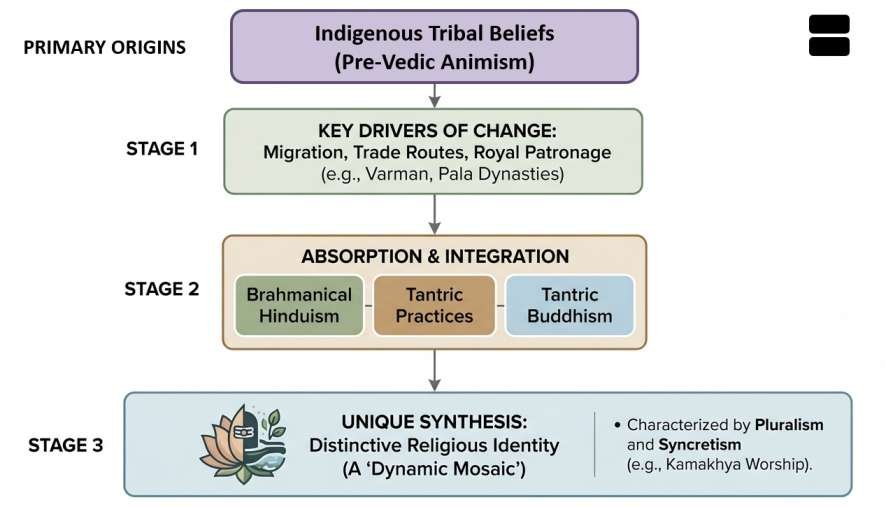
The religious life of Ancient Assam was remarkably rich and diverse. Unlike many other regions of early India where a single religious tradition dominated for long periods, Assam developed a pluralistic spiritual landscape where numerous belief systems coexisted and interacted. Over the centuries, indigenous tribal beliefs merged with Brahmanical Hinduism, while Buddhism and Jainism also left their cultural and archaeological traces.

This complex religious environment evolved through migration, trade contacts, royal patronage, and cultural exchange with neighbouring regions such as Bengal, Bihar, Tibet, and Southeast Asia. The result was a unique synthesis in which tribal animistic traditions, Tantric practices, and classical Hindu philosophies blended into a distinctive religious identity.

Understanding religion in ancient Assam therefore requires looking not only at temples and scriptures but also at local rituals, folk traditions, and archaeological remains, which together reveal the spiritual foundations of the region.
A. Pre-Vedic Animistic Traditions

B. Hinduism in Ancient Assam

C. Buddhism in Ancient Assam

D. Jainism in Ancient Assam

A. Pre-Vedic Animistic Traditions

Before the arrival of Vedic Brahmanism, the earliest inhabitants of Assam—including various tribal communities such as the Bodo, Khasi, Karbi, and other indigenous groupsfollowed systems of belief that modern scholars describe as animism.

Animism is the belief that natural objects and forces possess spiritual power. In ancient Assam, nature itself was perceived as sacred.

Worship of Nature

The people revered and worshipped various elements of nature, including:

    • Rivers, believed to be life-giving and divine.

    • Mountains and hills, seen as the dwelling places of spirits.

    • Forests and trees, considered sacred and inhabited by supernatural beings.

    • Natural spirits and guardian deities, believed to influence daily life.

Such beliefs were deeply connected to the environment of the Brahmaputra Valley, where rivers, forests, and hills dominated the landscape.

Ancestor Worship and Ritual Practices

Another important feature of early religion was ancestor worship. Tribal communities believed that the spirits of ancestors continued to guide and protect the living. Ritual offerings were therefore made to honour them.

Religious practices also included:

    • Fertility rituals, intended to ensure agricultural prosperity and population growth.

    • Seasonal ceremonies linked with harvest cycles.

    • Animal sacrifices, offered to appease spirits and local deities.

These traditions were not rigidly organized into formal institutions but were community-based rituals passed down through generations.

Influence on Later Hinduism

When Brahmanical Hinduism gradually spread into Assam, these indigenous traditions were not completely replaced. Instead, they were absorbed and integrated, especially within the development of Shaktism and Tantric worship.
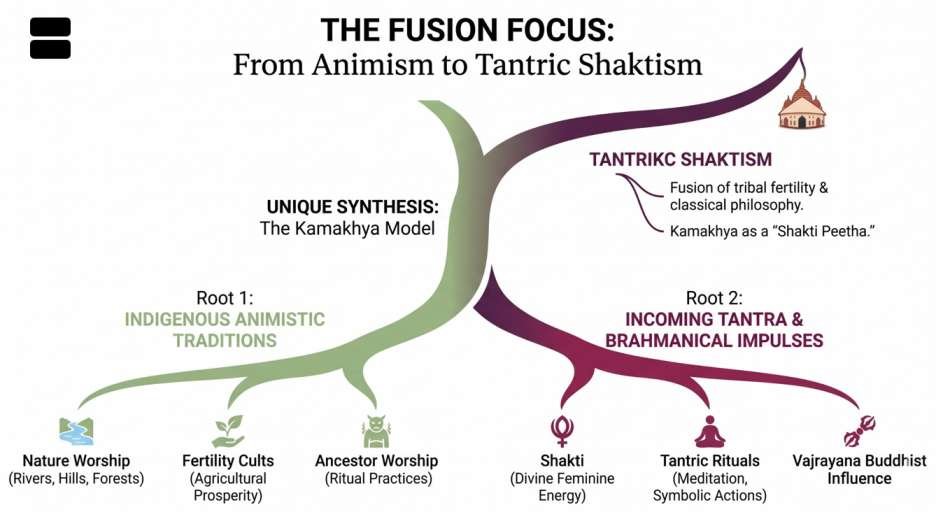
Thus, the early animistic traditions of Assam formed the spiritual foundation upon which later religious systems developed.

B. Hinduism in Ancient Assam

Over time, Hinduism became the dominant religious framework in Assam, particularly under the patronage of regional dynasties such as the Varman, Salastambha, and Pala rulers of Kamarupa.

However, the form of Hinduism practiced here was not identical to that of northern India. It incorporated local customs, tribal beliefs, and Tantric practices, creating a distinctive regional form.

The most prominent Hindu traditions in ancient Assam included:

    • Shaivism (worship of Shiva)

    • Vaishnavism (worship of Vishnu)

    • Shaktism (worship of the Goddess)

    • Sun worship (Surya cult)

Shaivism in Assam

    • Shaivism, the worship of Lord Shiva, was widely practiced in ancient Assam. Shiva was revered both in Brahmanical temples and in tribal forms of worship.
    • Many archaeological discoveries—such as stone lingams, temple remains, and sculpturesdemonstrate the popularity of Shaivism.
    • The Shiva Lingam, representing the cosmic creative force, was the most common symbol used in temples.
    • Numerous inscriptions and artefacts refer to Mahadeva, another name for Shiva.
    • In some regions, Shiva worship also incorporated local mountain and fertility cults, linking the deity with the natural landscape.
    • Few sites : Umananda Temple ,Da Parbatia Temple Ruins, Madan Kamdev Temple Complex, Sukreswar Temple, Surya Pahar

Vaishnavism and Royal Patronage

    • Alongside Shaivism, Vaishnavism, the worship of Lord Vishnu, was also important.
    • Many kings of ancient Assam sought to legitimize their authority by associating themselves with mythological or epic lineages connected to Vishnu.
    • Some rulers claimed descent from Bhagadatta, the legendary king of Pragjyotisha mentioned in the Mahabharata.
    • Temples dedicated to Vishnu and his avatars such as Narayana have been discovered through archaeological excavations. 
    • For rulers, such religious affiliations helped strengthen their political legitimacy, while for the population they provided a devotional framework connecting local traditions with broader Indian mythology.
    • Few Sites : Hayagriva Madhava Temple, Hajo Madhava Temple, Surya Pahar, Da Parbatia Temple Ruins, Madan Kamdev Temple Complex

Shaktism and the Tribal Origins of Kamakhya Worship

Among all religious traditions in ancient Assam, Shaktism was perhaps the most distinctive and influential.

Shaktism centres on the worship of Shakti, the divine feminine energy believed to be the source of all creation.

The Kamakhya Temple
    • The most important centre of Shakta worship in Assam is the Kamakhya Temple, located on Nilachal Hill near Guwahati.
    • This shrine eventually became one of the most important Tantric pilgrimage centres in India.
    • According to sacred texts such as the Kalika Purana and Yogini Tantra, the site marks the place where the yoni (womb) of the goddess Sati fell during the mythological dismemberment of her body by Lord Vishnu.
    • Because of this association, Kamakhya is regarded as one of the most sacred Shakti Peethas.
Tribal Roots of Goddess Worship

Scholars believe that the worship of Kamakhya may have originated from tribal fertility cults practiced by indigenous groups such as the Khasi and Bodo.

These early cults emphasized:

    • Female fertility

    • Agricultural prosperity

    • Cycles of nature and reproduction

When Hindu Tantric traditions arrived, they merged with these local beliefs, creating a powerful and unique religious system.

Tantric Rituals

The rituals associated with Kamakhya often involved Tantric practices, including:

    • Meditation on divine feminine power

    • Symbolic rituals of fertility and creation

    • Animal sacrifices, especially goats and buffaloes

This fusion of tribal traditions and Tantric Hindu philosophy made Kamakhya one of the most unusual and influential religious centres in India.

Sun Cult and Surya Sculptures

  • Another interesting feature of ancient Assamese religion was the worship of Surya, the Sun God.
  • Although not as dominant as Shaivism or Shaktism, the Sun cult was clearly present in the region.
  • Archaeological Evidence –  Stone sculptures of Surya have been discovered in places such as:
      • Kaki (Nagaon district)

      • Tezpur

  • These sculptures depict Surya riding a chariot drawn by horses, a motif common in Gupta-period Indian art.
  • The presence of these sculptures indicates that Sun temples or shrines once existed in these areas.
  • Cultural Significance : 
    • The Surya cult reflects the broader connections between Assam and the artistic traditions of northern India, especially during the Gupta and post-Gupta periods.
    • It also highlights the importance of solar symbolism, representing light, power, and cosmic order.

Minor Deities followed in Hinduism

In addition to the major deities, various minor gods and goddesses were also worshipped throughout ancient Assam.

Archaeological discoveries have revealed sculptures and inscriptions dedicated to:

Indra
  • Indra, the Vedic king of the gods, appears in several ritual contexts and mythological references.
  • Although his importance declined in later Hinduism, he remained part of the traditional pantheon.
Ganesha
  • Ganesha, the elephant-headed god of wisdom and auspicious beginnings, appears in many sculptures found in Assam.
  • Interestingly, some images of Ganesha incorporate tribal artistic styles, suggesting his popularity among both elite and common people.
Lakshmi and Saraswati
  • Two important goddesses frequently worshipped were:
    • Lakshmigoddess of wealth and prosperity

    • Saraswatigoddess of knowledge and learning

  • These deities were worshipped both in temples and household rituals, reflecting their everyday importance in social life.
  • The presence of these various deities demonstrates the inclusive and diverse character of religious life in ancient Assam.

C. Buddhism in Ancient Assam

Although Hinduism eventually became dominant, Buddhism also played an important role in Assam’s religious history.

Buddhism likely reached the region through eastern India, especially during the period of the Pala dynasty of Bengal and Bihar, which strongly supported Buddhist institutions.

Two major forms of Buddhism were present:

    • Mahayana Buddhism

    • Vajrayana (Tantric Buddhism)

Mahayana and Vajrayana Traditions

Mahayana Buddhism, which emphasizes the ideal of the Bodhisattva (a compassionate being who postpones enlightenment to help others), spread widely in eastern India and eventually reached Assam.

Later, Vajrayana Buddhism, a more mystical and Tantric form of the religion, became influential.

Important centres associated with Buddhist activity include:

1. Goalpara

Archaeological excavations have revealed Buddhist icons, stupas, and terracotta objects, suggesting the presence of monastic communities.

2. Hajo

The town of Hajo is a remarkable example of religious coexistence, being sacred to Hindus, Buddhists, and Muslims even today.

3. Kamakhya

Some scholars believe that before becoming a major Shakta centre, Kamakhya may have been associated with Tantric Buddhist worship.

Many Buddhist Tantric practices were later absorbed into Shaktism, illustrating the close interaction between the two traditions.

Buddhist Deities

Several images of Buddhist figures have been discovered in Assam, including:

    • Avalokiteshvarathe Bodhisattva of compassion

    • Taraa powerful female Bodhisattva

    • Prajnaparamitathe personification of transcendental wisdom

These discoveries show that Buddhist philosophical and artistic traditions were well established in the region.

Buddhist Stupas and Terracotta Plates

Archaeological evidence provides strong confirmation of Buddhism’s presence in ancient Assam.

1. Stupas
  • Several stupasBuddhist religious monuments—have been discovered in western Assam, particularly in Goalpara district.
  • These structures often contained relic chambers, where sacred objects or remains associated with Buddhist monks were placed.
2. Terracotta Votive Tablets
  • Excavations have also revealed terracotta votive tablets engraved with Buddhist mantras and sacred images.
  • Interestingly, these artefacts closely resemble those found in famous Buddhist centres such as:
    • Nalanda

    • Vikramashila

  • This similarity indicates cultural and religious exchanges between Assam and major Buddhist universities in Bihar and Bengal.

Such evidence suggests that Assam was actively connected to the broader Buddhist intellectual world of medieval India.

D. Jainism in Ancient Assam

Although Jainism never became a dominant religion in Assam, archaeological evidence confirms its presence.

The most important site connected with Jainism is Surya Pahar, located in Goalpara district.

Surya Pahar: A Multi-Religious Centre

Surya Pahar is one of the most fascinating archaeological sites in Assam because it contains evidence of three different religious traditions:

    • Hinduism

    • Buddhism

    • Jainism

This indicates that the region was once an important religious and cultural meeting point.

Jain Sculptures
  • Several rock-carved sculptures of Jain Tirthankaras, including Rishabhanatha, have been discovered at the site.
  • Tirthankaras are spiritual teachers who guide followers toward liberation.
Trade and Pilgrimage
  • Historians believe that Jain communities may have been connected to trade networks passing through the Brahmaputra valley.
  • Merchants and travellers often established religious shrines along trade routes, which explains the presence of Jain monuments in the region.
  • Although Jainism remained a minor tradition, it contributed to the religious diversity of ancient Assam.
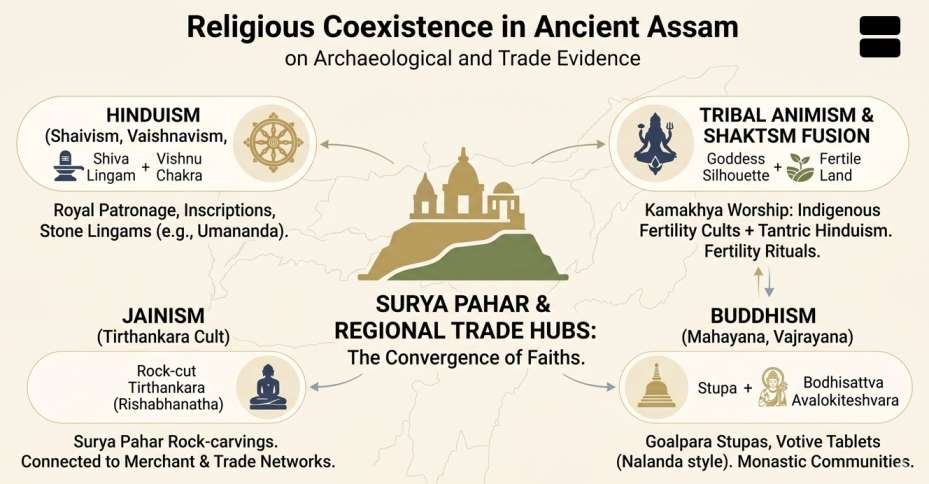
 

The religious history of Ancient Assam reflects a remarkable fusion of indigenous traditions and major Indian religions.

Beginning with animistic tribal beliefs, the region gradually incorporated Hinduism, Buddhism, and Jainism, creating a unique spiritual landscape.

The most distinctive feature of this evolution was the integration of tribal fertility cults with Tantric Hinduism, especially in the worship of Kamakhya, which later became one of the most important Shakta centres in India.

Archaeological discoveries—including temples, sculptures, stupas, inscriptions, and terracotta artefactsdemonstrate that ancient Assam was not isolated but actively connected to broader religious and cultural movements across the Indian subcontinent.

Thus, the religion of ancient Assam was not a single tradition but a dynamic mosaic of beliefs, reflecting centuries of cultural interaction, adaptation, and spiritual creativity.

Citations
  1. P. C. Choudhury. (1959). The History of Civilisation of the People of Assam to the Twelfth Century A.D. Guwahati: Department of Historical and Antiquarian Studies.

  2. H. K. Barpujari. (1990). The Comprehensive History of Assam, Vol. I: Ancient Period. Guwahati: Assam Publication Board.

  3. B. K. Barua. (1951). A Cultural History of Assam. Guwahati: Lawyers Book Stall.

  4. E. A. Gait. (1906). A History of Assam. Calcutta: Thacker, Spink & Co.

  5. Kalika Purana. (c. 10th century CE). Describes the origin of Kamakhya Temple and the prominence of Shaktism in Kamarupa.

  6. Surya Pahar. Archaeological site showing remains of Hindu, Buddhist, and Jain sculptures, indicating the multi-religious character of ancient Assam.

Let us know any further suggestions ,we at sudurbhai.com will be happy to hear from you in our comment section below ! 

2 thoughts on “Religion in Ancient Assam”

Leave a Reply to Bidisha Dihingia Cancel Reply

Your email address will not be published. Required fields are marked *

Scroll to Top