
Prehistoric Assam offers a fascinating glimpse into the earliest phases of human civilization in Northeast India. Long before written history began, this region witnessed the gradual evolution of human life—from simple stone tool users to communities practicing agriculture and ritual traditions.
Understanding Prehistoric Assam helps us connect the present with the deep past, revealing how geography, climate, and culture shaped human survival and innovation.
Paleolithic Cultures (Old Stone Age)
The Paleolithic Age represents the earliest stage of human existence, when humans depended entirely on hunting and gathering.
Important Sites in Prehistoric Assam
- Rongram Valley (Garo Hills)
Dates back to the Middle Pleistocene period (781,000–126,000 years ago).
Famous for handaxe-cleaver tools, similar to the Abbevillio-Acheulean culture (a major early human technological tradition).
A hunter might have used a handaxe to cut meat or break bones for marrow—an essential source of nutrition.
2. Daphabum (Lohit District, Arunachal Pradesh)
Tools made from metamorphic rocks.
Indicates early adaptation to available natural resources.
3. Khangkhui (Ukhrul, Manipur)
A cave-based site from the Late Pleistocene.
Shows evidence of more advanced human occupation, including shelter use.
Unlike open-air settlements, caves like Khangkhui provided natural protection from wild animals and harsh weather.
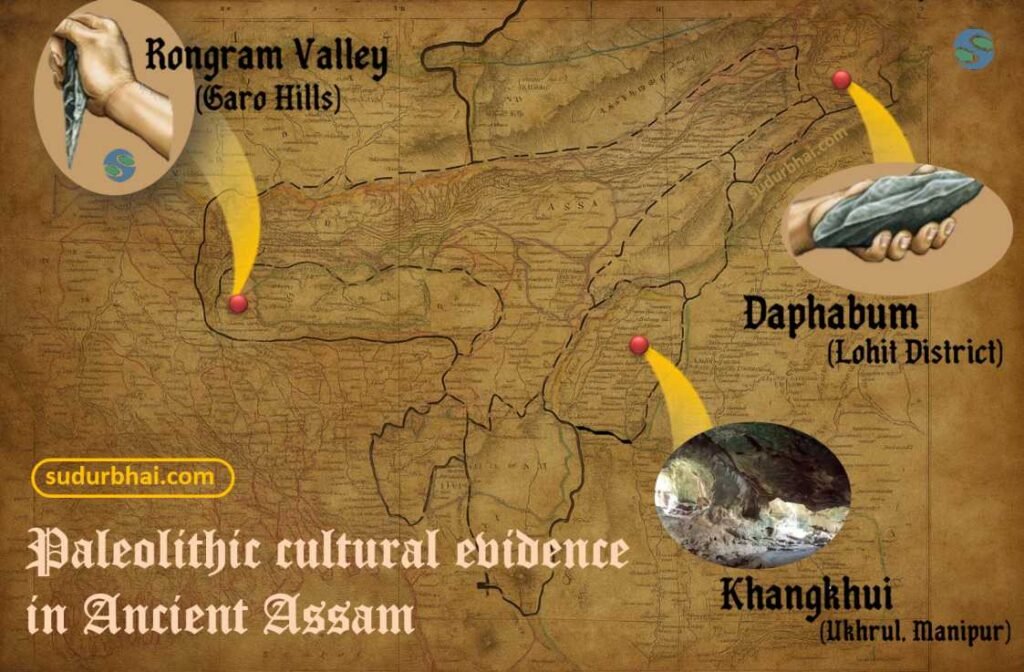
Tools and Lifestyle used in Prehistoric Assam
| Feature | Description |
|---|---|
| Tools | Handaxes, cleavers made of stone |
| Purpose | Hunting animals, cutting meat, processing food |
| Lifestyle | Nomadic hunter-gatherers |
| Evidence Limitation | No human skeletons found due to humid climate |
The absence of skeletal remains is due to Assam’s high rainfall, acidic soil, and humidity, which destroy organic materials over time.
Microlithic Cultures (Transition Phase)
The Microlithic Age marks a transition between the Paleolithic and Neolithic periods.
Key Features
- Tools discovered in Rongram Valley, between Neolithic layers and virgin soil.
- Use of microliths (small stone tools) made from dolerite (a hard volcanic rock).
- Evidence of crude handmade pottery.
Lifestyle and Settlement
| Aspect | Details |
|---|---|
| Tools | Small, sharp microliths |
| Material | Dolerite (unique compared to other regions) |
| Pottery | Simple handmade pots |
| Lifestyle | Semi-nomadic |
A microlith could be attached to a wooden shaft to create a composite tool, like a spear or arrow.
These people were more organized than Paleolithic humans, but still relied heavily on nature. Their semi-nomadic lifestyle suggests they moved seasonally in search of food.
Neolithic Cultures (New Stone Age)
The Neolithic Age marks a major turning point—humans began practicing agriculture and settled life.
Important Sites:
Daojali Hading (Dima Hasao)
Sarutaru (Kamrup District)
Selbagiri (Garo Hills)
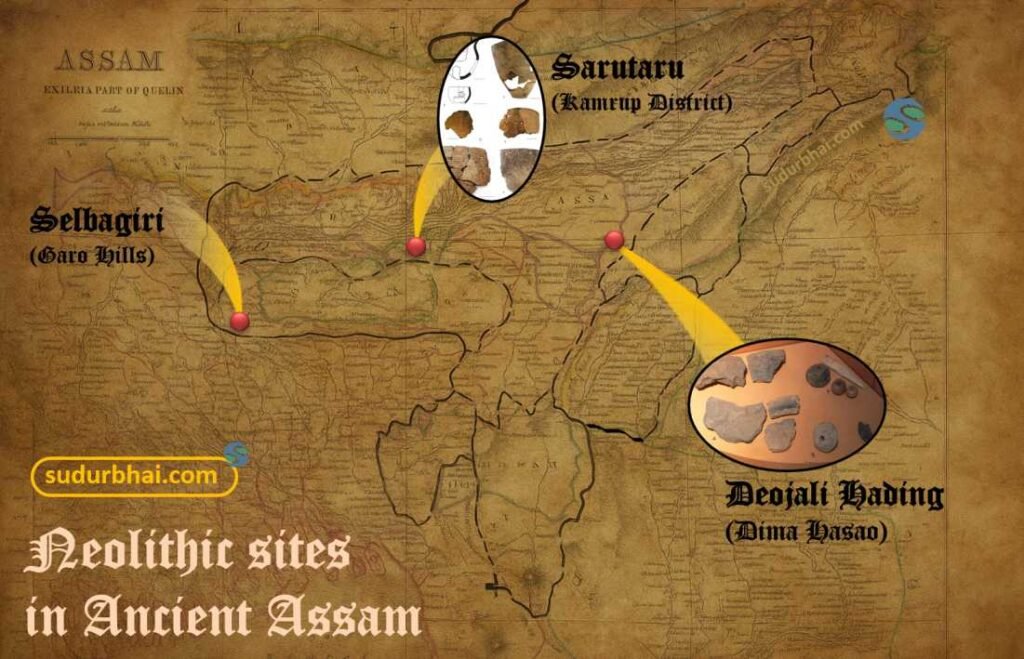
Tools, Artifacts, and Practices
| Tool Type | Use |
|---|---|
| Celts | Cutting trees, clearing land |
| Hatchets | Woodwork |
| Grooved hammer stones | Crushing and shaping materials |
These tools were ground and polished, making them more efficient and durable than earlier tools.
Agricultural Practices
One of the most important developments was shifting cultivation (Jhum cultivation).
What is Jhum Cultivation?
Forest land is cleared by cutting and burning vegetation.
Crops are grown for a few years.
Land is then left to regenerate.
Even today, many tribal communities in Northeast India follow Jhum cultivation, showing continuity from prehistoric times.
Cultural Connections
Strong links with the Hoabinhian culture of Southeast Asia.
Indicates that Assam was part of a wider cultural exchange network.
Settlement Pattern
People lived mostly on hills and highlands.
Reason-The plains of Assam were prone to seasonal flooding, making them unsuitable for permanent settlement.
Important Explorers and Contributions
| Explorer | Contribution |
|---|---|
| W. Penny | Discovered Neolithic tools in Biswanath |
| J.H. Hutton | Classified tools into types |
| J.P. Mills & K.L. Barua | Collected and documented tools |
Tool Classification by J.H. Hutton
Triangular
Rectangular
Shouldered
Archaeological Zones (A.H. Dani Classification)
Zone | Region |
|---|---|
1 | Cachar Hills |
2 | Sadiya Frontier |
3 | Naga Hills |
4 | Khasi Hills |
5 | Garo Hills |
6 | Brahmaputra Valley |
Megalithic Cultures
The Megalithic phase is one of the most culturally rich stages of Prehistoric Assam.
Key Features
- Practice of erecting large stone monuments (megaliths).
- Common among Khasi and Naga tribes.
- Some traditions continue even today.
Purpose of Megaliths
| Purpose | Explanation |
|---|---|
| Burial | Marking graves |
| Ancestor Worship | Honoring ancestors |
| Ceremonial Use | Ritual and social gatherings |
Example:
In Khasi culture, large stones are still erected to commemorate important individuals or events.
Cultural and Religious Significance
These practices laid the foundation for:
- Fertility cults
- Shaktism
- Vajrayana Buddhism
Unique Cultural Identity
- Unlike mainland India:
- Assam shows strong cultural affinity with Southeast Asia.
- There is no clear Metal Age, but the Megalithic culture fills this gap.
Why Prehistoric Assam Matters
Prehistoric Assam is not just about stones and tools—it is about human adaptation, survival, and innovation.
- Paleolithic Age: Survival through hunting and simple tools
- Microlithic Age: Transition with improved tools and pottery
- Neolithic Age: Agriculture, settlement, and cultural exchange
- Megalithic Age: Rituals, beliefs, and social identity