
Left-Wing Extremism (LWE), commonly associated with Naxalism or Maoism, has been one of India’s most persistent internal security challenges. It combines an ideological opposition to the existing political and socio-economic system with organised armed violence against the State.
The movement traces its origins to the Naxalbari uprising of 1967 in West Bengal and gradually spread across several tribal and underdeveloped regions of central and eastern India. Over time, LWE became closely associated with issues such as land alienation, tribal deprivation, weak governance, underdevelopment, mining-related displacement, forest rights and lack of access to justice.
At the same time, the movement cannot be understood merely as a reaction to poverty. It has an organised ideological and military structure that seeks to overthrow the existing State through armed revolution and protracted people’s war.
India’s approach towards LWE has therefore increasingly combined security operations, development, governance reforms, infrastructure expansion, rights-based legislation, surrender and rehabilitation, intelligence gathering and community engagement.
Meaning of Left-Wing Extremism
- Left-Wing Extremism refers to violent political movements inspired largely by Maoist revolutionary ideology.
- It rejects the existing parliamentary democratic system and seeks fundamental political transformation through armed struggle.
- In the Indian context, LWE is primarily associated with the activities of the Communist Party of India (Maoist) and its affiliated armed organisations.
- The movement has historically found support in pockets characterised by:
- Tribal marginalisation
- Land disputes
- Weak administrative penetration
- Poverty
- Difficult terrain
- Resource exploitation
- Limited public services
Meaning of Naxalism
- The term Naxalism originates from Naxalbari, a village in West Bengal where an armed peasant uprising took place in 1967.
- The uprising was associated with demands concerning:
- Land redistribution
- Rights of peasants
- Opposition to landlord domination
- Over time, the term “Naxalite” came to refer broadly to revolutionary communist groups advocating armed struggle against the State.
Naxalism and Maoism
- Naxalism is the broader historical term derived from the Naxalbari movement.
- Maoism refers more specifically to the ideological framework inspired by Mao Zedong’s strategy of revolutionary warfare.
- Maoist ideology in India emphasises:
- Armed revolution
- Guerrilla warfare
- Mobilisation of peasants and tribal populations
- Gradual expansion from rural areas
- Capture of political power through prolonged struggle
Thus:
Naxalism = Historical Indian Revolutionary Movement
Maoism = Ideological and Organisational Framework of Contemporary LWE
Historical Evolution of Naxalism
Background Before 1967
- The communist movement in India had already witnessed ideological divisions regarding:
- Parliamentary democracy
- Revolution
- Armed struggle
- The Communist Party of India (CPI) was formed in 1925.
- In 1964, ideological differences led to the formation of the Communist Party of India (Marxist).
Naxalbari Uprising, 1967
- The uprising began in Naxalbari in West Bengal.
- It was driven largely by grievances concerning:
- Land ownership
- Exploitation of peasants
- Sharecropping
- Tribal rights
- Leaders such as Charu Majumdar and others argued in favour of armed revolutionary struggle.
- The uprising was eventually suppressed, but its ideological influence spread to other regions.
Formation of CPI (ML)
- The Communist Party of India (Marxist-Leninist) was formed in 1969.
- It sought to organise armed revolution on the basis of Maoist principles.
- The movement suffered severe setbacks after:
- Arrests
- Leadership losses
- Internal divisions
Period of Fragmentation
- During the 1970s and 1980s, the Naxalite movement fragmented into several organisations.
- Two major groups later emerged:
- People’s War Group (PWG)
- Maoist Communist Centre of India (MCCI)
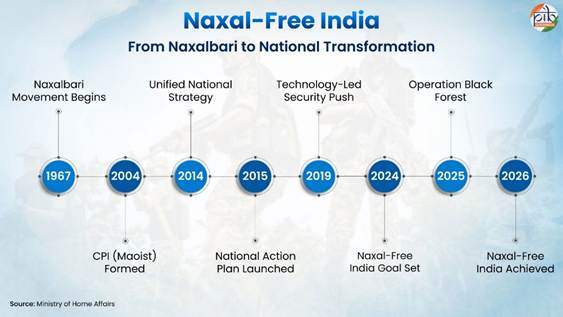
Formation of CPI (Maoist), 2004
- In 2004, the People’s War Group and Maoist Communist Centre of India merged to form the Communist Party of India (Maoist).
- CPI (Maoist) subsequently became the most important organisation associated with LWE in India.
Maoist Ideology
- Maoist ideology is based on the belief that the existing political system protects the interests of dominant economic and social classes.
- It rejects parliamentary democracy as insufficient for fundamental social transformation.
- It advocates armed insurrection and a prolonged revolutionary struggle against the State.
- Its strategy is commonly associated with:
- Mobilisation of peasants
- Establishment of influence in remote rural areas
- Guerrilla warfare
- Creation of alternative political structures
- Gradual expansion towards larger areas
The central objective is to weaken the authority of the State and replace it with a revolutionary political order.
Objectives of Left-Wing Extremist Groups
- Overthrow of the existing political system through revolutionary violence.
- Creation of an alternative form of government based on Maoist ideology.
- Weakening State institutions in areas under extremist influence.
- Disruption of:
- Administration
- Infrastructure
- Economic activities
- Elections
- Establishment of control over local populations.
- Mobilisation of marginalised groups against the State.
- Expansion of insurgent-controlled areas through guerrilla warfare.
Organisational Structure of the Maoist Movement
- CPI (Maoist) maintains both a political structure and an armed structure.
- The political organisation is responsible for:
- Ideological mobilisation
- Propaganda
- Recruitment
- Strategic planning
- The armed component operates through the People’s Liberation Guerrilla Army (PLGA).
People’s Liberation Guerrilla Army
- PLGA functions as the armed wing of CPI (Maoist).
- Its activities may include:
- Guerrilla attacks
- Ambushes
- Use of Improvised Explosive Devices
- Attacks on security forces
- Sabotage of infrastructure
- Cadres are trained to exploit:
- Dense forests
- Hilly terrain
- Poor road connectivity
- Limited State presence
Red Corridor
- The term Red Corridor refers to areas historically affected by Left-Wing Extremism.
- These areas were concentrated largely across tribal and economically underdeveloped parts of:
- Chhattisgarh
- Jharkhand
- Odisha
- Bihar
- Parts of Andhra Pradesh and neighbouring regions
- Many of these areas were characterised by:
- Dense forests
- Mineral resources
- Tribal population
- Poor infrastructure
- Weak governance
- Historical land grievances
- The geographical spread of LWE has significantly reduced over time, but some pockets continue to remain affected.
Factors Responsible for the Rise of Naxalism
Land Issues
- Land alienation has been one of the major historical causes of Naxalism.
- Common grievances include:
- Incomplete land reforms
- Absence of land titles
- Illegal occupation of tribal land
- Exploitation by landlords
- Poor compensation for acquired land
- Land represents not merely an economic asset but also:
- Identity
- Livelihood
- Social security
Jal–Jangal–Jameen
- The concept of Jal–Jangal–Jameen highlights the close relationship of tribal communities with:
- Water
- Forest
- Land
- Loss of access to these resources can generate:
- Livelihood insecurity
- Cultural alienation
- Political resentment
- Extremist groups often exploit these grievances to expand their local influence.
Tribal Dispossession
- Tribal communities may face displacement due to:
- Mining
- Dams
- Industrial projects
- Infrastructure development
- Problems become more severe when:
- Compensation is inadequate
- Rehabilitation is delayed
- Community participation is absent
- Forest rights are poorly implemented
Mining and Resource Exploitation
- Several LWE-affected regions are rich in:
- Coal
- Iron ore
- Bauxite
- Other minerals
- Yet many local communities remain economically deprived.
- This creates a resource-development paradox:
Resource-Rich Region + Poor Local Population = Perception of Exploitation
- Maoist organisations often use such grievances in their propaganda.
Governance Deficit
- Weak governance has created fertile conditions for Maoist influence in some remote regions.
- Major problems include:
- Administrative absenteeism
- Corruption
- Weak policing
- Poor service delivery
- Delayed justice
- Lack of grievance redressal
- Poor implementation of decentralisation, including PESA, can deepen distrust.
Development Deficit
- Remote LWE-affected areas have historically experienced inadequate access to:
- Roads
- Schools
- Hospitals
- Banking
- Electricity
- Telecommunications
- Development deficits reduce the visible presence of the State.
- Maoist groups may exploit this administrative vacuum to build influence.
Poverty and Socio-Economic Inequality
- Poverty does not automatically produce Naxalism.
- However, poverty combined with:
- Inequality
- Political exclusion
- Weak governance
- Lack of justice
can increase vulnerability.
- Poor education, limited health services and unemployment contribute to feelings of relative deprivation.
Marginalised Farmers
- Small and marginal farmers may face:
- Debt
- Low agricultural prices
- Lack of irrigation
- Poor access to markets
- Persistent rural distress may become part of broader extremist mobilisation.
Environmental Degradation
- Mining and industrial activities can:
- Destroy forests
- Reduce access to traditional resources
- Displace communities
- Damage agricultural livelihoods
- Environmental grievances can therefore overlap with tribal and land-related grievances.
Social Alienation
- Communities may feel socially disconnected from mainstream institutions due to:
- Geographic isolation
- Cultural differences
- Administrative neglect
- Such alienation can strengthen the appeal of organisations claiming to defend local interests.
Human Rights Concerns
- Allegations of:
- Excessive force
- Arbitrary detention
- Custodial abuse
can weaken confidence in the State.
- Security operations that ignore local sensitivities may become propaganda tools for extremist organisations.
Difficult Geography
- LWE groups have historically operated in areas with:
- Dense forests
- Hills
- Poor roads
- Sparse settlement
- Such terrain provides:
- Concealment
- Mobility
- Tactical advantage
- It also makes security operations and development projects more difficult.
Financing of Left-Wing Extremism
- Maoist organisations require finance for:
- Weapons
- Communication
- Recruitment
- Logistics
- Sources may include:
- Extortion
- Illegal taxation
- Levies on contractors
- Mining-related extortion
- Kidnapping
- Other illegal activities
- Disrupting the financial network is therefore an important component of counter-LWE strategy.
Maoist Recruitment
- Recruitment often targets:
- Youth
- Tribal communities
- Economically vulnerable populations
- Recruitment may occur through:
- Ideological indoctrination
- Local grievances
- Fear
- Social networks
- Maoists may attempt to portray themselves as protectors of:
- Tribal rights
- Land rights
- Local resources
Propaganda and Ideological Mobilisation
- Propaganda is used to:
- Create distrust towards the State
- Highlight incidents of alleged injustice
- Mobilise support
- Attract new recruits
- The ideological battle is therefore as important as the military battle.
Urban Networks and Front Organisations
- Maoist strategy has also sought to develop support networks outside remote rural areas.
- Such networks may be used for:
- Propaganda
- Logistics
- Recruitment
- Fundraising
- Building political support
- The term “Urban Naxal” is politically contested and lacks a precise universally accepted legal definition; therefore, it should be used cautiously in analytical writing.
- From an internal security perspective, the core issue is whether an individual or organisation provides material, financial or operational support to unlawful violent activities, rather than merely expressing dissent.
Impact of Left-Wing Extremism
Impact on National Security
- Challenges the authority of the State.
- Creates prolonged internal conflict.
- Requires deployment of large security resources.
- Can destabilise multiple States simultaneously.
Impact on Development
- Maoist violence may target:
- Roads
- Railways
- Schools
- Telecommunications
- Mining infrastructure
- Destruction of infrastructure slows development and increases isolation.
Impact on Local Communities
- Communities may become trapped between:
- Maoist pressure
- Security operations
- Effects may include:
- Displacement
- Fear
- Loss of livelihood
- Disruption of education
Impact on Economy
- LWE can discourage:
- Investment
- Tourism
- Industrial activity
- Infrastructure projects
- Extortion further increases the cost of doing business.
Impact on Democracy
- Maoists may attempt to:
- Disrupt elections
- Intimidate voters
- Prevent political participation
- This undermines democratic processes in affected areas.
Challenges in Combating Left-Wing Extremism
Difficult Terrain
- Dense forests and hills complicate:
- Surveillance
- Movement
- Communication
- Rescue operations
Improvised Explosive Devices
- Maoists frequently use IEDs and landmines.
- Deeply buried explosives can be difficult to detect.
- Such attacks can cause heavy casualties among security personnel.
Intelligence Gaps
- Successful counter-insurgency depends heavily on local intelligence.
- Weak human intelligence can reduce the effectiveness of security operations.
Inter-State Coordination
- LWE areas often extend across State boundaries.
- Extremists may exploit differences in:
- Police capacity
- Intelligence systems
- Operational strategies
- Better Centre-State and inter-State coordination is therefore essential.
Lack of Local Familiarity
- Security personnel deployed from outside may face:
- Language barriers
- Limited knowledge of terrain
- Difficulty understanding local social structures
Governance and Delivery Gaps
- Security success may not become permanent if government institutions fail to provide:
- Healthcare
- Education
- Justice
- Employment
- Weak delivery of development benefits can recreate grievances.
Government Approach Towards Left-Wing Extremism
India’s approach has evolved towards a multi-pronged strategy based on:
Security + Development + Rights + Governance + Rehabilitation
Security Measures
- Deployment of:
- Central Armed Police Forces
- State Police
- Specialised anti-Naxal units
- Strengthening of:
- Police stations
- Fortified camps
- Intelligence networks
- Use of:
- UAVs
- Surveillance technology
- Modern communication systems
SAMADHAN Strategy
SAMADHAN represents an integrated counter-LWE approach.
- S – Smart Leadership
- A – Aggressive Strategy
- M – Motivation and Training
- A – Actionable Intelligence
- D – Dashboard-based Key Performance Indicators and Key Result Areas
- H – Harnessing Technology
- A – Action Plan for Each Theatre
- N – No Access to Financing
Its core idea is to combine leadership, intelligence, technology, training, operational planning and financial disruption.
National Policy and Action Plan
- The Government adopted a comprehensive National Policy and Action Plan to address LWE.
- It combines:
- Security operations
- Development
- Protection of local rights
- Improvement in governance
- Intelligence coordination
Specialised Forces
- Special forces and locally oriented units have been developed for anti-Maoist operations.
- Examples include:
- Greyhounds
- Bastariya Battalion
- State-specific special units
Development Measures
- Development initiatives have focused on:
- Road connectivity
- Skills
- Education
- Rural development
- Aspirational Districts
- Livelihood support
- Programmes such as PMGSY and infrastructure expansion are particularly important in remote LWE areas.
Road Connectivity
- Roads perform a dual function:
- Promote economic integration
- Improve security mobility
- Better connectivity also increases access to:
- Schools
- Hospitals
- Markets
- Administration
Aspirational Districts Programme
- Many backward districts affected by LWE have benefited from targeted development interventions.
- The focus is on improving outcomes in:
- Health
- Education
- Agriculture
- Infrastructure
- Skill development
Security Related Expenditure
- The Security Related Expenditure Scheme supports States in meeting expenses associated with counter-LWE operations.
Special Central Assistance
- Financial assistance has been provided to strengthen development and infrastructure in affected districts.
Civic Action Programme
- CAPFs conduct Civic Action Programmes to improve relations with local communities.
- Activities may include:
- Medical camps
- Sports programmes
- Distribution of essential items
- Community interaction
- Such measures help build trust and social legitimacy.
Surrender and Rehabilitation Policy
- Rehabilitation policies encourage Maoist cadres to abandon violence.
- Benefits may include:
- Financial assistance
- Skill training
- Livelihood support
- Reintegration into society
- A successful surrender policy weakens armed groups while reducing the cycle of violence.
PESA, 1996
- Panchayats (Extension to Scheduled Areas) Act, 1996 strengthens local self-governance in Scheduled Areas.
- It gives importance to:
- Gram Sabha
- Community participation
- Local decision-making
- Effective implementation of PESA can reduce alienation in tribal regions.
Forest Rights Act, 2006
- The Forest Rights Act seeks to recognise certain traditional rights of forest-dwelling communities.
- Proper implementation is important for:
- Land security
- Livelihood protection
- Reduction of tribal grievances
Land Acquisition and Rehabilitation
- Fair compensation and transparent rehabilitation are essential in regions experiencing:
- Mining
- Industrialisation
- Infrastructure expansion
- Development that causes displacement without justice can strengthen extremist propaganda.
Technology in Counter-LWE Operations
- Modern technology is increasingly used for:
- UAV surveillance
- Satellite imagery
- Communication
- IED detection
- Mapping
- Intelligence analysis
- Technology must complement rather than replace human intelligence.
Greyhounds Model
- Greyhounds, developed in the erstwhile undivided Andhra Pradesh, became one of the most cited examples of specialised anti-Naxal policing.
- Important features include:
- Specialised training
- Local terrain knowledge
- High mobility
- Strong intelligence
- Small-unit operations
- The model demonstrates the importance of professional, specialised and intelligence-driven counter-insurgency operations.
Saranda Model
- The Saranda Model combined restoration of State presence with development measures.
- It emphasised:
- Roads
- Public Distribution System
- Employment programmes
- Government services
- It reflects the importance of following security operations with visible development and administration.
Sandesh Model
- The Sandesh Model highlighted the role of:
- Grassroots democracy
- Local participation
- Development
- It demonstrates that strengthening local democratic institutions can reduce extremist influence.
Declining Geography of LWE
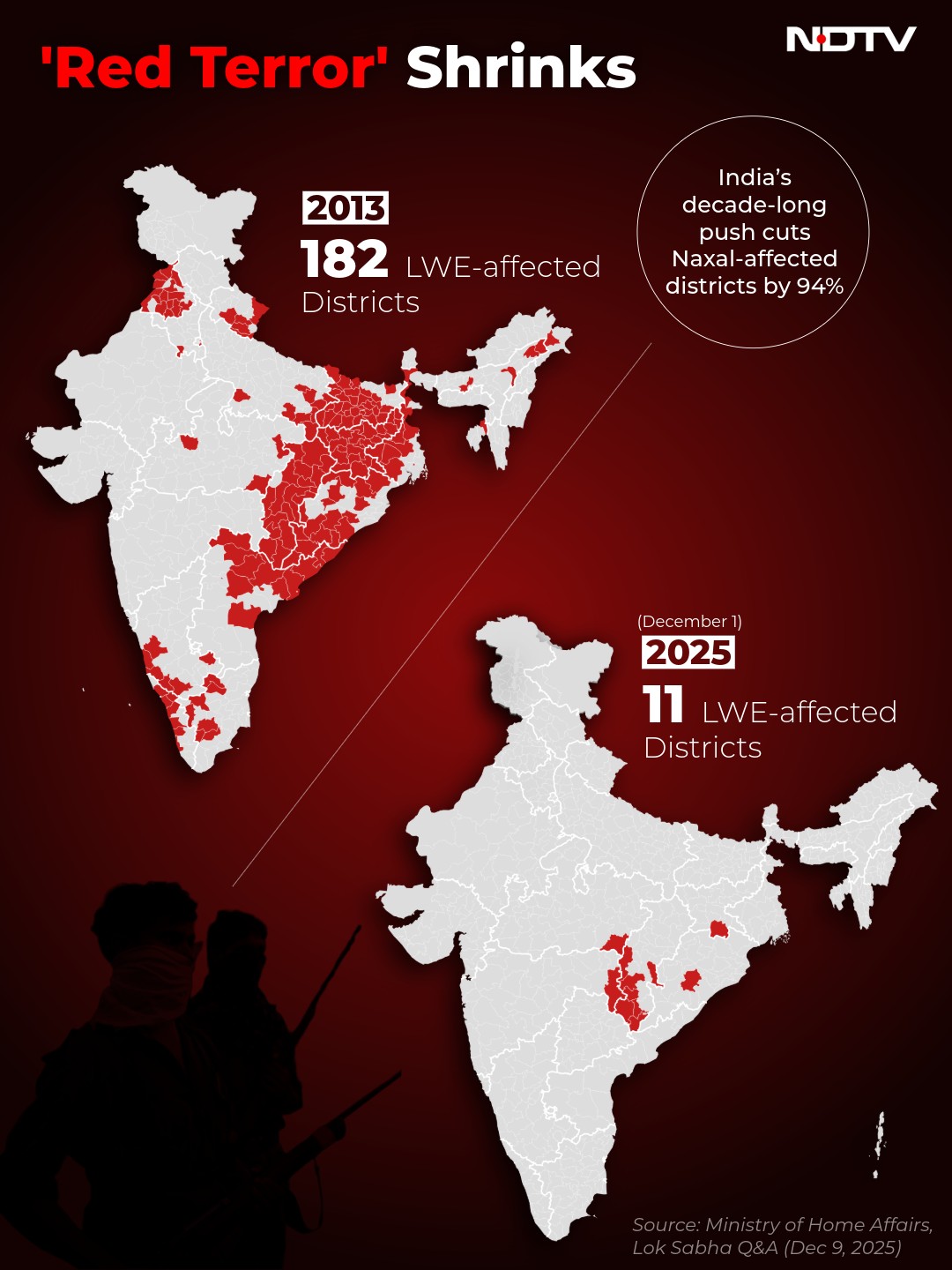
- The geographical spread and intensity of LWE violence have declined significantly compared with earlier decades.
- The number of affected districts has reduced sharply, while incidents of violence and fatalities have also fallen.
- The remaining challenge is increasingly concentrated in a smaller number of difficult pockets, particularly in parts of Chhattisgarh and adjoining areas.
Why Left-Wing Extremism Has Declined
- Improved security operations
- Better intelligence
- Expansion of road connectivity
- Strengthening of police infrastructure
- Greater Centre-State coordination
- Surrender and rehabilitation
- Declining recruitment
- Stronger financial disruption
- Better administrative penetration
- Increased development activities
Why the Remaining Challenge Is Difficult
- Remaining Maoist strongholds are often located in:
- Dense forests
- Difficult terrain
- Remote tribal areas
- These areas may still suffer from:
- Infrastructure deficits
- Governance gaps
- Local grievances
- Therefore, the last-mile phase of counter-LWE strategy can be more complex than simply reducing the overall geographical spread.
Way Forward
- Consolidate Security Gains
- Prevent Maoists from re-entering areas where they have lost influence.
- Strengthen Local Intelligence
- Improve trust-based intelligence gathering.
- Improve Inter-State Coordination
- Conduct coordinated operations across boundaries.
- Modernise Police Forces
- Improve training, mobility, communications and equipment.
- Focus on Last-Mile Development
- Ensure roads, schools, healthcare and connectivity reach remote settlements.
- Strengthen Tribal Rights
- Implement PESA and Forest Rights Act effectively.
- Responsible Mining
- Ensure local employment, fair compensation and environmental safeguards.
- Expand Livelihood Opportunities
- Promote SHGs, cooperatives, agriculture and forest-based enterprises.
- Encourage Surrender and Reintegration
- Provide credible rehabilitation and livelihood pathways.
- Target Maoist Financing
- Disrupt extortion and illegal financial networks.
- Use Technology Carefully
- Combine UAVs and surveillance with strong HUMINT.
- Build Community Trust
- Ensure that security personnel interact respectfully with local populations.
- Strengthen Grassroots Democracy
- Empower Panchayats and Gram Sabhas.
- Ensure Accountability
- Prevent human rights violations and punish misconduct.
- Counter Propaganda
- Communicate development achievements and expose extremist violence.
Left-Wing Extremism is both a security challenge and a governance challenge. Its ideological and armed dimensions require firm security action, but its persistence in certain regions has also been linked with land alienation, tribal deprivation, weak institutions, underdevelopment and lack of access to justice.
India’s experience demonstrates that neither force alone nor development alone can permanently resolve LWE. Sustainable success requires a calibrated combination of security, development, rights protection, responsive governance, local participation and rehabilitation.
The ultimate objective should not merely be the physical elimination of armed cadres, but the creation of conditions in which constitutional institutions become more credible than extremist organisations and democratic participation becomes more attractive than armed rebellion.