
India Bangladesh Relations
- India and Bangladesh share a deeply interconnected relationship shaped by geography, history, culture, language, security and economic interdependence.
- India and Bangladesh share a 4,096.7 km land boundary, India’s longest international land border with any neighbouring country.
- Bangladesh shares its border with five Indian states:
- West Bengal
- Assam
- Meghalaya
- Tripura
- Mizoram.
- India was the first country to recognise Bangladesh as an independent state in December 1971.
- The relationship is based on:
- Shared history of the 1971 Liberation War
- Bengali linguistic and cultural heritage
- Economic interdependence
- Connectivity
- Shared rivers
- Security cooperation
- Extensive people-to-people relations.
- Rabindranath Tagore wrote the national anthems of both countries:
- Jana Gana Mana — India
- Amar Sonar Bangla — Bangladesh.
- Both countries cooperate through regional and international platforms such as:
- BIMSTEC
- SAARC
- IORA
- Commonwealth
- BBIN.
- Since the political transition in Bangladesh in 2024, however, the bilateral relationship has entered a more uncertain and politically sensitive phase.

Evolution of India Bangladesh Relations
Liberation and Friendship Phase: 1971–1975
- India played a decisive role in the Bangladesh Liberation War of 1971.
- India:
- Sheltered nearly 10 million refugees
- Provided diplomatic and humanitarian assistance
- Supported the Mukti Bahini
- Militarily intervened in December 1971.
- Pakistan surrendered on 16 December 1971, leading to the emergence of Bangladesh.
- India and Bangladesh established diplomatic relations immediately after independence.
- The Treaty of Friendship, Cooperation and Peace, 1972 provided an institutional foundation for bilateral cooperation.
- Relations were particularly close under Sheikh Mujibur Rahman.
Period of Estrangement: 1975–1990
- Relations deteriorated after the assassination of Sheikh Mujibur Rahman in 1975.
- Military regimes under:
- Ziaur Rahman
- H.M. Ershad
sought closer relations with: - China
- Pakistan
- Islamic countries.
- Major bilateral concerns included:
- Farakka/Ganga water dispute
- Border tensions
- Illegal migration
- Support to insurgent groups operating against India
- Growing anti-India nationalism.
Democratic Flux: 1991–2008
- Restoration of parliamentary democracy created alternating phases of cooperation and tension.
- Relations generally improved under the Awami League, while periods of greater friction occurred under the Bangladesh Nationalist Party (BNP).
- A landmark achievement was the Ganga Water Sharing Treaty of 1996.
- However, problems relating to:
- Illegal migration
- Border management
- Insurgency
- Water sharing
continued.
Strategic Partnership Phase: 2009–2024
- Relations improved dramatically during Sheikh Hasina’s government.
- This period witnessed unprecedented cooperation in:
- Counter-terrorism
- Connectivity
- Border management
- Trade
- Energy
- Development partnership.
- Bangladesh acted against several anti-India insurgent organisations operating from its territory.
- Major achievements included:
- Land Boundary Agreement, 2015
- Maritime boundary settlement
- Revival of pre-1965 rail links
- Cross-border electricity trade
- Use of Chattogram and Mongla ports
- India-Bangladesh Friendship Pipeline
- Akhaura-Agartala railway.
Political Transition and Strategic Uncertainty: 2024–Present
- The political upheaval in Bangladesh in 2024 ended the long period of strategic stability associated with the Sheikh Hasina government.
- Bilateral relations subsequently became more complicated because of:
- Political mistrust
- Anti-India narratives within sections of Bangladesh
- Concerns regarding minorities
- Trade restrictions
- Border tensions
- Bangladesh’s closer engagement with China and Pakistan.
- At the same time, the two countries remain structurally interdependent, particularly in:
- Trade
- Energy
- Connectivity
- Border management.
- Therefore, the present phase can be described as one of strategic recalibration rather than complete disengagement.
Major Areas of Cooperation
Political Cooperation
- India regards Bangladesh as an important pillar of its:
- Neighbourhood First Policy
- Act East Policy
- SAGAR/MAHASAGAR vision
- BIMSTEC engagement.
- Bangladesh is equally dependent on stable relations with India for:
- Trade
- Transit
- Electricity
- Regional connectivity.
- Regular institutional mechanisms have historically included:
- Foreign Office Consultations
- Joint Consultative Commission
- Home Secretary-level talks
- Joint Rivers Commission
- Border coordination mechanisms.
Security and Border Management
- Security cooperation became one of the major successes of bilateral relations after 2009.
- Bangladesh acted against several Northeast Indian insurgent groups using its territory.
- A Coordinated Border Management Plan (CBMP) was signed in 2011.
- Cooperation between:
- Border Security Force (BSF)
- Border Guard Bangladesh (BGB)
is important for tackling: - Smuggling
- Human trafficking
- Drug trafficking
- Illegal movement
- Organised crime.
- India and Bangladesh also conduct maritime cooperation, including Coordinated Patrols (CORPAT) between their navies.
Land Boundary Agreement
- Partition created an extremely complicated India-East Pakistan boundary involving:
- Enclaves
- Adverse possessions
- Undemarcated stretches.
- The 1974 Land Boundary Agreement attempted to resolve these issues.
- A supplementary protocol was signed in 2011.
Land Boundary Agreement, 2015
- The 2015 Land Boundary Agreement (LBA) finally resolved the long-standing enclave problem.
- Under the agreement:
- 111 Indian enclaves in Bangladesh were transferred to Bangladesh.
- 51 Bangladeshi enclaves in India were transferred to India.
- Residents were given citizenship options.
- The agreement:
- Resolved a major humanitarian problem
- Simplified border administration
- Improved security
- Demonstrated India’s ability to resolve territorial disputes peacefully.
Maritime Boundary Settlement
- India and Bangladesh had competing claims in the Bay of Bengal.
- The maritime dispute was resolved through international arbitration in 2014 under UNCLOS mechanisms.
- India accepted the award despite Bangladesh receiving a substantial portion of the disputed maritime area.
- The settlement:
- Reduced bilateral tensions
- Facilitated offshore resource exploration
- Strengthened Blue Economy cooperation
- Demonstrated India’s support for a rules-based maritime order.
River Water Cooperation
- India and Bangladesh share 54 transboundary rivers.
- Bangladesh is the lower riparian state, making river-water management especially important.
- The Joint Rivers Commission (JRC) was established in 1972.
- Cooperation includes:
- Water sharing
- Flood forecasting
- Hydrological data
- River management
- Navigation.
Ganga Water Sharing Treaty, 1996
- Signed on 12 December 1996.
- It regulates sharing of Ganga water at Farakka during the lean season.
- The treaty operates from 1 January to 31 May each year.
- It established a 30-year framework covering 1996–2026.
- With the treaty reaching the end of its original 30-year period in December 2026, its future/renewal has become an important contemporary bilateral issue.
Why Renegotiation Matters
- The future arrangement needs to account for:
- Climate change
- Changing river discharge
- Irrigation demand
- Sedimentation
- Kolkata Port requirements
- Bangladesh’s dry-season requirements
- Ecological flows.
- A purely allocation-based approach should gradually evolve towards basin-wide river management.
Teesta Water Dispute
- The Teesta River originates in the eastern Himalayas and flows through:
- Sikkim
- West Bengal
- Bangladesh.
- Bangladesh seeks a larger and more predictable share of dry-season water.
- India and Bangladesh have not yet concluded a final Teesta water-sharing treaty.
- The major constraint is the absence of political consensus involving West Bengal.
- The Teesta issue demonstrates the intersection between: Foreign Policy + Federalism + Water Diplomacy
- Since water is a State List subject, India’s foreign policy commitments need cooperation from affected states.
- Therefore, resolution requires cooperative federalism between the Union Government and West Bengal.
Bilateral Trade between India and Bangladesh
- Bangladesh remains one of India’s most important trading partners in South Asia.
- Major Indian exports include:
- Cotton and cotton yarn
- Petroleum products
- Machinery
- Chemicals
- Food products
- Vehicles.
- Major imports from Bangladesh include:
- Ready-made garments
- Textiles
- Jute products
- Footwear.
- The relationship remains characterised by a large trade surplus in India’s favour.
- Official Indian trade data show that India’s exports to Bangladesh remained substantial in FY2025–26; Bangladesh was India’s 7th-largest export destination during April–November 2025.
Trade Challenges
- Bangladesh has raised concerns regarding:
- Trade imbalance
- Non-tariff barriers
- Standards and certification
- Limited testing facilities
- Border logistics.
- India, meanwhile, has concerns regarding:
- Trade restrictions
- Market access
- Policy unpredictability.
- Bilateral trade experienced new friction after the political transition, making trade normalisation an important requirement for rebuilding trust.
Connectivity Cooperation
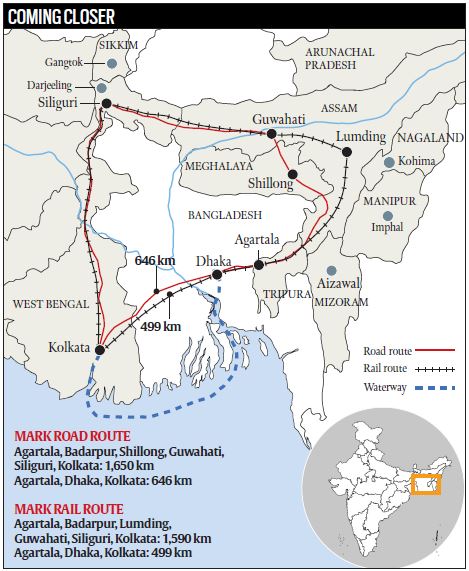
- Bangladesh’s geography makes it extremely important for connecting mainland India with Northeast India.
- Before Partition, rivers and railways through present-day Bangladesh provided natural access to the Northeast.
- Restoring these links can substantially reduce:
- Travel distance
- Logistics costs
- Dependence on the Siliguri Corridor.
Rail Connectivity
- Important links include:
- Maitree Express — Kolkata–Dhaka
- Bandhan Express — Kolkata–Khulna
- Mitali Express — New Jalpaiguri–Dhaka
- Haldibari–Chilahati
- Akhaura–Agartala.
- The Akhaura–Agartala rail link is strategically important because it connects Bangladesh directly with Tripura.
Road Connectivity
- Important bus routes have connected:
- Kolkata–Dhaka
- Agartala–Dhaka
- Shillong–Dhaka.
- Bangladesh is part of the BBIN Motor Vehicles Agreement, aimed at facilitating seamless passenger and cargo movement.
Maitri Setu
- Maitri Setu connects:
- Sabroom in Tripura
- Ramgarh in Bangladesh.
- It provides Northeast India improved access towards Chattogram Port.
Inland Waterway Connectivity
- The Protocol on Inland Water Transit and Trade (PIWTT) facilitates movement of cargo through India-Bangladesh river systems.
- It enables Indian cargo to reach Northeast India through Bangladesh.
- Benefits include:
- Lower transportation cost
- Reduced pressure on roads
- Lower carbon emissions
- Reduced dependence on the Siliguri Corridor.
- Inland waterways therefore connect India’s Neighbourhood First and Act East policies.
Port Connectivity
- Bangladesh has allowed India to use Chattogram and Mongla Ports for transit cargo.
- The arrangement became operational in 2023.
- It significantly improves Northeast India’s access to maritime trade.
- This can transform Bangladesh from merely a neighbouring country into a connectivity bridge between India’s mainland and Northeast.
Power and Energy Cooperation
- Energy has emerged as one of the strongest pillars of bilateral cooperation.
- Bangladesh has imported more than 1,000 MW of electricity from India through cross-border transmission systems.
- Important interconnections include:
- Bheramara–Baharampur
- Comilla–Tripura.
Maitree Super Thermal Power Project
- The 1,320 MW Maitree Super Thermal Power Plant at Rampal is a joint project involving:
- India’s NTPC
- Bangladesh Power Development Board.
- It represents large-scale bilateral energy cooperation.
India–Bangladesh Friendship Pipeline
- Inaugurated in 2023.
- Connects:
- Siliguri, India
- Parbatipur, Bangladesh.
- It transports high-speed diesel to northern Bangladesh.
- Benefits:
- Lower transport costs
- Reliable supply
- Reduced road transportation
- Greater energy security.
Trilateral Electricity Trade
- India is increasingly facilitating a regional electricity market involving:
- India
- Bangladesh
- Nepal.
- In 2024, electricity began flowing from Nepal to Bangladesh through the Indian grid.
- This is strategically important because it establishes the foundation of a:
BBIN Regional Energy Grid
- In the future, the region can integrate:
- Nepalese hydropower
- Bhutanese hydropower
- Indian transmission infrastructure
- Bangladeshi electricity demand.
Rooppur Nuclear Power Project
- Bangladesh’s Rooppur Nuclear Power Plant is primarily a Russia-Bangladesh project.
- India participates through:
- Training
- Capacity building
- Technical cooperation.
- It represents a rare example of India-Russia cooperation in a third country.
Development Partnership
- India has historically extended multiple Lines of Credit worth several billion dollars to Bangladesh.
- Major areas include:
- Railways
- Roads
- Ports
- Shipping
- Power
- Infrastructure.
- India has also supported:
- Schools
- Health centres
- Community infrastructure
- Capacity-building programmes.
- However, some LoC projects have experienced:
- Implementation delays
- Administrative bottlenecks
- Land-acquisition problems
- Slow disbursement.
Technical and Capacity-Building Cooperation
- Bangladesh has been a major beneficiary of India’s Indian Technical and Economic Cooperation (ITEC) programme.
- Training covers:
- Governance
- Public administration
- Information technology
- Policing
- Renewable energy
- Audit
- Skill development.
- Such programmes strengthen India’s soft power and institutional connectivity with Bangladesh.
Cultural Relations
- India and Bangladesh share:
- Bengali language and literature
- Music
- Cuisine
- Religious traditions
- Historical memories.
- Important shared personalities include:
- Rabindranath Tagore
- Kazi Nazrul Islam
- Bangabandhu Sheikh Mujibur Rahman.
- India’s Indira Gandhi Cultural Centre in Dhaka promotes:
- Yoga
- Music
- Dance
- Hindi
- Cultural exchanges.
Significance of Bangladesh for India
Security of Northeast India
- Bangladesh borders:
- Assam
- Meghalaya
- Tripura
- Mizoram.
- Cooperation with Bangladesh is crucial for:
- Counter-insurgency
- Border management
- Counter-terrorism
- Drug control.
Connectivity to Northeast India
- Bangladesh provides the shortest geographical routes between several Northeastern states and mainland India.
- Access through Bangladesh can reduce dependence on the narrow Siliguri Corridor or “Chicken’s Neck.”
- Chattogram and Mongla ports can substantially reduce logistics costs for Northeast India.
Act East Policy
- Bangladesh is India’s geographical gateway towards:
- Myanmar
- Southeast Asia
- Bay of Bengal.
- Thus:
India’s Act East Policy has a strong Bangladesh dimension.
Bay of Bengal
- Bangladesh occupies a strategically important position in the Bay of Bengal.
- Cooperation is important for:
- Maritime security
- Blue Economy
- Fisheries
- Disaster management
- Shipping
- Energy resources.
Countering Strategic Competition
- Bangladesh has close economic and defence relations with China.
- Maintaining strong India-Bangladesh relations therefore helps India preserve a favourable strategic environment in:
- Bay of Bengal
- Eastern South Asia
- India’s Northeast.
Regional Integration
- Bangladesh is central to:
- BIMSTEC
- BBIN
- Bay of Bengal connectivity.
- It can serve as an economic bridge linking South Asia and Southeast Asia.
Significance of India for Bangladesh
- India offers Bangladesh:
- A large neighbouring market
- Electricity
- Petroleum supplies
- Transit connectivity
- Investment
- Medical facilities
- Educational opportunities
- Development assistance.
- Stable relations with India can facilitate Bangladesh’s access to:
- Nepal
- Bhutan
- Wider South Asian markets.
- India is also important for:
- Flood forecasting
- River management
- Regional energy integration
- Border security.
Major Challenges in India–Bangladesh Relations
Teesta Water Sharing
- The absence of a final Teesta water-sharing agreement remains one of the most persistent bilateral irritants.
- Bangladesh regards Teesta as essential for irrigation in its northern districts.
- India must balance Bangladesh’s concerns with the requirements of West Bengal.
Future of the Ganga Water Treaty
- The 1996 Ganga Water Sharing Treaty completes its original 30-year duration in 2026.
- Negotiating its future is therefore a major contemporary issue.
- The next framework should incorporate:
- Climate change
- Environmental flows
- Irrigation
- Navigation
- Sedimentation
- Basin-level management.
Border Killings
- Deaths of Bangladeshi nationals during border incidents have periodically generated strong resentment in Bangladesh.
- Better coordination between BSF and BGB is necessary.
- India should promote:
- Non-lethal border management
- Technology-based surveillance
- Joint patrolling
- Better intelligence sharing.
Illegal Migration
- The long and densely populated border facilitates irregular cross-border movement.
- India has concerns regarding:
- Illegal migration
- Demographic pressures
- Security
- Smuggling.
- Bangladesh has expressed concerns regarding Indian political discourse surrounding:
- NRC
- Citizenship issues.
- These matters need careful diplomatic handling to avoid damaging people-to-people relations.
Rohingya Crisis
- Bangladesh hosts a very large population of Rohingya refugees displaced from Myanmar.
- Bangladesh expects greater international support for their safe and sustainable repatriation.
- India has an interest in resolving the crisis because prolonged instability can affect:
- Northeast India
- Bangladesh
- Myanmar
- Bay of Bengal security.
Cross-Border Crime
- Major concerns include:
- Drug trafficking
- Human trafficking
- Arms smuggling
- Wildlife trafficking
- Organised crime.
- Better border infrastructure and intelligence cooperation are essential.
Terrorism and Radicalisation
- Terrorist organisations such as Jamaat-ul-Mujahideen Bangladesh (JMB) have previously developed networks across the border.
- Political instability can increase concerns regarding:
- Radicalisation
- Terrorist recruitment
- Cross-border networks.
- Counter-terrorism cooperation must therefore remain insulated from political disagreements.
Trade Imbalance
- Bangladesh runs a substantial merchandise trade deficit with India.
- Concerns include:
- Non-tariff barriers
- Certification requirements
- Border infrastructure
- Market-access restrictions.
- Recent trade frictions demonstrate the need for a more predictable rules-based bilateral trade framework.
China Factor
- China is an important:
- Infrastructure partner
- Defence supplier
- Investor
- Trading partner of Bangladesh.
- Bangladesh participates in China’s Belt and Road Initiative (BRI).
- China’s presence in:
- Ports
- Infrastructure
- Defence
- Digital networks
attracts strategic attention in India.
- However, India should avoid viewing Bangladesh solely through a China-centric lens.
Appropriate Indian Strategy
India should compete through:
Geographical Proximity + Connectivity + Market Access + Culture + Development Partnership
rather than attempting to force Bangladesh into a binary India-versus-China choice.
Political Trust Deficit
- Political developments since 2024 have generated greater mistrust in bilateral relations.
- Concerns in India include:
- Security implications of political instability
- Treatment of minorities
- Anti-India rhetoric
- Growing engagement with China and Pakistan.
- Concerns within Bangladesh include perceptions of:
- Indian political interference
- Unequal economic relations
- Border killings
- Unresolved water issues.
- Rebuilding trust therefore requires engagement beyond any single political party or government.
Needed area of Cooperation
People-to-People Relations
- Political tensions can spill over into:
- Tourism
- Medical travel
- Education
- Cultural exchanges
- Sports
- Visa arrangements.
- India should therefore strengthen engagement with:
- Students
- Civil society
- Universities
- Businesses
- Artists
- Media
- Youth.
- Long-term bilateral stability requires societal goodwill, not merely government-to-government cooperation.
Climate Change and Disaster Management
- India and Bangladesh share a highly climate-vulnerable region.
- Common threats include:
- Cyclones
- Floods
- River erosion
- Sea-level rise
- Salinity intrusion
- Extreme rainfall.
- Future cooperation should include:
- Flood forecasting
- Cyclone warning systems
- Climate-resilient infrastructure
- River-basin management
- Mangrove conservation.
Sundarbans Cooperation
- India and Bangladesh share the Sundarbans, the world’s largest mangrove ecosystem.
- Both countries face common threats from:
- Sea-level rise
- Cyclones
- Salinity
- Biodiversity loss
- Human-wildlife conflict.
- The Sundarbans should become a major area of transboundary climate diplomacy.
Way Forward
Rebuild Political Trust
- India should engage with Bangladesh as a state and society rather than depending excessively on relations with any particular political formation.
- Dialogue should remain continuous despite political differences.
Resolve Teesta through Cooperative Federalism
- India needs a consensus involving:
- Union Government
- West Bengal Government
- Bangladesh.
- Scientific hydrological assessment should form the basis of an equitable arrangement.
Modernise the Ganga Water Framework
- The post-2026 framework should move from simple water allocation towards:
Integrated River Basin Management
- It should incorporate:
- Climate change
- Environmental flows
- Sedimentation
- Irrigation
- Navigation.
Strengthen Economic Integration
- Revive discussions on a comprehensive economic partnership.
- Focus on:
- Reducing non-tariff barriers
- Customs digitisation
- Better testing facilities
- Supply-chain integration
- Border infrastructure.
Make Connectivity Irreversible
- Expand:
- Railways
- Highways
- Inland waterways
- Coastal shipping
- Port access.
- Greater economic interdependence makes bilateral relations more resilient to political changes.
Develop a BBIN Energy Market
- Expand electricity trade among:
- Bangladesh
- Bhutan
- India
- Nepal.
- Bangladesh can become a major consumer and transit node in a South Asian electricity market.
Improve Border Management
- Move from simple border fencing towards smart border management through:
- Surveillance technology
- Joint intelligence
- Non-lethal methods
- Coordinated patrols
- Integrated Check Posts.
Strengthen Northeast–Bangladesh Economic Integration
- India’s Northeast and Bangladesh should be treated as a natural economic region.
- Cooperation can focus on:
- Logistics
- Tourism
- Agriculture
- Textiles
- Energy
- Border haats
- Ports.
Manage the China Factor Maturely
- India should not demand strategic exclusivity from Bangladesh.
- Instead, India should become the most reliable and economically useful partner through:
- Faster project implementation
- Market access
- Connectivity
- Technology
- Education.
Expand People-to-People Diplomacy
- Facilitate:
- Student exchanges
- Medical travel
- Academic cooperation
- Cultural festivals
- Tourism
- Youth exchanges.
- This can counter misinformation and rebuild societal trust.
Conclusion
- India-Bangladesh relations are too geographically and economically interconnected to be viewed merely through short-term political fluctuations.
- Bangladesh is crucial for India’s:
- Northeast security
- Act East Policy
- Bay of Bengal strategy
- Connectivity
- Regional energy integration.
- India is equally important for Bangladesh’s:
- Trade
- Energy
- Connectivity
- Water management
- Regional integration.
- The major challenge is to prevent disputes over water, borders, domestic politics and strategic competition from overwhelming the structural advantages of cooperation.
- The future relationship should move from:
“Historical Friendship” → “Strategic and Economic Interdependence”
- A stable relationship based on mutual respect, political sensitivity, connectivity, shared prosperity and people-to-people trust can make India-Bangladesh cooperation one of the strongest pillars of stability in the Bay of Bengal and eastern South Asia.