
India and Its Neighbourhood Relations
- India’s neighbourhood is the first and most immediate arena of its foreign policy.
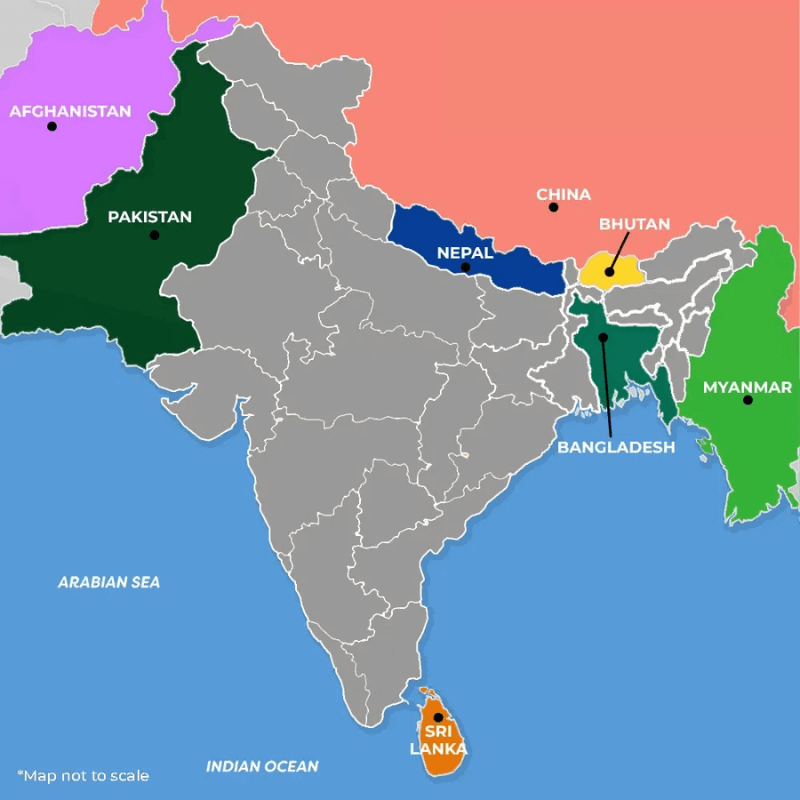
- India shares land or maritime boundaries with Pakistan, China, Nepal, Bhutan, Bangladesh, Myanmar, Sri Lanka and Maldives; Afghanistan is also traditionally treated within India’s South Asian neighbourhood framework.
- India’s neighbourhood policy is shaped by:
- Geography
- Historical and civilisational links
- National security
- Economic interdependence
- Connectivity
- Regional stability
- Competition with external powers
- India therefore combines bilateral diplomacy, regional/sub-regional cooperation, development partnerships and strategic balancing in dealing with its neighbours.
- The Ministry of External Affairs continues to describe a peaceful and prosperous neighbourhood as essential for India’s own development, giving neighbours high priority in foreign policy.
Immediate and Extended Neighbourhood
- India’s neighbourhood can broadly be classified into:
- Immediate Neighbourhood
- Pakistan
- Afghanistan
- Nepal
- Bhutan
- Bangladesh
- Sri Lanka
- Maldives
- Myanmar
- China
- These countries are important because of:
- Shared borders
- Historical links
- Cultural connections
- Migration and people-to-people ties
- Security interdependence
- Trade and connectivity.
- Extended Neighbourhood
- Indian Ocean Region
- Southeast Asia
- Central Asia
- West Asia
- Parts of the eastern African seaboard.
- India’s engagement with the extended neighbourhood operates through policies such as:
- Act East Policy
- Connect Central Asia Policy
- Indo-Pacific Vision
- SAGAR/MAHASAGAR
- West Asian partnerships
- Indian Ocean diplomacy.
Characteristics of India’s Neighbourhood
Strategic Location
- South Asia occupies an extremely important geopolitical location between:
- Indian Ocean sea routes
- West Asia
- Central Asia
- Southeast and East Asia.
- Important sea lanes carrying energy, commodities and manufactured goods pass through the wider Indian Ocean region.
- Therefore, the neighbourhood connects India’s continental and maritime security interests.
Huge Human and Economic Potential
- South Asia is one of the most densely populated regions of the world.
- It possesses significant:
- Human resources
- Agricultural resources
- Hydropower potential
- Mineral resources
- Consumer markets.
- Greater regional economic integration can significantly increase trade, investment and connectivity.
Historical and Civilisational Connections
- Political borders often cut across historically connected:
- Ethnic groups
- Languages
- Religions
- River systems
- Trade routes
- Cultural regions.
- This creates both opportunities for cooperation and sources of political sensitivity.
Persistent Political and Security Challenges
- The region has experienced:
- Interstate conflicts
- Civil wars
- Terrorism
- Insurgencies
- Military rule
- Political instability
- Drug trafficking
- Human trafficking.
- India must therefore deal simultaneously with traditional and non-traditional security challenges.
New Non-Traditional Challenges
- Modern neighbourhood diplomacy increasingly involves:
- Climate change
- Natural disasters
- Water security
- Food security
- Energy security
- Migration
- Pandemics
- Cybersecurity
- Critical infrastructure
- Transnational crime.
India’s Broad Approach Towards Its Neighbours
- India’s objective is to create a stable, peaceful and economically interconnected neighbourhood.
- Important features include:
Constructive Engagement
- India generally prefers dialogue and diplomatic engagement to prolonged confrontation.
- Even where serious disputes exist, channels for:
- Political dialogue
- Military communication
- Diplomatic negotiations
are often maintained.
Respect for Sovereignty
- India officially emphasises:
- Sovereign equality
- Territorial integrity
- Non-interference
- Mutual respect.
- This is particularly important because smaller neighbours sometimes fear Indian predominance.
Development Partnership
- India increasingly presents development cooperation as demand-driven rather than prescriptive.
- Major instruments include:
- Lines of Credit
- Grant assistance
- High Impact Community Development Projects
- Technical assistance
- Humanitarian assistance
- ITEC capacity-building programmes.
Asymmetric Engagement
- Since India is considerably larger economically and geographically than most neighbours, it has at times followed an asymmetric or non-reciprocal approach.
- India may provide concessions without demanding equivalent concessions from smaller neighbours.
- This idea is closely associated with the Gujral Doctrine.
Significance of the Neighbourhood for India
National Security
- Instability in neighbouring countries can directly affect India through:
- Terrorism
- Insurgency
- Illegal migration
- Drug trafficking
- Arms smuggling
- Radicalisation.
- Therefore, India’s internal security is closely connected with developments beyond its borders.
Economic Development
- A peaceful neighbourhood facilitates:
- Cross-border trade
- Investment
- Energy cooperation
- Regional value chains
- Infrastructure development.
Connectivity with India’s North-East
- Bangladesh and Myanmar are especially important for connecting India’s North-East with the rest of South and Southeast Asia.
- Projects involving ports, highways, railways and inland waterways can reduce the region’s geographical isolation.
Maritime Security
- Sri Lanka, Maldives, Bangladesh and Myanmar are strategically significant for India’s security in the:
- Bay of Bengal
- Arabian Sea
- Indian Ocean Region.
- India seeks cooperation in:
- Maritime Domain Awareness
- Anti-piracy
- Search and rescue
- HADR
- Coastal security.
Rise of China
- China’s expanding political, economic and strategic presence across South Asia has made neighbourhood diplomacy even more important for India.
- Chinese involvement includes:
- Belt and Road Initiative
- China-Pakistan Economic Corridor
- Ports
- Infrastructure financing
- Defence cooperation.
- India particularly objects to CPEC because it passes through territory claimed by India, raising sovereignty concerns.
Global-Power Aspirations
- India cannot credibly emerge as a major global power without maintaining stable and productive relations in its immediate neighbourhood.
Neighbourhood First Policy
- Neighbourhood First gives India’s immediate neighbours high political and diplomatic priority.
- It is not best understood as a policy suddenly “created in 2008”; rather, prioritising neighbours has long existed in Indian foreign policy, while the Neighbourhood First formulation became particularly prominent after 2014.
- The policy seeks:
- Political trust
- Connectivity
- Economic integration
- Development cooperation
- Security cooperation
- People-to-people relations.
- India officially continues to place high priority on its neighbours under this framework.
Core Features
- Political and diplomatic priority to immediate neighbours.
- Development assistance according to partner-country priorities.
- Enhanced:
- Road connectivity
- Rail connectivity
- Waterways
- Air connectivity
- Energy grids
- Digital connectivity.
- Providing rapid assistance during:
- Natural disasters
- Economic crises
- Health emergencies.
- Strengthening sub-regional institutions such as:
- BIMSTEC
- BBIN.
Objectives of Neighbourhood First Policy
Connectivity
- India seeks greater movement of:
- Goods
- People
- Electricity
- Services
- Information
- Capital.
- Regional connectivity is viewed as a force multiplier for economic development.
Peaceful Relations
- India requires peace and tranquillity around its borders to focus resources on domestic development.
Economic Cooperation
- India promotes:
- Cross-border trade
- Investment
- Energy cooperation
- Infrastructure connectivity.
Energy Integration
- Growing electricity trade links India with:
- Bhutan
- Nepal
- Bangladesh.
- A more integrated regional electricity market can improve:
- Energy security
- Renewable-energy utilisation
- Grid resilience.
Disaster Management
- India increasingly functions as a first responder during disasters in its neighbourhood.
- Cooperation includes:
- HADR
- Weather information
- Emergency supplies
- Medical assistance
- Search and rescue.
Defence and Security Cooperation
- India conducts:
- Joint exercises
- Maritime surveillance
- Defence training
- Capacity building
- Information sharing
with several neighbouring countries.
Evolution of India’s Neighbourhood Policy
Pre-Independence Foundations
- India’s nationalist leadership strongly opposed:
- Colonialism
- Imperialism
- Racism.
- The Asian Relations Conference was held in New Delhi in 1947, not 1948.
- It reflected India’s early ambition to promote Asian solidarity and post-colonial cooperation.
1950s–1960s: Nehruvian Idealism
- Major principles included:
- Peaceful coexistence
- Non-alignment
- Anti-colonialism
- Cooperation with Asian countries.
- Important developments included:
- India-Bhutan Treaty of Friendship – 1949
- India-Nepal Treaty – 1950
- Panchsheel Agreement with China – 1954.
- However, the 1962 India-China War exposed the limitations of excessive strategic optimism.
1960s–1980s: Greater Security Orientation
- India’s approach became increasingly shaped by:
- Security
- Regional balance of power
- External-power involvement.
- Major developments:
- Bangladesh Liberation War – 1971
- Shimla Agreement – 1972
- Sikkim became an Indian state – 1975
- Formation of SAARC – 1985
- Indo-Sri Lanka Accord and IPKF deployment – 1987.
1990s: Gujral Doctrine and Economic Diplomacy
- Economic reforms after 1991 made regional economic integration more important.
- The Gujral Doctrine emphasised that India should make unilateral concessions to smaller neighbours where possible without insisting on strict reciprocity.
- This sought to reduce the perception of India as a regional hegemon.
2000s–2014: Connectivity and Economic Integration
- India increasingly emphasised:
- Cross-border infrastructure
- Energy cooperation
- Trade
- Development partnerships.
- China’s growing economic engagement in South Asia also increasingly affected India’s calculations.
2014 Onwards: Neighbourhood First
- Prime Minister Narendra Modi invited leaders from SAARC countries to his 2014 swearing-in ceremony, signalling political priority to the neighbourhood.
- Major areas of emphasis included:
- Connectivity
- Energy
- Development assistance
- Maritime security
- Disaster response
- Digital integration.
Important Examples of Neighbourhood Connectivity
Bangladesh
- Major initiatives have included:
- Railway connections
- Inland-waterway transit
- Energy trade
- Use of Chattogram and Mongla ports
- India-Bangladesh Friendship Pipeline.
- The 2015 Land Boundary Agreement implementation removed a major long-standing bilateral problem.
Nepal
- Cooperation includes:
- Cross-border electricity trade
- Integrated Check Posts
- Rail connectivity
- Petroleum pipeline
- Hydropower projects.
Bhutan
- Bhutan remains one of India’s most important development partners.
- Major cooperation centres on:
- Hydropower
- Trade
- Education
- Infrastructure
- Security.
Myanmar
- Myanmar is India’s physical gateway to Southeast Asia.
- Key projects include:
- Kaladan Multi-Modal Transit Transport Project
- India-Myanmar-Thailand Trilateral Highway.
- Myanmar is also important for managing insurgency and security along India’s North-East frontier.
Shift from SAARC towards BIMSTEC and Sub-Regionalism
- SAARC remains institutionally alive, but high-level summit activity has remained stalled because of India-Pakistan tensions.
- India has consequently placed greater functional emphasis on:
- BIMSTEC
- BBIN
- Bilateral connectivity mechanisms.
- BIMSTEC connects South Asia with Southeast Asia and includes Bangladesh, Bhutan, India, Myanmar, Nepal, Sri Lanka and Thailand.
- MEA continues to maintain dedicated institutional engagement with both BIMSTEC and SAARC.

Recent Developments in India’s Neighbourhood Policy
Vaccine Maitri
- During the COVID-19 period India supplied vaccines and medical support to several neighbouring countries.
- This strengthened India’s image as a:
- Health partner
- First responder
- Regional pharmaceutical hub.
Sri Lankan Economic Crisis
- During Sri Lanka’s severe economic crisis in 2022, India provided extensive assistance including:
- Credit for petroleum
- Essential commodities
- Medicines
- Food-related support.
- Official Indian figures showed assistance running into several billion US dollars, making India one of Sri Lanka’s most important immediate partners during the crisis.
Development Finance
- As of the latest MEA compilation, India had extended more than 300 Lines of Credit worth about US$32 billion to 68 countries.
- Important neighbourhood allocations included roughly:
- Bangladesh – US$7.862 billion
- Nepal – US$1.65 billion
- Sri Lanka – more than US$2 billion
- Myanmar – US$745 million
- Maldives – US$1.43 billion.
Digital Public Infrastructure Diplomacy
- Digital cooperation has become a new instrument of diplomacy.
- India is promoting:
- UPI connectivity
- Digital payments
- Digital public infrastructure
- E-governance cooperation
with partner countries.
Political Changes in the Neighbourhood
- India’s neighbourhood diplomacy increasingly has to manage frequent domestic political transitions in neighbouring countries.
- Bangladesh underwent significant political upheaval after 2024, and bilateral relations subsequently required careful recalibration.
- India and Bangladesh nevertheless continued official engagement; their foreign ministers met in New Delhi in April 2026.
- Similarly, India has continued active engagement with Maldives, including high-level bilateral exchanges following periods of political friction.
SAGAR and MAHASAGAR
SAGAR
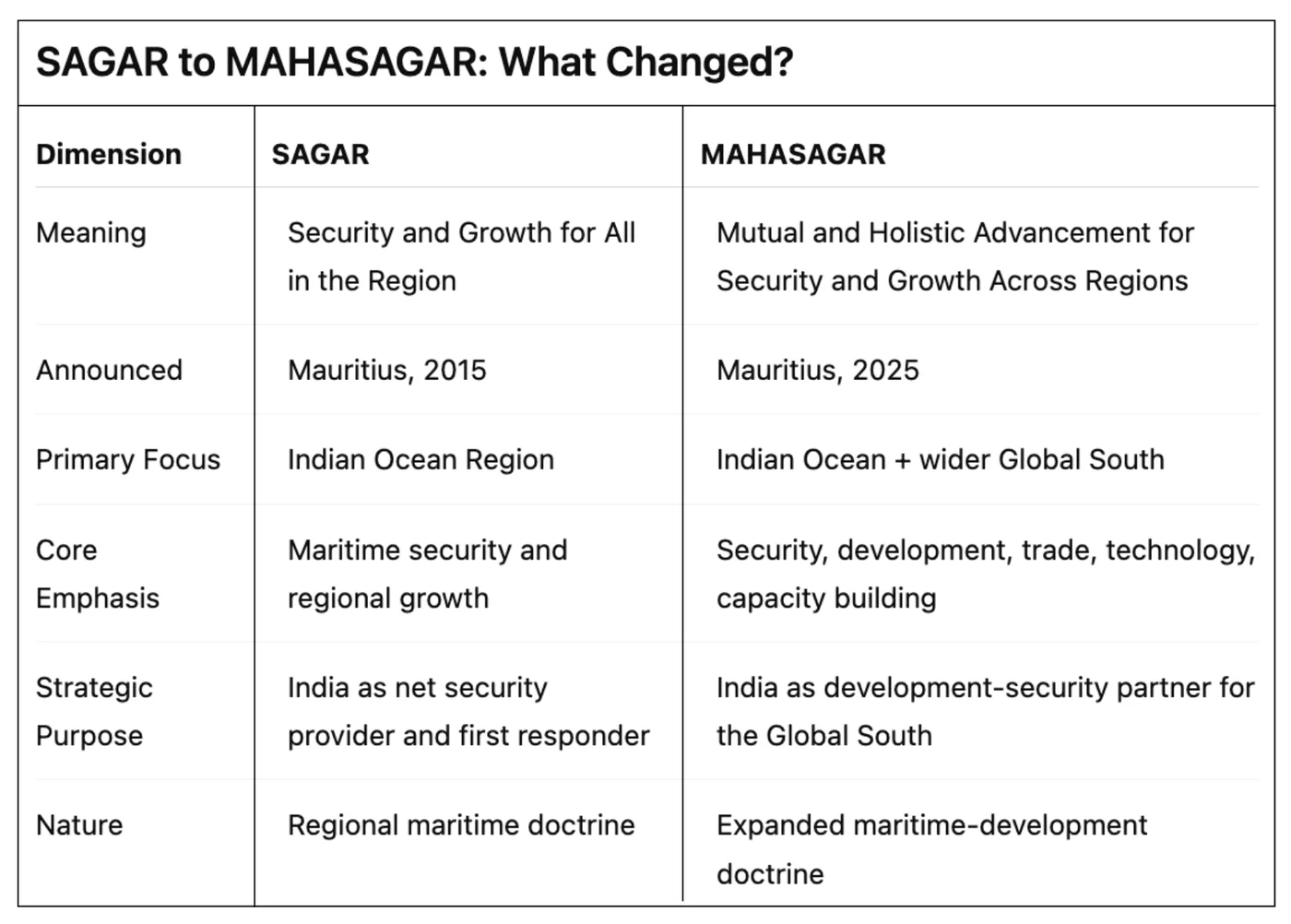
- SAGAR – Security and Growth for All in the Region was announced in 2015 as India’s maritime vision.
- It emphasises:
- Maritime security
- Capacity building
- Economic cooperation
- Disaster response
- Sustainable use of maritime resources.
MAHASAGAR – New Development
- In March 2025, India announced MAHASAGAR – Mutual and Holistic Advancement for Security and Growth Across Regions.
- MAHASAGAR expands the logic of SAGAR beyond the immediate maritime neighbourhood toward broader Global South cooperation.
- Its priorities include:
- Trade for development
- Capacity building
- Sustainable growth
- Mutual security
- Technology sharing
- Project-specific concessional finance and grants.
Extended Neighbourhood
Southeast Asia
- India’s Act East Policy places ASEAN at the core of India’s extended eastern neighbourhood.
- Objectives include:
- Economic cooperation
- Strategic relations
- Cultural ties
- Connectivity
- People-to-people contacts.
Indo-Pacific
- India’s Indo-Pacific approach emphasises:
- Open and inclusive regional order
- ASEAN centrality
- Freedom of navigation
- Maritime security
- Rules-based cooperation.
- Important mechanisms include:
- Quad
- ASEAN-led institutions
- Malabar exercises
- Maritime Domain Awareness initiatives.
Central Asia
- India’s Connect Central Asia Policy seeks stronger engagement in:
- Energy
- Security
- Trade
- Culture
- Connectivity.
- Important initiatives include:
- Chabahar Port
- International North-South Transport Corridor
- India-Central Asia dialogue mechanisms.
West Asia
- West Asia is crucial for India because of:
- Energy imports
- Indian diaspora
- Remittances
- Trade
- Maritime routes
- Security.
- Major recent initiatives include:
- India-UAE CEPA
- I2U2 cooperation
- India-Middle East-Europe Economic Corridor (IMEC).
Western Indian Ocean and African Littoral
- Countries such as:
- Mauritius
- Seychelles
- Madagascar
- East African coastal states
are increasingly important for: - Maritime security
- Blue economy
- Anti-piracy
- Development cooperation.
Relevance of India’s Neighbourhood Policy
Geostrategic Significance
- Stable neighbourhood relations strengthen India’s ability to act as a major Indo-Pacific and Global South power.
- Stronger relations can limit excessive dependence of neighbouring countries on any single external power.
Security Significance
- Cooperation helps address:
- Cross-border terrorism
- Insurgency
- Illegal trafficking
- Maritime threats
- Cyber threats.
Economic Significance
- Regional economic integration can:
- Expand markets
- Reduce transportation costs
- Improve energy security
- Develop India’s border regions.
Importance for the North-East
- Bangladesh and Myanmar provide India’s North-East with shorter access to:
- Ports
- International markets
- Southeast Asia.
- Therefore, Neighbourhood First and Act East intersect strongly in Northeast India.
Soft-Power Significance
- India’s cultural influence derives from:
- Buddhism
- Hinduism
- Language
- Cinema
- Education
- Yoga
- Historical migration
- Diaspora networks.
Challenges to India’s Neighbourhood First Policy
India-Pakistan Relations
- Cross-border terrorism and persistent political hostility remain major obstacles to wider South Asian regional cooperation.
- India-Pakistan tensions have significantly weakened SAARC’s effectiveness.
Growing Chinese Presence
- China has significantly expanded:
- Infrastructure financing
- Trade
- Defence cooperation
- Political engagement
throughout South Asia.
- India therefore faces a challenge of providing credible alternatives rather than merely opposing Chinese projects.
Perception of Indian Dominance
- Because of India’s:
- Size
- Economy
- Military strength
smaller neighbours sometimes fear excessive dependence or interference.
- India’s diplomacy therefore has to combine leadership with respect, consultation and sensitivity.
Domestic Political Instability in Neighbouring Countries
- Political transitions can rapidly alter foreign-policy orientations.
- This has been visible at different times in:
- Bangladesh
- Maldives
- Nepal
- Sri Lanka
- Myanmar.
Cross-Border Terrorism and Insurgency
- Terrorism and militant networks continue to affect India’s relations with parts of its neighbourhood.
Border Disputes
- Major disputes include:
- India-China boundary
- Some outstanding India-Nepal boundary issues.
- Such disputes can generate wider political mistrust.
Water-Sharing Issues
- Transboundary rivers make cooperation essential.
- Important unresolved or sensitive questions include:
- Teesta
- Ganga basin management
- Brahmaputra data and water cooperation.
Project Delays
- Indian infrastructure projects abroad have sometimes suffered from:
- Slow implementation
- Administrative delays
- Cost escalation
- Security conditions.
- Faster execution is essential because infrastructure delivery has become an important component of geopolitical competition.
Weak Regional Integration
- South Asia remains among the world’s least economically integrated regions.
- Barriers include:
- Political distrust
- Poor connectivity
- Non-tariff barriers
- Weak logistics
- India-Pakistan hostility.
Climate Change
- South Asia is highly vulnerable to:
- Floods
- Cyclones
- Sea-level rise
- Glacial melting
- Heat waves
- Water stress.
- Climate change can increasingly trigger:
- Food insecurity
- Migration
- Economic disruption
- Humanitarian crises.
Way Forward
Respect and Sensitivity
- India’s relations with neighbours should be based on:
- Mutual respect
- Sovereignty
- Consultation
- Sensitivity to smaller states’ concerns.
Follow the Spirit of the Gujral Doctrine
- India should avoid demanding strict reciprocity from smaller neighbours where its own interests permit asymmetric concessions.
Deliver Projects Faster
- Greater emphasis should be placed on:
- Time-bound execution
- Local consultation
- Transparent financing
- High-impact projects.
Strengthen Regional Connectivity
- Priorities should include:
- Railways
- Roads
- Ports
- Inland waterways
- Power grids
- Digital infrastructure
- Cross-border payment systems.
Promote BBIN and BIMSTEC
- Where SAARC remains constrained, India should deepen functional cooperation through:
- BIMSTEC
- BBIN
- Bilateral mechanisms
- Sector-specific minilateral initiatives.
Develop Regional Energy Markets
- India can promote:
- Cross-border electricity trade
- Hydropower development
- Renewable-energy integration
- Regional transmission grids.
Improve Border Infrastructure
- Border regions should evolve from being viewed merely as security frontiers to economic gateways.
- Integrated Check Posts, logistics hubs and transport corridors can accelerate regional integration.
Strengthen Maritime Cooperation
- Priorities should include:
- Maritime Domain Awareness
- Anti-piracy
- Coast Guard cooperation
- HADR
- Search and rescue
- Blue economy.
Expand Digital Diplomacy
- India’s experience with:
- UPI
- Digital identity
- Digital public infrastructure
- FinTech
can become an important instrument of development partnership.
Become the First Responder
- India’s geography and capabilities allow it to function as the first responder during regional disasters and economic emergencies.
- This strengthens both national security and regional goodwill.
Compete Through Development, Not Coercion
- India’s most sustainable response to external competition is to become the preferred development and security partner by providing:
- Reliable connectivity
- Transparent financing
- Technology
- Capacity building
- Rapid humanitarian assistance.
Conclusion
- India’s global ambitions are inseparable from the stability of its neighbourhood.
- The future of India’s neighbourhood policy lies in moving from merely managing crises to creating regional interdependence.
- A combination of Neighbourhood First + Act East + BIMSTEC/BBIN + SAGAR/MAHASAGAR + development partnerships can help India create a more connected, stable and prosperous regional order.
- The key principle should therefore be:
“A secure, connected and prosperous neighbourhood strengthens India’s own security, development and rise as a leading power.”