
Historical Background of Assam’s Polity
The historical trajectory of Assam’s polity represents a complex journey of political evolution, moving from highly organized independent medieval monarchies to colonial administrative experiments, and ultimately transitioning into a unique model of asymmetric federalism within the Indian Union. Unlike many parts of mainland India that experienced centralized imperial rule under the Mauryas, Guptas, or Mughals, the Brahmaputra and Barak valleys maintained a distinct political identity for centuries.
The region’s governance structures have been consistently shaped by its diverse geography, the co-existence of plains and hill communities, and its strategic frontier location. The modern political setup of Assam is not a recent creation; rather, it is the result of centuries of institutional developments. These include the sophisticated Paik system of the Ahoms, the colonial administrative divisions between the hills and plains, and post-independence ethnic movements for self-determination. For civil service aspirants, particularly those preparing for the Assam Public Service Commission (APSC) examination, understanding this historical background is essential to analyzing contemporary governance, identity politics, and constitutional safeguards like the Sixth Schedule.
Pre-Colonial Administration (Ahom Kingdom, Koch, Kachari etc.)
Before the British annexation in the early 19th century, Assam was characterized by a multi-centric political landscape. Various indigenous kingdoms developed distinct monarchical, feudal, and tribal administrative systems that balanced central authority with local autonomy.
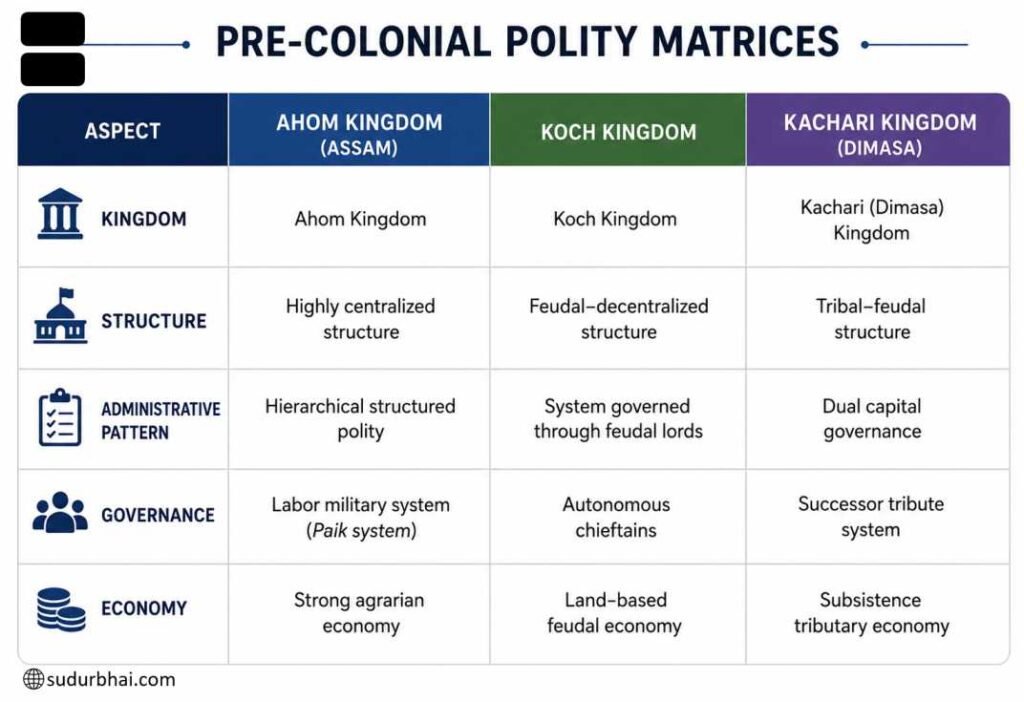
The Ahom Kingdom (1228–1826)
Founded by the Tai-Shan prince Chaolung Sukaphaa in 1228, the Ahom dynasty ruled for nearly six centuries (598 years), making it one of the longest-running continuous dynasties in Indian history. Their administrative framework was highly structured and evolved significantly over time.
The Central Administrative Architecture
- The Monarch (Swargadeo): The Ahom ruler, termed Chao-Pha (God-King) or Swargadeo (Heavenly King), held absolute sovereign authority. While succession generally followed the principle of male primogeniture, the king’s power was not entirely unchecked; it required the institutional validation of the higher nobility.
- The Council of Ministers (Patra Mantris / Dangarias): Originally consisting of two primary counselors—the Burhagohain and the Borgohain—the council was expanded by later monarchs to include the Borpatragohain, Barbarua, and Borphukan. The three principal Dangarias (Gohains) held the constitutional authority to veto a king’s decisions or even depose an incompetent ruler.
- Key Executive and Military Officers:
- Barbarua: Functioned as the chief executive officer of the secretariat and the head of the judiciary for the region stretching east from Kaliabor.
- Borphukan: Served as the regional viceroy and military commander for Lower Assam (west of Kaliabor), based at Guwahati. This position held significant diplomatic responsibilities due to frequent contact with the Mughals and neighboring kingdoms.
The Paik System: The Core Administrative Engine
The Paik System served as the foundational socioeconomic and military structure of the Ahom state:
- Every able-bodied adult male citizen between the ages of 15 and 50 was classified as a Paik and was legally obligated to provide compulsory service to the state in rotation.
- Four paiks (later reduced to three in the late Ahom period) formed a basic unit called a Got. While one paik performed state labor or military duties, the remaining members of the Got managed his agricultural land.
- Paiks were organized into functional occupational groups called Khels (e.g., bow-makers, boat-builders) under the command of graded officers like the Bora (over 20 paiks), Saikia (over 100 paiks), and Hazarika (over 1,000 paiks).
- In lieu of monetary salaries, the state granted each paik two puras (approximately 2.6 acres) of tax-free rice-producing land (Gati-mati), creating a labor-based rather than cash-based state economy.
Frontier Diplomacy: The Posa System
To secure its mountainous borders, the Ahom state developed the Posa system. Under this framework, specific hill tribes (such as the Nyishis, Bhutias, and Nagas) were granted the right to collect fixed annual contributions of grain, cattle, and labor from designated plains villages (Posa paiks). In return, the tribes agreed to maintain peace along the frontier, creating an early precedent for managing relations between hill and plains communities.
Decline and Collapse
The Ahom administrative system grew increasingly strained during the late 18th century. The Moamoria Rebellion (1769–1805)—a socio-religious conflict between the Ahom state and the followers of the Moamoria Satra—weakened the kingdom’s central authority. The resulting internal political instability led to repeated Burmese invasions, which severely disrupted the region’s traditional administrative structures and paved the way for British intervention.
The Koch Kingdom
Established by Vishwa Singha in the early 16th century, the Koch dynasty came to rule large parts of Western Assam and North Bengal, reaching its peak under Nara Narayan and his military commander Chilarai.
- Feudal-Decentralized Structure: Unlike the highly centralized Ahom state, the Koch kingdom operated on a more decentralized feudal model. The central monarch relied on regional chieftains (Bhuyans) who maintained local autonomy in exchange for swearing loyalty, paying regular tribute, and providing military contingents during wartime.
- Military Organization: The Koch kings organized their population into two main classes: the Karjies (royal officers) and the Thakurias (local administrators), utilizing local militias to maintain control over their territories. The kingdom was later divided into Koch Bihar and Koch Hajo, which weakened its overall position and left it vulnerable to Ahom expansion and Mughal intervention.
The Kachari (Dimasa) Kingdom
The Kachari Kingdom was an indigenous tribal-feudal state that ruled parts of the Brahmaputra valley before gradually moving southward into Maibang and Cachar.
- Dual Governance System: The Kachari administration blended traditional tribal customs with formal monarchical structures. The kingdom was divided into administrative units called Rajyams, governed by local chieftains who acknowledged the central authority of the Dimasa king.
- Agrarian Administration: The Kacharis developed extensive irrigation and land revenue systems tailored to riverine plains and foothill areas. Over time, through a mix of strategic royal marriages, military conflicts, and treaties, the kingdom came under Ahom influence before its final annexation by the British under the doctrine of lapse.
British Colonial Administration and Changes (1826–1947)
The British annexation of the region fundamentally restructured Assam’s political, economic, and social systems, introducing centralized bureaucratic governance to replace traditional medieval structures.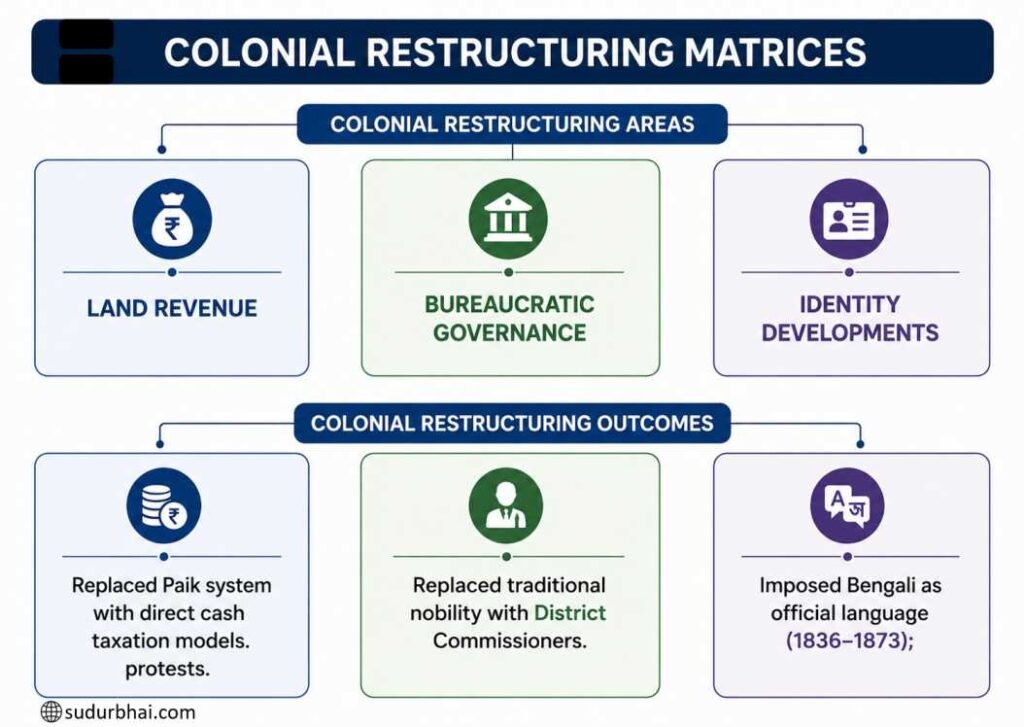
The Treaty of Yandabo (1826) and Initial Annexation
Following the defeat of the Burmese forces in the First Anglo-Burmese War, the Treaty of Yandabo was signed on February 24, 1826. Under this treaty, the King of Ava ceded Assam to the British East India Company. Initially, the British experimented with indirect rule, restoring Upper Assam to an Ahom prince, Purandar Singha, in 1833. However, citing administrative mismanagement and shortfalls in tribute payments, the British deposed him in 1838, bringing the entire region under direct colonial administration.
Radical Structural Shifts in Governance
- Transition from Labor to Cash Revenue: The British abolished the Paik system, replacing labor-based state obligations with direct cash taxation on land holdings. They introduced specialized land settlements, classification systems, and income taxes, which placed an unfamiliar financial burden on the traditional agrarian economy.
- Introduction of Modern Bureaucracy: The traditional Ahom titles and administrative roles (such as Barbarua and Borphukan) were replaced by a centralized bureaucratic structure. The state was divided into districts managed by District Commissioners and Deputy Commissioners, concentrating administrative, executive, and judicial authority within the colonial civil service.
- The Language Crisis and Assamese Identity: In 1836, colonial administrators replaced Assamese with Bengali as the official language of the courts and educational institutions in Assam, arguing it would simplify administration. This policy caused deep resentment among the local population and sparked a long linguistic movement led by figures like Anandaram Dhekial Phukan. Supported by American Baptist Missionaries, this effort eventually led to the re-establishment of Assamese as the official provincial language in 1873.
- The Plantation Economy and Demography: The colonial government prioritized the expansion of the commercial tea industry, passing the Assam Clearance Waste Land Rules. To supply the necessary labor for these massive tea estates, the British facilitated the migration of large numbers of indentured laborers from Central and Eastern India (who became the Tea Tribes community). They also encouraged agricultural migration from East Bengal to maximize land revenue, which significantly altered the demographic and political landscape of the province.
The Inner Line Regulation and the Hill-Plains Divide
Recognizing the distinct social structures of the tribal hill regions and seeking to protect commercial interests in the plains, the British enacted the Bengal Eastern Frontier Regulation of 1873. This act established the Inner Line, a regulatory boundary that prohibited plains residents or commercial entities from entering or acquiring land in designated hill tracts without an official permit.
Under the Government of India Act, 1935, these regions were formally classified as Excluded Areas (under the direct administration of the Governor) and Partially Excluded Areas. This administrative separation protected tribal areas from standard provincial legislation and laid the early groundwork for the post-independence Sixth Schedule.
Post-Independence Reorganisation and Statehood
Following India’s independence in 1947, the state entered a new phase of political and territorial restructuring to balance national integration with regional demands for ethnic self-determination.
The Challenges of Partition and Boundary Changes
At independence, the state of Assam encompassed almost the entire northeast region, excluding the princely states of Manipur and Tripura. The partition of India brought immediate geopolitical challenges:
- Following a referendum, the Muslim-majority district of Sylhet (with the exception of three subdivisions) was transferred to East Pakistan (now Bangladesh).
- This transfer disrupted long-standing trade routes, left Assam geographically isolated from mainland India except for the narrow Siliguri Corridor, and led to an initial influx of displaced refugees.
The Separation of States from Greater Assam
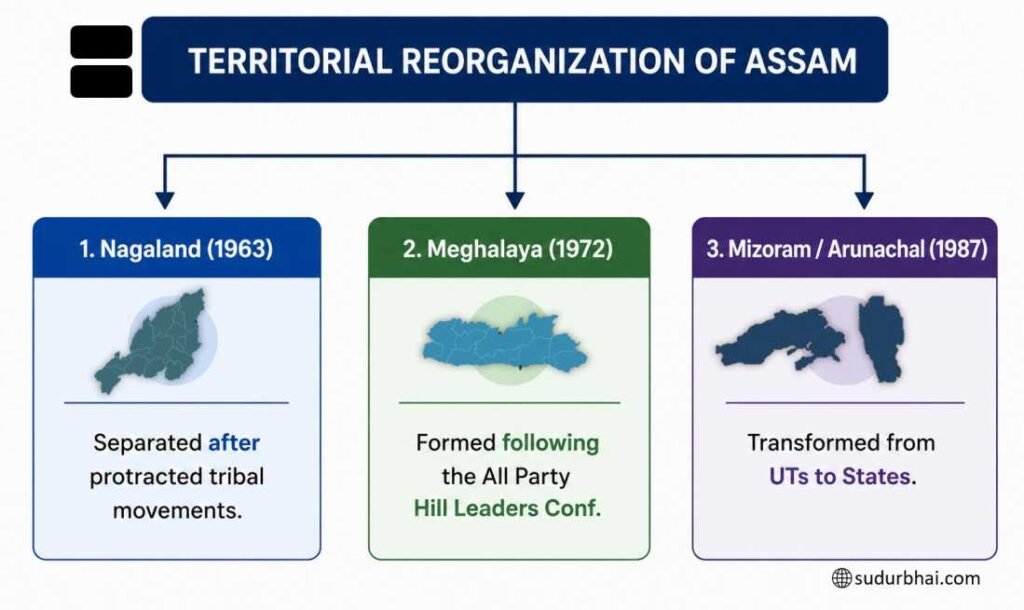
During the 1950s and 1960s, regional identities and tribal movements led to demands for administrative autonomy. Rather than maintaining a single large administrative unit, the central government reorganized the region along ethnic and linguistic lines:
- Nagaland (1963): Following extended political movements by Naga groups, the Naga Hills District was separated from Assam to form the 16th state of the Indian Union.
- Meghalaya (1972): The United Khasi-Jaintia Hills and Garo Hills districts, which had formed an autonomous state within Assam in 1970 following movements led by the All Party Hill Leaders Conference (APHLC), achieved full statehood under the North-Eastern Areas (Reorganisation) Act, 1971.
- Mizoram and Arunachal Pradesh: The Mizo Hills District and the North-East Frontier Agency (NEFA) were separated from Assam in 1972 to become Union Territories. Both later transitioned to full statehood in 1987.
The Assam Accord (1985)
Between 1979 and 1985, the state experienced intense political mobilization during the Assam Movement, led by the All Assam Students’ Union (AASU) and the All Assam Gana Sangram Parishad (AAGSP). The movement protested undocumented immigration and called for the protection of indigenous rights.
The conflict concluded with the signing of the Assam Accord on August 15, 1985, a tripartite agreement involving the Central Government, the State Government, and the movement’s leaders. The Accord established March 24, 1971 as the definitive cut-off date for citizenship determination in the state and included Clause 6, which mandated constitutional, legislative, and administrative safeguards to preserve the cultural, linguistic, and social identity of the Assamese people.
Formation of Modern Assam: Key Milestones
The modern political and administrative landscape of Assam has been shaped by a series of critical legislative, linguistic, and structural milestones.
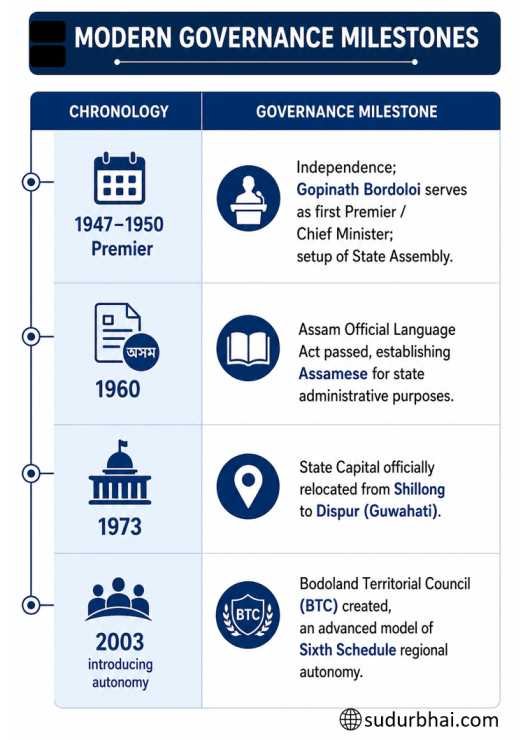
Democratic Foundations (1947–1950)
Following independence, Bharat Ratna Gopinath Bordoloi served as the state’s first Premier (and later Chief Minister). He played a key role in protecting the state’s territorial integrity during the partition process and worked to secure the inclusion of the Sixth Schedule in the Indian Constitution to safeguard tribal autonomy.
The Language Act Controversy (1960)
The passage of the Assam Official Language Act in 1960 designated Assamese as the primary language for state administrative purposes. While it recognized local linguistic identity in the Brahmaputra Valley, it also sparked protests in the hill districts and the Bengali-majority Barak Valley. This eventually led to administrative adjustments that permitted the use of Bengali for official purposes in Cachar district and protected minority linguistic rights.
Relocation of the Capital to Dispur (1973)
Following the creation of Meghalaya, the historical capital of Assam, Shillong, became part of the new state. In response, the Assam Government relocated its administrative capital to Dispur (a suburb of Guwahati) in 1973, shifting the political and administrative focus back to the Brahmaputra valley.
Institutionalizing Autonomy: The Bodoland Territorial Council (2003)
To address long-standing demands for self-determination by the Bodo community without further partitioning the state’s territory, the Central and State governments signed the second Bodo Accord in 2003. This led to a constitutional amendment that created the Bodoland Territorial Council (BTC) under the Sixth Schedule.
Governing the Bodoland Territorial Region (BTR), this council was granted expanded legislative, executive, and financial authority over 40 subjects, creating a new framework for managing regional ethnic aspirations within the state. This approach has since been extended to other communities through the creation of various statutory autonomous development councils (such as those for the Tiwas, Misings, and Rabhas).
The historical background of Assam’s polity demonstrates a continuous effort to balance centralized governance with regional diversity. Over centuries, the state’s administrative systems have evolved from the organized structures of the Ahom kingdom to a modern model of asymmetric federalism within the Indian Union.
Assam’s modern political landscape has been shaped by its history as a frontier province, colonial economic policies, and post-independence movements for cultural and political recognition. By utilizing constitutional mechanisms like the Sixth Schedule and regional autonomous councils, Assam’s governance framework shows how democratic systems can adapt to protect indigenous rights and manage ethnic diversity while maintaining national integration. Understanding this historical development remains essential for addressing contemporary policy challenges and managing the state’s ongoing growth.