
Understanding Culture
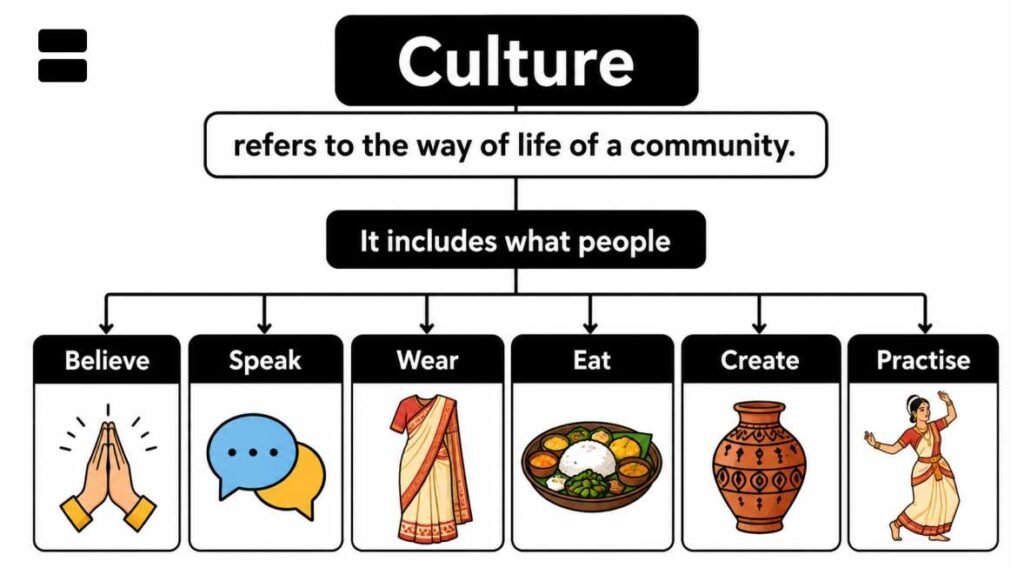
Meaning of Culture
- Culture refers to the way of life of a community. It includes what people believe, speak, wear, eat, create and practise in their daily lives.
- Culture is learned through society and passed from one generation to another.
- Children learn their language, customs, food habits and social behaviour from their families and communities.
- For example, learning to weave a Gamosa, prepare Pitha, or participate in Bihu is part of cultural learning.
- The word culture ultimately comes from the Latin words colere, meaning “to cultivate or tend,” and cultura, meaning “cultivation.”
- Over time, its meaning expanded from cultivating land to developing human knowledge, behaviour and ways of life.
- The German term Kultur also became important in discussions of cultural and intellectual development.
Edward B. Tylor’s Explanation
- In 1871, anthropologist Edward B. Tylor explained culture as the complete body of knowledge, beliefs, art, morals, laws, customs and learned habits acquired by people as members of society.
- In simple terms, culture includes both what people make and how they live.
Material and Non-Material Culture
| Type | Meaning | Examples from Assam |
|---|---|---|
| Material culture | Physical objects created and used by people. | Jaapi, Xorai, Gamosa, jewellery, utensils, houses and weaving tools. |
| Non-material culture | Ideas, beliefs, knowledge and practices followed by a community. | Languages, religious beliefs, folk songs, hospitality, customs and rituals. |
- These two forms are closely connected.
- A Gamosa is a physical object and therefore part of material culture.
- The respect and affection expressed by presenting it belong to non-material culture.
Formation and Distinctive Features of Assamese Culture
A Meeting Place of Different Communities
- Assam’s culture developed through centuries of interaction among communities living in the Brahmaputra Valley, Barak Valley and surrounding hills.
- Its location connected it with different parts of the Indian subcontinent, the Himalayan region and Southeast Asia.
- Communities brought their own languages, religious practices, food habits, weaving traditions and artistic skills.
- Their interaction produced a broad cultural tradition often described as Asomiya Sanskriti, meaning Assamese culture.
Cultural Synthesis, Assimilation and Coexistence
- Cultural synthesis means combining elements from different traditions to create a shared cultural form.
- For example, Assamese food, dress and festivals reflect contributions from several communities.
- Assimilation means gradually adopting some cultural practices of another community.
- Coexistence means different communities living together while retaining their own identities.
- Assam’s cultural development includes all three processes. A shared regional identity exists alongside distinct community traditions.
Ethnic and Linguistic Diversity
- Assam is home to communities such as the Bodo, Mising, Karbi, Rabha, Dimasa, Deori, Tiwa and Tai-Ahom, among many others.
- Older accounts use terms such as Miri for the Mising and broad labels such as Kachari for several related communities.
- These terms should be understood in their historical context.
- Mising is the preferred contemporary name.
- The Mishmi, mentioned in accounts of the wider region, are associated primarily with neighbouring Arunachal Pradesh.
- Communities maintain distinctive:
- Languages and dialects.
- Traditional clothing and ornaments.
- Festivals and religious practices.
- Food habits and craft traditions.
- Assamese functions as an important link language, especially across much of the Brahmaputra Valley.
- A link language, or lingua franca, helps people with different mother tongues communicate.
- Assam remains multilingual; language use varies across the Barak Valley, hill areas and other regions.
- Older racial categories such as “Mongoloid” are outdated. Assam’s diversity is better explained through communities, languages, migration and cultural interaction.
Religious Diversity and Vaishnavite Influence
- Assam has a diverse religious landscape that includes Hinduism, Islam, Christianity, Buddhism and indigenous faith traditions.
- Within Hinduism, Vaishnavism, Shaktism and Shaivism have influenced different aspects of regional culture.
- Srimanta Sankardeva played a major role in spreading Ekasarana Nama Dharma, an important devotional tradition of Assam.
- Its central features include:
- Devotion to one supreme deity, understood as Krishna or Vishnu.
- Naam-Kirtan, or collective singing and recitation of the divine name.
- Emphasis on devotion and ethical conduct.
- Opposition to elaborate sacrificial practices and excessive ritualism.
- Namghars and Satras became important centres of religious and cultural activity.
- Namghar: A community prayer hall.
- Satra: A Vaishnavite religious institution that also preserves learning, music, dance and other arts.
- It is too broad to describe every Assamese Vaishnavite institution as rejecting all image worship; practices differ between traditions.
- Although devotional movements encouraged wider participation, caste distinctions and social inequalities did not disappear completely.
Agriculture, Festivals and Community Life
- Assam’s culture has a strong agrarian foundation, meaning that many traditions developed around agriculture and village life.
- Bihu is a major expression of this relationship between society and the agricultural calendar.
| Bihu | Alternative Name | Main Association |
|---|---|---|
| Bohag Bihu | Rongali Bihu | Spring, the Assamese New Year and the beginning of a new agricultural cycle. |
| Kati Bihu | Kongali Bihu | Prayers for crops during a relatively lean agricultural period. |
| Magh Bihu | Bhogali Bihu | Harvest celebrations, community feasts and abundance. |
- Bihu brings together people from different backgrounds, although participation and customs vary between communities.
- Important cultural symbols include the Gamosa, Jaapi, Tamul-Paan and Xorai.
Gamosa: Textile, Respect and Assamese Identity
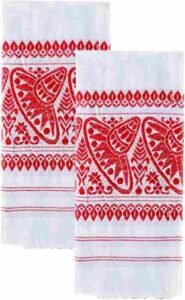
Meaning and Appearance
- The Gamosa, also written as Gamusa or Gamocha, is one of Assam’s most recognisable traditional textiles.
- It is generally a rectangular woven cloth with:
- A white body.
- Red borders.
- Decorative designs, especially towards the ends.
- Cotton is widely used, while special varieties may also be woven from silk.
- Its colour, size, pattern and material vary according to purpose, region and weaving tradition.
Origin of the Name
- A common explanation connects the word with:
- Ga: Body.
- Mosa/Musa: Wiping.
- This explains its everyday use as a body cloth, but its social significance extends far beyond that function.
- Another interpretation connects it with the Kamrupi term Gaamasa, associated with cloth used to cover sacred objects. Such explanations represent different interpretations of the word’s origin.
Cultural Significance
- The Gamosa represents respect, affection, dignity, hospitality and Assamese identity.
- It is presented to:
- Guests and visitors.
- Teachers and elders.
- Artists and public figures.
- People being honoured for their achievements.
- During Bihu, presenting a Gamosa can express affection and strengthen relationships.
- Its use extends across many social and religious settings, making it an important symbol of shared regional belonging.
Everyday and Religious Uses
- Everyday uses include:
- Wiping the body.
- Covering the head.
- Wearing it around the neck or shoulder.
- Using it during agricultural work.
- Ceremonial and religious uses include:
- Offering respect during Naam-Kirtan.
- Use in wedding ceremonies.
- Covering sacred books or objects with appropriate ceremonial varieties.
- Presenting it during festivals and public functions.
- Cloth used for sacred purposes is treated separately from cloth used for ordinary household work.
Historical Background
- References to the Gamosa occur in discussions of Ramcharan Thakur’s Gurucharita and the Buranjis, Assam’s historical chronicles.
- Accounts of the Ahom period describe the ceremonial gifting of decorated Gamosas.
- During the Assam Movement, 1979–1985, it acquired greater public prominence as a symbol of regional identity. Its cultural history, however, is much older.
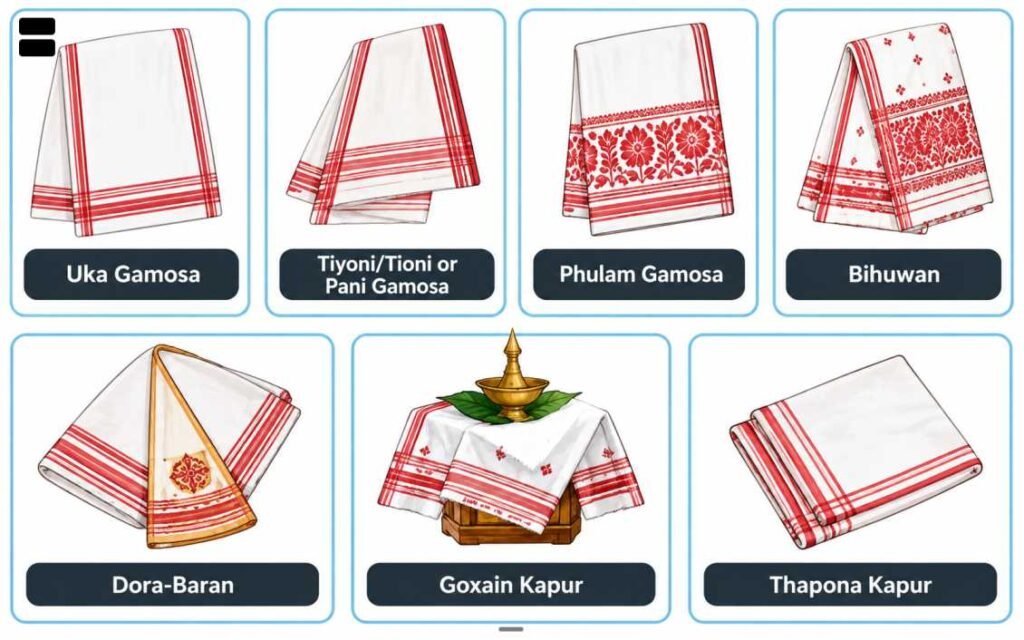
Important Varieties and Related Ceremonial Cloths
| Name | Main Feature or Use |
|---|---|
| Uka Gamosa | A relatively plain variety with limited decoration, used for practical or customary purposes. |
| Tiyoni/Tioni or Pani Gamosa | Used for bathing and household activities. |
| Phulam Gamosa | A decorated Gamosa carrying woven floral or other ornamental designs. |
| Bihuwan | A Gamosa presented during Bihu as a token of affection or respect; generally decorative. |
| Dora-Baran | A ceremonial textile associated with honouring the groom during marriage. |
| Goxain Kapur | Cloth associated with covering or adorning the sacred altar. |
| Thapona Kapur | Cloth used in connection with sacred scriptures or the prayer setting. |
- Names and precise uses can vary locally.
- Phulam describes decoration, while Bihuwan refers especially to its association with Bihu; the terms therefore overlap.
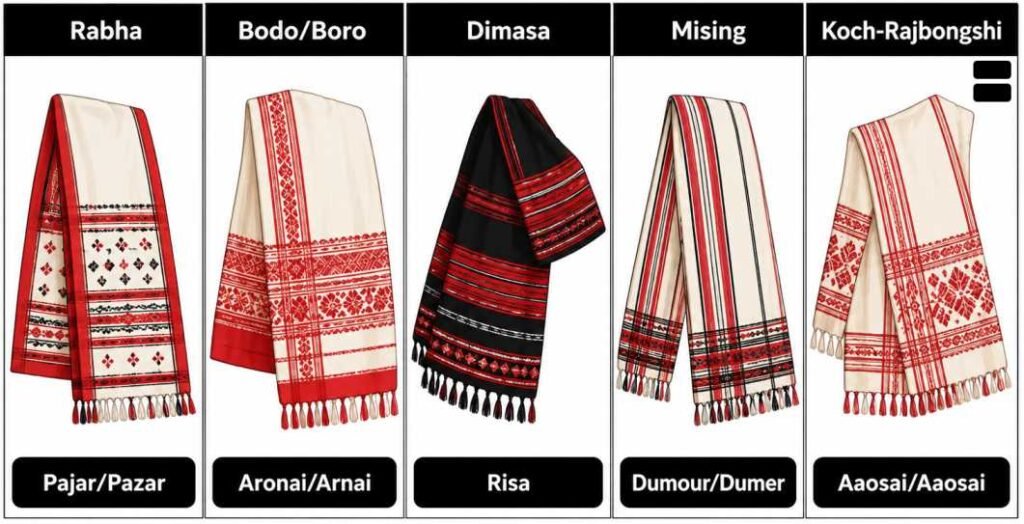
Community Textile Traditions
- Assam’s communities possess textiles with their own names, designs and ceremonial importance.
| Community | Associated Textile |
|---|---|
| Rabha | Pajar/Pazar |
| Bodo/Boro | Aronai/Arnai |
| Dimasa | Risa |
| Mising | Dumour/Dumer |
| Koch-Rajbongshi | Aaosai/Aaosai |
- These textiles illustrate Assam’s weaving diversity. They should be recognised as distinct community traditions, rather than treated as identical versions of the white-and-red Assamese Gamosa.
Designs and Women’s Weaving Skills
- Gamosa designs frequently draw inspiration from flowers, birds, animals and geometric forms.
- Examples include lotus, ducks, cranes, elephants and fish.
- A motif is a recognisable decorative shape or pattern repeated in a design.
- Motifs such as Kolka, a curved paisley-like form, and Angurlata, a grapevine pattern, illustrate changes in textile design over time.
- Women weavers have played a major role in preserving this tradition.
- Weaving involves knowledge of yarn, looms, colour combinations, pattern creation and finishing.
- These skills support both cultural continuity and household income.
Swanirbhar Naari Scheme
- The Swanirbhar Naari initiative supports indigenous weavers by procuring specified traditional handwoven products directly from them.
- Its purpose includes improving market access and reducing dependence on middlemen.
Tamul-Paan: A Tradition of Hospitality
Meaning
- Tamul means areca nut, while Paan means betel leaf.
- Together, Tamul-Paan, also referred to in some contexts as Guapan, forms an important part of Assamese social and ceremonial life.
Social and Cultural Importance
- Offering Tamul-Paan is a customary expression of:
- Hospitality.
- Respect.
- Friendship.
- Goodwill.
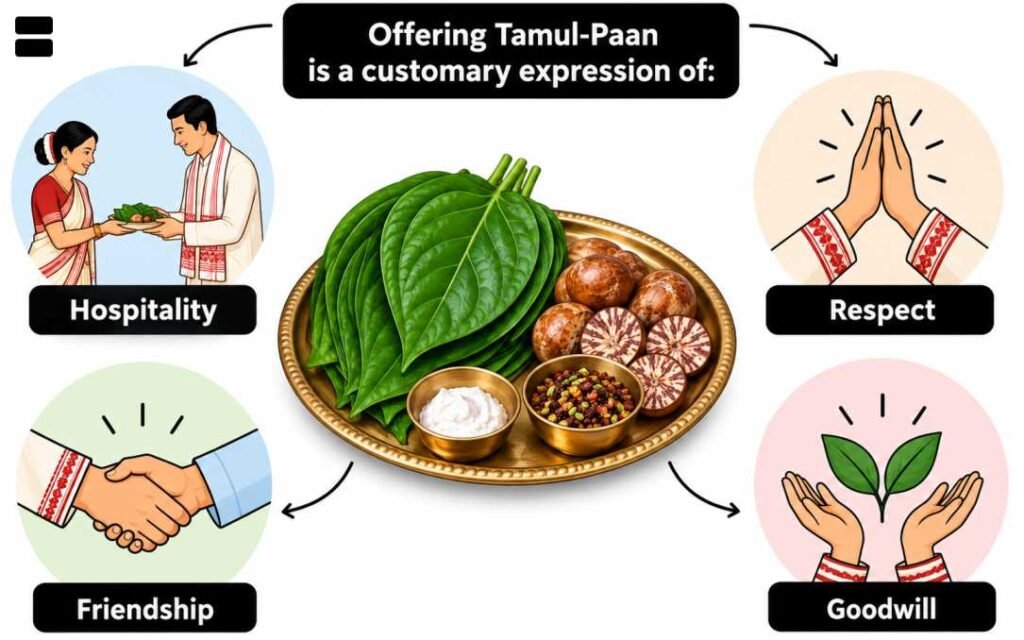
- It may be offered to guests in a traditional metal vessel such as a Bota.
- Its presence at weddings, religious functions and family gatherings reflects the continuity of customary practices.
- Chewing Tamul-Paan is also a social habit in parts of Assam.
Ritual Significance
- Tamul-Paan may form part of:
- Religious offerings.
- Marriage-related exchanges.
- Formal invitations.
- Ceremonies seeking blessings or goodwill.
- The act of offering it communicates respect even when the recipient does not consume it.
Xorai: A Ceremonial Offering Vessel
Structure and Material
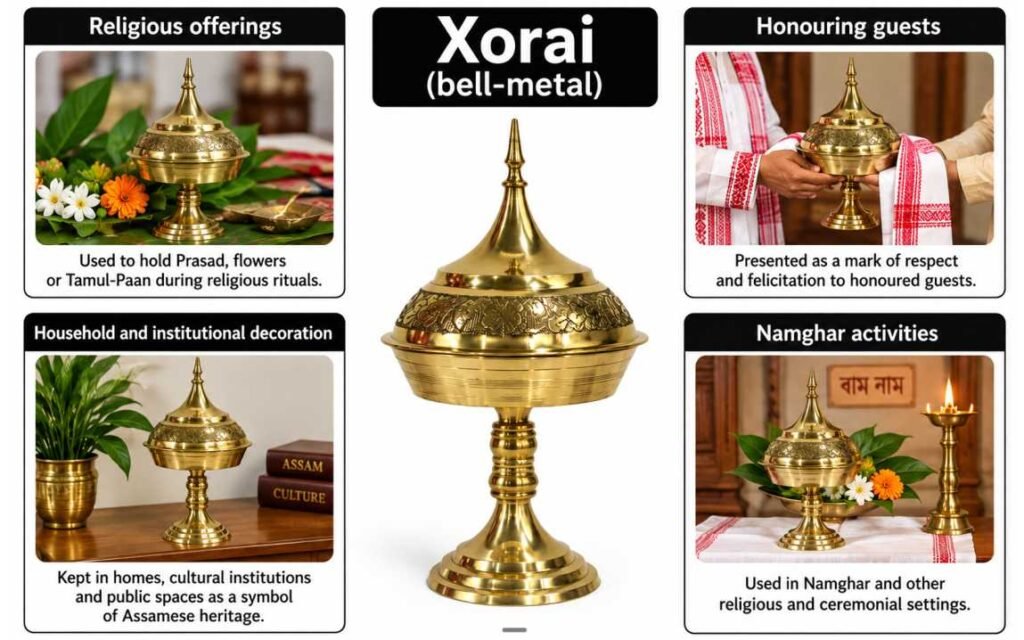
- The Xorai is a traditional Assamese raised offering tray or vessel.
- It is commonly associated with bell-metal craftsmanship.
- Bell metal is an alloy mainly made from copper and tin.
- Xorais may be made with or without a lid.
Main Uses
- Religious offerings:
- Holding Prasad, flowers or Tamul-Paan.
- Honouring guests:
- Presenting gifts or ceremonial tokens during felicitation programmes.
- Household and institutional decoration:
- Displaying it as a symbol of Assamese heritage.
- Namghar activities:
- Using it in appropriate religious and ceremonial settings.
Cultural Meaning
- The Xorai represents reverence, hospitality, dignity and respect.
- It shows how a useful household object can also become a cultural emblem.
Important Craft Centres
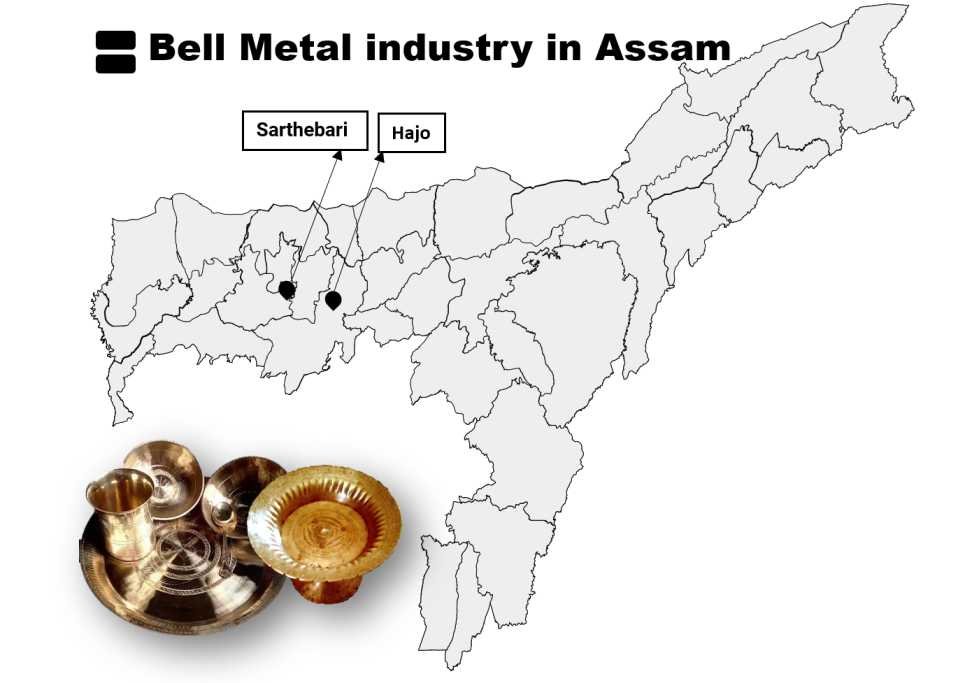
- Sarthebari is especially associated with Assam’s bell-metal industry.
- Hajo is another important centre of traditional metalwork, particularly brass craftsmanship.
- Both centres contribute to Assam’s wider tradition of making ceremonial and household metal objects.
Jaapi: Protective Headgear and Cultural Symbol
Meaning and Construction
- The Jaapi, also written as Japi, is a traditional broad conical hat of Assam.
- Its main materials include:
- Bamboo strips.
- Cane, where used.
- Tokou palm leaves.
- A lightweight framework is made from bamboo or cane, and the leaves are arranged to provide a protective covering.
- Decorative varieties may include coloured cloth, woven patterns, wool and other embellishments.
Origin of the Name
- A widely used explanation connects Jaapi with the Assamese word Jaap, referring to a bundle or layered arrangement of leaves.
- The construction method involves arranging and securing materials in layers.
From Practical Object to Cultural Emblem
- Plain Jaapis protected farmers and other outdoor workers from sun and rain.
- More elaborate forms became associated with status, honour and ceremonial display.
- Today, the Jaapi is used for:
- Welcoming and honouring guests.
- Cultural performances.
- Household decoration.
- Souvenirs and public displays of Assamese identity.
Main Types of Jaapi
| Type | Description and Use |
|---|---|
| Haluwa/Pani Jaapi | A practical variety used by agricultural workers for protection from sun and rain. |
| Uka Jaapi | A plain, undecorated protective Jaapi; also associated with farmers and workers. |
| Gorokhiya Jaapi | Associated with cattle herders. |
| Bor Jaapi | A larger form historically linked with status and ceremonial occasions. |
| Sorudoi/Sorudaya Jaapi | An ornamental variety associated with decorative and cultural uses. |
| Phulam/Phoolam Jaapi | A decorated Jaapi used in performances, felicitation and display. |
| Tupi Jaapi | A recognised headgear variety within Assam’s Jaapi tradition. |
| Dang Jaapi | Described in regional accounts as a Jaapi held using a bamboo handle or pole for shade during travel or processions. |
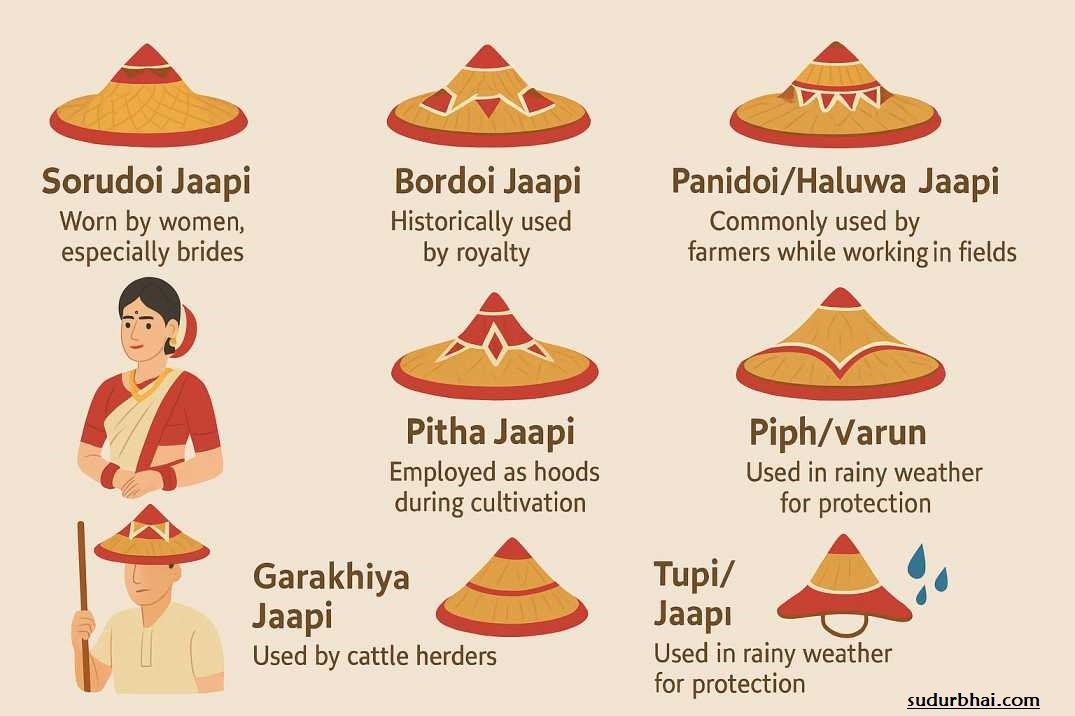
- Regional names and classifications may overlap.
- Uka Jaapi should not be defined only as a small plaything for children. The Assam State Rural Livelihoods Mission identifies it as protective headgear used by farmers and workers.
Jaapi During the Ahom Period
- Jaapis were used both as practical headgear and as markers of rank and prestige.
- Elaborately decorated examples were associated with important officials and ceremonial occasions.
- An official account describes:
- Gold ornamentation on Jaapis associated with officials such as the Buragohain, Borgohain and Borpatrogohain.
- Silver ornamentation on the Jaapi associated with the Borphukan.
Social and Religious Associations
- The Jaapi appears in descriptions of marriage ceremonies, community rituals and practices of honouring elders.
- In some marriage traditions, it provides ceremonial shade during activities connected with collecting water or preparing for the wedding.
- Regional accounts also associate it with:
- Sacred spaces and offerings.
- Prayers for agricultural prosperity.
- Respect for elders and religious figures.
- These practices should be understood as community-specific customs, rather than customs followed by every household in Assam.
Jaapi in Dance, Decoration and Cinema
- The Phulam Jaapi is used in some Bihu performances and staged cultural presentations.
- Its shape and bright decoration create a recognisable visual connection with Assam.
- Jaapi designs are also used in:
- Souvenirs.
- Wall decorations.
- Exhibitions.
- Jewellery and other craft products.
- Jyotiprasad Agarwala’s Joymoti (1935) incorporated Assamese objects such as the Jaapi and Xorai into its visual setting, helping represent regional material culture through cinema.
Traditional Dress and Textile Heritage
Mekhela-Chador
- The Mekhela-Chador, also written as Mekhela-Sador, is a major traditional attire worn by Assamese women.
- It is associated with cultural identity, elegance and ceremonial dress.
- It consists of two separate main pieces.
| Component | Description |
|---|---|
| Mekhela | The lower garment, shaped like a wide tube, arranged into pleats and secured around the waist. |
| Chador/Sador | A long upper cloth draped around the body and over the shoulder. |
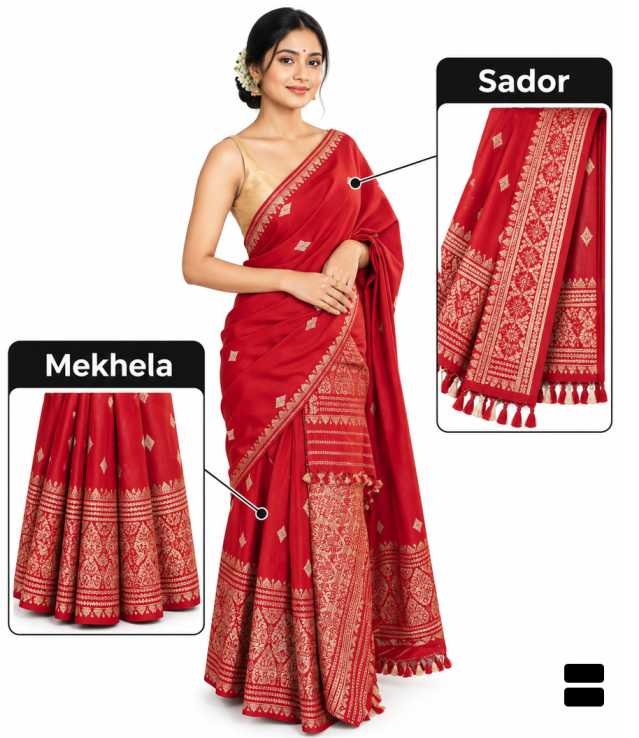
- It is generally worn with a blouse and an underskirt or petticoat.
- The Riha is another traditional cloth used particularly in bridal and ceremonial dress.
- It is an additional garment, rather than one of the two pieces that give the Mekhela-Chador its name.
- Assam’s different communities also have their own distinctive clothing traditions.
Major Silks of Assam
| Silk | Main Characteristics | Common Uses |
|---|---|---|
| Muga | Famous for its natural golden colour and close association with Assam. | Ceremonial garments, Mekhela-Chadors and other valuable textiles. |
| Pat/Paat | A smooth, lustrous silk, generally white or off-white in its natural form. | Festive clothing and finely woven garments. |
| Eri | A soft, warm silk with a comparatively wool-like texture. | Shawls, wraps and clothing suited to cooler weather. |
Sualkuchi and Household Weaving
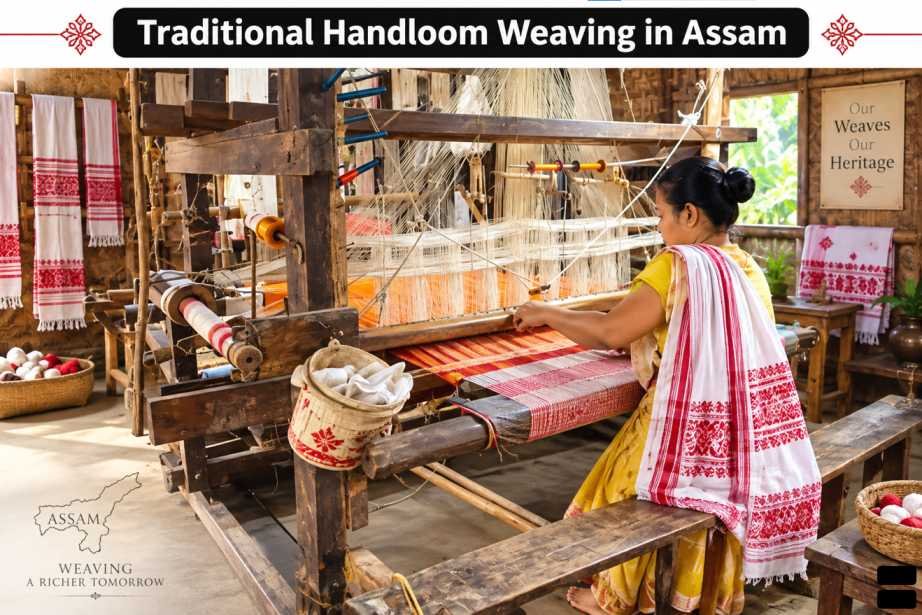
- Sualkuchi is a major centre of Assam’s silk-weaving industry.
- It is known for skilled weaving and intricate textile designs.
- Weaving is also practised in rural households across the state.
- Knowledge often passes between generations.
- Production serves both household needs and commercial markets.
- Assam’s textile heritage includes cotton as well as silk, with different communities contributing distinctive designs and colour combinations.
Traditional Assamese Jewellery
Meaning and General Features
- Traditional Assamese jewellery is known as Axomiya Gohona or Asomiya Alankar.
- It reflects:
- Artistic skill.
- Regional identity.
- Nature-based designs.
- Wedding and festival traditions.
- Common materials include gold, silver and gold-plated metal, together with beads, stones and decorative enamel.
- Kesa Xoon/Kesha Xoon, literally “raw gold,” is a traditional expression associated with Assamese gold ornaments.
Inspiration and Colour
- Designs draw inspiration from:
- Flowers and leaves.
- Birds and other animals.
- The moon and natural shapes.
- Musical instruments.
- Traditional objects such as the Jaapi.
- Red, green and black are prominent in many designs.
- Mina or enamel work means adding a coloured decorative coating to the metal surface. Assam’s official craft descriptions emphasise handmade production, nature-inspired designs and these characteristic colours.
Important Necklaces and Pendants
| Ornament | Main Identifying Feature |
|---|---|
| Dugdugi/Doog-Doogi | Commonly recognised by its heart-shaped pendant. |
| Golpata/Gal-pata | A choker-style necklace, worn close to the neck. |
| Junbiri/Jonbiri | A crescent-moon-shaped pendant. |
| Dholbiri | A design inspired by the Dhol, the traditional drum. |
| Lokaparo | Features a pair of pigeons or pigeon-like birds; the motif occurs in necklaces and earrings. |
| Moni Mala | A beaded necklace; materials vary and may include gold, coral or other beads. |
| Jethi Poti | A traditional neck ornament incorporating a sequence of decorative elements or medallions. |
| Jaapi-design ornament | Uses the form of the traditional Jaapi as its central motif. |
- The paired-bird Lokaparo, crescent-shaped Jonbiri and broad Gaam Kharu are particularly recognisable examples.
Other Necklace Designs Mentioned in Traditional Lists
- Keseru Haar:
- Described as a relatively simple necklace with a slender, elongated form.
- Detailed descriptions of its symbolism require confirmation.
- Prajapati Haar:
- Associated with a butterfly motif.
- Henpota:
- Described in some accounts as a design showing two birds facing one another.
- Other recorded design names include Bana, Gejera, Juri Pepa, Thoka Xun, Hilikha and Juti Fula.
- These names illustrate the variety of Assam’s ornament traditions.
Earrings
- Thuria:
- A traditional earring with a comparatively broad or cylindrical form.
- Often decorated with ornamental surface designs.
- Keru:
- A recognised traditional earring type.
- Thuria and Keru should not automatically be treated as identical names.
- Jangfai Keru:
- A named variety within the wider Keru tradition.
- Lokaparo earrings:
- Carry the characteristic paired-bird design.
- Makar Kundal:
- An earring name associated with the Makara, a mythical aquatic creature.
Bangles and Bracelets
- Gaam Kharu/Gam Kharu:
- A prominent broad bangle or bracelet.
- Often worn with traditional festive dress.
- Other names appearing in traditional ornament lists include:
- Muthi Kharu.
- Khowa/Khwoua Kharu.
- Bala.
- Their shapes and decorative details can vary according to local traditions and artisans.
Forehead, Waist and Other Ornaments
- Kapali:
- A forehead ornament associated with ceremonial adornment.
- Kardhani:
- A waist ornament or chain.
- Other names in traditional lists include Dharia Biri, Nakhpuh, Ansathi and Mal Kharu.
Craftsmanship and Production Centres
- Jewellery-making may involve:
- Shaping metal sheets or wire.
- Creating decorative forms.
- Enamelling.
- Stone setting.
- Using lac as a supporting filling in certain ornaments.
- Polishing and assembling the finished pieces.
- Jorhat is an important centre of traditional Assamese jewellery.
- Other associated centres include Sivasagar, Nagaon, Barpeta and Goalpara.
- Jewellery is worn during Bihu, weddings, religious occasions and cultural performances.
Assamese Cuisine
Main Characteristics
- Assamese cuisine reflects the state’s agriculture, climate, rivers and community diversity.
- Important features include:
- Extensive use of rice.
- Preference for fresh and seasonal ingredients.
- Use of vegetables, leafy greens, fish and other locally available foods.
- Distinctive alkaline and sour preparations.
- A range of preserved and fermented foods.
- Many preparations use relatively mild seasoning, but cooking methods and spice levels differ between communities.
Traditional Serving Utensils
- Bell-metal utensils have an important place in Assamese dining traditions.
- Their use reflects craft heritage, customary practice and ceremonial value.
Tea
- Tea, commonly called Saah, is an important everyday beverage.
- It may be served as:
- Black tea.
- Milk tea.
- Lemon tea.
- Other preparations, including green or spiced tea.
- Offering tea to visitors is a familiar expression of hospitality.
Jolpan: Traditional Light Food
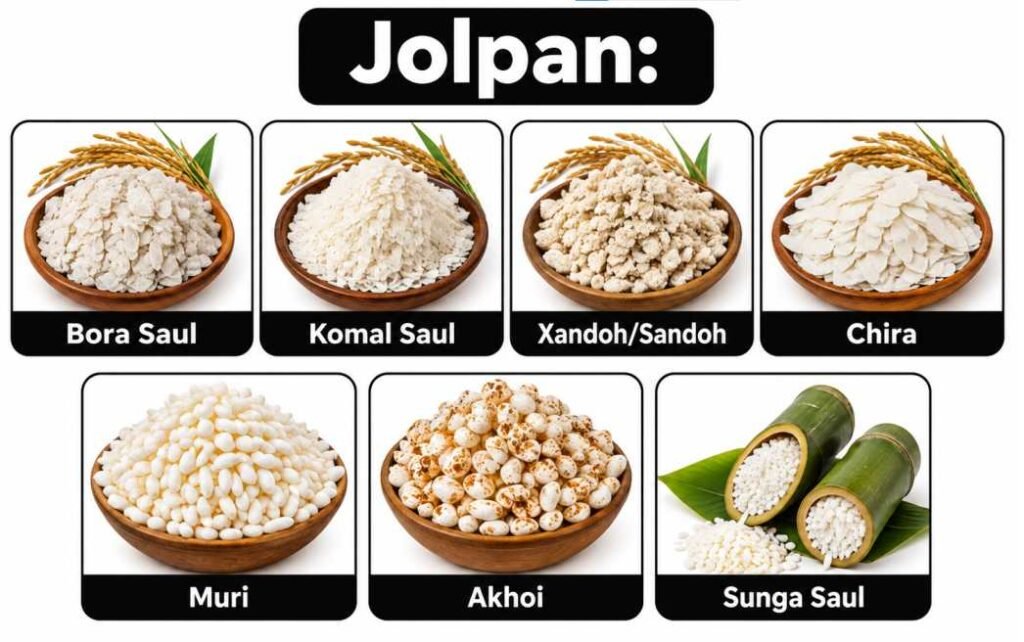
- Jolpan refers to traditional light food eaten at breakfast, as a snack or when receiving guests.
- It often combines rice-based items with curd, milk or jaggery.
| Item | Simple Explanation |
|---|---|
| Bora Saul | A sticky or glutinous rice used in several traditional preparations. |
| Komal Saul | A specially processed soft rice that can be eaten after soaking. |
| Xandoh/Sandoh | A preparation made from roasted and ground rice. |
| Chira | Flattened rice. |
| Muri | Puffed rice. |
| Akhoi | Popped rice. |
| Sunga Saul | Rice cooked inside a bamboo tube. |
- These foods show the many ways in which Assam’s communities process and prepare rice.
Pitha
- Pitha refers to a broad group of traditional cakes or snacks, commonly made from rice flour.
- Different varieties may be steamed, roasted or fried.
| Variety | Main Feature |
|---|---|
| Til Pitha | A rice-flour preparation usually containing a sesame and jaggery filling. |
| Ghila Pitha | A small, generally fried rice-based cake. |
| Sunga Pitha | Prepared using a bamboo tube. |
| Bhapot Diya/Bhapotdiya Pitha | A steamed preparation. |
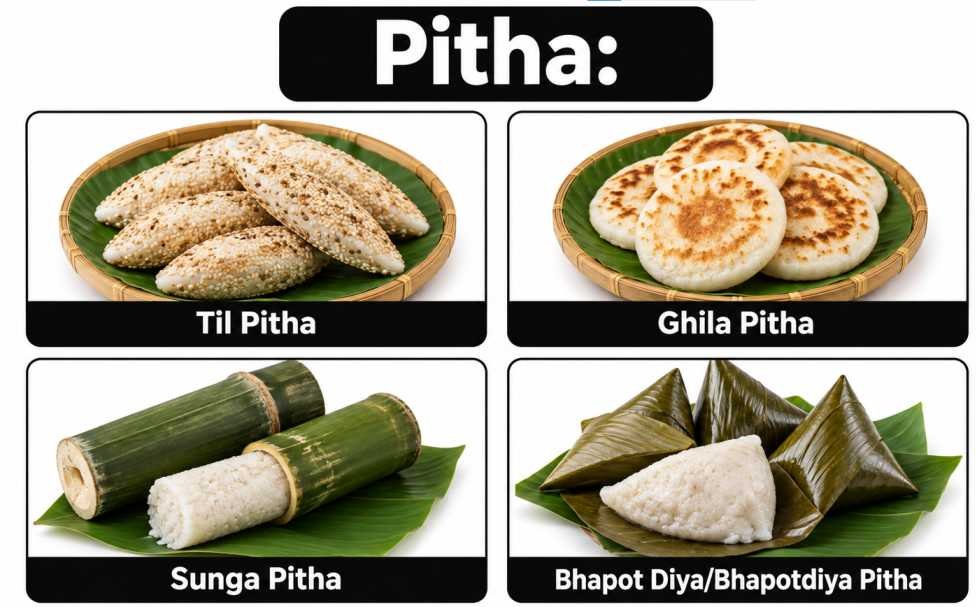
- Pithas are especially associated with Bihu and household celebrations.
Laru
- Laru are traditional sweet balls prepared from different ingredients.
- Examples include:
- Tilor Laru: Made mainly from sesame and a sweetener.
- Coconut Laru: Made mainly from grated coconut and a sweetener.
Khar
- Khar refers both to an alkaline ingredient and to dishes prepared with it.
- Traditionally, the alkaline liquid may be obtained by filtering water through the ash of dried parts of particular banana plants.
- Khar dishes may use ingredients such as raw papaya, vegetables or pulses.
- In some traditional meals, a Khar preparation is served near the beginning.
Tenga
- Tenga means sour and refers to preparations with a sour taste.
- Sourness may come from ingredients such as tomato, lemon or other sour fruits.
- Masor Tenga, a light sour fish preparation, is a well-known example.
- The sequence of serving Khar and Tenga varies between households and occasions.
Payash and Poitabhat
- Payash/Payas:
- A sweet rice pudding prepared with rice, milk and sugar or jaggery.
- Commonly associated with celebrations and special meals.
- Poitabhat:
- Cooked rice soaked in water and left for a period, traditionally often overnight.
- Commonly eaten during warm weather with suitable accompaniments.
- Although fermentation may occur, describing every preparation as having proven probiotic benefits would be too broad.