
Agriculture and allied activities form the foundation of Assam’s rural economy. Even though modern sectors like services (IT, banking, etc.) and industries are growing, the reality is that most people in Assam still depend on farming and nature-based activities for survival.
In simple words, Assam’s economy still runs mainly on its fields (agriculture), rivers (fisheries), forests (timber), and animals (livestock).
Importance and Contribution of Agriculture & Allied Sector
Agricultural sector in Assam’s Economy
- Agriculture plays a central and dominant role in Assam’s economy.
- It is called the backbone of Assam’s economy because most rural life depends on it
- It contributes around 25–35% of GSDP (Gross State Domestic Product)
- It provides jobs and livelihood to around 50–70% of the total workforce
What does this mean in simple terms?
- Even though agriculture does not generate the highest income, it still:
- Employs the largest number of people
- Keeps rural households alive economically
- Even though agriculture does not generate the highest income, it still:
Key Importance
Agriculture in Assam is important not just for farmers, but for the entire economy and daily life.
1. Ensures Food Security
- The most important crop is rice (staple food)
- Agriculture ensures that people in Assam have enough basic food supply
2. Provides Raw Materials to Industries
- Agriculture supports many industries by supplying raw materials:
- Tea processing industry → tea leaves
- Jute industry → raw jute for packaging
- Sugar industry → sugarcane
3. Supports Rural Livelihoods
- Most villages depend on farming and allied activities
- It is the main source of income in rural Assam
4. Supports Exports and Trade
- Agriculture also brings income from outside the state and country:
- Assam tea → world-famous export product
- Horticulture products → fruits and vegetables like pineapple, banana, citrus
Allied Sector Contribution in Assam Economy
- Apart from farming, there are several supporting activities called allied sectors.
- These include:
- Fisheries (fish farming and river fishing)
- Animal husbandry (cattle, poultry, pigs, goats)
- Sericulture (silk production like Muga and Eri silk)
- Forestry (bamboo, timber, medicinal plants)
Why is Allied sector important?
- These activities:
- Provide extra income to farmers
- Reduce dependence on only agriculture
- Offer year-round employment, even when farming is not possible
- These activities:
Key Economic Insight
- Agriculture in Assam provides high employment but low income contribution
What does this mean?
- A very large number of people work in agriculture
- But the total income generated from agriculture is not very high
Result:
- Low productivity per worker
- Many people are not fully utilized in productive work.
- This leads to a situation called Disguised Unemployment where,
- People appear to be working
- But their actual contribution to output is very low
Major Crops of Assam
- Assam’s agriculture is mainly rice-based, meaning most farmers grow rice as their primary crop. However, due to its fertile soil, heavy rainfall, and diverse climate, Assam also produces many other crops like tea, fruits, spices, and oilseeds.
- Rice is the backbone, but Assam’s farming system also includes tea, fruits, and cash crops.
1. Rice (Staple Crop )
- Rice is the most important crop of Assam, both economically and socially.
- It covers around 60–62% of total cropped area
- It is the main food of the people of Assam
- Almost every rural household depends on rice farming
Types of Rice in Assam
1. Ahu (Autumn Rice)
- Grown during early part of the year
- Depends mainly on rainfall (rain-fed farming)
- Less productive compared to other types
2. Sali (Winter Rice)
- Most important rice crop in Assam
- Grown during monsoon season
- Produces the highest yield
- Forms the main food supply of the state
3. Boro (Summer Rice)
- Grown in winter–spring season
- Requires irrigation (water supply from rivers/wells)
- Helps increase total rice production
2. Tea
- Assam is India’s largest tea-producing region
- Famous worldwide for strong Assam tea flavor
- Major tea gardens are located in:
- Upper Assam
- Brahmaputra Valley region
- Importance of Tea
- It is a major export crop
- Provides large-scale employment in plantations
- Contributes significantly to Assam’s economy
3. Jute
- Grown mainly in flood-prone lowland areas
- Thrives in moist soil conditions
- Uses of Jute:
- Gunny bags
- Packaging materials
- Ropes and sacks
4. Oilseeds
- Main oilseed crop: mustard (rapeseed)
- Used to produce edible cooking oil
5. Sugarcane
- Used for making:
- Sugar
- Jaggery (gur)
6. Other Crops
- Apart from major crops, Assam also grows:
- Pulses (gram, lentils, green gram)
- Potato, wheat, maize
7. Horticulture (Fruits & Vegetables )
- Assam has very good conditions for growing fruits and vegetables due to its:
- High rainfall
- Fertile soil
- Warm climate
Fruits:
- Pineapple (very famous in Assam)
- Banana
- Orange (citrus fruits)
Vegetables and spices:
- Ginger
- Turmeric
- Chilli (Bhot Jolokia)
Key Issue associated with agriculture in Assam
- Rice Monoculture Problem
- Assam depends too heavily on rice farming, which creates a major issue called Rice Monoculture (over-dependence on rice)
- Other problems associated with agriculture in Assam are:
- High risk during floods and droughts
- Lack of crop diversification
- Low income stability for farmers
Cropping Pattern and Zones
- Cropping pattern means how crops are grown over a year in a particular region—which crops are grown, in which season, and how farming is organized.
- In Assam, cropping is strongly influenced by:
- Monsoon rainfall
- River flooding (especially Brahmaputra system)
- Fertile alluvial soil in plains
- Cropping pattern shows how farmers “plan their farming year” based on seasons and weather.
Cropping Pattern
1. Highly Monsoon-Dependent Agriculture
- Most farming in Assam depends on rainfall from the monsoon
- Irrigation is still limited in many areas
- So, timing of rain decides crop success or failure
2. Rice Dominates the System
- Rice is the main crop in almost every season
- It occupies the largest share of farmland
3. Moderate Cropping Intensity (~140–150%)
- Cropping intensity means how many crops are grown on the same land in a year
- In Assam, it is moderate (not very high)
- Some land produces 1 crop/year, others produce 2–3 crops/year
4. Seasonal Cropping System
Assam follows three main cropping seasons:
A. Kharif Season (Monsoon Season)
- Main agricultural season
- Depends heavily on rainfall
- Major crops:
- Rice (Ahu and Sali varieties)
- Jute
- Maize
- Pulses
B. Rabi Season (Winter Season )
- Grown after monsoon ends
- Depends more on soil moisture and irrigation
- Major crops:
- Mustard
- Potato
- Wheat
C. Summer Season
- Mostly irrigated farming
- Less area compared to other seasons
- Major crop:
- Boro rice (irrigated rice)
Agricultural Zones of Assam
- Assam is divided into different agro-climatic zones, meaning each region has different soil, climate, and farming patterns.

1. Brahmaputra Valley Zone
This is the most important agricultural region of Assam.
Features:
- Very fertile alluvial soil
- Large flat plains
- High population density
Major crops:
- Rice (dominant crop)
- Tea (especially Upper Assam)
- Jute
- Mustard
This is the “food bowl” and economic backbone of Assam agriculture
2. Barak Valley Zone
Located in southern Assam.
Features:
- Valley surrounded by hills
- High rainfall and fertile soil
Agriculture:
- Rice-based farming system
- Important growth of:
- Horticulture (fruits & vegetables)
- Fisheries (ponds and wetlands)
Barak Valley focuses more on rice, fruits, and fish production
3. Hill Regions (Karbi Anglong & Dima Hasao)
These areas have hilly terrain and forests.
Features:
- Steep slopes
- Dense forests
- Difficult farming conditions
Agriculture type:
- Jhum cultivation (shifting cultivation)
→ farmers clear small forest patches, grow crops, then move
- Jhum cultivation (shifting cultivation)
Other activities:
- Forest-based livelihood
- Growing scope for horticulture (fruits and spices)
Farming here is traditional and less intensive due to hills and forests
Key Issue in Agriculture
Low Diversification and High Dependence on Rice
- Most farmland is used for rice cultivation
- Very few alternative crops are grown in large scale
Problems caused:
- High vulnerability to floods and climate changes
- Farmers’ income remains unstable
- Lack of agricultural variety reduces growth opportunities
Land Reforms and Credit
This topic explains two very important things for agriculture in Assam:
- Land Reforms → How land is distributed and owned
- Agricultural Credit → How farmers get money/loans for farming
Land reforms decide “who owns land”, and credit decides “who gets money to farm.”
Land Reforms
- Land reforms are government efforts to make land ownership fair, equal, and productive.
Objectives
- The main goals of land reforms in Assam are:
- Fair distribution of land
→ So that land is not concentrated in a few hands - Protection of tenant farmers
→ Farmers who cultivate land owned by others should get security - Reduction of inequality
→ Reduce gap between rich landowners and poor farmers
- Fair distribution of land
Problems
- Even after reforms, Assam still faces several land-related issues:
1. Small and fragmented landholdings (~83%)
- Most farmers own very small pieces of land
- Land is often divided into tiny scattered plots
- Problem:
- Difficult to use machines
- Low productivity
2. Weak tenancy rights
- Many farmers cultivate land they do not legally own
- They have no strong legal protection
- They can lose land anytime
3. Encroachment and unclear land records
- Land records are often outdated
- Illegal occupation of land is common
4. Flood-induced land loss
- Floods in Assam (especially Brahmaputra basin)
- River erosion washes away fertile land
Current Efforts
- To improve the situation, the government is taking steps:
1. Digitization of land records
- Land documents are being converted into digital records
- Helps reduce errors and corruption
- Mission Basundhara of Govt. of Assam is a similar step taken in this direction by Assam Government.
2. Distribution of land rights (pattas)
- Government gives legal ownership papers called pattas
- Helps farmers become legal landowners
Agricultural Credit
Agricultural credit means money or loans given to farmers for farming activities like seeds, fertilizers, machines, etc.
Sources of Credit
- Farmers get money from two main sources:
1. Institutional Sources (Formal system )
- These are organized and government-regulated sources:
- Banks
- NABARD (National Bank for Agriculture and Rural Development)
- Cooperative banks
- Regional Rural Banks (RRBs)
- Kisan Credit Card (KCC)
- These are organized and government-regulated sources:
Importance:
- Safer loans
- Lower interest rates
- Government support
2. Non-Institutional Sources (Informal system)
- These include:
- Moneylenders (still common in villages)
- These include:
Problems:
- Very high interest rates
- Risk of debt trap
- No legal protection
Problems in Agricultural Credit
- Even with banks and schemes, farmers face issues:
1. Low credit access in rural areas
- Many villages are far from banks
- Poor awareness of schemes
2. Dependence on informal lenders
- Farmers still borrow from moneylenders
- Especially in remote areas
3. Delay in loan disbursement
- Loans take time to be approved
- Farmers need money quickly during sowing season.
Irrigation and Mechanization
- This topic explains two important parts of modern agriculture:
- Irrigation → Supply of water to crops
- Mechanization → Use of machines in farming
Water and machines are the two pillars of modern farming, but both are still underdeveloped in Assam.
Irrigation
- Irrigation means artificial supply of water to crops when rainfall is not enough.
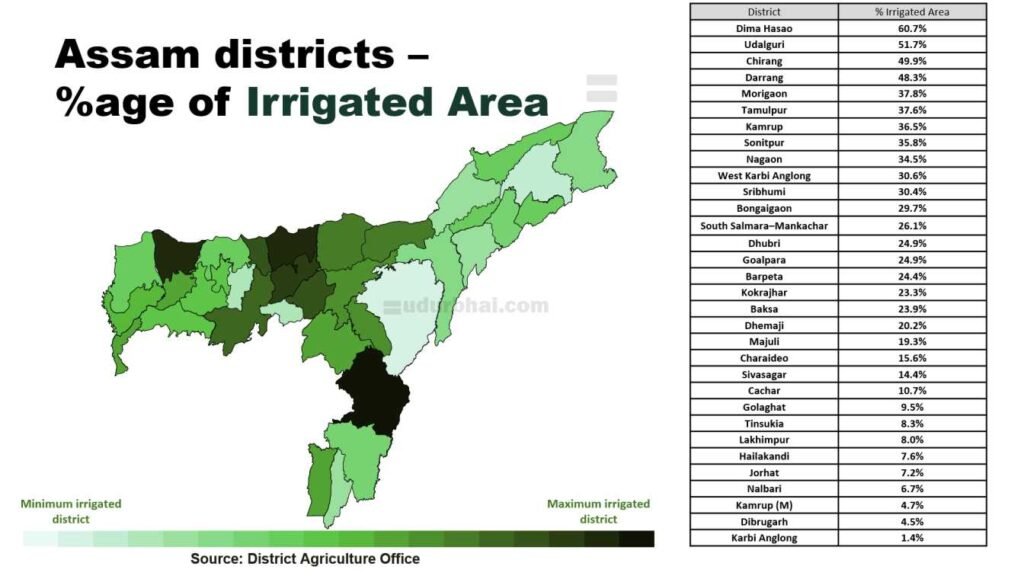
- Although Assam receives very high rainfall, irrigation is still not well developed.
Current Situation
- Assam is a high rainfall state
- But agriculture is still mostly rain-dependent (rainfed farming)
- This means farmers rely mainly on monsoon rains
Rainfall is uneven and unpredictable, so farming becomes risky
Sources of Irrigation
- Farmers in Assam use different sources of water:
- Rivers → direct water from Brahmaputra and tributaries
- Canals → man-made water channels
- Tube wells → groundwater extraction
- Tanks and wetlands (beels) → traditional water storage systems
Problems in Irrigation
1. Low irrigation coverage
- Only a small part of farmland has assured irrigation
- Many areas still depend on rainfall
- Crop production is uncertain
2. Flood damage to irrigation systems
- Floods often destroy:
- canals
- pumps
- irrigation structures
- Even existing irrigation systems get damaged frequently
- Floods often destroy:
3. Uneven water supply
- Some areas get enough water
- Others face water shortage
- Water is available, but not properly managed or distributed
Mechanization
Mechanization means using machines in farming instead of only manual labour or animals.
Machines make farming faster and more efficient
Current Level of Mechanization
- Assam has a moderate level of mechanization
- Machines are used, but not everywhere
Common Agricultural Machines Used
- Tractors → for ploughing land
- Power tillers → small-scale land preparation
- Harvesters → cutting and collecting crops
Machines are slowly replacing traditional manual farming methods
Challenges in Mechanization
1. Small landholdings
- Most farmers have very small and scattered land
- Machines are difficult to use on small plots
2. High cost of machines
- Tractors and harvesters are expensive
- Poor farmers cannot afford them easily
3. Lack of training
- Farmers are often not trained to use machines
- Maintenance knowledge is also low
4. Flood damage
- Machines and tools get damaged during floods
- This increases financial loss
Allied Activities
Allied activities are supporting economic activities related to agriculture, but not directly crop farming. They include activities like fishing, livestock rearing, silk production, and forest-based work.
If agriculture is the main engine, allied activities are the supporting wheels that keep rural life running smoothly.
These sectors are very important in Assam because they:
- Provide extra income to farmers
- Create employment for landless people
- Improve nutrition (food supply like fish, milk, eggs)
1. Fisheries
- Assam has a very rich water system with:
- Rivers (Brahmaputra and Barak)
- Beels (natural wetlands)
- Ponds and tanks
- Because of this, fisheries are a very important livelihood activity.
- Assam has a very rich water system with:
Important Fish Species
- Rohu
- Catla
- Magur
Importance of Fisheries
- Provides cheap and nutritious food (protein source)
- Creates rural employment opportunities
- Supports local economy and trade
2. Animal Husbandry
- Animal husbandry means rearing animals for economic purposes.
- Common animals in Assam include:
- Cattle
- Goats
- Poultry (chicken, ducks)
- Pigs
Products from Animal Husbandry
- Milk
- Meat
- Eggs
Special Feature of Assam
Assam has a high pig population, especially in:
- Tribal communities
- Hill regions
Importance
- Provides quick income for rural families
- Supports nutrition (protein-rich food)
- Works as a backup income source during crop failure
3. Sericulture
- Sericulture means silk production by rearing silkworms.
- Assam is famous for its unique and high-quality silk varieties.
Types of Silk in Assam
- Muga silk → most famous, golden-colored, unique to Assam
- Eri silk → warm and eco-friendly silk
- Mulberry silk → common silk variety
Importance of Sericulture
- Provides employment, especially for rural women
- Supports handloom and textile industry
- Assam’s silk has high cultural and global value
4. Forestry
- Forestry refers to use of forest resources for livelihood and industry.
- Assam has rich forest resources like:
- Bamboo
- Timber (wood)
- Medicinal plants
Importance of Forestry
- Provides raw materials for cottage industries
- Supports handicrafts and bamboo products
- Offers livelihood to tribal and forest-dependent communities
Agricultural Marketing
- Agricultural marketing refers to the process through which farm products move from farmers to consumers.
- It is the journey of crops from the field to your plate.
- In Assam, this system is still mostly traditional and not well organized, which creates many problems for farmers.
Structure
- The marketing system in Assam is mostly traditional and unorganized
- Farmers usually sell their products in local markets (haats)
- There is limited use of modern systems like digital trading
- Farmers do not have direct access to markets, so they depend on others to sell their produce
Role of Middlemen
- Middlemen (traders/agents) act as intermediaries between farmers and buyers
- They purchase crops from farmers and sell them further
Problem:
- Farmers often get low prices
- Middlemen take a large share of profit
- Farmers do the hard work, but middlemen often earn more profit
Marketing Chain
- The typical flow of agricultural products is:
Farmer → Trader → Wholesaler → Consumer
- Farmer → produces crops
- Trader → buys from farmer (often at low price)
- Wholesaler → buys in bulk and distributes
- Consumer → final buyer
In this chain ; More steps = more cost, less profit for farmers.
Problems
- Assam’s agricultural marketing system faces several major challenges:
1. Lack of storage facilities
- Farmers do not have proper warehouses
- Cannot store crops for long.
- Forced to sell immediately at low prices
2. Poor cold storage
- Perishable goods (fruits, vegetables) spoil quickly
- Very few cold storage units
3. Weak transport system
- Poor road connectivity in rural areas
- Difficult to transport goods to markets
4. High post-harvest losses
- Damage during storage and transport
- Especially in fruits and vegetables
5. Low bargaining power of farmers
- Farmers are often:
- Small-scale
- Poor
- Unorganized
- Farmers are often:
Government Efforts
- To improve agricultural marketing, the government has introduced several initiatives:
1. Regulated Markets
- Markets controlled by government rules
- Ensure fair pricing and transparency
- Reduces exploitation by middlemen
2. FPOs (Farmer Producer Organizations)
- Groups of farmers working together
- Sell products collectively
- Benefit:
- Better bargaining power
- Higher prices
- Lower costs
3. e-NAM Platform (Electronic National Agriculture Market)
- Online platform for buying and selling crops
- Connects farmers to markets across India
- Benefit:
- Better price discovery
- Wider market access.
Organic Farming
Organic farming is becoming an important part of modern agriculture, especially in states like Assam where natural conditions already support low-chemical farming.
What is Organic Farming?
- Organic farming means growing crops without using chemical fertilizers, pesticides, or synthetic inputs.
- Instead, farmers use:
- Natural manure (cow dung, compost)
- Bio-fertilizers
- Natural pest control methods
Importance of organic Farming in Assam
- Assam has a natural advantage for organic farming because:
- Farmers already use less chemical fertilizers compared to other states
- The environment is rich in biodiversity and natural resources
- Soil quality is still relatively healthy
Suitable Crops for Organic Farming
- Organic farming is especially suitable for:
- Tea → Assam tea has high demand in global organic markets
- Rice → staple crop, can be grown using natural methods
- Horticulture crops → fruits, vegetables, spices
- Assam can easily shift to organic farming because it is already close to natural farming practices
Advantages of organic farming
- Organic farming provides many benefits:
1. Eco-friendly
- No harmful chemicals
- Protects environment, water, and biodiversity
2. Higher market value
- Organic products sell at higher prices
- High demand in national and international markets
3. Better soil health
- Improves soil fertility in the long run
- Maintains natural nutrients
Challenges to organic farming in Assam
- Despite its advantages, organic farming faces several problems:
1. Low awareness
- Many farmers do not know about:
- Organic techniques
- Market benefits
- Many farmers do not know about:
2. Certification problems
- To sell products as “organic”, farmers need official certification
- Process is:
- Complicated
- Time-consuming
- Costly
3. Lower initial yield
- In the beginning, crop production may decrease
- Soil takes time to adjust to natural methods
Government Support
- The government is promoting organic farming through different initiatives:
1. Organic Clusters
- Groups of farmers practicing organic farming together
- Helps in:
- Training
- Marketing
- Certification
2. Training Programs
- Farmers are trained in:
- Natural farming techniques
- Compost making
- Pest control
- Farmers are trained in:
3. Subsidies
- Financial support for:
- Organic inputs
- Certification costs
- Financial support for:
4. PKVY Scheme (Paramparagat Krishi Vikas Yojana)
- Promotes cluster-based organic farming
- Provides:
- Financial assistance
- Certification support
- Market linkage.
Floods and Agriculture
Floods are one of the most important factors affecting agriculture in Assam. They are both a blessing and a curse — helping the soil in some ways but causing heavy damage in others.
Floods help the land but hurt the farmers
Flood Situation in Assam
- Assam lies in the Brahmaputra river basin, which is one of the most flood-prone regions in India
- Every year, about 29–40% of the total area gets affected by floods
- Floods are not occasional in Assam — they are a yearly event
Causes of Flood
- Floods in Assam happen due to a combination of natural and human factors:
1. Heavy monsoon rainfall
- Assam receives very high rainfall during monsoon (June–September)
- Excess rain leads to water overflow
2. River overflow (Brahmaputra system)
- The Brahmaputra and its tributaries carry huge amounts of water and silt
- During monsoon, rivers overflow and flood nearby areas
3. Siltation and deforestation
- Siltation (deposition of sediments) raises riverbeds
- Deforestation in catchment areas increases soil erosion
Negative Impacts of Floods
- Floods cause serious damage to agriculture and rural life:
1. Crop destruction (especially rice)
- Standing crops, especially kharif rice, get submerged
- Leads to huge losses for farmers
2. Soil erosion
- Fertile topsoil is washed away
- Land becomes less productive
3. Loss of livestock
- Animals like cattle, goats, poultry may die or get displaced
4. Delayed farming cycles
- Floodwater remains for long time
- Farmers cannot sow crops on time
5. Increase in poverty
- Loss of crops and assets reduces income
- Leads to debt and financial stress
Positive Impact of Floods
- Despite the damage, floods also bring some benefits:
1. Deposition of fertile alluvial soil
- Floodwater brings nutrient-rich silt
- Improves soil fertility
2. Improves soil nutrients
- Acts like a natural fertilizer
- Helps in better crop growth in the next season
- Floods damage crops now but improve soil for future farming
Flood Management
- To reduce the harmful effects of floods, several measures are taken:
1. Embankments
- Raised barriers along rivers
- Prevent water from entering fields
2. Early warning systems
- Forecasts and alerts before floods
- Helps people prepare and reduce losses
3. Crop insurance (PMFBY)
- Farmers get financial compensation for crop loss
- Reduces economic risk
4. Flood-resistant crops
- Special crop varieties that can survive waterlogging or submergence
5. Floating agriculture (e.g., Majuli region)
- Crops grown on floating beds made of organic materials
- Useful in waterlogged areas.