
The constitutional position of Assam within the Indian Union represents one of the most sophisticated experiments in asymmetric federalism anywhere in the world. Positioned at the geopolitical and cultural crossroads of Northeast India, Assam’s governance framework is not a rigid template but a dynamic constitutional bridge. It balances the imperatives of national integration with the profound necessity of preserving the distinct socio-cultural, linguistic, and political identities of its diverse indigenous and tribal populations.
While Assam operates under the general structural framework of the Constitution of India, its historical trajectory—marked by partition, intense immigration pressures, and tribal aspirations—has necessitated unique constitutional safeguards. From the foundational provisions of Article 1 to the administrative autonomy of the Sixth Schedule and the specialized architecture of the Bodoland Territorial Region (BTR), Assam’s constitutional journey showcases how the Indian Republic accommodates regional exceptionalism without compromising territorial integrity.
Assam as a State under the Constitution of India
Assam is recognized as a constituent, full-fledged state of the Union of India under Article 1 and is listed in the First Schedule of the Constitution. Its core administrative machinery conforms to the parliamentary model of cabinet government established for all Indian states under Part VI of the Constitution.
State Legislative Structure
Unlike some states that maintain a bicameral legislature, Assam operates a unicameral legislature known as the Assam Legislative Assembly (Vidhan Sabha).

- Composition: The Assembly consists of 126 directly elected members (MLAs) chosen through universal adult suffrage.
- Bicameralism: Although the Constitution contains enabling provisions (Article 169) for the creation or abolition of a Legislative Council (Vidhan Parishad), Assam does not possess an upper house.
The Governor’s Role: General and Discretionary
The Governor of Assam is the constitutional head of the state (Article 153), appointed by the President of India. While the Governor generally acts on the aid and advice of the Council of Ministers headed by the Chief Minister (Article 163), the Governor of Assam enjoys exceptional discretionary powers not available to their counterparts in non-frontier states:
- Under the Sixth Schedule, the Governor acts as the ultimate arbiter in resolving disputes regarding the sharing of royalties on mineral licenses between the State Government and the Autonomous District Councils (ADCs).
- The Governor retains discretionary power over the administration, public order, and boundary modifications of tribal autonomous areas.
Division of Powers (Seventh Schedule)
The legislative and executive jurisdiction of Assam is governed by the Seventh Schedule, which demarcates functional domains into three distinct lists:
List Type | Constitutional Scope in Assam | Key Functional Areas |
Union List (List I) | Exclusive jurisdiction of the Parliament of India. | 1.National defense |
State List (List II) | Exclusive jurisdiction of the Assam Legislative Assembly. | 1.Public order |
Concurrent List (List III) | Shared jurisdiction between the Centre and the State. | 1.Education |
Financial Relations
The fiscal relationship between the Centre and Assam is managed through Articles 268 to 293. Due to its geographical vulnerabilities and economic status, Assam has historically been classified as a Special Category State, ensuring it receives preferential fiscal treatment:
- Statutory Grants: Received under Article 275(1), which provides financial assistance to states in need, specifically designated for promoting the welfare of Scheduled Tribes and raising the administration of tribal areas to the level of the rest of the state.
- Tax Devolution: Assam receives its designated share of central taxes based on the recommendations of the Finance Commission.
Judiciary
The judicial architecture of Assam is headed by the Gauhati High Court (established in 1948). It occupies a unique place in Indian judicial history. Initially holding jurisdiction over the entire undivided Northeast, it still acts as a common High Court for four states: Assam, Nagaland, Mizoram, and Arunachal Pradesh. This multi-state jurisdiction ensures uniform judicial interpretation across culturally diverse terrains.
Emergency Provisions
Like all states, Assam is subject to the emergency provisions under Articles 352 to 360. However, the invocation of Article 356 (President’s Rule) has historically played a visible role in Assam’s political trajectory during times of acute student agitation, ethnic conflicts, or internal disturbances. Furthermore, parts of Assam have historically been subject to special central security legislation, such as the Armed Forces (Special Powers) Act (AFSPA), illustrating the delicate balance between state-level law enforcement and national security intervention.
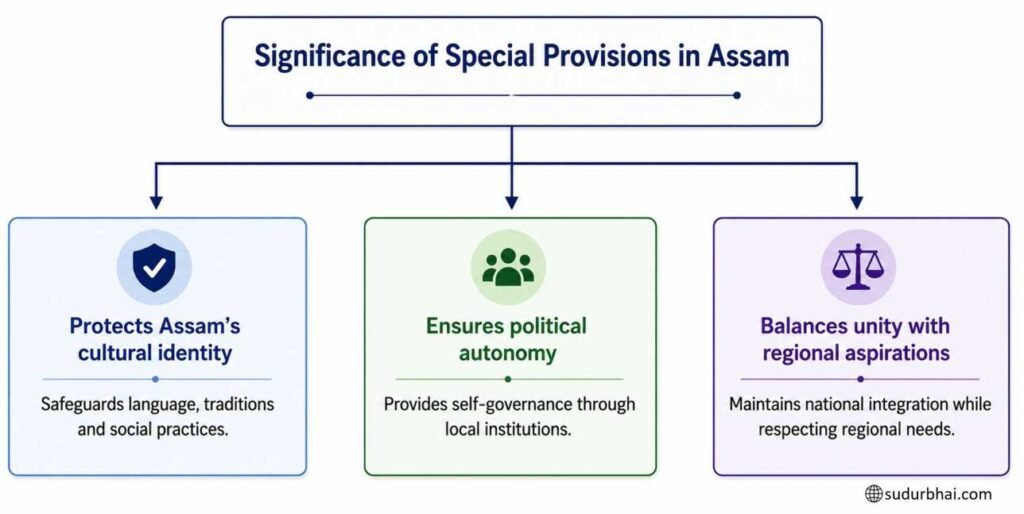
Special Provisions Applicable to Assam (Articles 371B, Others)
To address the historical neglect of tribal populations and mitigate the friction between plains communities and hill tribes, the Constitution includes several asymmetric, protective clauses specifically tailored for Assam.
Article 371B: Special Provision for the State of Assam
Inserted into the Constitution via the 22nd Constitutional Amendment Act of 1969, Article 371B serves as a vital legislative bridge:
- The Committee of the Assembly: It empowers the President of India to provide for the constitution and functions of a special committee of the Assam Legislative Assembly.
- Composition: This committee consists of MLAs elected from the tribal areas specified in the Sixth Schedule along with other MLAs specified by the President.
- Core Objective: The purpose is to ensure that bills and policy measures affecting the tribal districts are vetted by representatives of those districts before being debated by the full, plains-dominated legislature. It acts as an institutional veto and advisory platform protecting tribal customs from majority encroachment.
Constitutional Safeguards for Indigenous Identity
- Article 366(25): Works in tandem with Article 342 to define and identify Scheduled Tribes (STs) in Assam. This ensures that specific indigenous groups enjoy reservation benefits in public employment, education, and political seats.
- Article 244(2): Directly links the administration of designated tribal areas in Assam to the provisions of the Sixth Schedule, bypassing standard regional administrative codes.
Sixth Schedule – Autonomous District Councils in Assam
The Sixth Schedule (read with Article 244(2) and Article 275(1)) is often hailed as a “Constitution within a Constitution.” Conceived by the Gopinath Bordoloi Committee of the Constituent Assembly, it seeks to protect the tribal way of life from assimilation and exploitation.
Applicability in Assam
In Assam, the Sixth Schedule is operationalized through three distinct Autonomous District Councils (ADCs), representing specific geographically defined hill areas:
- Dima Hasao Autonomous Council (formerly North Cachar Hills)
- Karbi Anglong Autonomous Council (KAAC)
- Bodoland Territorial Council (BTC) (administered as a more advanced model)
Composition and Structure
Each standard ADC is structured to ensure democratic grassroots representation:
- Membership: Typically consists of a maximum of 30 members.
- Elections: 26 members are elected through universal adult franchise, while 4 members are nominated by the Governor to represent unrepresented minority groups within those tribal districts.
- Tenure: The councils serve a term of 5 years from the date of their first meeting.
Multi-Dimensional Powers of ADCs
Unlike standard local self-government bodies like Panchayats, ADCs possess a triad of legislative, executive, and judicial powers:
- Legislative Powers: ADCs can draft laws on critical local matters including land allotment, forest management (excluding reserved forests), inheritance of property, marriage & social customs, and village administration. However, all laws passed by the ADCs require the assent of the Governor to become valid.
- Executive Powers: The council establishes and manages primary schools, dispensaries, markets, ferries, fisheries, and roads within its territory. They are empowered to collect land revenue and levy taxes on professions, trades, and vehicles.
- Judicial Powers: ADCs are authorized to constitute Village Councils or Courts for trial of suits and cases between Scheduled Tribe members. They can appoint officers to preside over these courts, effectively bypassing lengthy civil litigation in state courts.
Bodoland Territorial Region (BTR) and Other Autonomous Arrangements
The creation of the Bodoland Territorial Region (BTR) represents a massive evolution in the application of the Sixth Schedule, demonstrating the flexibility of the Indian Constitution in accommodating sub-regional ethno-nationalist aspirations.
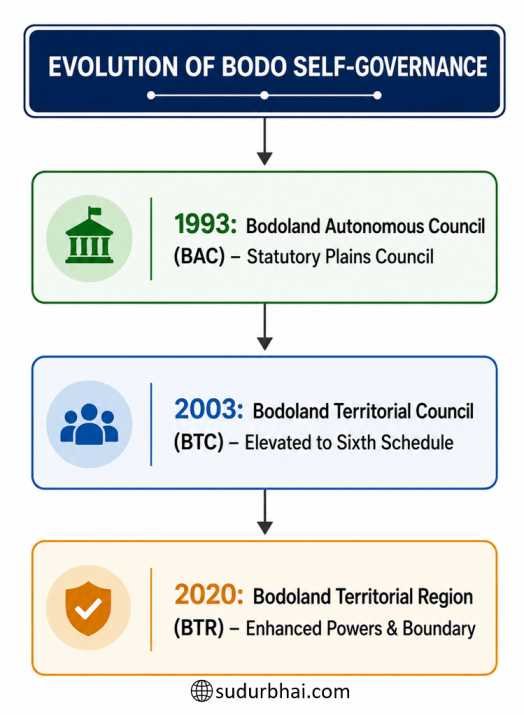
Evolution of BTR
- 1993 (First Bodo Accord): Created the Bodoland Autonomous Council (BAC), which was a statutory body lacking Sixth Schedule protections and struggled due to limited administrative power.
- 2003 (Second Bodo Accord): Led to the creation of the Bodoland Territorial Council (BTC) under the Sixth Schedule via the 90th Constitutional Amendment Act.
- 2020 (Third Bodo Accord): Re-designated the region as the Bodoland Territorial Region (BTR) with enhanced executive, legislative, and financial autonomy, resolving a decades-long armed conflict.
Governance Structure of the BTC
The BTR operates with an expanded legislative and executive base:
- The Legislative Council: Consists of 46 members—40 elected (seats reserved for STs, non-tribals, and open seats) and 6 nominated by the Governor from unrepresented communities (with a focus on women).
- Political Head: Run by an Executive Committee led by a Chief Executive Member (CEM) whose role inside the territory is styled similarly to a state cabinet.
Enhanced Powers of BTR
The BTR wields control over more than 40 subjects (compared to the standard list assigned to older ADCs), including higher education, agriculture, public works, and handloom. It enjoys a direct funding line from central and state budgets, bypasses many traditional state-level bottlenecks, and has official constitutional protection for the Bodo Language (included in the Eighth Schedule of the Indian Constitution).
Other Autonomous Arrangements in Assam (Statutory/Non-Sixth Schedule)
To address the ethnic aspirations of communities living in the plains areas of Assam—who cannot be easily accommodated under the hilly geography of the Sixth Schedule—the Government of Assam created Statutory Autonomous Councils.
These councils are created by Acts of the Assam Legislative Assembly rather than constitutional amendments. They enjoy executive and developmental powers but lack the legislative and judicial authority granted to Sixth Schedule ADCs.
Key Statutory Autonomous Councils
Assam currently hosts several statutory councils for plains tribes and distinct communities:
- Mising Autonomous Council (MAC) (Est. 1995)
- Rabha Hasong Autonomous Council (RHAC) (Est. 1995)
- Tiwa Autonomous Council (TAC) (Est. 1995)
- Sonowal Kachari Autonomous Council (Est. 2005)
- Deori Autonomous Council (Est. 2005)
- Thengal Kachari Autonomous Council (Est. 2005)
- Moran, Matak, Kamtapur, and Bodo Kachari Welfare Autonomous Councils (Created post-2020 to settle localized socio-political demands).
Comparative Framework: Sixth Schedule ADCs vs. Statutory Councils
Feature | Sixth Schedule ADCs (e.g., KAAC, Dima Hasao) | Statutory Plains Councils (e.g., Mising, Rabha Hasong) |
Constitutional Basis | Directly created under the Sixth Schedule of the Constitution. | Created via Acts of the State Legislative Assembly. |
Legislative Power | Can make laws on land, forests, social customs, etc., subject to Governor’s assent. | No legislative powers; operate as executive and developmental bodies. |
Judicial Power | Can establish customary courts to resolve civil disputes. | No judicial powers; subject entirely to regular state judiciary. |
Financial Autonomy | Entitled to share of mineral royalties; direct statutory grants. | Dependent entirely on budget allocations from the State Government. |
The constitutional position of Assam is a masterclass in political flexibility and asymmetric federalism. Rather than imposing a uniform administrative model, the Constitution of India has dynamically expanded to construct customized layers of self-governance in Assam.
Through the mechanisms of Article 371B, the democratic decentralization of the Sixth Schedule, the advanced sub-state model of the Bodoland Territorial Region, and various Statutory Councils, Assam successfully coordinates a complex web of ethnic co-existence. While challenges related to financial dependency, overlapping jurisdictions, and inter-ethnic friction persist, this layered constitutional design remains the primary anchor of Assam’s democratic stability, regional development, and national integration.