
Introduction to the Polity of Assam: Structure, Evolution, and Governance
The Polity of Assam constitutes a dynamic sub-system within the democratic, federal framework of the Constitution of India. Governed by standard constitutional mandates alongside a distinct set of protective exceptions, Assam represents a classic study in asymmetric federalism. This constitutional flexibility is a direct response to the state’s complex history, ethnic and linguistic diversity, geographical isolation, and geopolitical position as a border state.
From its integration into independent India to modern administrative reforms, the state’s polity has evolved to balance territorial integrity with localized ethnic self-determination. For civil service aspirants, particularly those preparing for the Assam Public Service Commission (APSC) Combined Competitive Examination (CCE), mastering the structural and procedural nuances of Assam’s polity is crucial. It provides deep insight into real-world administrative challenges, tribal governance, and the legal adaptations designed to preserve the state’s unique social fabric.
Importance of Polity in APSC
The Study of Assam Polity is highly critical for candidates preparing for the APSC Civil Services Examination. It is integrated across multiple stages of the selection process:
- APSC CCE Prelims (General Studies I): Features a significant number of factual and conceptual questions regarding the state’s executive structure, Panchayati Raj reforms, autonomous councils, and state-specific legislations.
- APSC CCE Mains (GS Paper V – General Subject Paper on Assam): This dedicated paper carries 250 marks and tests in-depth knowledge of Assam’s political evolution, historical treaties, border disputes, the implementation of the Sixth Schedule, and administrative policies.
- APSC CCE Interview (Personality Test): Questions frequently focus on contemporary policy debates, such as administrative restructuring, the implementation of recommendations from the Biplab Sarma Committee on Clause 6 of the Assam Accord, the governance of Bodoland Territorial Region (BTR), and public service delivery mechanisms.
- Practical Administrative Foundation: Beyond examinations, a thorough understanding of this framework is essential for future civil servants to effectively navigate the complex legal, social, and cultural landscapes of Assam’s rural and Sixth Schedule areas.
Assam in the Indian Federal Structure
Assam is a full-fledged, constituent state of the Indian Union, recognized under Article 1 and the First Schedule of the Constitution of India. While it operates within the standard federal framework, it features distinct constitutional provisions designed to manage its unique socio-political landscape.
Division of Legislative Powers
Assam’s legislative powers are structured around the standard division of subjects under the Seventh Schedule:
- State List (List II): The Assam Legislative Assembly holds exclusive powers to legislate on local matters, such as public order, police, public health, sanitation, agriculture, and land.
- Concurrent List (List III): Shared legislative authority with Parliament over subjects like education, forests, and labor welfare. In case of conflict, federal law prevails under Article 254, unless the state law has received the President’s assent.
- Residual Powers: In line with India’s centralized federal structure, any subject not explicitly listed under the three legislative lists falls under the exclusive jurisdiction of the Parliament.
Executive Structure
- De Jure Head (Governor): The constitutional head of the state executive, appointed by the President. The Governor holds unique discretionary powers in Assam, particularly regarding the administration of tribal areas under the Sixth Schedule.
- De Facto Head (Chief Minister): Holds real executive authority and leads the state’s administrative machinery. The Chief Minister works with the Council of Ministers, which is collectively responsible to the state’s unicameral legislature.
Financial Relations
As a resource-rich but economically sensitive border state, Assam’s financial administration relies heavily on federal transfers:
- Finance Commission Devolution: Receives a share of central taxes based on fiscal indicators, forest cover, and geographical terrain.
- Grants-in-Aid (Article 275(1)): Receives specific statutory grants to support administrative standards in tribal areas and fund developmental programs.
- Centrally Sponsored Schemes (CSS): As a northeastern state, Assam benefits from a favorable 90:10 funding pattern for most central programs, where the Union government contributes 90% of the funds and the state government provides the remaining 10%.
Judicial Integration
Judiciary in Assam is integrated into the national hierarchy, with the Gauhati High Court serving as the highest judicial authority in the state. The court also maintains jurisdictional authority over Nagaland, Mizoram, and Arunachal Pradesh, reflecting a shared judicial framework across much of the northeastern region.
Special Provisions Applicable to Assam
To accommodate its ethnic diversity and ensure the political representation of its indigenous and tribal populations, the Constitution includes several special provisions for Assam.
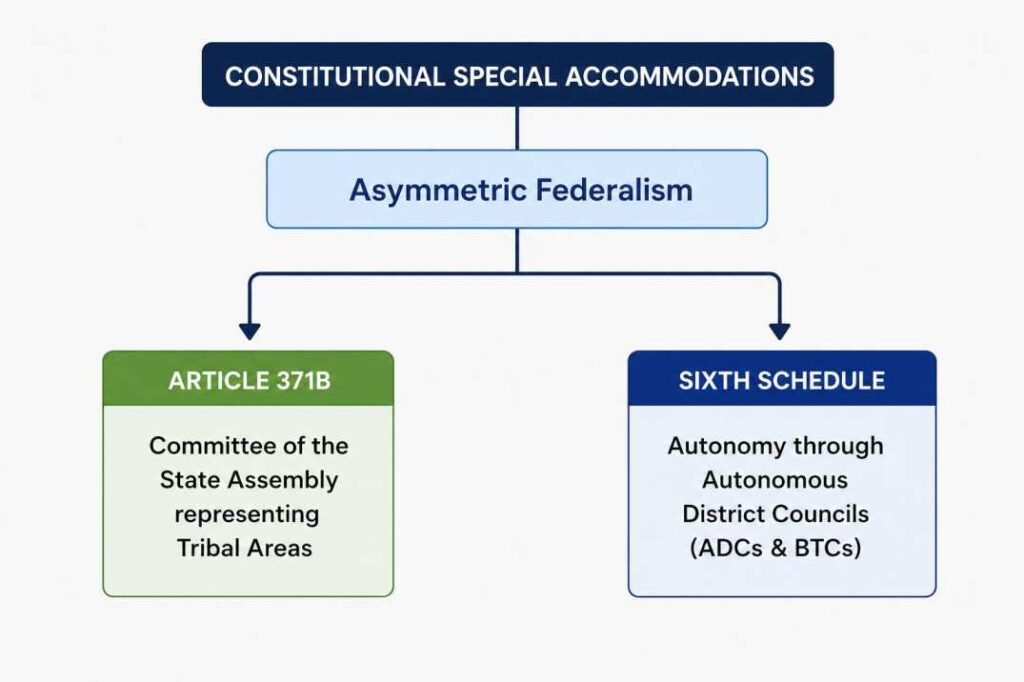
Article 371B: Special Provision for Assam
This article was inserted into the Constitution via the 22nd Constitutional Amendment Act of 1969.
- Purpose: To protect the interests of the tribal populations of Assam by establishing a specialized legislative body.
- Mechanism: Empowers the President of India to order the creation of a special committee within the Assam Legislative Assembly. This committee is composed of assembly members elected from the specified tribal areas of the state.
- Significance: Ensures that bills and legislative proposals impacting tribal regions undergo structured review by representatives from those communities before being debated in the full assembly.
The Sixth Schedule (Articles 244(2) & 275(1))
The Sixth Schedule provides a high degree of local autonomy to specified tribal areas in Assam through the creation of Autonomous District Councils (ADCs).
Scope of Autonomy
- Legislative Powers: ADCs can make laws regarding land use, forest management, inheritance, marriage, social customs, and village administration, subject to approval by the Governor.
- Executive Powers: Councils manage local services such as primary schools, dispensaries, markets, fisheries, and local roads.
- Judicial Powers: Councils can establish village courts to try minor civil and criminal cases according to customary tribal law.
- Financial Powers: ADCs are authorized to levy certain local taxes, collect land revenue, and receive royalties from mineral extraction within their territory.
Autonomous District Councils in Assam
Assam currently has three Autonomous District Councils operating under the Sixth Schedule:
Name of Autonomous Council | Administrative Headquarters | Key Ethnic Group Served | Unique Constitutional Status |
Dima Hasao Autonomous Council | Haflong | Dimasa, Naga, Hmar, Kuki | Governed under the standard provisions of the Sixth Schedule. |
Karbi Anglong Autonomous Council | Diphu | Karbi, Lalung, Kuki | Governed under the standard provisions of the Sixth Schedule. |
Bodoland Territorial Council (BTC) | Kokrajhar | Bodo, Rajbongshi, others | Enjoys expanded legislative and financial powers under the 2003 Constitutional Amendment. |
The Bodoland Territorial Council (BTC), which governs the Bodoland Territorial Region (BTR), is composed of 46 members (40 elected and 6 nominated by the Governor from unrepresented communities). The BTC holds legislative authority over a wider range of subjects compared to other district councils, demonstrating a highly customized approach to regional self-governance.
Historical Evolution of Administration in Assam
Assam’s administrative systems have been shaped by three major historical periods: the pre-colonial era of independent kingdoms, the colonial period of administrative restructuring, and post-independence reorganizations.
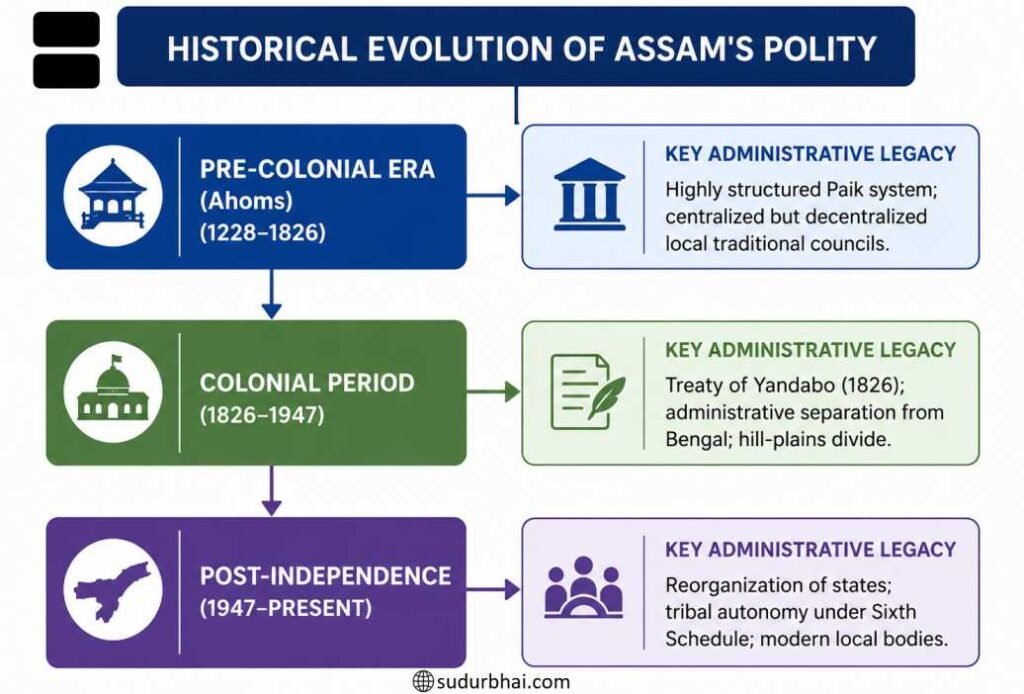
Pre-Colonial Period: The Ahom Administrative Legacy (1228–1826)
For nearly six centuries, the Ahom Dynasty ruled the Brahmaputra Valley, developing a highly organized administrative system. Key features of this system included:
- The King (Swargadeo): The absolute sovereign who held supreme executive, legislative, and judicial authority.
- The Council of Ministers (Patra Mantri): Included the Burhagohain, Borgohain, and Borpatragohain, who advised the King and managed state administration.
- The Paik System: A system of compulsory labor and military service. Every adult male citizen (called a Paik) was required to provide service to the state in times of peace and war, helping form the basis of the kingdom’s military and civil works.
- Administrative Officers:
- Barbarua: Head of the state secretariat, civilian administration, and judiciary.
- Barphukan: The governor of Lower Assam, who managed regional administration and handled relations with neighboring hill tribes and kingdoms.
- Local Dispute Resolution: Utilized local councils and traditional systems to resolve community-level disputes, which helped lay early foundations for local self-governance.
Colonial Period (1826–1947): Direct British Administration
Following the Treaty of Yandabo in 1826, which ended the First Anglo-Burmese War, Assam came under British control. This period introduced major structural changes to the region’s governance:
- Administrative Integration and Separation: Assam was initially administered as a district under the Bengal Presidency. In 1874, it was separated from Bengal and established as a Chief Commissioner’s Province with its capital at Shillong.
- The Hill-Plains Divide: The British introduced administrative divisions between the plains and hill districts. Under the Government of India Act, 1935, tribal hill areas were designated as either “Excluded Areas” or “Partially Excluded Areas,” which restricted the jurisdiction of the provincial legislature over these zones. This division laid the groundwork for the post-independence Sixth Schedule.
- Linguistic and Social Changes: The initial introduction of Bengali as the official language in schools and courts (later reversed in 1873) and the expansion of the commercial tea sector led to significant social changes and migration, which continue to influence the state’s politics today.
Post-Independence Period: Reorganization and Statehood
In 1947, Assam became a state within independent India, initially encompassing much of the northeastern region. Over the following decades, political developments and tribal movements led to several administrative reorganizations:
- Territorial Division: New states were created out of Assam to accommodate the political aspirations of different communities. This included Nagaland in 1963, Meghalaya in 1972, and Mizoram and Arunachal Pradesh in 1987.
- Constitutional Autonomy: Rather than further dividing the state, the government utilized constitutional mechanisms—specifically the Sixth Schedule and various peace accords, such as the Assam Accord of 1985 and successive Bodo Accords—to grant local autonomy while preserving Assam’s overall territorial integrity.
The polity of Assam is a unique blend of historical administrative legacies, regional autonomy, and standard constitutional governance. Its administrative systems have evolved from the centralized structures of the Ahom era to a modern system that utilizes constitutional protections to accommodate its ethnic diversity.
Through provisions like Article 371B and the Sixth Schedule, Assam’s governance framework shows how asymmetric federalism can be used to protect indigenous rights and manage tribal areas while maintaining national integration. For civil servants and policymakers, understanding these structures is essential for addressing the state’s unique governance challenges, ensuring balanced development, and maintaining social harmony.