
Geographical Location of Assam
Latitudinal Extent of Assam
Assam lies between 24°08′ N to 28°02′ N latitudes
Entirely located in sub-tropical zone
Close proximity to the Tropic of Cancer (23½° N) influences:
- High summer temperatures
- Strong monsoonal rainfall
- Dense vegetation cover
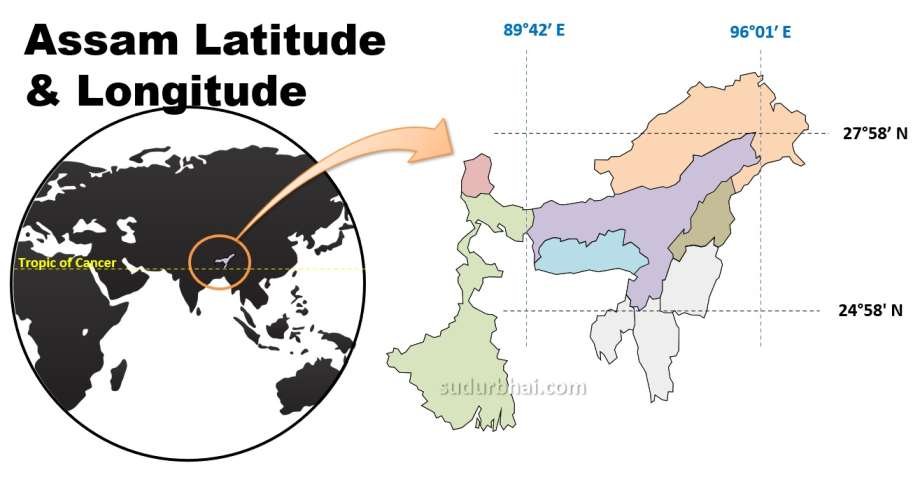
Longitudinal Extent of Assam
Extends from 89°42′ E to 96°02′ E longitudes
Lies in the eastern part of India
Experiences early sunrise compared to western India. [one of the important reason for the demand of adoption of Tea Garden Time (Cha Bagan Time)]
Areal Extent of Assam
Total geographical area: 78,438 sq km
Ranks 16th among Indian states by area.
- Ranks 15th among Indian states by population.
Accounts for about 2.4% of India’s total geographical area
- Among North-East Indian States;
- Area wise, Assam = 2nd Largest state of N-E India
[Area of NE states (decreasing order) : Arunachal Pradesh > Assam > Meghalaya > Manipur > Mizoram > Nagaland > Tripura] - Population wise , Assam = Largest State of N-E India.
[Population of NE states (decreasing order) : Assam > Tripura > Meghalaya > Manipur > Nagaland > Arunachal Pradesh > Mizoram > Sikkim]
- Area wise, Assam = 2nd Largest state of N-E India
Assam’s Location in Relation to Major Physical Features
Himalayan Influence
Northern Assam influenced by:
Eastern Himalayas
Heavy orographic rainfall
Flash floods
Indo-Myanmar Ranges
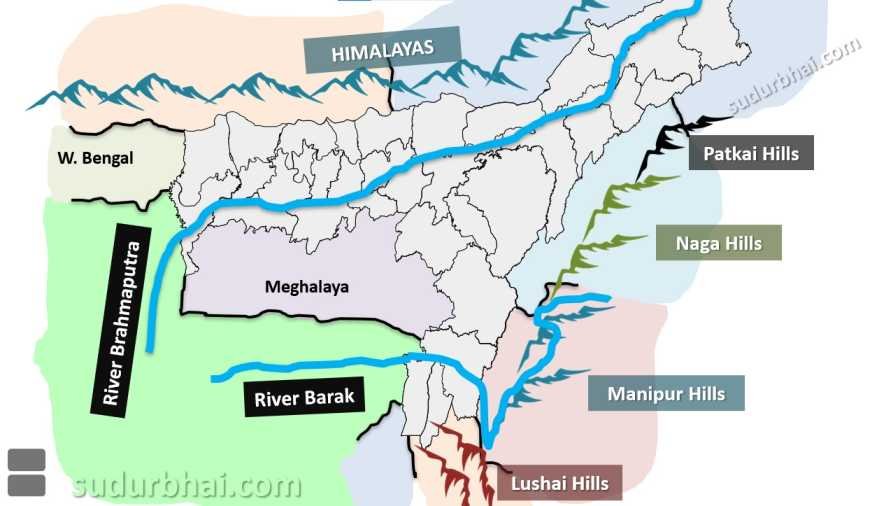
Eastern and southern boundaries defined by:
Patkai Hills
Naga Hills
Lushai Hills
Act as:
Climatic barrier
Cultural divide
River Systems and Boundaries
Brahmaputra Valley dominates central Assam
Barak Valley lies in southern Assam
Rivers act as:
Natural boundaries
Communication routes
Flood hazards
Today is my first view on your page and honestly it is very helpful 🙏❤️
Thank u …great content
One of the best INITIATIVE that you are doing,, it’s mind blowing and very very important for competitive exams, if possible then create practice MCQ,, otherwise it’s also helpful.
I’m here because I was facing too much struggle in understanding Assam history cuz as a non Assamese but living in Assam and preparing for Assam competitive exams it’s prerequisite thing. So I searched in Google with some expectations that I would get some PDF about assam history. I went to deep inner silence for minutes after just reading some content arrange and cleared and easy narrative are fabulous. Further I explored the website and get to see other subjects also. Thank whoever you and your team. Lots of love from Gohpur.
outstanding thank you so much sir
The best website I’ve ever come across.