
Background: Women in Indian Political Life
Early Political Participation
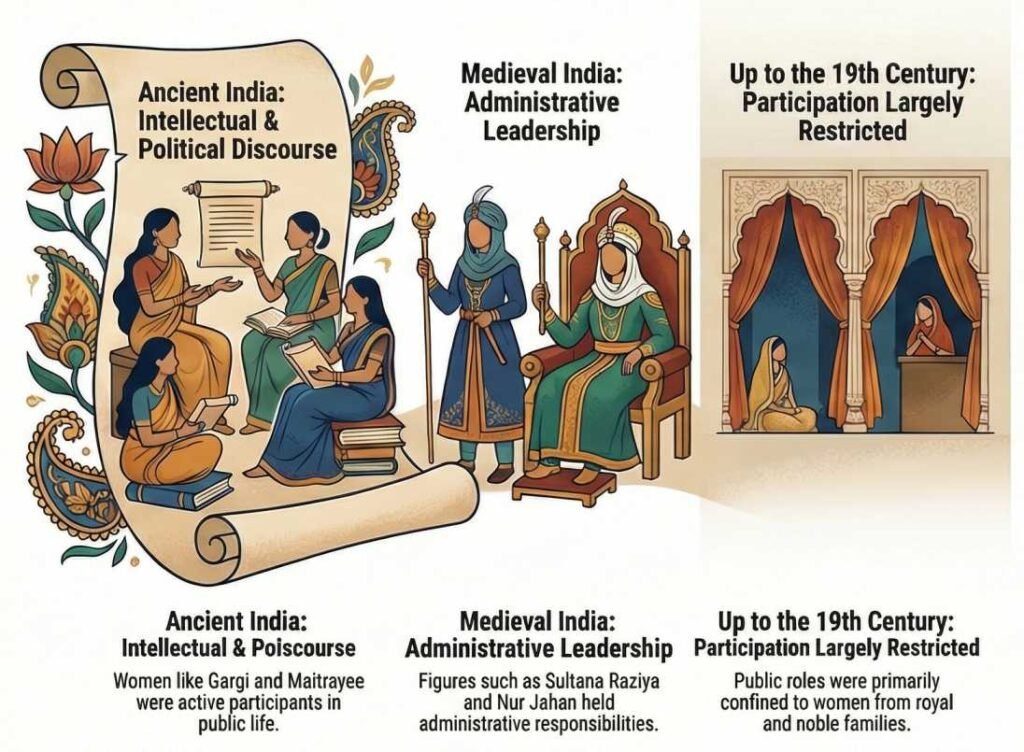
Ancient India: Women like Gargi and Maitrayee actively took part in intellectual and political discourse.
(Shows that women’s political involvement began early in Indian civilization.)Medieval India: Women such as Sultana Raziya and Nur Jahan handled administrative responsibilities.
(Indicates continued, though limited, leadership roles of women.)
Restriction up to 19th Century
Women’s public participation largely confined to royal and noble families.
Poor socio-economic conditions restricted common women from entering politics.
(Highlights social inequality and gender bias.)
Rise of Women’s Organizations
Establishment of major all-India women’s groups:
Bharat Mahila Parishad (1904)
Bharat Stri Mahamandal (1910)
Women’s Indian Association (1917)
(These provided platforms for women’s collective mobilization.)
National Freedom Movement and Gandhi’s Influence
Colonial Exploitation
East India Company focused on profit maximization, exploiting Indian resources.
Growing feeling of anti-imperialism among Indians.
Revolt of 1857
First major resistance against the British.
Failed due to organizational weaknesses.
Formation of Indian National Congress (1885)
Provided a common national platform for political mobilization and unity.
Gandhi and Satyagraha
Non-Cooperation Movement (1920) launched as a peaceful weapon against British rule.
Satyagraha based on Truth and Non-Violence.
Resist wrong peacefully
Do not hate the evildoer
Accept suffering to stir opponent’s conscience
Requires courage and complete rejection of fear
Five Steps of Satyagraha
Surrender titles
Withdraw children from government schools
Boycott courts
Refuse elections
Boycott foreign goods
Gandhi’s Social Vision
Removal of untouchability
Status equality for women
Strengthening hand-spinning (charkha)
Hindu-Muslim unity
Entry of Indian Women into the Movement
Women’s participation before 1930 was limited.
Mostly:
Wives and daughters of national leaders (e.g., families of C.R. Das, Motilal Nehru)
A few college-educated women
Gandhi’s appeal in Young India (1930) encouraged women to spin charkha, picket liquor shops and foreign goods shops.
Result:
1600 women jailed in Delhi
Heavy participation in Bombay
British observers noted the movement improved women’s social position.
Assam Joins the National Freedom Struggle
Formation of APCC (1921)
Assam connected to national politics with the creation of the Assam Provincial Congress Committee.
Impact of Gandhi’s Visit (1921)
His visit created an electrifying effect.
Gandhi praised Assamese women, boosting their confidence.
Early Platforms for Assamese Women
Assam Chhatra Sanmilan
Assam Sahitya Sabha
Formation of Assam Mahila Samiti (1926)—first major women-oriented political organization.
Early Assamese Women Leaders
Hemanta Kumari Devi Bordoloi
Nalinibala Devi
Bijuli Phukan
Sumitra Bhattacharya
Kiranmayee Agarwalla
Rajabala Das
(They organized meetings, mobilized rural women, spread awareness.)
Assamese Women in Non-Cooperation Movement (1921)
Promotion of Swadeshi
Almost all Assamese women were skilled in spinning and weaving.
Their production of khadi ensured the success of foreign cloth boycott.
Gandhi praised Assam:
“Its women can weave much more than enough for themselves.”
Bonfire of Foreign Clothes
At Guwahati meeting (18 August 1921), women threw their valued foreign garments into a bonfire.
Anti-Opium & Anti-Liquor Campaigns
Women picketed shops selling opium and liquor.
Social boycott of those who refused to quit intoxication.
Dariki Dasi Baruah
Arrested during pregnancy for anti-opium picketing.
Died in jail due to mistreatment.
Symbol of sacrifice and courage.
Contributions to Tilak Swaraj Fund
Women donated ornaments, cash, even diamond rings.
12 women of Sibsagar gave all their jewellery.
Bhanumati Talukdar (“Sarojini of Assam”) left family to work for Congress.
Chandraprova Saikiani left her job to work full-time.
Picketing and Social Reform
Picketing in front of:
Liquor shops
Opium shops
Foreign goods shops
Government schools (to discourage attendance)
Participation in:
Congress fund collection
Campaign against untouchability
Promotion of Hindi
Women Participation – Civil Disobedience Movement (1930)
Mukti Sangha – Revolutionary Women’s Group
Formed by schoolgirls in Guwahati:
Pushpalata Das
Sarala Saxena
Jyotsna Mazumdar
Later joined by Sukumari and Parul Moitra.
They took a blood oath and Pushpalata was expelled for her activities.
Support to Dandi March
Assames could not join physically but extended support via:
Symbolic processions (e.g., Kaliabor to Nowgong – 30 miles)
Defying prohibitory orders
Many women suffered lathi charges.
Independence Day (26 January 1930)
400+ women marched to Nowgong.
Leaders:
Guneswari Devi
Darbai Mech
Mohini Gohain
Kiranbala Bora
Police assaulted women; Kamalabala Kakati arrested in Sibsagar.
Assam and the Anti-Untouchability Campaign (1934)
Gandhi’s Harijan tour inspired many Assamese women to take initiative.
Giribala Devi opened her family temple to Harijans.
Swarnalata Devi called “Kasturba of Assam” for her welfare work.
Assamese women helped set up schools in Harijan localities.
Swarnalata Barua promoted Hindi actively.
Formation of Women’s Wing of Congress (1940)
Congress Working Committee initiated women’s wings nationwide.
Assam’s wing formed in September 1940.
Secretaries: Pushpalata Das and Amolprova.
Strengthened women’s participation in political activities.
Women Participation – Quit India Movement (1942)
Background
World War II, Japanese invasion threat, and failure of Cripps Mission triggered mass discontent.
Gandhi called for “Do or Die”.
Assamese Women’s Role
Joined both constructive (training, protest) and destructive (underground) activities.
Many were part of Mrityu Bahini (Death Squads).
Flag Hoisting Resistance (20 September 1942)
Major centres: Gohpur, Dhekiajuli, Bihali, Sootea
Leader: Pushpalata Das
Martyrs of Police Firing
Kanaklata Barua
Khahuli Devi
Kamuli Devi
Despite violence, Tileswari Mahanta successfully hoisted the flag at Bihali Police Station.
Underground Revolutionary Activities
Key contributors:
Aikan Bhuyan – burned Amguri High School.
Sudhalata Dutta – walked 142 km carrying a child to deliver secret messages.
Reboti Lahon – died during underground work.
Jaymati Saikia – helped burn Bebejia bridge.
Pitrani Saikia, Dagati Bora – sheltered underground activists.
Gunawati Devi, Rakshada Devi – supported sabotage groups.
Ratnabala Phukan – destroyed government buildings, hosted underground cells.
Budheswari Hazarika – sank military cargo boats.
Police Atrocities on Women
Establishment of complete Police Raj.
Women suffered:
Beatings, abuse, night raids
Rape, molestation, torture
Attacks on pregnant women
Miscarriages and stillbirths
Bordoloi Committee Report recorded 80+ cases of such abuses.
Overall :
Assamese women’s involvement evolved from limited participation (1921) to massive political activism (1942).
Their courage compelled even the British Prime Minister to admit that:
They feared not Gandhi, but the illiterate women of India who spread the message of revolt in every home.
Their participation became a powerful symbol of resistance, proving essential to India’s freedom struggle.