Ancient Assam is not just a geographical region—it is a blend of mythology, history, culture, and political evolution. Its past stretches from mythological imagination to documented dynasties, making it one of the most fascinating regions in Indian history.
Etymology of Assam
The name “Assam” has deep historical and linguistic roots.
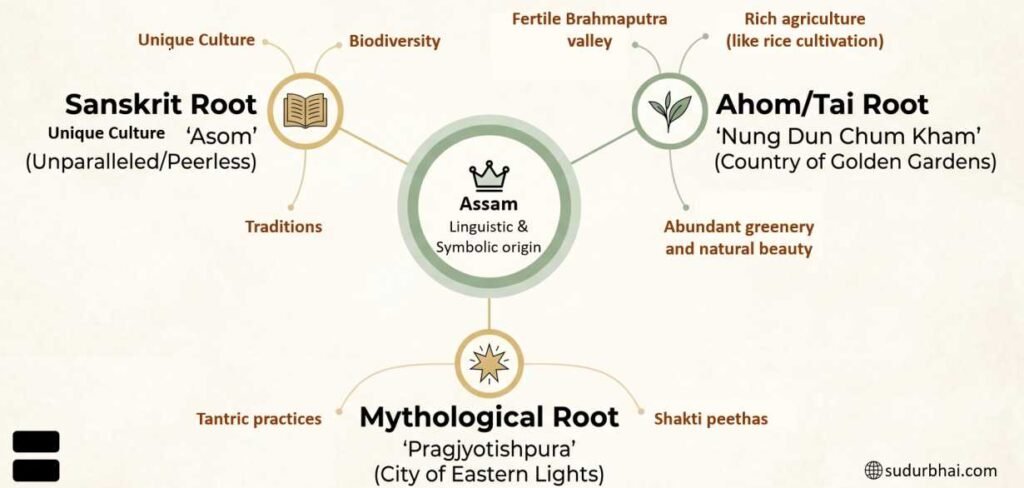
- It is believed to be derived from the Sanskrit word “Asom”, meaning “Unparalleled” or “Peerless”.
This reflects the region’s unique culture, biodiversity, and traditions that set it apart from the rest of India. - The Ahom rulers referred to the land as “Nung Dun Chum Kham”, meaning the “Country of Golden Gardens”.
This beautifully symbolizes:- The fertile Brahmaputra valley
- Rich agriculture (like rice cultivation)
- Abundant greenery and natural beauty
Example:
Even today, Assam is famous for its tea gardens, which echo this ancient description of a “golden land.”- It is believed to be derived from the Sanskrit word “Asom”, meaning “Unparalleled” or “Peerless”.
Mythological Significance of Assam
- Ancient Assam holds a sacred and mystical place in Hindu mythology.
Pragjyotishpura – The City of Eastern Lights
- Assam was known as “Pragjyotishpura”, meaning:
- “Prag” = East
- “Jyotish” = Light
Thus, it translates to the “City of Eastern Lights”
- According to belief, this is where Lord Brahma created the stars, giving Assam a cosmic and celestial identity.
Religious Importance
- Ancient texts like:
- Kalika Purana
- Yogini Tantra
describe Assam as a major center of Tantric practices and Shaktism (worship of the Divine Mother).
- The Kamakhya Temple (located in Guwahati) is one of the most powerful Shakti Peethas in India.
Example:
The famous Ambubachi Mela celebrated at Kamakhya Temple symbolizes the fertility of the Earth goddess, attracting devotees from across India. - Assam was known as “Pragjyotishpura”, meaning:
Early Dynasties and Capitals of Assam
The political history of Assam began with semi-mythical and tribal rulers, gradually evolving into structured kingdoms.
1. Danava Dynasty (Earliest Known Rulers)
- The earliest recorded ruler was Mahiranga Danava.
- He was followed by:
- Hatakasur
- Sambasur
- Ratnasur
These rulers are often described in mythological texts, blending legend with history.
2. Kirata Rule
- Ghatakasur, a Kirata chief, represents the rise of indigenous tribal leadership.
Insight:
This shows that Assam’s history is not only royal but also deeply rooted in tribal and local cultures.
3. Bhauma Dynasty (Narakasura Lineage)
- The legendary king Narakasura founded the Bhauma dynasty.
- He established his capital at Pragjyotishpura (modern Guwahati).
- His son Bhagadatta succeeded him and is mentioned in the Mahabharata as a warrior who fought in the Kurukshetra War.
Example:
Bhagadatta is described as a powerful elephant warrior, symbolizing Assam’s ancient military strength.
Sources of Early Assamese History
Ancient Assam’s history is reconstructed from:
- Puranas (Hindu mythological texts)
- Tantras (religious scriptures)
- Epics like the Mahabharata
These sources combine history, mythology, and cultural narratives, making Assam’s past both factual and symbolic.
Historical Division of Assam’s Past
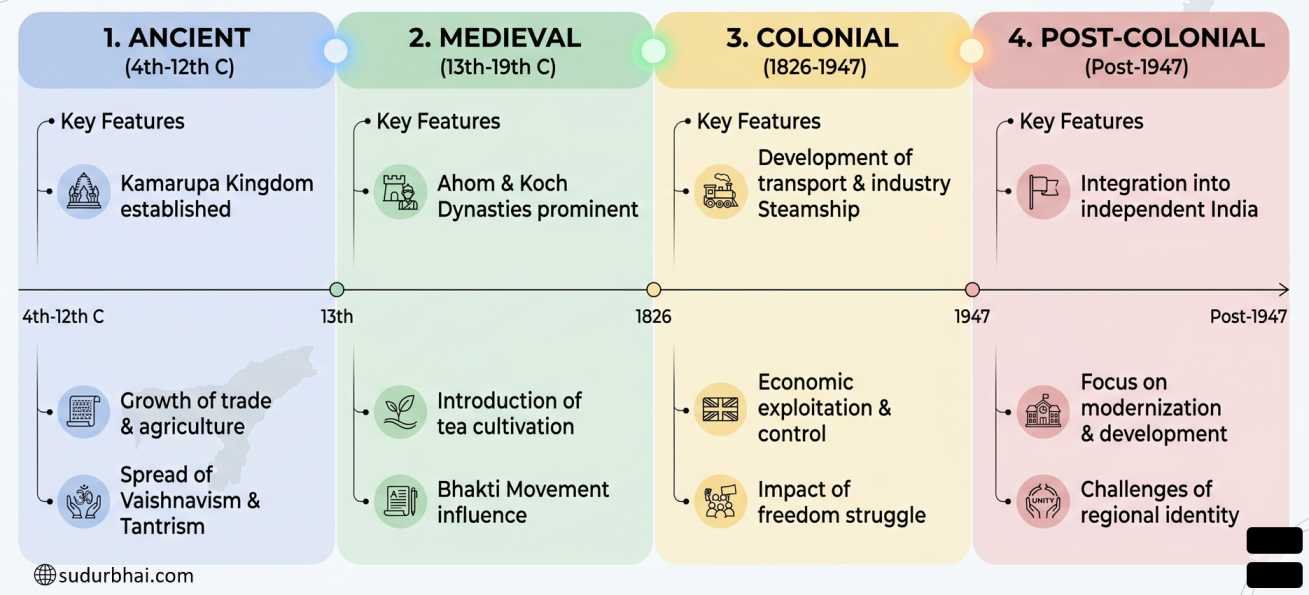
Assam’s long historical journey can be categorized into four major eras:
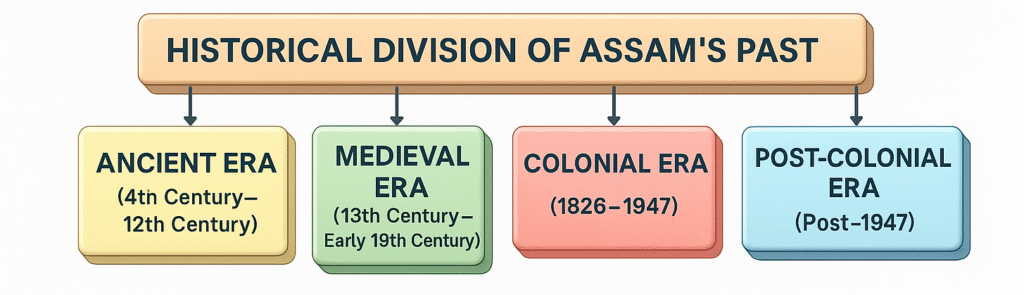
| Historical Era | Time Period | Key Features |
|---|---|---|
| Ancient Era | 4th – 12th Century | Rise of Kamarupa, powerful dynasties |
| Medieval Era | 13th – Early 19th Century | Regional kingdoms, Ahom dominance |
| Colonial Era | 1826 – 1947 | British rule after Treaty of Yandaboo |
| Post-Colonial Era | Post-1947 | Modern Assam after Independence |
1. Ancient Era (4th – 12th Century)
Begins with mention of Kamarupa in the Allahabad Pillar Inscription of Samudragupta.
Major dynasties:
Varman Dynasty
Salasthambha Dynasty
Pala Dynasty
This period saw:
Growth of administration
Development of religion and art
Strong regional identity
2. Medieval Era (13th – Early 19th Century)
Begins with Bakhtiyar Khilji’s invasion (1206).
Rise of the powerful Ahom Dynasty (1228–1826).
Example:
The Ahoms successfully resisted Mughal invasions, especially in the famous Battle of Saraighat (1671).
3. Colonial Era (1826–1947)
Starts with the Treaty of Yandaboo (1826).
Assam came under British rule.
Key changes:
Introduction of tea plantations
Development of railways
Economic transformation
4. Post-Colonial Era (After 1947)
Begins after India’s Independence.
Assam becomes part of modern India.
Focus areas:
Political reorganization
Cultural revival
Economic development