
Assam has a very strong base for tourism because the state combines natural beauty, wildlife, rivers, wetlands, tea gardens, cultural diversity, religious centres, historical monuments and traditional knowledge systems within a relatively compact geographical area. This makes tourism not merely a recreational activity, but also an important instrument for employment generation, regional development, conservation and cultural preservation.
The tourism sector is especially important for Assam because many of the state’s attractions are located in rural, forested and relatively less industrialised regions. As a result, tourism can create economic opportunities in areas where large-scale industries may not be suitable.
Meaning of Tourism
Tourism refers to the temporary movement of people from their normal place of residence to another destination for a limited period, usually for purposes such as leisure, recreation, pilgrimage, business, education, healthcare or cultural exploration.
In simple terms, when a person travels away from home for a short period and later returns, that movement generally falls within tourism.
Examples include:
- A family visiting Kaziranga National Park.
- A pilgrim travelling to Kamakhya Temple.
- A foreign tourist visiting Assam’s tea gardens.
- A patient travelling to Guwahati for specialised treatment.
- A researcher travelling to Majuli to study culture and heritage.
Tourism is therefore a broad activity and is not limited only to sightseeing.
Importance of Tourism for Assam
Employment Generation
Tourism is considered a labour-intensive sector, which means it creates a large number of jobs compared to many capital-intensive industries.
Tourism generates:
Direct employment, such as:
- Hotel workers
- Tour guides
- Travel agents
- Drivers
- Restaurant workers
- Safari operators
- Boat operators
Indirect employment, such as:
- Farmers supplying food to hotels
- Handloom producers
- Artisans
- Construction workers
- Shopkeepers
- Transport providers
The importance of this lies in the fact that a tourist spends money in many places during a trip. For example, expenditure on transport, food, accommodation and souvenirs benefits several sections of the local economy.
Multiplier Effect of Tourism
The multiplier effect means that money spent by a tourist keeps circulating within the economy.
For example:
- A tourist pays a homestay owner.
- The homestay owner buys vegetables from a local farmer.
- The farmer buys goods from a local shop.
- The shopkeeper pays workers.
Thus, one tourist’s expenditure can create income for several people.
Regional Development through Tourism
Many tourism destinations of Assam are located in relatively remote areas.
Development of tourism can lead to improvement in:
- Roads
- Electricity
- Mobile and internet connectivity
- Drinking water
- Public transport
- Banking facilities
- Markets
- Healthcare services
Therefore, tourism can help reduce regional imbalances by bringing development to areas that otherwise receive less investment.
Promotion of Local Culture
Tourism can help preserve local culture by creating demand for:
- Traditional music
- Folk dance
- Indigenous cuisine
- Handloom
- Handicrafts
- Traditional festivals
- Local architecture
- Performing arts
When cultural traditions also generate income, local communities may have a stronger reason to preserve them.
However, tourism should not turn culture into mere entertainment. Cultural practices should be presented with respect and community participation.
Major Forms of Tourism in Assam
Wildlife Tourism
Assam is one of India’s most important wildlife tourism regions because of its rich biodiversity and protected areas.
Major destinations include:
- Kaziranga National Park
- Manas National Park
- Nameri National Park
- Orang National Park
- Dibru-Saikhowa National Park
- Dehing Patkai National Park
- Raimona National Park
- Sikhna Jwhwlao National Park
Important wildlife attractions include:
- One-horned rhinoceros
- Royal Bengal tiger
- Asian elephant
- Wild water buffalo
- Hoolock gibbon
- Golden langur
- Numerous resident and migratory birds
Wildlife tourism includes activities such as:
- Jeep safaris
- Bird watching
- Wildlife photography
- Nature interpretation
- Forest trails
- River-based wildlife observation
Wildlife tourism can generate revenue for conservation, but if tourist pressure becomes excessive, it may also disturb animals and habitats. Therefore, regulation is essential.
Religious Tourism
Religious tourism refers to travel for pilgrimage and spiritual purposes.
Assam has important religious centres associated with:
- Shaktism
- Vaishnavism
- Shaivism
- Buddhism
- Islam
- Sikhism and other traditions
Important destinations include:
- Kamakhya Temple
- Umananda Temple
- Hajo
- Basistha Temple
- Navagraha Temple
- Batadrava Than
- Barpeta Satra
- Majuli Satras
- Sivadol and other temples of Sivasagar
Religious tourism is economically important because pilgrims also spend money on:
- Hotels
- Food
- Local transport
- Religious items
- Handicrafts
- Local services
Another advantage is that pilgrimage tourism may continue throughout the year and is often less seasonal than wildlife tourism.
Cultural Tourism
Cultural tourism allows visitors to experience the traditions and lifestyle of local communities.
Assam’s cultural diversity provides strong potential because different communities possess distinct:
- Languages
- Food habits
- Music
- Dance
- Dress
- Festivals
- Handicrafts
- Social customs
Major cultural attractions include:
- Bihu
- Bhaona
- Sattriya tradition
- Tribal festivals
- Traditional Assamese cuisine
- Muga and Eri silk
- Bamboo and cane craft
- Mask-making tradition of Majuli
Cultural tourism can help preserve traditions, but it should be community-led so that local people remain the main beneficiaries.
Heritage Tourism
Heritage tourism focuses on places connected with history, architecture and archaeology.
Important sites in Assam include:
- Rang Ghar
- Talatal Ghar
- Kareng Ghar
- Sivadol
- Charaideo Maidams
- Madan Kamdev
- Surya Pahar
- Historical sites of Tezpur
- Hajo
Heritage tourism is important because it:
- Creates awareness of history
- Generates funds for conservation
- Supports local businesses
- Promotes academic and educational tourism
- Creates pride in local heritage
However, heritage structures require careful conservation, because heavy tourist pressure and unplanned construction can damage them.
Tea Tourism
Assam is internationally recognised for tea production, making tea tourism a distinctive form of tourism for the state.
Tea tourism may include:
- Stay in heritage tea bungalows
- Guided walks through tea gardens
- Observation of tea plucking
- Visits to processing factories
- Tea tasting sessions
- Interaction with plantation communities
Tea tourism is important because it connects:
- Agriculture
- History
- Plantation culture
- Hospitality
- Rural tourism
It can also diversify income in tea-growing regions.
River Tourism
The Brahmaputra River is one of Assam’s most important tourism resources.
Possible activities include:
- River cruises
- Sunset cruises
- Dolphin watching
- Riverfront tourism
- Island tourism
- Photography
- Boating
- Cultural programmes along riverbanks
River tourism can be especially useful because it can connect several destinations within a single route.
For example, a river-based tourism circuit can combine:
- Guwahati
- Majuli
- Sivasagar region
- Wildlife destinations
- Cultural settlements
River tourism can also create opportunities for boat operators, local guides and riverside communities.
Rural Tourism
Rural tourism enables visitors to experience village life.
Possible experiences include:
- Staying in traditional houses
- Watching handloom weaving
- Participating in agricultural activities
- Learning fishing practices
- Tasting local food
- Visiting village festivals
- Observing bamboo and cane craft
Rural tourism is especially useful because it can provide non-farm income to rural households.
This reduces overdependence on agriculture and can support village-based entrepreneurship.
Adventure Tourism
Assam’s rivers, hills, forests and waterfalls provide potential for adventure tourism.
Activities may include:
- Trekking
- Hiking
- Camping
- Kayaking
- River rafting
- Cycling
- Angling
- Nature trails
Areas such as – Dima Hasao , Karbi Anglong , West Karbi Anglong have strong potential for such activities. Adventure tourism, however, must include proper safety standards, trained guides and emergency facilities.
Waterfall Tourism
Assam contains several scenic waterfalls that remain relatively less known.
Important examples include:
- Borjhora Waterfall – Bongaigaon
- Panimpur Waterfall – Dima Hasao
- Belughat Waterfall – West Karbi Anglong
- Theopani Waterfall – Kamrup Metropolitan
- Soloka Dare or Baroigaon Waterfall – Kamrup
- Langvoku Waterfall – West Karbi Anglong
- Hurnatpi Waterfalls – West Karbi Anglong
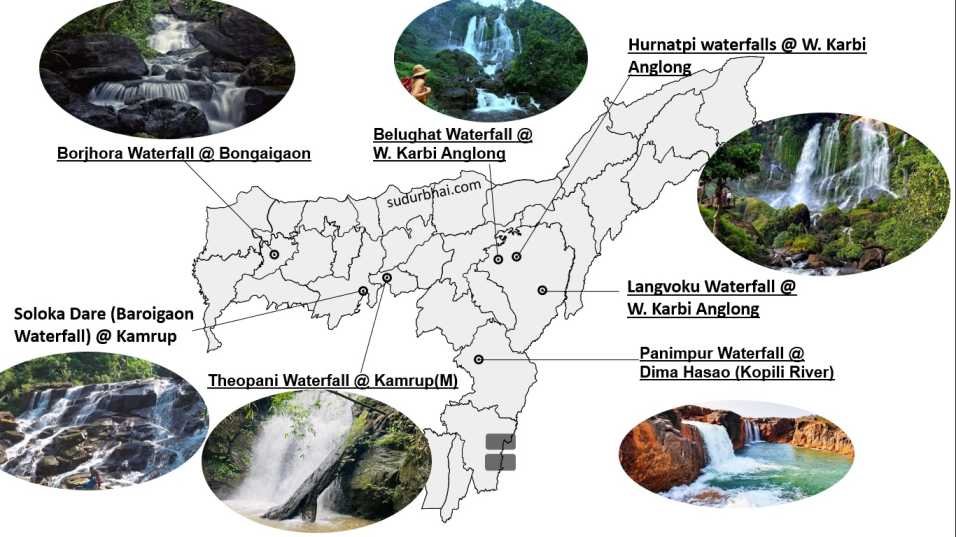
Development of such destinations can help reduce overconcentration of tourists in a few famous places.
However, infrastructure must remain eco-sensitive because waterfalls and surrounding hills are often fragile environments.
Ecotourism
Ecotourism means responsible travel to natural areas in a manner that conserves the environment and improves the well-being of local communities. It is not simply tourism in a forest.
For tourism to truly qualify as ecotourism, it should include:
- Environmental protection
- Local participation
- Conservation awareness
- Sustainable use of resources
- Fair distribution of economic benefits
Difference between Nature Tourism and Ecotourism
Nature tourism simply means visiting natural places. Ecotourism goes a step further.
For example:
- A tourist entering a forest only for sightseeing is engaging in nature tourism.
- A tourist staying in a community-run eco-lodge, following waste rules, learning about biodiversity and contributing to conservation is participating in ecotourism.
Thus, all ecotourism is nature-based tourism, but all nature tourism is not necessarily ecotourism.
Core Elements of Ecotourism
Ecotourism should combine four major elements: Nature Conservation + Environmental Education + Local Participation + Sustainable Livelihood
Each element is important.
- If tourism generates income but destroys forests, it is not sustainable.
- If it protects nature but excludes local communities, it is socially unjust.
Therefore, a balance is necessary.
Guiding Principles of Ecotourism
Minimum Environmental Impact
Tourism should cause as little damage as possible to:
- Forests
- Rivers
- Wetlands
- Wildlife
- Soil
- Vegetation
This requires control over:
- Construction
- Plastic use
- Vehicle movement
- Waste generation
- Noise
Eco-friendly infrastructure should be preferred over large concrete constructions.
Respect for Natural Resources
Natural resources have value beyond tourism.
A forest, for example, is important because it:
- Stores carbon
- Protects soil
- Supports wildlife
- Regulates water
- Supports local livelihoods
Therefore, tourism should not treat forests merely as commercial attractions.
Conservation Benefit
A portion of tourism revenue should support:
- Wildlife protection
- Forest restoration
- Scientific research
- Anti-poaching activities
- Habitat improvement
This creates a positive cycle in which tourism helps finance the conservation of the resources on which it depends.
Environmental Education
Ecotourism should educate visitors about:
- Biodiversity
- Ecosystems
- Wildlife behaviour
- Conservation challenges
- Local environmental practices
For example, trained nature guides can explain:
- Why wetlands are important
- Why elephants require corridors
- Why plastic is harmful to wildlife
This transforms tourism from simple recreation into a learning experience.
Community Participation
Local communities should have an active role in tourism. They should participate in:
- Homestays
- Guiding
- Food services
- Local transport
- Handicrafts
- Destination management
This is important because local people live closest to natural resources and bear the costs of conservation. If they benefit from tourism, they are more likely to support conservation.
Fair Distribution of Benefits
Tourism income should not be captured entirely by large outside companies. Local people should receive a meaningful share.
For example:
- Village homestays
- Local guides
- Local food businesses
- Community transport services
can ensure that money remains within the destination.
Ecotourism Potential of Assam
Rich Biodiversity
Assam has a wide variety of ecosystems, including:
- Tropical forests
- Grasslands
- Wetlands
- Riverine areas
- Hill ecosystems
This diversity makes the state highly suitable for ecotourism.
Protected Areas
Important ecotourism destinations include:
- Kaziranga
- Manas
- Nameri
- Orang
- Raimona
- Dehing Patkai
- Dibru-Saikhowa
Protected areas can attract tourists, but tourism should be strictly regulated to prevent ecological damage.
Wetland Ecotourism
Assam has numerous beels and floodplain wetlands. Wetland-based tourism can include:
- Bird watching
- Photography
- Community boating
- Nature interpretation
- Wetland trails
Wetlands also have ecological functions such as:
- Flood moderation
- Groundwater recharge
- Fisheries
- Bird habitat
Therefore, tourism development should support wetland conservation.
Community-Based Ecotourism
Community-based ecotourism means tourism where local people are major owners and beneficiaries.
Villages can operate:
- Homestays
- Food services
- Nature camps
- Cultural programmes
- Guided tours
This model is generally more sustainable because the community develops a direct economic interest in protecting the environment.
Positive Impacts of Ecotourism
Environmental Benefits
Ecotourism can:
- Support conservation
- Create awareness
- Generate funds for protected areas
- Encourage restoration of degraded habitats
- Reduce pressure on forests
If villagers receive income from tourism, they may be less dependent on unsustainable extraction of forest resources.
Economic Benefits
Ecotourism creates employment for:
- Guides
- Drivers
- Homestay owners
- Boat operators
- Artisans
- Food suppliers
It is especially important for remote areas where conventional industries may not be feasible.
Social Benefits
Ecotourism can:
- Strengthen community institutions
- Encourage participation in local planning
- Create new opportunities for youth
- Reduce migration in some rural areas
Cultural Benefits
Local traditions can gain value through tourism. Tourists may show interest in:
- Folk songs
- Cuisine
- Handloom
- Rituals
- Traditional architecture
This can help preserve cultural knowledge.
However, commercialisation should be controlled so that traditions are not distorted merely for entertainment.
Challenges Associated with Ecotourism
Environmental Pollution
Tourism can produce:
- Plastic waste
- Sewage
- Air pollution
- Noise pollution
In fragile environments, even small amounts of pollution can cause significant damage.
Pressure on Forests
Tourism infrastructure may require:
- Roads
- Hotels
- Parking areas
- Shops
If developed without planning, these can lead to:
- Tree cutting
- Habitat loss
- Soil erosion
- Fragmentation of wildlife habitat
Wildlife Disturbance
Excessive safari traffic and tourist noise can affect:
- Feeding
- Breeding
- Resting
- Movement
Wildlife tourism should therefore follow regulated routes and timings.
Carrying Capacity
Carrying capacity refers to the maximum number of visitors a place can support without suffering environmental damage or decline in visitor experience.
For example:
A forest trail may comfortably handle 100 visitors per day. If 5,000 visitors enter daily, problems may include:
- Soil erosion
- Waste
- Noise
- Wildlife disturbance
- Overcrowding
Therefore, ecotourism should be planned according to ecological limits.
Leakage of Tourism Revenue
Revenue leakage occurs when tourism income leaves the local area.
For example:
If a large outside company owns:
- The hotel
- Transport
- Food supply
- Tour package
then very little money may remain with the local community. Community-run enterprises can reduce this problem.
Commercialisation of Culture
Local traditions may sometimes be changed or simplified merely to attract tourists.
This can reduce cultural authenticity. Therefore, communities should decide how their culture is presented.
Regular Tourism and Ecotourism
| Basis | Regular Tourism | Ecotourism |
|---|---|---|
| Main Purpose | Recreation and entertainment | Conservation and learning |
| Environmental Concern | May be secondary | Central |
| Community Role | Often limited | Active participation |
| Scale | Can be mass tourism | Usually controlled |
| Conservation | Not compulsory | Essential |
| Economic Benefit | May flow outside | Should benefit local communities |
| Tourist Experience | Sightseeing and relaxation | Observation, learning and responsible travel |
Medical Tourism
Medical tourism refers to travel to another place for healthcare services.
It may include:
- Surgery
- Diagnosis
- Specialised treatment
- Rehabilitation
- Traditional medicine
- Wellness therapies
For example, if a person travels from another Northeastern state to Guwahati for specialised treatment and stays there for some time, it becomes a form of medical tourism.
Types of Medical Tourism
Clinical Medical Tourism
This includes treatment in:
- Hospitals
- Diagnostic centres
- Speciality centres
Examples include:
- Cardiology
- Orthopaedics
- Oncology
- Surgery
- Diagnostics
Wellness Tourism
Wellness tourism focuses more on overall well-being rather than treatment of disease.
It may include:
- Yoga
- Ayurveda
- Meditation
- Naturopathy
- Spa
- Herbal therapy
Traditional Medicine-Based Tourism
This form of tourism uses:
- Traditional healing knowledge
- Medicinal plants
- Herbal products
- Indigenous practices
Assam and Northeast India have strong potential because of their biodiversity and traditional knowledge.
Why Medical Tourism is Relevant for Assam
Strategic Importance of Guwahati
Guwahati is the major urban and healthcare centre of Northeast India. Patients from other Northeastern states often travel to Guwahati for:
- Specialist doctors
- Diagnostics
- Surgery
- Advanced treatment
This provides a natural base for medical tourism.
Improving Healthcare Infrastructure
Expansion of:
- Hospitals
- Medical colleges
- Diagnostic facilities
- Specialised treatment centres
can strengthen the medical tourism sector.
Combination of Treatment and Tourism
Patients are often accompanied by family members. During longer treatment periods, attendants may visit:
- Kamakhya
- Riverfront areas
- Local markets
- Nearby heritage and cultural destinations
Thus, medical tourism can create demand for other tourism services.
Medicinal Plant Advantage of Assam and Northeast India
Assam and Northeast India possess rich medicinal plant resources.
The region has a large number of plants used traditionally in:
- Ayurveda
- Folk medicine
- Herbal therapy
- Wellness products
This gives the region a natural advantage for wellness tourism.
Important Medicinal Plants
Mishmi Teeta
- Botanical name: Coptis teeta
- Known for medicinal alkaloids.
- Traditionally valued in herbal medicine.
Sarpagandha
- Botanical name: Rauvolfia serpentina
- Used in traditional systems of medicine.
Aconitum ferox
- Used traditionally in some medical systems.
- However, it can contain toxic compounds and therefore requires professional handling and processing.
Tulsi
- Commonly used in traditional wellness preparations.
- Often associated with herbal drinks and household remedies.
Brahmi
- Traditionally associated with:
- Memory
- Cognitive health
- Herbal wellness
- Traditionally associated with:
Amla
- Used in:
- Herbal foods
- Ayurvedic preparations
- Cosmetic products
- Used in:
Aloe Vera
- Commonly used in:
- Skincare
- Cosmetic products
- Wellness preparations
- Commonly used in:
Aromatic Plants
Important aromatic plants include:
- Lemongrass
- Citronella
- Mint
These plants can be processed into:
- Essential oils
- Perfumes
- Aromatherapy products
- Cosmetics
- Spa products
Natural Advantages of Assam for Wellness Tourism
Assam has:
- High rainfall
- Fertile soils
- Warm and humid climate
- Rich biodiversity
These conditions are suitable for cultivation of many medicinal and aromatic plants.
This can support a local supply chain for:
- Herbal centres
- Wellness resorts
- Ayurvedic units
- Cosmetic industries
Medicinal Plants and Wellness Tourism
Medicinal plant resources can support:
- Ayurvedic centres
- Herbal clinics
- Naturopathy centres
- Yoga retreats
- Aromatherapy centres
Herbal gardens can also be developed as tourist attractions.
Visitors may learn about:
- Plant identification
- Traditional uses
- Cultivation
- Processing
This creates a combination of education, tourism and wellness.
Economic Importance of Medicinal Plants
Medicinal plant cultivation can create livelihood opportunities in:
- Nursery development
- Cultivation
- Harvesting
- Drying
- Processing
- Packaging
- Marketing
It can be especially useful for:
- Farmers
- Women
- Self-help groups
- Rural entrepreneurs
Meaning of Value Addition
Value addition means converting a raw material into a product of higher value.
Examples:
- Lemongrass → Lemongrass oil
- Amla → Herbal health products
- Aloe vera → Cosmetic products
- Medicinal leaves → Herbal extracts
Value addition increases income and creates new industries.
Institutional Support
National Medicinal Plants Board
Can support:
- Cultivation
- Nursery development
- Conservation
- Processing
- Capacity building
North Eastern Council
Can support:
- Regional development
- Medicinal plant projects
- Tourism
- Entrepreneurship
CSIR-NEIST, Jorhat
Can contribute through:
- Research
- Product development
- Processing technology
- Training
- Innovation
ICAR and Krishi Vigyan Kendras
Can help farmers through:
- Training
- Demonstrations
- Cultivation advice
- Agricultural extension
Integrated Medical-Wellness Tourism Model
A strong system can operate as:
Medicinal Plant Cultivation
↓
Processing and Value Addition
↓
Herbal Products
↓
Wellness Centres and Resorts
↓
Tourism and Retail
↓
Rural Employment
This creates an integrated economy where agriculture, healthcare and tourism support one another.
Challenges to Medical Tourism in Assam
Limited Specialised Healthcare
High-quality medical tourism requires:
- Specialist doctors
- Advanced hospitals
- Modern diagnostics
- Rehabilitation facilities
Without these, patients may prefer larger medical hubs outside the region.
Quality Assurance
Medical tourists need confidence in:
- Treatment quality
- Hygiene
- Safety
- Pricing
- Professional standards
Therefore, accreditation and standardisation are important.
Limited Branding
Assam is widely known for:
- Tea
- Wildlife
- Kamakhya
- Brahmaputra
But it is not equally known as a medical or wellness destination.
Strong branding and marketing are therefore necessary.
Research Gap
Traditional medicinal knowledge needs:
- Documentation
- Scientific testing
- Standardisation
- Safety assessment
This is essential before commercial use on a large scale.
Overharvesting
Excessive collection of medicinal plants from forests can reduce wild populations.
Therefore, commercial cultivation should be encouraged.
Conservation of Medicinal Plants
In-situ Conservation
In-situ conservation means protecting plants in their natural habitat.
Examples include:
- Protected forests
- Medicinal plant reserves
Ex-situ Conservation
Ex-situ conservation means protecting plants outside their natural habitat.
Examples include:
- Botanical gardens
- Nurseries
- Seed banks
- Tissue culture laboratories
A simple difference is:
- In-situ = protect where it naturally grows
- Ex-situ = protect outside the natural habitat
Government Initiatives for Tourism
Tourism Policy of India, 2002
The policy emphasised the 7-S Mantra:
- Swaagat – Welcome
- Soochanaa – Information
- Suvidhaa – Facilitation
- Surakshaa – Security
- Sahyog – Cooperation
- Sanrachnaa – Infrastructure
- Safaai – Cleanliness
These seven elements represent the basic requirements for a successful tourism destination.
Swadesh Darshan Scheme
The scheme focuses on destination and circuit-based tourism development.
Theme-based circuits included:
- Northeast Circuit
- Wildlife Circuit
- Eco Circuit
- Rural Circuit
- Heritage Circuit
- Tribal Circuit
- Spiritual Circuit
The idea is to develop several connected destinations together rather than improving only one isolated location.
PRASHAD Scheme
This scheme focuses on pilgrimage and heritage destinations.
It aims to improve:
- Visitor facilities
- Accessibility
- Infrastructure
- Employment opportunities
Adopt a Heritage
This initiative encourages participation of private and public institutions in developing tourist amenities at heritage sites.
The purpose is to improve facilities while preserving heritage value.
Assam Government Initiatives to promote Tourism
Assam Darshan Scheme
The scheme was introduced to improve important:
- Religious places
- Historical sites
- Places of natural beauty
The major focus areas include:
- Better infrastructure
- Improved connectivity
- Financial support
- Visitor facilities
Punya Dham Scheme
This scheme was designed to facilitate pilgrimage tours for senior citizens of Assam.
Its broader significance lies in promoting:
- Religious tourism
- Social inclusion
- Access to pilgrimage destinations
Homestay Promotion
Homestays allow tourists to stay with local families.
Advantages include:
- Direct income for local households
- Cultural interaction
- Rural employment
- Authentic tourism experience
Homestays are especially suitable for ecotourism and rural tourism.
Reasons for Growth of Tourism in Assam
Greater Government Attention
Tourism promotion has increased through:
- Advertising
- Infrastructure development
- Tourism campaigns
- Events
- Destination branding
Improvement in Security
A better law-and-order environment increases tourist confidence.
Tourists generally avoid places they consider unsafe.
Therefore, improvement in peace and security can directly influence tourist arrivals.
Post-COVID Recovery
Tourism declined sharply during the pandemic.
After travel restrictions were removed, tourist numbers increased strongly from a very low base.
This is known as a base effect, where percentage growth appears very high because the previous level was unusually low.
Digitalisation
Online systems make tourism easier through:
- Hotel booking
- Safari booking
- Digital payments
- Online information
- Travel planning
Digital services reduce uncertainty and improve convenience.
Private Investment
Private investors can develop:
- Hotels
- Resorts
- Restaurants
- Homestays
- Transport services
This improves tourism infrastructure and service quality.
Challenges of Assam’s Tourism Industry
Poor Connectivity
Many attractive places remain difficult to reach.
Problems include:
- Weak roads
- Limited railway access
- Poor last-mile connectivity
A beautiful destination cannot attract large numbers of tourists if reaching it is difficult.
Floods and Natural Hazards
Annual floods can damage:
- Roads
- Bridges
- Railways
- Tourism facilities
Flooding can also reduce accessibility to wildlife destinations.
Seasonal Nature of Tourism
Some attractions are available only during certain months.
For example:
- Wildlife tourism may be affected during monsoon.
- Adventure activities may depend on weather conditions.
This creates seasonal income for tourism workers.
Concentration in Few Destinations
A large number of visitors focus mainly on:
- Kaziranga
- Kamakhya
- Guwahati
As a result, many lesser-known destinations remain underdeveloped.
Tourism diversification is therefore necessary.
Inadequate Basic Facilities
Many destinations may lack:
- Toilets
- Drinking water
- Parking
- Accommodation
- Signboards
- Tourist information centres
- Waste management
These basic services directly affect tourist satisfaction.
Skill Deficit
Tourism needs trained:
- Guides
- Drivers
- Hospitality workers
- Adventure instructors
- Nature interpreters
Skill development improves both visitor experience and local employment.
Environmental Pressure
Unplanned tourism can create:
- Waste
- Plastic pollution
- Noise
- Forest pressure
- Water pollution
Thus, tourism development must be environmentally regulated.
Role of Local Communities
Local communities are essential for sustainable tourism.
They can participate through:
- Homestays
- Guiding
- Food services
- Handicrafts
- Local transport
- Cultural programmes
When local people earn from tourism, they are more likely to support conservation.
Role of NGOs in Ecotourism
NGOs can contribute through:
- Environmental awareness
- Community mobilisation
- Guide training
- Biodiversity documentation
- Waste management
- Homestay development
- Sustainable livelihood programmes
They can act as a bridge between:
- Government
- Local communities
- Conservation organisations
- Tourists
Way Forward for Tourism in Assam
Diversification of Destinations
Tourism should expand beyond:
- Kaziranga
- Kamakhya
More focus can be given to:
- Dima Hasao
- Karbi Anglong
- Majuli
- Sivasagar
- Charaideo
- Tezpur
- Hajo
- Wetlands
- Waterfalls
This will distribute tourism benefits more evenly.
Development of Tourism Circuits
Possible tourism circuits include:
- Wildlife Circuit
- Ahom Heritage Circuit
- Satra Circuit
- Tea Tourism Circuit
- Brahmaputra River Circuit
- Tribal Cultural Circuit
- Medical and Wellness Circuit
- Medicinal Plant Circuit
Tourism circuits are useful because tourists can visit several related destinations in a single journey.
Better Connectivity
Development is needed in:
- Roads
- Railways
- Air transport
- River transport
- Last-mile connectivity
Good connectivity is one of the most important foundations of tourism growth.
Skill Development
Local youth should be trained in:
- Hospitality
- Language skills
- Tour guiding
- Digital marketing
- Ecotourism
- First aid
- Adventure safety
This can improve service quality while creating employment.
Way Forward for Ecotourism in Assam
Carrying Capacity-Based Tourism
Tourist numbers should be regulated according to ecological limits.
This prevents:
- Overcrowding
- Waste accumulation
- Habitat damage
- Wildlife disturbance
Waste-Free Tourism
Destinations should promote:
- Plastic restrictions
- Waste segregation
- Recycling
- Sewage treatment
This is especially important in forests and wetlands.
Community Ownership
Greater local ownership should be encouraged through:
- Homestays
- Community guides
- Village tourism committees
- Local enterprises
This ensures that tourism income remains in the area.
Eco-Friendly Infrastructure
Tourism facilities should preferably use:
- Renewable energy
- Rainwater harvesting
- Local materials
- Energy-efficient lighting
- Wastewater treatment
Such infrastructure reduces environmental pressure.
Way Forward for Medical and Wellness Tourism
Develop Guwahati as a Medical Tourism Hub
Guwahati can integrate:
- Hospitals
- Hotels
- Airport transport
- Tourism services
- Rehabilitation centres
This can make the entire patient experience smoother.
Herbal Wellness Centres
Assam can develop:
- Ayurveda centres
- Naturopathy resorts
- Herbal spas
- Yoga retreats
- Medicinal plant gardens
This would combine biodiversity with wellness tourism.
Medicinal Plant Clusters
Clusters can connect:
- Farmers
- Researchers
- Processing units
- Wellness centres
- Tourism businesses
This can create a complete value chain.
Scientific Validation
Traditional medicinal knowledge should be:
- Documented
- Tested scientifically
- Standardised
- Safely commercialised
This is essential for credibility and consumer safety.
Integrated Sustainable Tourism Model for Assam
A sustainable tourism model can follow this sequence:
Natural and Cultural Resources
↓
Conservation and Protection
↓
Infrastructure and Accessibility
↓
Community Participation
↓
Tourism Enterprises
↓
Employment and Income
↓
Reinvestment in Conservation
The central idea is that tourism should create a cycle in which nature and culture generate income, and a part of that income is used to protect the same resources.
Conclusion
Assam has strong potential to develop:
- Wildlife tourism
- Ecotourism
- Religious tourism
- Tea tourism
- Heritage tourism
- River tourism
- Rural tourism
- Medical tourism
- Wellness tourism
Its major strength lies in the combination of: Biodiversity + Brahmaputra + Wildlife + Tea + Culture + Heritage + Traditional Knowledge + Medicinal Plants
However, the future of tourism in Assam should not be based merely on increasing tourist numbers.
The emphasis should be on:
- Quality tourism
- Sustainable tourism
- Community participation
- Environmental conservation
- Destination diversification
- Better infrastructure
- Strong local livelihoods
A successful tourism strategy for Assam should therefore aim for high-value, community-based and environmentally responsible tourism, where economic development and conservation move together.