
The Northeastern Region of India occupies a uniquely sensitive position in the country’s internal security framework because of its geographical isolation, ethnic diversity, international borders, historical grievances, migration-related tensions and strategic location between South and Southeast Asia.
The region consists of eight States, including Sikkim, and is characterised by an extraordinary diversity of ethnic groups, tribes, languages and customary institutions. It is connected with the rest of India through the narrow Siliguri Corridor, popularly called the Chicken’s Neck, which gives the region significant strategic importance.
Insurgency in the Northeast has never been a single uniform movement. Different insurgent groups have emerged from distinct historical and political contexts involving ethnic identity, autonomy, statehood, sovereignty, demographic anxiety, land rights and perceptions of economic neglect. Consequently, a uniform security-centric approach cannot adequately address the complexities of the region.
India’s approach has gradually shifted towards a combination of security operations, political dialogue, peace accords, constitutional accommodation, decentralisation, economic development and regional connectivity.
Strategic Importance of Northeast India
The Northeastern Region possesses significance far beyond its geographical size.
Its strategic importance arises from its location between China, Myanmar, Bangladesh, Bhutan and Nepal, while also providing India’s principal land gateway towards Southeast Asia. The region is therefore critical to both internal security and foreign policy.
The Act East Policy gives the Northeast additional strategic relevance because roads, railways, waterways and economic corridors connecting India with Myanmar and Southeast Asia largely depend upon peace and political stability in the region.
The region is also rich in natural resources such as oil, natural gas, coal, forests, tea and hydropower potential. At the same time, difficult terrain and historically weak infrastructure have complicated development and administrative penetration.
Meaning of Insurgency
Insurgency refers to an organised political and armed movement that challenges the authority of the established State and attempts to gain control, autonomy or political concessions through sustained mobilisation and, often, violence.
Unlike ordinary crime, insurgency usually possesses:
- A political objective
- An ideological or identity-based narrative
- Organisational leadership
- Armed cadres
- Local support networks
- Attempts to undermine State authority
Insurgency may seek independence, greater autonomy, territorial reorganisation or protection of ethnic and political interests.
Historical Background of Insurgency in Northeast India
The roots of insurgency in the Northeast are closely associated with the region’s distinct historical experience.
During the colonial period, many hill areas were governed separately from the plains and remained only loosely integrated with British administrative structures. Such policies reinforced geographical, administrative and cultural separation.
After Independence, political integration and reorganisation of the region produced both opportunities and anxieties. New States were gradually created, including Nagaland, Meghalaya, Mizoram and Arunachal Pradesh, while Manipur and Tripura attained statehood in 1972.
In several areas, local communities feared that integration might weaken their traditional political autonomy, ethnic identity, customary laws and control over land and resources. These anxieties contributed to insurgent movements in different parts of the region.
Major Causes of Insurgency in Northeast India
Geographical Isolation
The Northeast is separated from the Indian mainland by the narrow Siliguri Corridor. Mountainous terrain, dense forests and historically poor transport networks created a sense of physical and psychological distance.
Geographical isolation contributed to weaker administrative reach and slower economic integration in several remote areas.
Ethnic Diversity
The region contains a large number of tribal, linguistic and ethnic communities, each with distinct traditions and political aspirations.
Conflicts have sometimes emerged when the territorial claims of one community overlap with the traditional lands claimed by another. As a result, identity-based mobilisation may generate inter-ethnic competition, displacement and violence.
Identity and Cultural Protection
Many movements in the Northeast arose from concerns regarding the preservation of:
Language, customary institutions, traditional land ownership, tribal identity and political representation.
Where communities perceive threats to their cultural identity, political demands may range from greater autonomy to separate statehood or sovereignty.
Demographic Change and Migration
Migration has been one of the most sensitive issues in several Northeastern States, particularly Assam and Tripura.
Large-scale demographic changes can generate fears regarding:
- Loss of land
- Cultural erosion
- Employment competition
- Political representation
- Language
- Indigenous identity
Such concerns have played an important role in regional political movements and, in some cases, insurgent mobilisation.
Economic Underdevelopment
Despite abundant natural resources, several areas historically experienced:
- Poor transport connectivity
- Limited industrialisation
- Weak healthcare
- Inadequate educational facilities
- High unemployment
This created a perception among sections of the population that the region’s resources were being utilised without corresponding benefits reaching local communities.
Political Alienation
Some insurgent movements emerged because communities believed that their political aspirations were not being adequately recognised.
Demands may involve:
- Greater autonomy
- Separate administrative units
- Protection of customary rights
- Special constitutional safeguards
- Sovereignty
When democratic negotiations fail or political expectations remain unresolved for long periods, extremist organisations may gain influence.
Governance Deficit
Weak governance can intensify insurgency by creating dissatisfaction with the State.
Problems such as corruption, weak service delivery, poor infrastructure, unemployment and ineffective local administration reduce trust in institutions.
External Support
Some insurgent organisations have historically benefited from cross-border safe havens, arms routes and foreign assistance.
The long and difficult international borders of the Northeast have made security management particularly complicated.
Constitutional and Administrative Safeguards for Northeast India
India has adopted several special constitutional arrangements to accommodate the region’s unique social and political structure.
Sixth Schedule
The Sixth Schedule of the Constitution provides for Autonomous District Councils and Regional Councils in certain tribal areas.
These institutions seek to protect local autonomy in matters such as:
- Land
- Customary practices
- Local administration
- Culture
- Community resources
The Sixth Schedule represents an important example of asymmetric federalism.
Articles 371A to 371H
Various Northeastern States enjoy special constitutional provisions under Articles 371A–371H.
These provisions recognise the need for differentiated administrative arrangements considering the region’s historical and cultural diversity.
Inner Line Permit
The Inner Line Permit (ILP) system regulates the entry of outsiders into certain Northeastern States.
It is designed partly to protect the social, cultural and demographic interests of indigenous communities.
Nagaland Insurgency
Nagaland witnessed one of the earliest and longest-running insurgent movements in independent India.
Origins of the Naga Movement
The Naga National Council (NNC) emerged as an important political organisation demanding greater political autonomy and eventually independence.
A section of Naga political leadership rejected integration with India and sought a separate political future.
NSCN
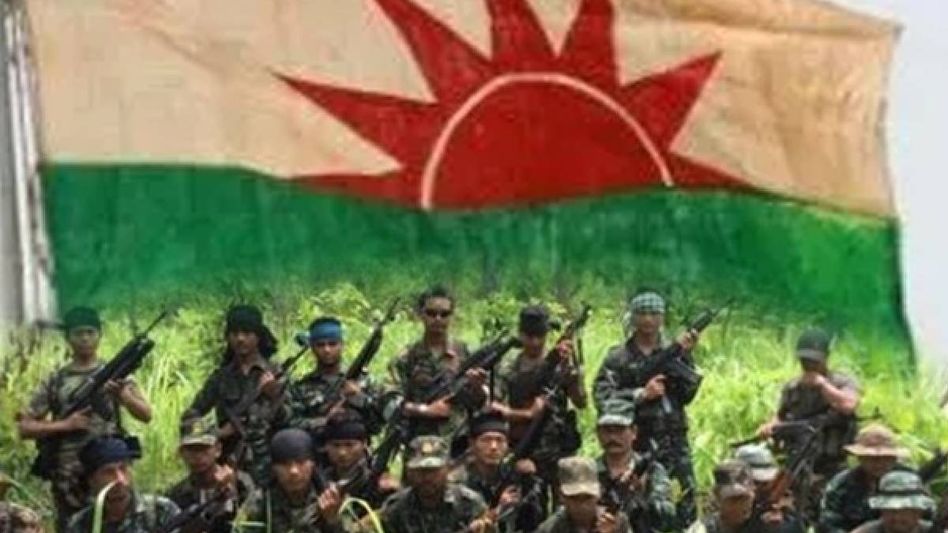
The National Socialist Council of Nagaland (NSCN) was formed in 1980 by leaders including Isak Chishi Swu, Thuingaleng Muivah and S. S. Khaplang after disagreements over the Shillong Accord.
In 1988, organisational differences resulted in a split into:
- NSCN-IM
- NSCN-K
Greater Nagalim
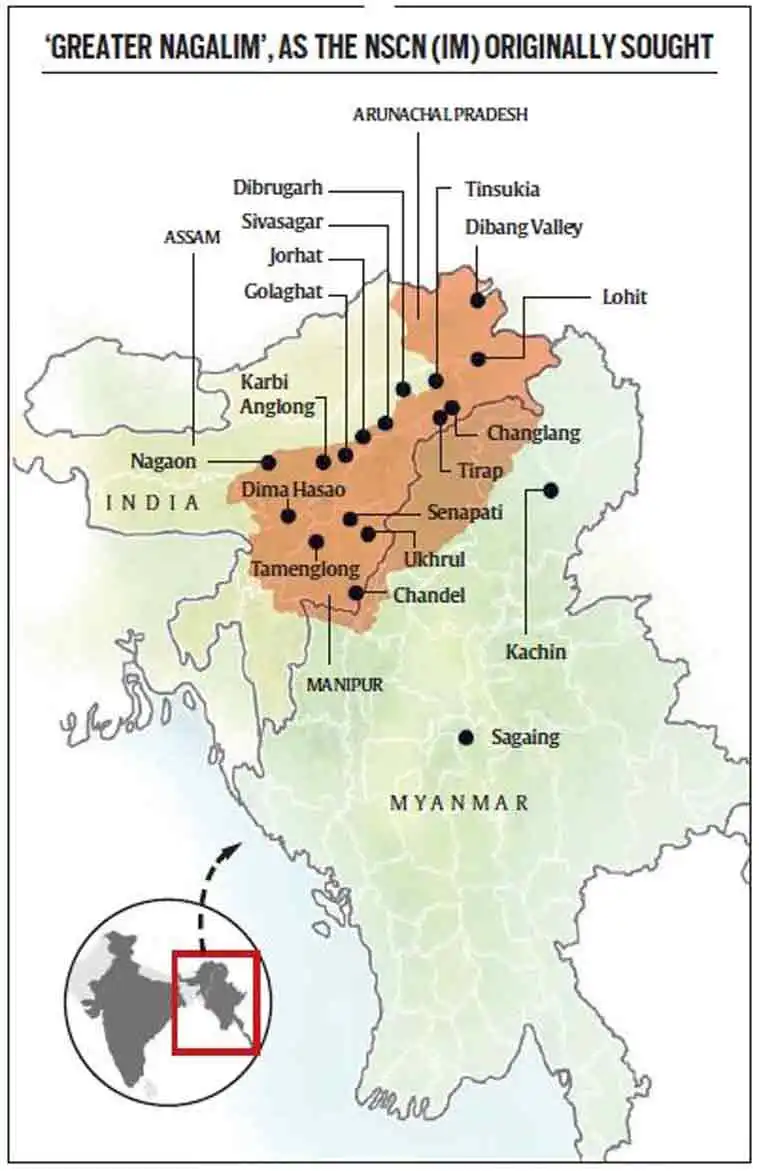
A major political aspiration associated with sections of the Naga movement has been the idea of Greater Nagalim, involving the integration of Naga-inhabited areas across existing State boundaries.
This creates a complex political challenge because territorial claims may affect neighbouring States such as Manipur, Assam and Arunachal Pradesh.
Naga Peace Process
The Naga conflict demonstrates India’s gradual transition from predominantly security-oriented responses towards negotiation and political accommodation.
Important developments include the Shillong Accord, subsequent ceasefire arrangements and negotiations with NSCN-IM and other Naga political groups.
A central challenge in the peace process remains reconciling demands concerning identity, autonomy, symbols and political arrangements with the territorial integrity and constitutional concerns of neighbouring States.
Significance of the Naga Peace Process
The Naga peace process has wider significance because a durable settlement could:
- Reduce one of India’s longest insurgencies
- Strengthen regional stability
- Improve India–Myanmar border management
- Accelerate economic development
- Improve connectivity under the Act East Policy
Manipur Insurgency
Manipur’s security challenges are particularly complex because they involve overlapping issues of ethnicity, geography, political representation, land and insurgency.
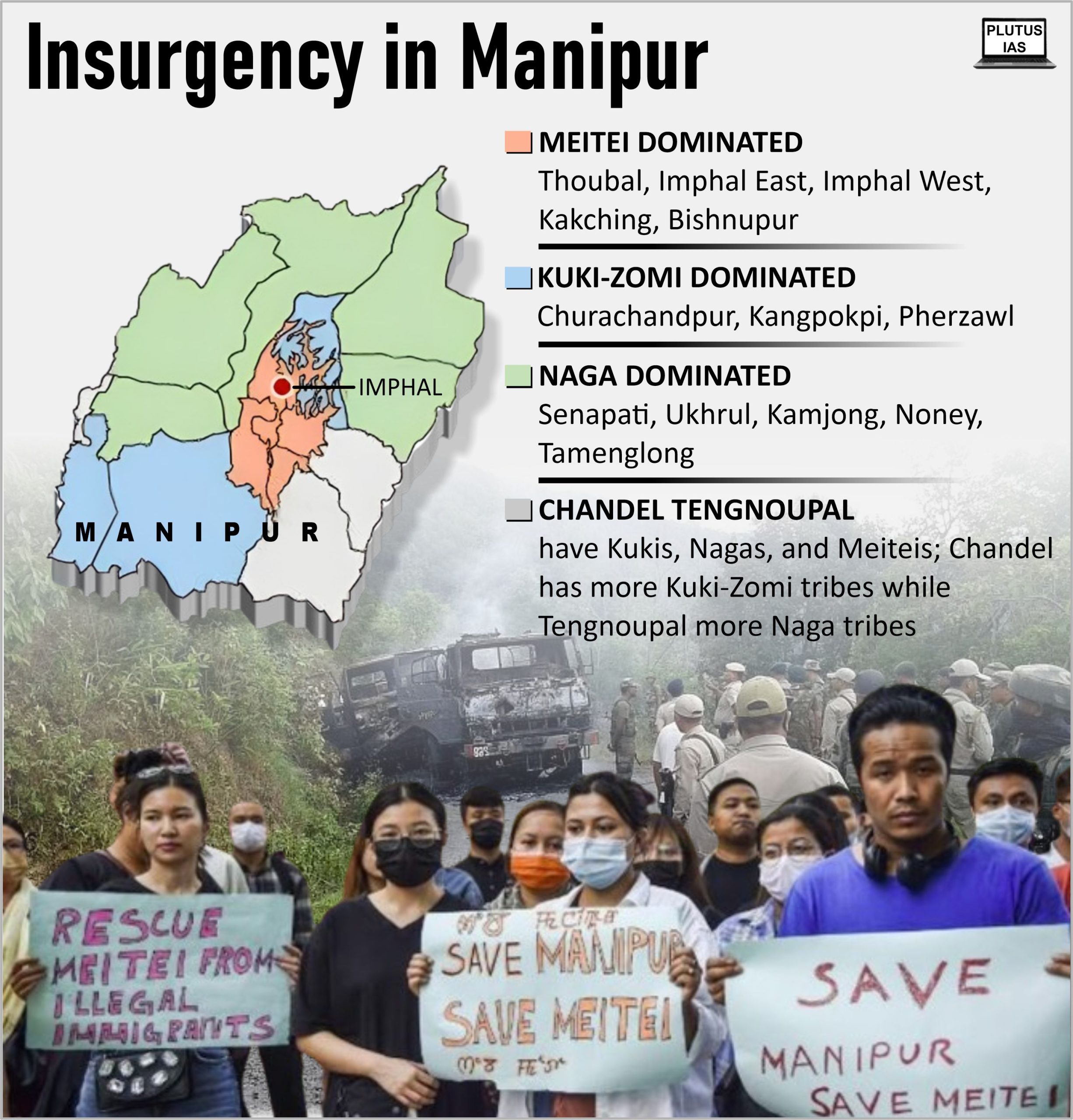
The State contains a significant divide between the Imphal Valley and surrounding hill areas, with different communities historically concentrated in these geographical zones.
Various insurgent groups emerged during the post-Independence period, some demanding independence and others seeking ethnic or territorial objectives.
Meitei–Kuki–Naga Dimensions
The security situation in Manipur cannot be understood only as a conflict between the State and insurgent groups.
It also involves complex relationships among:
- Meiteis
- Kukis
- Nagas
- Other tribal communities
Competition over land, political representation, reservation, migration and territorial control can create serious ethnic tensions.
The violent conflict that intensified in 2023 highlighted how ethnic mistrust can evolve into a major internal security and humanitarian challenge.
Security Challenges in Manipur
Important challenges include:
- Proliferation of weapons
- Ethnic militias
- Displacement
- Cross-border movement
- Drug trafficking
- Insurgent networks
- Weakening of inter-community trust
The proximity of Myanmar adds an external dimension because instability across the border may increase movement of refugees, arms and narcotics.
Assam Insurgency
Assam’s insurgency has been shaped by a combination of demographic anxieties, political grievances, ethnic aspirations and perceptions of economic neglect.
ULFA
The United Liberation Front of Asom (ULFA) was formed in 1979 and originally demanded an independent Assam.
Its emergence was associated with concerns regarding:
- Migration
- Assamese identity
- Economic exploitation
- Political alienation
Over the years, counter-insurgency operations, political engagement and declining public support significantly weakened the movement. However, ULFA-I remains outside the mainstream peace process.
Operation All Clear
Operation All Clear, launched by Bhutan in 2003, targeted insurgent camps located inside Bhutan.
The operation significantly affected the operational capacity of several Northeast insurgent organisations and demonstrated the importance of cross-border security cooperation.
Bodoland Movement
The Bodo movement emerged from demands for political recognition, identity protection and territorial autonomy.
Over time, negotiations led to the creation and restructuring of autonomous arrangements under the Sixth Schedule.
The evolution of the Bodo movement demonstrates how violent ethnic movements can gradually be transformed through constitutional accommodation, autonomy and political dialogue.
Karbi and Dimasa Movements
In Karbi Anglong and adjoining regions, insurgent movements arose around demands for greater autonomy, separate statehood and ethnic recognition.
Similarly, sections of the Dimasa community mobilised around territorial and political demands.
Peace agreements and autonomous institutions have gradually reduced the intensity of several such conflicts.
Mizoram Insurgency
Mizoram provides one of the most successful examples of conflict resolution in India’s internal security history.
The Mizo National Front (MNF) emerged under Laldenga and initially demanded independence.
The movement escalated into armed insurgency, including the 1966 uprising.
Mizoram Peace Accord, 1986
The Mizoram Peace Accord of 1986 brought an end to the insurgency through negotiation.
The settlement involved:
- Abandonment of armed struggle
- Entry of insurgent leadership into democratic politics
- Constitutional accommodation
- Statehood
- Reintegration of former insurgents
Mizoram subsequently emerged as one of the most peaceful States in the Northeast.

Why the Mizoram Peace Accord Is Considered Successful
Its success resulted from a combination of:
- Political accommodation
- Mutual trust
- Clear implementation of commitments
- Reintegration of former insurgents
- Acceptance of democratic politics
- Respect for regional identity
The Mizoram experience demonstrates that credible negotiation supported by constitutional flexibility can transform insurgency into democratic participation.
Tripura Insurgency
Tripura experienced insurgency partly as a consequence of dramatic demographic transformation following migration from East Pakistan and later Bangladesh.
Sections of the tribal population developed concerns regarding:
- Land alienation
- Cultural identity
- Political marginalisation
Several insurgent organisations emerged during the later twentieth century.
However, insurgency declined significantly through a combination of:
- Effective policing
- Development
- Political accommodation
- Rehabilitation
- Administrative penetration
The withdrawal of AFSPA from Tripura in 2015 reflected the substantial improvement in security conditions.
Tripura as a Counter-Insurgency Model
Tripura demonstrates that insurgency can decline when the State simultaneously strengthens:
Security Operations + Development + Local Governance + Rehabilitation + Political Inclusion

Meghalaya
Meghalaya has generally experienced lower levels of insurgency compared with some neighbouring States.
However, security concerns have included:
- Tribal–non-tribal tensions
- Illegal migration
- Local insurgent organisations
- Border-related issues
- Governance challenges
Arunachal Pradesh
Arunachal Pradesh has not experienced insurgency on the scale of Nagaland or Manipur, but its geographical position makes it strategically important.
Certain insurgent groups have historically used parts of the State as:
- Transit routes
- Temporary hideouts
- Routes towards Myanmar
Its proximity to China and Myanmar further enhances its strategic significance.
Role of Geography in Northeast Insurgency
The physical geography of the Northeast has strongly influenced the nature of insurgency.
Dense forests, mountains, river valleys and porous international borders provide concealment and cross-border mobility to insurgent organisations.
At the same time, difficult terrain raises the cost of:
- Border surveillance
- Infrastructure development
- Policing
- Communication
- Administrative outreach
Therefore, geographical conditions amplify both security vulnerabilities and developmental difficulties.
Cross-Border Dimension of Northeast Insurgency
The Northeast shares long international borders with several neighbouring countries.
Insurgent organisations have historically attempted to exploit:
- Porous boundaries
- Forest routes
- Remote border settlements
- Weakly monitored crossing points
Cross-border areas may facilitate:
- Arms smuggling
- Narcotics trafficking
- Movement of insurgents
- Safe havens
This makes regional diplomatic and security cooperation essential.
Myanmar and Northeast Security
Myanmar has special importance because several Indian States share a long and difficult border with it.
Political instability in Myanmar can produce multiple consequences for Northeast India:
- Refugee movements
- Insurgent mobility
- Arms trafficking
- Narcotics trafficking
- Humanitarian pressures
The Golden Triangle drug-producing region also creates a significant narcotics-security challenge for India’s Northeast.
Drug Trafficking and Insurgency
Drug trafficking increasingly intersects with internal security in the Northeast.
Criminal networks may exploit the India–Myanmar border to move narcotics using:
- Traditional routes
- Local networks
- Vehicles
- New technologies
Drug trafficking can finance:
- Organised crime
- Armed groups
- Illegal weapons networks
Therefore, narcotics control has become an essential part of the region’s security strategy.
Migration and Refugee Challenges
Migration is among the most politically sensitive subjects in Northeast India.
Security concerns arise when communities perceive demographic changes as threats to:
- Land ownership
- Employment
- Language
- Cultural identity
- Political representation
At the same time, refugee situations also involve humanitarian obligations.
An effective policy must therefore balance:
Humanitarian Concerns + Border Management + Indigenous Rights + National Security
Armed Forces Special Powers Act
The Armed Forces (Special Powers) Act (AFSPA) has historically been applied in several conflict-affected areas of the Northeast.
Its purpose is to provide additional operational powers to security forces in areas officially declared disturbed.
Supporters argue that AFSPA can be necessary where insurgency exceeds the capacity of ordinary policing.
Critics raise concerns regarding:
- Human rights
- Accountability
- Public alienation
- Prolonged militarisation
As security conditions have improved, the geographical application of AFSPA has been progressively reduced in several Northeastern areas.
The long-term objective should be to create conditions where ordinary civil administration and policing can replace exceptional security arrangements.
Impact of Insurgency on Northeast India
Human Cost
Insurgency produces:
- Deaths
- Injuries
- Displacement
- Psychological trauma
- Breakdown of community relations
Economic Impact
Persistent instability discourages:
- Investment
- Tourism
- Infrastructure development
- Private enterprise
Security concerns can therefore reinforce the very underdevelopment that initially contributes to alienation.
Governance Impact
Insurgency weakens administration by:
- Restricting movement of officials
- Extorting contractors
- Disrupting development schemes
- Creating parallel authority
Impact on Education and Youth
Conflict can interrupt:
- Schooling
- Higher education
- Employment
- Mobility
Unemployment and social instability may subsequently increase vulnerability to recruitment.
Impact on National Integration
Violent separatism directly challenges territorial integrity and national unity.
At the same time, excessive securitisation without political dialogue may reinforce perceptions of alienation.
Government Approach Towards Northeast Insurgency
India’s policy has increasingly evolved towards a multi-dimensional approach.
Security Operations
Security forces continue to act against organisations involved in:
- Armed violence
- Extortion
- Kidnapping
- Illegal arms trafficking
Security measures are necessary to prevent violent groups from coercing local populations.
Political Dialogue
The government has increasingly relied on peace negotiations and ceasefire arrangements to bring insurgent groups into constitutional politics.
Dialogue provides armed organisations with a peaceful route to pursue legitimate political concerns.
Peace Accords
Peace agreements have played a major role in stabilising the Northeast.
Important examples include arrangements involving:
- Mizoram
- Bodo organisations
- Karbi groups
- Naga groups
- Other tribal and insurgent organisations
Peace accords generally attempt to combine:
Disarmament + Rehabilitation + Political Accommodation + Development
Surrender and Rehabilitation
Surrender policies provide opportunities for insurgent cadres to return to normal life.
Rehabilitation may include:
- Financial assistance
- Vocational training
- Employment support
- Reintegration programmes
Effective rehabilitation prevents surrendered cadres from returning to armed organisations.
Development Initiatives
Development is central to long-term peace.
Major priorities include:
- Road connectivity
- Railways
- Airports
- Digital connectivity
- Education
- Healthcare
- Skills
- Employment
- Border-area development
Development must particularly reach remote and conflict-affected communities.
Ministry of Development of North Eastern Region
The Ministry of Development of North Eastern Region (DoNER) plays an important role in coordinating and monitoring development initiatives relating to the region.
Act East Policy
The Act East Policy can transform the Northeast from a perceived geographical periphery into a gateway to Southeast Asia.
Improved connectivity with Myanmar and Southeast Asia can generate:
- Trade
- Employment
- Tourism
- Investment
- Infrastructure
Economic integration can strengthen peace by giving communities a direct stake in regional stability.
Role of Autonomous Councils
Autonomous District Councils provide institutional mechanisms through which tribal communities can exercise greater control over local affairs.
When designed and implemented effectively, autonomy can reduce demands for violent separatism by accommodating diversity within the Constitution.
Role of Local Communities
Local communities are critical stakeholders in internal security.
Community participation can improve:
- Intelligence gathering
- Conflict resolution
- Development planning
- Trust in administration
The State should therefore treat local communities as partners in peace, rather than merely as populations to be secured.
Challenges in Achieving Lasting Peace
Despite significant improvement, several challenges remain.
- Unresolved political demands continue in some regions.
- Multiple factions can complicate negotiations.
- Ethnic territorial claims may overlap.
- Border instability can revive insurgent networks.
- Narcotics and organised crime can provide new sources of financing.
- Unemployment continues to affect youth.
- Corruption may weaken development programmes.
- Peace agreements may lose credibility if implementation is slow.
- Inter-community tensions can transform quickly into violence.
Way Forward
Political Accommodation
Legitimate political and cultural aspirations should be addressed through:
- Dialogue
- Federalism
- Autonomy
- Democratic representation
Time-Bound Implementation of Peace Accords
Peace agreements should be followed by credible implementation.
Delays can create:
- Distrust
- Frustration
- Renewed mobilisation
Strengthening Local Governance
Autonomous councils, Panchayats and local institutions should be made more accountable and financially capable.
Economic Transformation
Development should focus on:
- Local employment
- Agro-processing
- Tourism
- Border trade
- Handicrafts
- Entrepreneurship
- Skills
Connectivity
Improving road, rail, digital and air connectivity is essential for both development and national integration.
Border Management
India should strengthen:
- Surveillance
- Border infrastructure
- Intelligence
- Cooperation with neighbouring countries
Counter-Narcotics Strategy
Drug trafficking must be addressed through:
- Enforcement
- Financial investigation
- International cooperation
- Rehabilitation of addicts
- Community awareness
Youth Engagement
Young people should receive:
Education + Skills + Employment + Political Voice
A generation with meaningful opportunities is less vulnerable to insurgent recruitment.
Community Reconciliation
Post-conflict areas require:
- Dialogue
- Rehabilitation
- Return of displaced persons
- Inter-community trust building
Security with Sensitivity
Security operations must remain:
- Intelligence-driven
- Proportionate
- Accountable
- Sensitive to local communities
Insurgency in Northeast India is not a single security problem but a collection of historically distinct political, ethnic, territorial and socio-economic movements. Its causes range from identity concerns and demographic anxiety to underdevelopment, political alienation, difficult geography and external linkages.
India’s experience, particularly in Mizoram and Tripura, demonstrates that insurgencies can be brought to an end when effective security is combined with credible political dialogue, constitutional accommodation, development and rehabilitation.
The long-term objective should therefore move beyond merely achieving the absence of violence. Sustainable peace requires trust between communities, effective governance, economic opportunity, secure borders and democratic accommodation of legitimate regional aspirations.
The Northeast should ultimately be transformed from a region historically viewed through the lens of insurgency into a stable bridge between India and Southeast Asia and a central pillar of India’s economic and strategic future.