
India Nepal Relations
- India and Nepal share a unique, multidimensional and deeply rooted relationship based on geography, history, culture, religion, economic interdependence and extensive people-to-people contacts.
- The relationship is distinguished by:
- Open border
- Free movement of people
- Deep cultural and religious links
- Cross-border marriages
- Employment and migration
- Defence cooperation
- Economic interdependence.
- These close familial and social connections are often described as “Roti-Beti ka Rishta.”
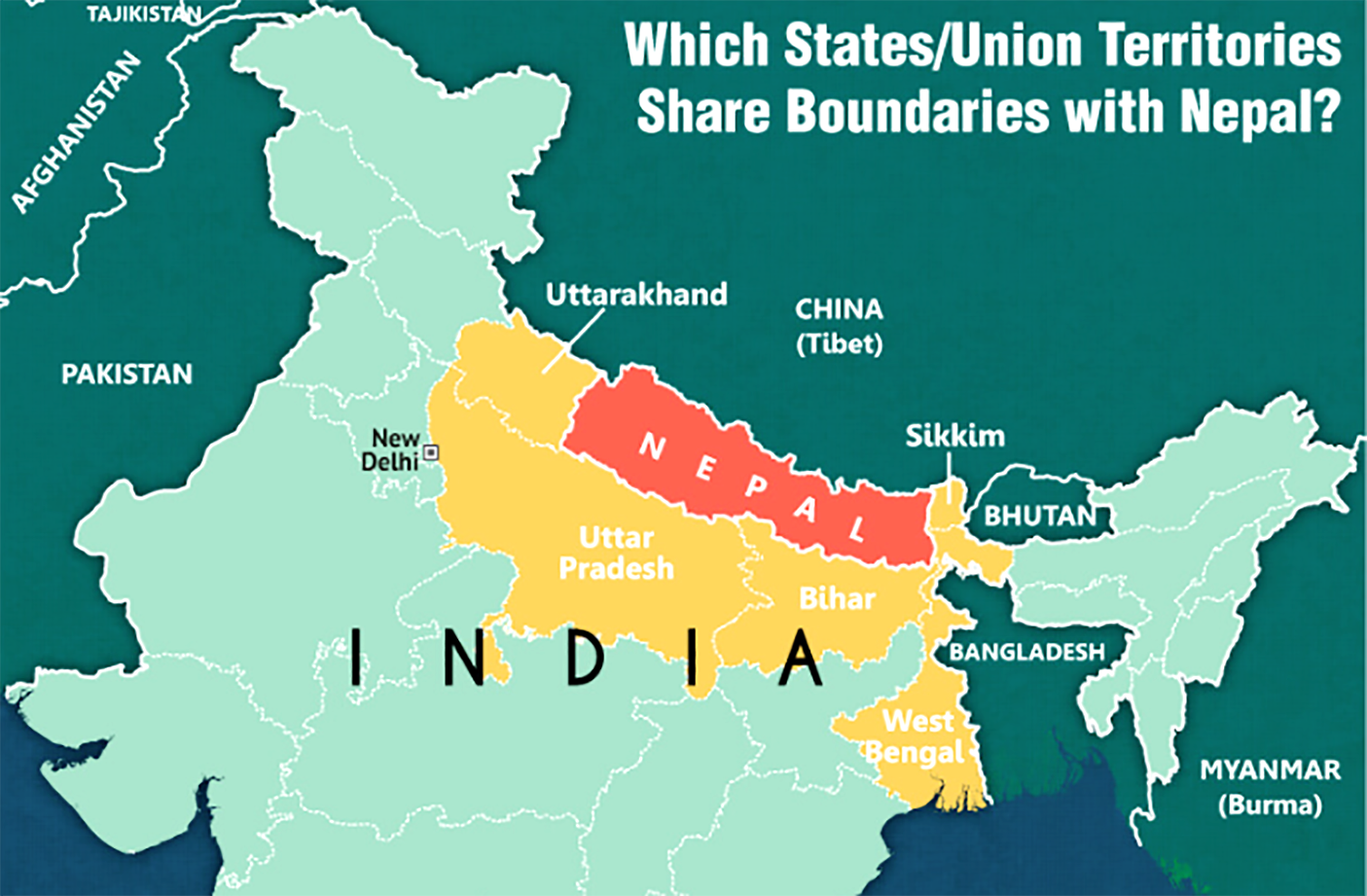
- India and Nepal share an approximately 1,850-km-long border across:
- Uttarakhand
- Uttar Pradesh
- Bihar
- West Bengal
- Sikkim.
- Nepal borders the Tibet Autonomous Region of China to its north.
- The India-Nepal Treaty of Peace and Friendship, 1950 remains the foundational framework of the special bilateral relationship.
- Nepal’s location between India and China gives it considerable strategic importance in India’s Himalayan security architecture.
Historical Background
Ancient Civilisational Links
- India-Nepal relations date back several centuries and are linked with:
- Hinduism
- Buddhism
- Shared pilgrimage traditions
- Language and culture
- Historical trade routes.
- Lumbini in Nepal is the birthplace of Gautama Buddha.
- Important civilisational links include:
- Pashupatinath
- Janakpur
- Ayodhya
- Bodh Gaya
- Varanasi
- Lumbini.
Rana Rule and Democratic Transition
- The Rana oligarchy dominated Nepalese politics from 1846 to 1951.
- Nepalese political activists were influenced by India’s freedom struggle.
- The Nepali Congress played an important role in the democratic movement against Rana rule.
- The Rana system collapsed in 1951, beginning a prolonged struggle between monarchy and democratic forces.
Nepal’s Democratic Evolution
From Monarchy to Republic
- Nepal’s political evolution passed through several phases:
- 1951: End of Rana rule
- 1959: First parliamentary elections
- 1960: King Mahendra dissolved Parliament and introduced the partyless Panchayat system
- 1990: Multiparty democracy restored
- 1996–2006: Maoist insurgency
- 2006: Comprehensive Peace Agreement
- 2008: Monarchy abolished; Nepal became a Federal Democratic Republic
- 2015: New Constitution promulgated.
Constitution of 2015
- Nepal’s 2015 Constitution established the country as a:
- Federal
- Democratic
- Republican
- Secular state.
- However, sections of the:
- Madhesi
- Tharu
- Janajati
- Dalit communities
- The communities raised concerns over:
- Political representation
- Federal boundaries
- Citizenship
- Electoral representation.
- The resulting political agitation significantly affected India-Nepal relations.
2015 Crisis and Its Impact on Relations
- India-Nepal relations deteriorated sharply during the 2015 Madhesi agitation.
- Nepal experienced severe shortages of:
- Fuel
- Medicines
- Essential commodities.
- Sections of Nepalese society accused India of facilitating an “unofficial blockade.”
- India denied imposing a blockade and argued that movement was disrupted by protests on the Nepalese side.
- Nevertheless, the episode generated:
- Strong anti-India sentiment
- Greater emphasis on Nepalese nationalism
- Nepal’s attempt to diversify connectivity away from India
- Greater engagement with China.
Nepal’s Diversification towards China
- Following the 2015 crisis, Nepal sought to reduce excessive dependence on India.
- Nepal signed a Transit and Transportation Agreement with China in 2016.
- China subsequently became an increasingly important partner in:
- Infrastructure
- Roads
- Connectivity
- Hydropower
- Telecommunications
- Political engagement.
- Nepal also joined China’s Belt and Road Initiative (BRI).
- However, difficult Himalayan terrain means that India continues to remain Nepal’s most practical and important transit route.
Areas of Cooperation between India and Nepal
Political Cooperation
- India and Nepal maintain regular dialogue through mechanisms such as:
- India-Nepal Joint Commission
- Foreign Secretary-level talks
- Home Secretary-level meetings
- Border mechanisms
- Joint committees on water resources
- Power and trade-related mechanisms.
- Prime Minister Modi’s 2014 visit to Nepal marked a renewed emphasis on India’s Neighbourhood First Policy.
- India has consistently stated its support for:
- Nepal’s sovereignty
- Stability
- Democracy
- Development.
- High-level exchanges have increasingly focused on economic deliverables rather than political rhetoric.
Economic Relations
- India is Nepal’s largest and most important economic partner.
- India plays a central role in Nepal’s:
- Trade
- Transit
- Investment
- Energy supply
- Employment
- Development assistance.
- Nepal’s economy is particularly dependent on Indian routes for access to seaports and international markets.
- Major Indian exports to Nepal include:
- Petroleum products
- Machinery
- Iron and steel
- Vehicles
- Pharmaceuticals
- Food products.
- Nepal’s exports to India include:
- Electricity
- Edible oils
- Spices
- Textiles
- Agricultural products.
Trade Imbalance
- Nepal runs a large merchandise trade deficit with India.
- This creates periodic political concerns within Nepal regarding economic dependence.
- However, India also provides Nepal:
- A large nearby market
- Transit access
- Duty concessions
- Investment
- Employment opportunities.
Trade and Transit Framework
Treaty of Trade
- India provides preferential market access to many Nepalese products under bilateral trade arrangements.
- Trade arrangements seek to:
- Promote Nepalese industrialisation
- Facilitate bilateral commerce
- Reduce logistical barriers.
Treaty of Transit, 2023
- A new India-Nepal Treaty of Transit was signed on 1 June 2023.
- It replaced the previous transit treaty.
- It is valid for seven years and automatically renewable unless terminated according to agreed procedures.
- The revised framework expanded Nepal’s transit opportunities, including greater use of:
- Railways
- Indian ports
- Inland waterways.
- This provides landlocked Nepal with more diversified access to global markets.
Connectivity Cooperation
Rail Connectivity
- Important cross-border railway projects include:
- Jayanagar–Kurtha–Bijalpura line
- Jogbani–Biratnagar railway link
- Proposed Raxaul–Kathmandu railway.
- Rail connectivity is aimed at reducing:
- Transportation costs
- Border congestion
- Trade delays.
Road Connectivity
- India supports:
- Border roads
- Integrated Check Posts
- Bridges
- Terai road projects.
- Improved connectivity is essential for both:
- Trade
- People-to-people movement.
Integrated Check Posts
- ICPs have been developed at important border points such as:
- Birgunj–Raxaul
- Biratnagar–Jogbani
- Nepalgunj–Rupaidiha.
- These facilities improve:
- Customs processing
- Passenger movement
- Trade efficiency.
Petroleum Connectivity
Motihari–Amlekhgunj Pipeline
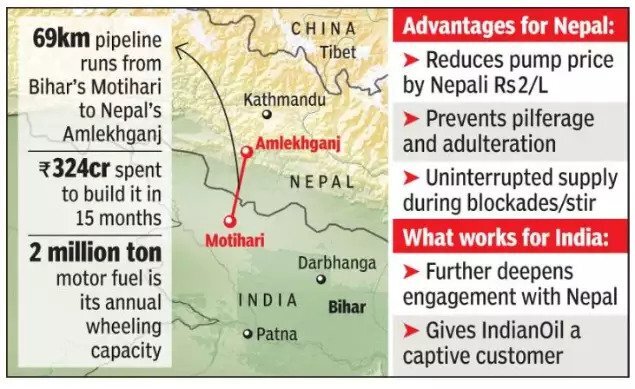
- The Motihari–Amlekhgunj petroleum pipeline, inaugurated in 2019, was the first cross-border petroleum products pipeline in South Asia.
- It has:
- Reduced transportation costs
- Reduced tanker movement
- Improved fuel security for Nepal.
- India and Nepal are expanding petroleum connectivity through additional pipeline and storage projects.
Hydropower Cooperation
- Hydropower has become one of the most transformative pillars of India-Nepal relations.
- Nepal possesses enormous hydropower potential because of:
- Himalayan rivers
- Steep gradients
- High river discharge.
- India provides:
- Investment
- Transmission connectivity
- Market access
- Technical cooperation.
Long-Term Power Trade Agreement
- In January 2024, India and Nepal finalised a Long-Term Power Trade Agreement.
- It envisages increasing Nepal’s electricity exports to India to up to 10,000 MW within ten years.
- This represents a major shift from traditional donor-recipient relations towards energy interdependence.
Major Hydropower Projects
- Important India-linked projects include:
- Arun-III – 900 MW
- Arun-IV
- Lower Arun
- West Seti
- Seti River projects.
- Hydropower cooperation benefits:
- Nepal through revenue and investment
- India through clean electricity and energy security.
Nepal–India–Bangladesh Electricity Trade
- A major new development is the emergence of trilateral electricity trade.
- India has allowed Nepal to transmit electricity to Bangladesh through the Indian grid.
- The first such power transaction began in 2024.
- This is important because it creates the foundations of a future BBIN regional electricity market.
Digital Connectivity
UPI in Nepal
- UPI merchant payments became operational in Nepal in March 2024 through cooperation between NPCI International and Fonepay.
- Indian travellers can use UPI-enabled apps to make QR-based payments at participating merchants in Nepal.
- This strengthens:
- Tourism
- Small businesses
- Retail payments
- Cross-border economic integration.

Fast Payment System Integration
- In February 2024, RBI and Nepal Rastra Bank signed Terms of Reference for linking:
- India’s UPI
- Nepal’s National Payments Interface.
- The objective is to facilitate cross-border person-to-person and person-to-merchant payments.
Defence Cooperation
- Defence relations remain an important pillar of the bilateral relationship.
- India assists the Nepali Army through:
- Training
- Equipment
- Capacity building
- Disaster-response cooperation.
Exercise Surya Kiran
- Exercise Surya Kiran is the regular India-Nepal joint military exercise.
- Major areas include:
- Counter-terrorism
- Jungle warfare
- Mountain warfare
- Humanitarian Assistance and Disaster Relief (HADR).
Honorary General Tradition
- The Army Chiefs of India and Nepal traditionally receive the honorary rank of General of the other country’s army.
- This symbolises the exceptionally close institutional relationship between the two militaries.
Gorkha Connection
- Nepalese Gorkhas have served in the Indian Army for generations.
- Gorkha recruitment is not merely a defence issue; it also generates:
- Employment
- Pensions
- Remittances
- Social linkages.
Agnipath Issue
- The introduction of India’s Agnipath recruitment scheme in 2022 created uncertainty regarding recruitment of Nepalese citizens into Gorkha regiments.
- Nepal did not immediately permit recruitment under the new system.
- Consequently, traditional recruitment of Nepalese Gorkhas into the Indian Army has remained disrupted since 2022.
- This has become an important unresolved issue in defence relations.
Cultural and Civilisational Relations
Roti-Beti Relationship
- India and Nepal possess extensive cross-border:
- Marriage ties
- Family relationships
- Religious connections
- Shared linguistic communities.
- The open border has allowed these relationships to remain unusually strong.
Religious Links
- Important shared religious centres include:
- Pashupatinath
- Lumbini
- Janakpur
- Ayodhya
- Varanasi
- Bodh Gaya.
- Major initiatives include:
- Ramayana Circuit
- Buddhist Circuit.
Sister-City Partnerships
- Important city partnerships include:
- Kathmandu–Varanasi
- Janakpur–Ayodhya
- Lumbini–Bodh Gaya.
India’s Development Assistance to Nepal
- India is one of Nepal’s major development partners.
- Assistance focuses on:
- Education
- Healthcare
- Roads
- Bridges
- Power transmission
- Drinking water
- Community infrastructure
- Post-disaster reconstruction.
- India has extended multiple Lines of Credit amounting to around US$1.65 billion for various infrastructure and reconstruction projects.
High Impact Community Development Projects
- India’s High Impact Community Development Projects (HICDPs) focus on locally identified projects such as:
- Schools
- Health centres
- Drinking-water facilities
- Community halls
- Small infrastructure.
- Their significance lies in creating direct grassroots benefits rather than only large flagship infrastructure.
Disaster Cooperation
2015 Nepal Earthquake
- After the devastating April 2015 earthquake, India launched Operation Maitri.
- India provided:
- Search and rescue teams
- Medical assistance
- Relief supplies
- Reconstruction assistance.
- India subsequently committed a US$1 billion reconstruction package.
- Disaster-response cooperation strengthens India’s role as a first responder in its neighbourhood.
Multilateral Cooperation
- India and Nepal cooperate through:
- BIMSTEC
- BBIN
- SAARC
- United Nations
- Non-Aligned Movement.
- The BBIN framework is particularly important for:
- Connectivity
- Energy
- Transport
- Sub-regional economic integration.
Significance of Nepal for India
Strategic Importance
- Nepal lies directly between India and China.
- Political instability or excessive strategic presence of an external power in Nepal could directly affect India’s Himalayan security.
- Nepal is therefore an important component of India’s northern strategic frontier.
Security Importance
- India and Nepal share an open border, which facilitates legitimate movement but can also be misused for:
- Smuggling
- Trafficking
- Counterfeit currency
- Criminal activity.
- Effective intelligence and border-management cooperation is therefore essential.
Economic Importance
- Nepal provides opportunities for Indian investment in:
- Hydropower
- Infrastructure
- Banking
- Tourism
- Telecom
- Manufacturing.
Water Resources
- Rivers originating or flowing through Nepal are crucial for northern India.
- Important shared river systems include:
- Kosi
- Gandak
- Mahakali.
- Cooperation is important for:
- Flood control
- Irrigation
- Hydropower
- Climate resilience.
Connectivity
- Nepal can help deepen India’s integration of the Himalayan region and BBIN sub-region.
- Enhanced infrastructure can also support economic development in:
- Bihar
- Uttar Pradesh
- Uttarakhand
- West Bengal.
Significance of India for Nepal
- India provides Nepal with:
- Closest access to the sea
- Largest nearby market
- Transit facilities
- Employment opportunities
- Energy supplies
- Development finance
- Investment.
- India remains one of Nepal’s most important sources of:
- Petroleum
- Food products
- Medicines
- Machinery.
- Millions of Nepalese citizens have historically lived, worked or studied in India under the open-border framework.
Major Challenges in India–Nepal Relations
Border Disputes
- The India-Nepal boundary has been largely demarcated, but disputes remain primarily around:
- Kalapani
- Lipulekh
- Limpiyadhura
- Susta.
Kalapani–Lipulekh–Limpiyadhura Dispute
- The dispute arises from different interpretations of the 1816 Treaty of Sugauli.
- The treaty identified the Kali River as part of the western boundary.
- The disagreement concerns the actual source of the Kali River.
- Nepal argues that the river originates near Limpiyadhura, placing:
- Limpiyadhura
- Kalapani
- Lipulekh
within Nepal.
- India maintains that these territories form part of Uttarakhand.
Nepal’s New Political Map
- In 2020, Nepal adopted a revised political map incorporating:
- Kalapani
- Lipulekh
- Limpiyadhura.
- India rejected the map as a unilateral alteration of territorial claims.
- The dispute remains unresolved and requires bilateral diplomatic negotiation.
Susta Dispute
- Susta lies near the Gandak/Narayani River.
- The dispute arose partly because of shifts in the river’s course.
- Unlike Kalapani, it is linked primarily to:
- River morphology
- Historical boundary interpretation.
- Technical boundary mechanisms are better suited to address such disputes than political mobilisation.
Water Issues
- India-Nepal water relations have sometimes been affected by disagreements over:
- Kosi Agreement
- Gandak Agreement
- Mahakali Treaty
- Flood management
- Hydropower benefit-sharing.
- Nepal has sometimes perceived earlier agreements as providing disproportionate benefits to India.
- India, meanwhile, emphasises:
- Flood control
- Irrigation
- Power generation
- Joint development.
Pancheshwar Multipurpose Project
- The Pancheshwar Multipurpose Project arises from the Mahakali Treaty of 1996.
- It has enormous potential for:
- Hydropower
- Irrigation
- Flood management.
- However, the project has faced repeated delays over:
- Benefit sharing
- Water valuation
- Technical issues.
Open Border: Opportunity and Challenge
Opportunities
- The India-Nepal open border is a unique strategic asset.
- It facilitates:
- Labour mobility
- Trade
- Family links
- Pilgrimage
- Tourism.
- But it can also be exploited for:
- Human trafficking
- Narcotics trafficking
- Smuggling
- Criminal movement.
- The policy challenge is therefore:
Keep the border open for legitimate movement while making it smarter and more secure.
1950 Treaty of Peace and Friendship
- The treaty remains the institutional foundation of the special bilateral relationship.
- It recognises:
- Sovereignty
- Territorial integrity
- Close security cooperation
- Special privileges for citizens.
- However, sections of Nepal’s political class regard the treaty as:
- Outdated
- Asymmetrical
- Symbolic of excessive Indian influence.
- Both countries have discussed reviewing and updating the treaty, but no revised treaty has been concluded.
Eminent Persons Group
- An Eminent Persons Group (EPG) consisting of representatives from both countries was established to review the overall relationship, including the 1950 Treaty.
- The EPG completed its report in 2018.
- However, the report has not been formally acted upon.
- The continuing debate reflects the need to modernise bilateral frameworks while preserving the open-border and people-centric character of the relationship.
Challenges
China Factor
- China’s growing role in Nepal is one of India’s major strategic concerns.
- Chinese engagement includes:
- BRI projects
- Roads
- Infrastructure
- Digital networks
- Political engagement
- Security cooperation.
- Nepal seeks to balance relations with both India and China, rather than depend completely on either.
India’s Appropriate Response
- India should avoid treating every Nepal-China engagement as a zero-sum contest.
- A stronger response is to compete through:
- Faster delivery
- Grants
- Connectivity
- Hydropower markets
- Digital integration
- Education
- People-to-people relations.
- India’s geographical proximity and social links remain advantages that China cannot easily replicate.
Madhesi Issue
- Madhesis are communities primarily inhabiting Nepal’s Terai region along the Indian border.
- During the 2015 constitutional process, Madhesi groups raised concerns regarding:
- Political representation
- Provincial boundaries
- Citizenship
- Inclusion.
- Because of deep familial and ethnic links across the border, developments in the Terai have direct social and political implications for India.
- India’s involvement, however, has sometimes been perceived in Nepal as interference in domestic politics.
- The lesson for India is to favour quiet diplomacy and institutional engagement rather than public political pressure.
Trust Deficit and Anti-India Sentiment
- Sections of Nepalese society periodically accuse India of:
- Political interference
- Project delays
- Economic dominance
- Excessive influence.
- Anti-India sentiment can also be used by political parties for domestic nationalist mobilisation.
- India therefore needs to replace perceptions of a “big brother” with those of an equal and reliable partner.
Challenges in Project Implementation
- India’s development projects have sometimes suffered from:
- Administrative delays
- Slow land acquisition
- Coordination problems
- Project cost escalation.
- Delayed implementation can weaken India’s credibility relative to external competitors.
- Faster project delivery is therefore a strategic requirement, not merely an administrative concern.
Climate and Environmental Challenges
- India and Nepal share the fragile Himalayan ecosystem.
- Common threats include:
- Glacial retreat
- Glacial Lake Outburst Floods (GLOFs)
- Landslides
- Flash floods
- River sedimentation
- Climate-induced disasters.
- Joint cooperation should include:
- Glacier monitoring
- Early-warning systems
- Flood forecasting
- Watershed management
- Climate-resilient infrastructure.
Measures Needed to Strengthen India–Nepal Relations
Modernise the Relationship
- Both countries should review outdated arrangements through mutual consultation and sovereign equality.
- A modernised relationship should preserve:
- Open border
- National treatment advantages
- Security cooperation
while addressing Nepal’s concerns over asymmetry.
Resolve Border Disputes Technically
- Kalapani, Lipulekh, Limpiyadhura and Susta should be addressed through:
- Historical maps
- Treaty documents
- Survey data
- Geospatial technology
- Sustained diplomatic negotiation.
- Border disputes should not be allowed to dominate the entire relationship.
Expand Hydropower Integration
- Implement the 10,000 MW power trade target.
- Promote:
- Joint ventures
- Transmission corridors
- Renewable-energy cooperation
- BBIN electricity trade.
- Energy interdependence can become the strongest stabilising factor in bilateral relations.
Strengthen Digital Integration
- Expand:
- UPI connectivity
- Remittance platforms
- Cross-border banking
- FinTech cooperation.
- Digital integration can directly benefit:
- Migrant workers
- Traders
- Tourists
- Students.
Improve Connectivity
- Accelerate:
- Rail links
- Roads
- Petroleum pipelines
- Integrated Check Posts
- Inland waterways.
- Connectivity should transform the open border into an economic growth corridor.
Resolve the Gorkha Recruitment Issue
- India and Nepal should seek a mutually acceptable framework concerning recruitment of Nepalese citizens into the Gorkha regiments.
- The issue has:
- Defence
- Employment
- Pension
- Social-security implications.
Strengthen Sub-Regional Cooperation
- India and Nepal should use:
- BBIN
- BIMSTEC
to promote: - Energy integration
- Connectivity
- Trade
- Disaster management.
Promote Climate Cooperation
- Establish stronger bilateral mechanisms for:
- GLOF monitoring
- Flood management
- Himalayan research
- Climate-resilient infrastructure.
Focus on People, Not Only Governments
- India-Nepal relations are strongest when centred on:
- Students
- Migrant workers
- Pilgrims
- Businesses
- Border communities
- Cultural institutions.
- The relationship should therefore remain people-centric rather than exclusively elite-driven.
Way Forward
- The future of India-Nepal relations should rest on four interconnected pillars:
Connectivity + Energy + Development + Mutual Sensitivity
- India should:
- Respect Nepal’s sovereign choices
- Avoid unnecessary involvement in domestic politics
- Accelerate project implementation
- Expand non-reciprocal developmental benefits where feasible.
- Nepal should recognise the unique advantages offered by:
- Open-border arrangements
- Access to Indian markets
- Transit to the sea
- Employment opportunities
- Energy trade.
- Both countries should transform their relationship from one based primarily on historical sentiment into one of institutionalised economic interdependence.
Conclusion
- India-Nepal relations are among the most unique relationships in South Asia because they connect states, societies, economies and families simultaneously.
- Periodic disputes over:
- Borders
- Political interference
- China
- The 1950 Treaty
should not be allowed to overshadow this structural interdependence.
- The strongest contemporary opportunities lie in:
- 10,000 MW electricity trade
- Cross-border railways
- Petroleum pipelines
- Digital payments
- BBIN energy trade
- Climate cooperation.
- The long-term objective should be:
“From Roti-Beti relations to Connectivity-Energy-Digital Interdependence.”
- A relationship based on mutual respect, sovereign equality, faster delivery and deeper economic integration can make India-Nepal ties more resilient to political fluctuations.