
Indian Foreign Policy
Meaning of Foreign Policy
- Foreign policy refers to the strategy adopted by a country to promote and protect its national interests, ideals, objectives and principles in its relations with other countries.
- It is dynamic in nature and changes according to developments at both the domestic and international levels.
- It includes activities such as:
- Diplomacy
- Trade negotiations
- Military and strategic partnerships
- International aid and development cooperation
- The fundamental purpose of foreign policy is to safeguard a country’s national interest, security, sovereignty and prosperity.
Historical Background of India’s Foreign Policy
- India possesses one of the oldest civilisational traditions in the world.
- Historically, Indian kingdoms and empires such as the Mauryas, Guptas and Mughals conducted their external relations according to their own political interests.
- During the British colonial period, India’s external relations were determined primarily by British imperial interests.
- After Independence in 1947, India regained the ability to formulate an independent foreign policy based on its own national interests.
Factors Determining India’s Foreign Policy
- India’s foreign policy is broadly influenced by two sets of factors — domestic and international.
Domestic Factors
- History – colonial experience, freedom struggle and anti-imperialist traditions.
- Culture and civilisation – traditions of coexistence, tolerance and peaceful engagement.
- Geography – India’s strategic location, land borders and Indian Ocean position.
- Economy – developmental requirements, trade, investment and energy needs.
- Domestic political conditions – political leadership, institutions and national priorities.
International Factors
- Cold War rivalry between the US-led and Soviet-led blocs.
- Formation and growing role of the United Nations.
- Nuclear arms race and global security competition.
- Movements against colonialism and imperialism.
- Changing regional and global balance of power.
The “3 S” Framework of Indian Foreign Policy
- India’s major foreign-policy objectives can be summarised through the 3 S’s:
- Space → maintaining sufficient strategic autonomy in international affairs.
- Stability → ensuring stability within India and in its neighbourhood.
- Strength → developing economic, military and soft power to protect and advance national interests.
Objectives and Principles of India’s Foreign Policy
- India’s foreign policy combines the pursuit of national interests with broader international responsibilities.
- It seeks to protect India’s security and developmental interests while promoting peace, justice and international cooperation.
Basic Objectives of India’s Foreign Policy
- Safeguarding National Interest and Sovereignty
- Protection of territorial integrity, sovereignty and political independence is the foremost objective.
- India consistently emphasises respect for the sovereignty and territorial integrity of states.
- Promotion of International Peace and Security
- India supports:
- Peaceful coexistence
- Non-interference
- Disarmament
- Resolution of disputes through dialogue and negotiation
- India’s participation in UN Peacekeeping Operations reflects this commitment.
- India supports:
- Promoting Domestic Development and Well-Being
- Foreign policy is also used as an instrument for:
- Economic growth
- Foreign investment
- Technology transfer
- Trade expansion
- Inclusive development
- Agreements such as India-Singapore CECA, India-Japan EPA and India-Korea CEPA illustrate the economic dimension of diplomacy.
- Foreign policy is also used as an instrument for:
- Enhancing National Security
- India seeks to address both traditional and non-traditional security threats.
- Major instruments include:
- Strategic partnerships
- Defence cooperation
- Counterterrorism cooperation
- Intelligence sharing
- Enhancing India’s Global Standing
- India seeks a greater role in global governance and multilateral institutions.
- India’s participation in forums such as the G20, SCO and G7 outreach meetings reflects its expanding international profile.
- Protecting the Indian Diaspora
- Protection and welfare of Indians living abroad has become an important foreign-policy objective.
- Major evacuation operations have included:
- Operation Devi Shakti – Afghanistan
- Operation Ganga – Ukraine
- Operation Kaveri – Sudan
Principles Guiding India’s Foreign Policy
- Panchsheel – peaceful coexistence based on mutual respect and non-interference.
- Non-Alignment – maintaining independence in foreign-policy decision-making.
- Anti-Colonialism and Anti-Imperialism – opposition to colonial domination.
- Anti-Racism – support for racial equality and opposition to discrimination.
- Peaceful Settlement of Disputes – preference for dialogue and negotiation rather than force.
- Multilateralism – support for the United Nations, international law and regional organisations.

Evolution of India’s Foreign Policy
Foreign Policy during the National Movement
- The roots of India’s independent foreign policy can be traced to the Indian National Movement.
- In 1921, the All India Congress Committee (AICC) adopted an important resolution on foreign policy.
- It argued that the colonial Government of India did not represent the views of the Indian people.
- The Madras Session of the Congress in 1927 became another landmark.
- It stressed that India should conduct its external relations independently, without British interference.
- Between 1921 and 1947, the Congress broadly advocated:
- Opposition to fascism
- Opposition to Western imperialism
- Support for anti-colonial movements
- Opposition to racial, social and economic discrimination.
Foreign Policy after Independence
- After 1947, India began framing foreign policy according to its national requirements and international circumstances.
- India promoted:
- Friendship and cooperation with all countries
- Peaceful relations irrespective of countries’ political systems
- Friendly relations with neighbouring countries
- Since Independence coincided with the emergence of the Cold War, India avoided becoming part of either major power bloc.
- Consequently, Non-Alignment became one of the central principles of India’s foreign policy.
India under Nehru
- Jawaharlal Nehru played the most important role in shaping India’s early post-Independence foreign policy and is therefore regarded as its principal architect.
- In his 7 September 1946 broadcast, Nehru outlined important foreign-policy objectives:
- End of colonialism
- Opposition to racism
- Independence from power blocs
- Close relations with China and other Asian neighbours
- Nehru wanted India to remain outside great-power politics while continuing to take positions on questions involving freedom, justice and aggression.
- For Nehru, Non-Alignment did not mean neutrality; it meant retaining India’s independence of decision-making.
- India required peace and stability to address domestic poverty, economic development and national integration.
- Joining a military bloc could have dragged India into the Cold War confrontation and diverted scarce resources towards an arms race.
Nehru and Panchsheel
- Panchsheel emerged as an important principle of India’s foreign policy during Nehru’s period.
- It became particularly important in the context of India-China relations.
- The five principles were:
- Mutual respect for territorial integrity and sovereignty
- Mutual non-aggression
- Mutual non-interference
- Equality and mutual benefit
- Peaceful coexistence
- Panchsheel was intended to promote peace, cooperation and respect for national identity.
- At the Bandung Conference of 1955, its principles were incorporated into the Ten Principles of International Peace and Cooperation.
- These principles were subsequently accepted as important foundations of the Non-Aligned Movement (NAM).
Non-Alignment Movement
- Non-Alignment aimed to preserve national independence by avoiding membership in the military blocs led by the USA and Soviet Union.
- It was not neutrality, isolationism or political inactivity.
- Instead, it meant:
- Avoiding permanent military blocs.
- Taking an independent position on international issues.
- Judging every issue according to its merits and India’s national interests.
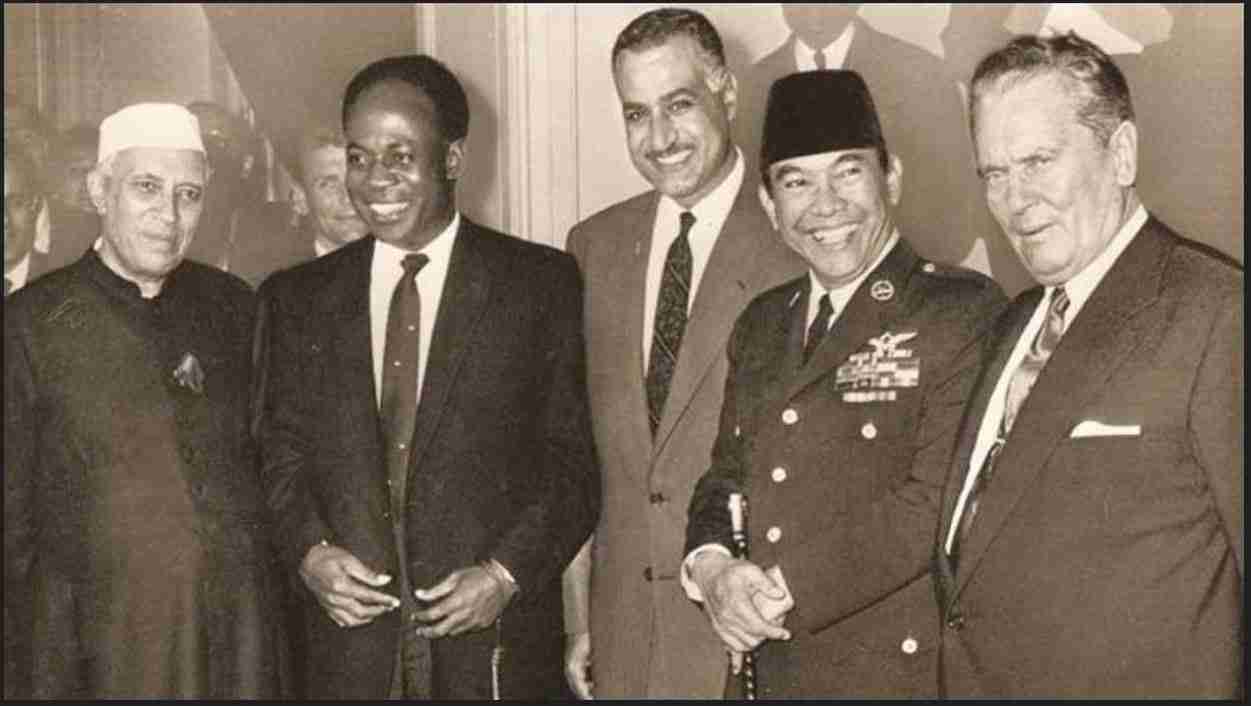
- NAM was associated with five major leaders:
- Jawaharlal Nehru – India
- Gamal Abdel Nasser – Egypt
- Sukarno – Indonesia
- Kwame Nkrumah – Ghana
- Josip Broz Tito – Yugoslavia
- The first NAM Summit was held at Belgrade in 1961.
Importance of NAM for India
- It allowed India to pursue an independent foreign policy.
- It enabled India to balance relations with the two superpowers.
- It reduced pressure to automatically support either bloc.
- It reinforced the principle that every sovereign state has the right to formulate an independent foreign policy.
- NAM also supported the democratisation of international institutions and greater representation for developing countries in organisations such as the UN, WTO and World Bank.
Kashmir Issue
- Kashmir became one of the most important factors shaping India-Pakistan relations and India’s security policy.
- The dispute also contributed to the extension of Cold War politics into South Asia.
- India referred the issue to the United Nations.
- The UN Security Council proposed mechanisms including India-Pakistan negotiations and a plebiscite.
- India subsequently opposed:
- External intervention in the Kashmir dispute.
- The proposed plebiscite under the prevailing circumstances.
- Kashmir consequently remained a major determinant of India’s defence and external relations.
Indo-China Relations under Nehru
- Nehru initially believed that India and China possessed several common experiences:
- Both were ancient Asian civilisations.
- Both had suffered under foreign domination.
- Both faced poverty and underdevelopment.
- India therefore hoped that cooperation between the two countries could contribute to an Asian resurgence.
- India also supported China’s representation in the United Nations Security Council.
- During the Korean War, India refused to support the US position declaring China an aggressor.
Tibetan Crisis
- After the Chinese Revolution of 1949, China asserted its claim over Tibet.
- In 1950, Chinese forces entered eastern Tibet and occupied Chamdo.
- India protested but also attempted mediation.
- Under the 1954 Panchsheel Agreement, India relinquished several privileges in Tibet inherited from the British period and recognised China’s position regarding Tibet.
- China indicated that Tibet would receive considerable autonomy, although this expectation was not realised.
1962 India-China War
- The conflict primarily emerged from an unresolved boundary dispute.
- Two major factors were:
- Chinese control over Tibet eliminated the traditional buffer between India and China.
- China rejected the McMahon Line as the boundary in the eastern sector.
- India later discovered that China had constructed a strategic highway through Aksai Chin.
- China also began depicting disputed territory as part of China in its maps.
- Relations deteriorated further after India granted asylum to the Dalai Lama.
- In 1962, China launched attacks in Aksai Chin and NEFA.
- After the conflict:
- China retained control over Aksai Chin.
- NEFA remained under Indian control.
- India substantially increased its defence expenditure.
- India’s perceptions of China underwent a major strategic transformation.
Foreign Policy under Lal Bahadur Shastri
- Lal Bahadur Shastri became Prime Minister after Nehru.
- He broadly continued India’s commitment to Non-Alignment.
- At the same time, India developed closer relations with the Soviet Union.
Sirima-Shastri Pact, 1964
- The agreement attempted to settle the problem of people of Indian origin in Ceylon/Sri Lanka.
- Under the agreement:
- 525,000 were to be repatriated to India.
- 300,000 were to receive Sri Lankan citizenship.
- The agreement helped address a long-standing source of friction between India and Sri Lanka.
China’s Nuclear Test, 1964
- China conducted its first atomic bomb test during Shastri’s tenure.
- China’s emergence as a nuclear power created considerable security concerns in India and South Asia.
- It also strengthened domestic arguments favouring the development of an Indian nuclear capability.
India-Pakistan War, 1965
- The 1965 India-Pakistan War became a major test of India’s post-Nehru foreign and security policy.
- Kashmir remained the central source of disagreement.
- Important factors behind the conflict included:
- Political instability and unrest in Kashmir.
- Pakistan’s acquisition of advanced US-supplied military equipment.
- Pakistan’s belief that India remained militarily vulnerable after the 1962 China war.
- Growing China-Pakistan strategic cooperation.
Tashkent Declaration
- The Tashkent Declaration was concluded between India and Pakistan with Soviet mediation.
- Both countries agreed to:
- Withdraw to pre-war positions.
- Repatriate prisoners of war.
- Avoid the use of force.
- Resolve disputes through peaceful means.
- However, the agreement failed to resolve the Kashmir dispute.
Foreign Policy under Indira Gandhi
- Indira Gandhi broadly continued Non-Alignment, but her approach was comparatively more pragmatic and realist.
- Her foreign policy sought to restore and strengthen India’s international position.
- Her period witnessed India’s emergence as an increasingly important regional power.
Bangladesh Crisis
- In Pakistan’s 1970 elections, Sheikh Mujibur Rahman’s Awami League emerged dominant in East Pakistan.
- Pakistan’s military establishment refused to transfer power.
- A military crackdown in East Pakistan triggered:
- Political resistance.
- Large-scale violence.
- Massive refugee flows into India.
- India provided moral and material assistance to the Bangladesh liberation struggle.
- The US and China supported Pakistan.
- To strengthen its strategic position, India signed the Indo-Soviet Treaty of Peace, Friendship and Cooperation.
- The conflict ultimately resulted in:
- Surrender of around 90,000 Pakistani troops.
- Creation of Bangladesh.
- Emergence of India as a stronger regional power.
- Return of millions of refugees.
- Significant enhancement of India’s international prestige.

Shimla Agreement, 1972
- The agreement was signed between Indira Gandhi and Zulfikar Ali Bhutto.
- Major outcomes included:
- India returned most Pakistani territory captured during the war.
- Pakistan agreed to respect the Line of Control (LoC).
- Both countries agreed to resolve their disputes bilaterally.
- India agreed to return Pakistani prisoners of war, subject to arrangements involving Bangladesh.
Indo-Soviet Relations
- Strategic pressures from China and Pakistan, combined with US support for Pakistan, pushed India closer to the Soviet Union.
- The USSR became an important:
- Defence partner.
- Supplier of sophisticated military equipment.
- Economic partner.
- Supporter of India’s position on Kashmir.
Indo-Soviet Treaty, 1971
- India and the USSR signed a 20-year Treaty of Peace, Friendship and Cooperation.
- It substantially strengthened the strategic relationship.
- The Soviet Union later supported:
- India’s approach towards the Shimla Agreement.
- Bilateral settlement of India-Pakistan disputes.
- India’s proposal for the Indian Ocean as a Zone of Peace.
Relations with the USA
- India-US relations initially deteriorated because of:
- US support for Pakistan during the Bangladesh crisis.
- American arms supplies to Pakistan.
- US rapprochement with China.
- Development of the US military base at Diego Garcia.
- American criticism of India’s 1974 nuclear test.
- Relations subsequently improved in areas including:
- Trade
- Science and technology
- IMF-related support
- Fuel supply for the Tarapur Nuclear Plant
Foreign Policy under Rajiv Gandhi
- Rajiv Gandhi broadly maintained continuity with the foreign-policy principles of Nehru and Indira Gandhi, while introducing greater flexibility.
- His major priorities included:
- World peace
- Non-Alignment
- Nuclear disarmament
- Peaceful coexistence
- Better international economic order
- Cooperation with neighbouring countries
- His government also moved towards closer engagement with the West for advanced technology.
Nuclear Disarmament
- Rajiv Gandhi strongly advocated global nuclear disarmament.
- He favoured:
- Complete elimination of nuclear weapons.
- A time-bound disarmament programme.
- Participation of all nuclear powers.
- Replacement of nuclear deterrence with peaceful coexistence.
Commitment to NAM
- Rajiv Gandhi reaffirmed India’s commitment to NAM in 1985.
- He sought to make NAM more responsive to:
- Economic inequalities
- Racialism
- Colonialism
- Development challenges
- Environmental concerns.
Strengthening SAARC
- Rajiv Gandhi regarded SAARC as an opportunity to promote regional cooperation.
- He emphasised:
- Collective self-reliance
- Multilateralism
- Economic and cultural cooperation
- Technical collaboration among South Asian countries.
Indo-Sri Lanka Accord, 1987
- The Indo-Sri Lanka Accord was signed by Rajiv Gandhi and J.R. Jayewardene on 29 July 1987.
- India subsequently deployed the Indian Peace Keeping Force (IPKF) in Sri Lanka.
- The IPKF encountered strong resistance, particularly from the LTTE.
- It was eventually withdrawn under Prime Minister V.P. Singh in March 1990.
Foreign Policy under P.V. Narasimha Rao
- The end of the Cold War in 1991 fundamentally transformed India’s strategic environment.
- The collapse of the Soviet Union ended the bipolar world order, while the USA emerged as the dominant global power.
- Narasimha Rao therefore sought to restructure India’s foreign policy around:
- Economic reforms
- Global economic integration
- Improved relations with major powers
- Engagement with new strategic partners
- India expanded relations with:
- USA
- European Union
- Russia
- China
- Japan
- Israel
- Brazil
- South Africa
- Southeast Asian countries.
Liberalisation and Foreign Policy
- The 1991 Balance of Payments crisis accelerated economic reforms.
- The New Economic Policy opened the Indian economy to global trade and investment.
- Economic considerations consequently became an increasingly important component of Indian diplomacy.
Impact of the End of Bipolarity
- The disintegration of the USSR created uncertainties regarding:
- Defence supplies
- Spare parts
- Diplomatic support
- India’s strategic balance against the US and other powers.
- India responded by adopting a more pragmatic and diversified foreign policy.
- Economic and military capabilities became increasingly important instruments of foreign policy.
- India’s growing economic weight strengthened its influence in institutions such as the WTO and G20.
Look East Policy
- The Look East Policy (LEP) was initiated under P.V. Narasimha Rao in the early 1990s.
- Its objective was to deepen India’s engagement with Southeast Asia and ASEAN.
- Major areas included:
- Trade and investment
- Connectivity
- Maritime security
- Strategic cooperation.
Reasons for Look East Policy
- Countering China’s economic influence in Southeast Asia.
- Finding new markets for India’s expanding middle class, workforce and products.
- Diversifying India’s economic engagement beyond the politically unstable regions of West and Central Asia.
Foreign Policy under I.K. Gujral
Gujral Doctrine
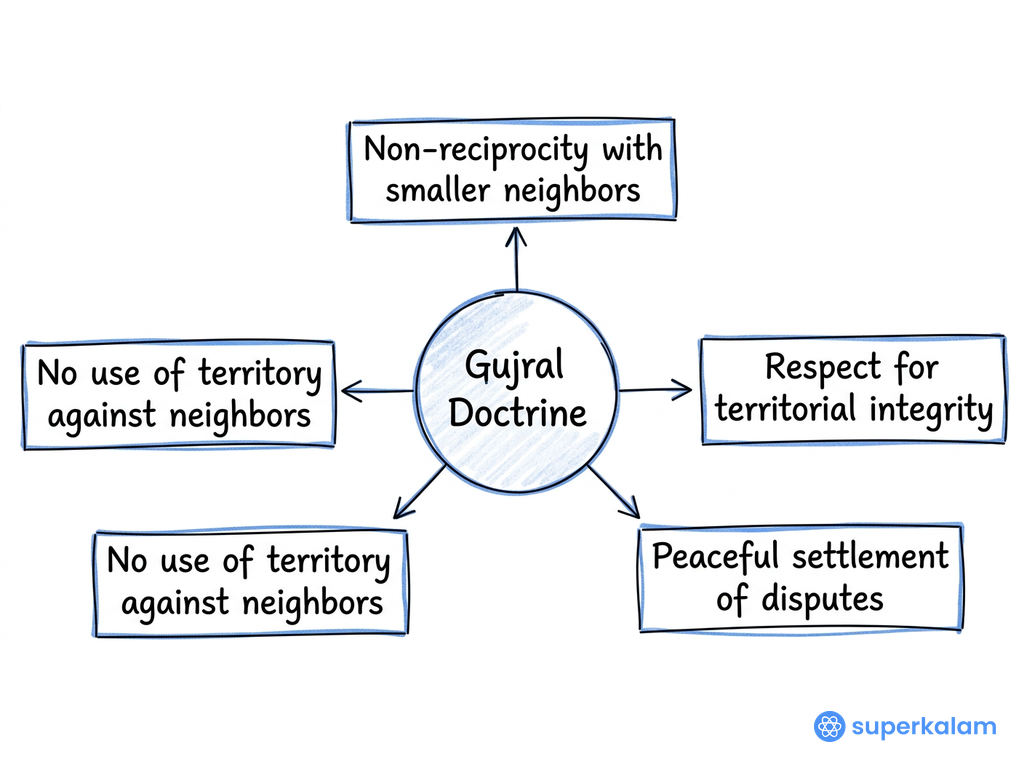
- The Gujral Doctrine focused on improving India’s relations with its immediate neighbours, particularly smaller South Asian states.
- It was based on five principles:
- India should not insist on reciprocity from smaller neighbours and should provide assistance in good faith.
- No South Asian country should allow its territory to be used against another country.
- Countries should not interfere in one another’s internal affairs.
- All countries should respect each other’s territorial integrity and sovereignty.
- Bilateral disputes should be settled through mutual negotiations without third-party interference.
Foreign Policy under Atal Bihari Vajpayee
Pokhran-II Nuclear Tests, 1998
- India opposed the discriminatory nature of the global nuclear non-proliferation regime.
- India:
- Opposed the indefinite extension of the NPT.
- Refused to sign the CTBT.
- Conducted a series of nuclear tests in May 1998.
- Pakistan subsequently conducted its own nuclear tests.
- India faced international criticism and economic sanctions.
- India’s nuclear doctrine emphasised:
- Credible Minimum Deterrence
- No First Use
- Commitment to universal and non-discriminatory nuclear disarmament.

Bus Diplomacy and Lahore Declaration
- Vajpayee initiated a Delhi-Lahore bus service to strengthen people-to-people relations.
- Vajpayee personally travelled to Lahore.
- The Lahore Declaration was signed on 21 February 1999.
- India and Pakistan committed themselves to:
- Peaceful coexistence.
- Implementation of the Shimla Agreement.
- Nuclear confidence-building measures.
- Nuclear disarmament and non-proliferation.
- Peaceful settlement of outstanding disputes.

Kargil Conflict
- Pakistani intrusions across the LoC led India to launch Operation Vijay.
- India maintained diplomatic communication with major powers.
- The United States called for the withdrawal of Pakistani intruders.
- India’s restraint during the operation helped it gain significant international diplomatic support.
Foreign Policy under Manmohan Singh
- Under Manmohan Singh, Indian diplomacy became increasingly outward-looking, economically integrated and pragmatic.
- Economic development became a major driver of India’s external relations.
Relations with Russia
- India and Russia strengthened their strategic partnership.
- Major areas of cooperation included:
- BrahMos cruise missile
- Military technology
- Combat aircraft
- Anti-tank missiles
- Civilian nuclear energy
- Kudankulam nuclear reactors
- Economic cooperation.
Relations with the USA
- India-US relations witnessed a significant transformation.
- Factors encouraging closer relations included:
- India’s economic liberalisation.
- Need to manage the rise of China.
- Counterterrorism cooperation.
- India’s growing economic and strategic importance.
India-US Civil Nuclear Deal
- The agreement sought to:
- Remove long-standing strategic differences.
- Support India’s energy security and economic development.
- Strengthen the global nuclear non-proliferation system.
- It ended the long-standing US restrictions on civilian nuclear trade with India.
- India agreed to place designated civilian nuclear facilities under IAEA safeguards.
- In 2008, the IAEA approved India’s safeguards agreement, paving the way for the NSG exemption.
Manmohan Doctrine
- India’s developmental priorities should guide foreign policy.
- India should pursue greater integration with the global economy.
- Stable and mutually beneficial relations should be maintained with all major powers.
- Greater regional cooperation and connectivity should be promoted.
- India’s foreign policy should reflect both national interests and national values.
Foreign Policy under Narendra Modi
- Modi’s foreign policy began with a strong emphasis on Neighbourhood First, symbolised by inviting SAARC leaders to his first swearing-in ceremony.
- Foreign policy increasingly focused on:
- Foreign investment
- Technology
- Global markets
- Regional stability
- National security
- Soft power.
- The 4 Ds — Democracy, Demography, Demand and Diaspora — were projected as important strengths of India’s global engagement.
- A major objective has been to transform India from a “balancing power” into a “leading power.”
India First
- India First places national interest at the centre of foreign-policy decision-making.
- It combines:
- Realism
- Cooperation
- Coexistence
- Partnership
- National capabilities.
- It is also linked with the civilisational principle of Vasudhaiva Kutumbakam — “the world is one family.”
Neighbourhood First Policy
- Gives priority to developing a peaceful, prosperous, connected and integrated neighbourhood.
- Major areas include:
- Connectivity
- Development cooperation
- Trade
- Political engagement
- People-to-people contacts.
Cultural Diplomacy and Soft Power
- India increasingly uses its civilisational and cultural heritage as a diplomatic resource.
- Important instruments include:
- Yoga
- Buddhism
- Indian traditions
- International Solar Alliance
- Cultural exchanges
- Digital and social-media diplomacy.
Indian Diaspora
- The Indian diaspora is viewed as an important strategic and soft-power asset.
- Engagement with the diaspora can promote:
- Trade
- Investment
- Technology transfer
- Cultural exchange
- Political goodwill.
- The government has also emphasised rapid assistance to Indians in distress abroad.
India-US Relations
- India-US cooperation expanded in both civil nuclear and defence sectors.
- Important defence agreements included:
- LEMOA – 2016
- COMCASA – 2018
- These agreements strengthened military interoperability and access to advanced defence technology.
Look East to Act East
- The Look East Policy was upgraded to Act East Policy to demonstrate greater strategic intent.
- Act East has three major dimensions:
- Institutional
- Commercial
- Security
- India expanded engagement through:
- ASEAN
- BIMSTEC
- East Asia Summit
- India-Myanmar-Thailand Highway
- Maritime and security cooperation.
SAGAR Vision
- SAGAR – Security and Growth for All in the Region represents India’s approach towards maritime cooperation in the Indian Ocean Region (IOR).
- It was announced in 2015.
Major Components of SAGAR
- Security → strengthening coastal and maritime security.
- Capacity Building → expanding economic and security cooperation.
- Collective Action → tackling piracy, terrorism and natural disasters.
- Sustainable Development → promoting regional prosperity.
- Maritime Engagement → strengthening trust and respect for maritime rules.
Need for SAGAR
- Blue Economy
- Maritime resources can support:
- Livelihoods
- Energy security
- Trade
- Connectivity
- Renewable energy
- Marine-resource development.
- Maritime resources can support:
- Regional Security
- Greater cooperation is required for:
- Humanitarian assistance
- Disaster relief
- Counter-piracy
- Counterterrorism.
- Greater cooperation is required for:
- Managing China’s Maritime Influence
- China’s expanding presence in the IOR and the “String of Pearls” have created strategic concerns for India.
- Blue Economy
Significance of SAGAR
- Strengthens India’s partnerships with Indian Ocean littoral states.
- Reinforces India’s role as a regional security provider.
- Complements:
- Act East Policy
- Sagarmala
- Project Mausam
- Blue Economy initiatives.
- Reflects the growing importance of the maritime domain in Indian foreign policy.
India’s Foreign Policy Challenges
Peaceful and Stable Neighbourhood
- India’s domestic development requires a peaceful and prosperous neighbourhood.
- India needs stronger political, economic and cultural interdependence with neighbouring countries.
Managing Major Powers
- The international system is becoming increasingly multipolar.
- India must simultaneously manage relations with:
- USA
- China
- Russia
- European powers
- Other emerging powers.
- The challenge is to preserve strategic autonomy without alienating major partners.
China Challenge
- China’s rise presents both strategic and territorial challenges.
- Major issues include:
- Border dispute
- Doklam
- Galwan
- Indian Ocean competition
- China’s relationship with Pakistan.
Terrorism and Extremism
- Cross-border terrorism remains a significant security concern.
- India requires stronger:
- Intelligence sharing
- Counterterrorism cooperation
- Diplomatic coordination.
Economic and Trade Challenges
- India’s external economic interests are affected by:
- Protectionism
- Tariffs
- Trade barriers
- Global economic instability.
- Economic diplomacy is therefore increasingly important for protecting Indian exports, investments and market access.
Non-Traditional Security Challenges
- Foreign policy must increasingly address:
- Climate change
- Cybersecurity
- Pandemics
- Critical technologies
- Energy security
- Critical minerals.
Strategic Autonomy
- India’s close relations with different and sometimes competing powers create diplomatic complexity.
- Maintaining relations with Russia while deepening ties with the US and Europe is one major example.
- India’s approach therefore continues to emphasise issue-based partnerships and strategic autonomy.
India’s multiangle Diploacy
Cultural Diplomacy
- Cultural diplomacy means using a country’s culture and civilisational assets to advance foreign-policy objectives.
- It strengthens international relations by promoting understanding, respect and people-to-people connections.
Significance of Cultural Diplomacy
- Improves the country’s international image.
- Creates a foundation of trust between societies.
- Facilitates future political, economic and strategic cooperation.
- Encourages mutual understanding and reduces cultural differences.
- Important instruments include:
- Scholarships
- Academic exchanges
- Cultural festivals
- Artist exchanges
- Conferences and seminars.
India’s Cultural Diplomacy and Soft Power
- India established the Indian Council for Cultural Relations (ICCR) in 1950.
- ICCR promotes Indian culture through:
- Cultural centres
- Festivals of India
- Academic chairs
- Cultural exchanges.
- Major Indian soft-power resources include:
- Yoga
- Ayurveda
- Buddhism
- Bollywood
- Indian cuisine
- Indian philosophy
- Indian diaspora.
- Pravasi Bharatiya Divas and the Know India Programme strengthen India’s engagement with its diaspora.
- The adoption of 21 June as International Day of Yoga significantly expanded India’s cultural influence.
Sports Diplomacy
- Sports diplomacy refers to using sports to influence diplomatic, social and political relations.
- In South Asia, cricket diplomacy has frequently been used in India-Pakistan relations.
- Important examples include:
- Zia-ul-Haq’s 1987 cricket-for-peace initiative.
- Vajpayee-era cricket engagement.
- Manmohan Singh–Pervez Musharraf cricket diplomacy in 2005.
- Sports diplomacy can:
- Reduce political tension.
- Facilitate informal dialogue.
- Promote people-to-people contact.
- Generate goodwill.
- Create favourable conditions for formal negotiations.
Space Diplomacy
- Space diplomacy involves using space technology and cooperation to advance diplomatic relations and national interests.
- India’s space diplomacy is largely carried out through ISRO.
Major Dimensions
- Satellite and Rocket Cooperation
- Cooperation with international space agencies in satellite development and launch technologies.
- Satellite Communication
- India’s South Asia Satellite was designed to strengthen communication and disaster-management capabilities among neighbouring countries.
- Disaster Management
- Satellite data is shared for search, rescue and disaster-management operations.
- Satellite Navigation
- NavIC can provide navigation and location-based services.
- Capacity Building
- India provides training in remote sensing and space technology to professionals from other countries.
- Space cooperation enhances India’s reputation as a major space power while generating international goodwill and strengthening its soft power.
- Satellite and Rocket Cooperation
Economic Diplomacy
- Economic diplomacy refers to using economic instruments to advance national interests and foreign-policy objectives.
- Major instruments include:
- Exports and imports
- Investment
- Foreign aid
- Lending
- Free Trade Agreements
- Infrastructure projects.
- After the 1991 economic reforms, economic diplomacy became increasingly important.
- Major priorities now include:
- Market access
- Energy security
- Regional economic integration
- Foreign investment
- Connectivity.
- India’s Act East Policy has a strong economic component involving ASEAN and regional connectivity projects.
- India also uses platforms such as the WTO to protect national interests on issues including MSP, agricultural subsidies and public stockholding.
- Thus, economic diplomacy connects India’s domestic development objectives with its international engagement.
Defence Diplomacy
- Defence diplomacy refers to military activities undertaken primarily to promote strategic cooperation, mutual confidence and diplomatic goodwill.
Major Instruments of Defence Diplomacy
- Military training programmes.
- Training of foreign military personnel.
- Deployment of military advisers.
- Naval ship and aircraft visits.
- High-level defence visits.
- Staff talks and defence dialogues.
- Conferences and seminars.
- Joint military exercises.
- India has used defence diplomacy since Independence to strengthen its international partnerships.
- India’s military experience in areas such as mountain warfare, counter-insurgency and counterterrorism has supported training partnerships with other countries.
- Defence relations with countries such as Russia, France, Israel and the USA demonstrate India’s preference for strategic autonomy and diversified partnerships.
India’s Contemporary Security Challenges
- India’s contemporary security environment is shaped by a combination of traditional and non-traditional threats.
Cross-Border Terrorism
- Terrorism originating from across India’s borders remains an important national-security challenge.
- It has particularly affected Jammu & Kashmir.
International Terrorism
- India has faced multiple forms of terrorist violence targeting:
- Civilian centres
- Economic infrastructure
- Places of worship
- Public institutions.
Maritime Security
- The growing strategic importance of the Indo-Pacific and Indian Ocean Region has increased India’s maritime-security responsibilities.
- Major challenges include:
- Piracy
- Terrorism
- Presence of extra-regional powers
- Security of sea lanes
- Freedom of navigation.
Cybersecurity
- Cyberspace has emerged as a new domain of warfare.
- Growing digitalisation increases vulnerability to:
- Malware
- Ransomware
- Cyber espionage
- Attacks on critical infrastructure.
Drug Trafficking
- India’s location between the Golden Triangle and Golden Crescent increases its vulnerability to illegal drug trafficking.
- Drug trafficking also creates wider challenges related to organised crime, terrorism and youth drug abuse.
Nuclear Threat
- India’s security environment is affected by the nuclear capabilities of Pakistan and China.
- India maintains a doctrine centred on nuclear deterrence and No First Use, while continuing to face the challenge of maintaining credible deterrence in an evolving regional security environment.