
Table of Contents
ToggleRocks
- Rocks are naturally occurring solid aggregates of one or more minerals that constitute the Earth’s crust.
- They form the fundamental building blocks of the Earth’s lithosphere.
- Most rocks are composed of minerals, although a few, such as Coal and Obsidian, are composed predominantly of non-mineral substances or volcanic glass.
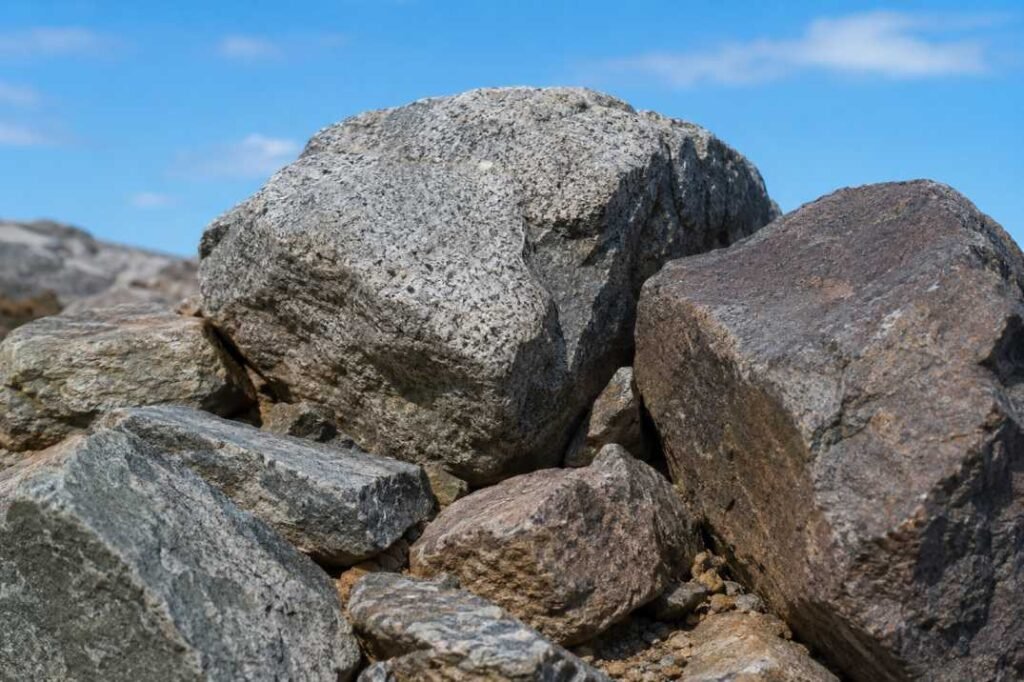
Relationship between Rocks and Minerals
- A Mineral is a naturally occurring inorganic substance with a definite chemical composition and crystalline structure.
- A Rock is an aggregate of one or more minerals.
- The same type of rock may exhibit variations in mineral composition depending on its place of formation.
- Minerals are extracted from rocks through mining and are valuable sources of metals and industrial raw materials.
Characteristics of Rocks
- Rocks may be hard (Granite) or soft (Shale).
- They may be porous or non-porous.
- They can be layered or massive.
- Rocks are continuously transformed from one type to another through the Rock Cycle.
Classification of Rocks
Based on their mode of origin, rocks are classified into three major types:
- Igneous Rocks
- Sedimentary Rocks
- Metamorphic Rocks
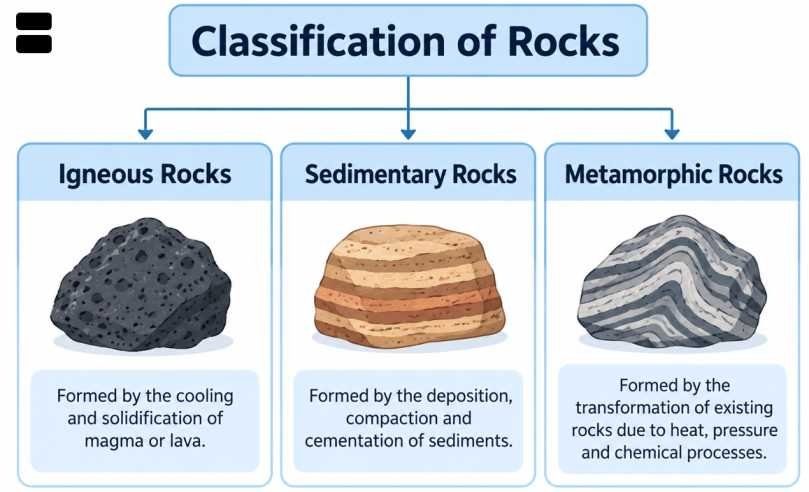
Igneous Rocks
- Igneous Rocks are formed by the cooling and solidification of molten magma or lava.
- They are also known as Primary Rocks because they were the first rocks to form during the cooling of the early Earth.
Formation
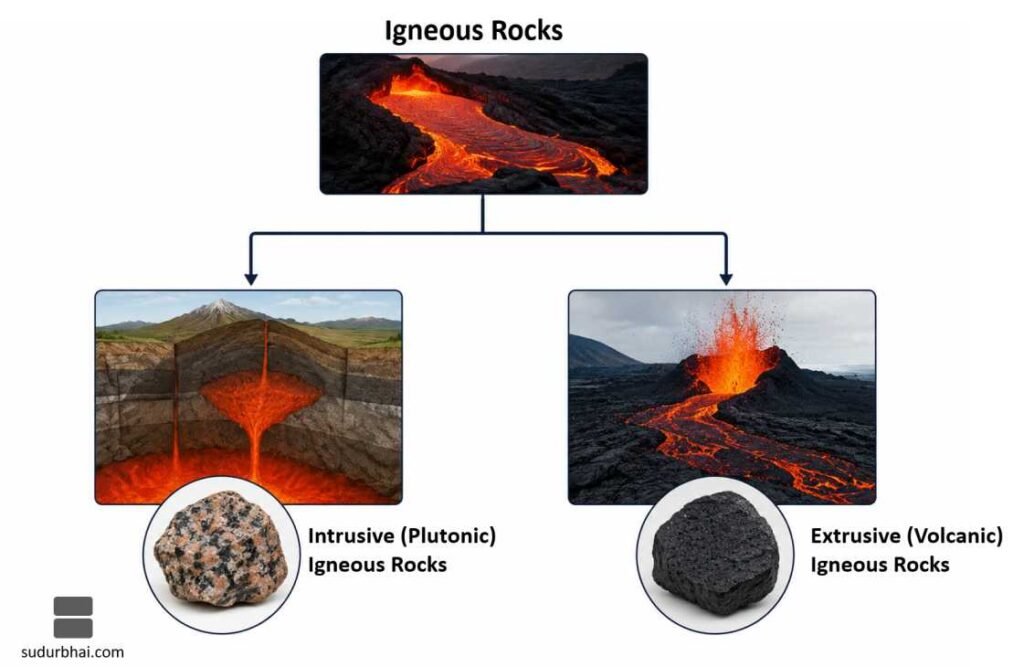
Igneous rocks originate in two ways:
- Cooling of Magma beneath the Earth’s surface.
- Cooling of Lava after volcanic eruptions on the Earth’s surface.
Characteristics
- Generally hard, compact, and crystalline.
- Non-layered or massive in structure.
- Do not contain fossils.
- Highly resistant to weathering.
- Rich in silicate minerals.
- Form many of the Earth’s mountain ranges and plateaus.
Types of Igneous Rocks
Intrusive (Plutonic) Igneous Rocks
- Form when magma cools slowly beneath the Earth’s surface.
- Slow cooling produces large crystals.
- Usually coarse-grained.
- Examples
- Granite
- Gabbro
- Diorite
Extrusive (Volcanic) Igneous Rocks
- Form when lava cools rapidly on the Earth’s surface.
- Rapid cooling results in fine-grained or glassy texture.
- Examples
- Basalt
- Obsidian
- Pumice
- Andesite
- Rhyolite
Composition of Igneous Rocks
Depending on silica content:
| Type | Silica Content | Examples |
|---|---|---|
| Acidic Rocks | More than 65% | Granite, Rhyolite |
| Intermediate Rocks | 55–65% | Diorite, Andesite |
| Basic Rocks | 45–55% | Basalt, Gabbro |
| Ultrabasic Rocks | Less than 45% | Peridotite |
Distribution of Igneous rocks in India
- The Deccan Plateau is largely composed of Basalt, formed by extensive volcanic eruptions known as the Deccan Traps.
Economic Importance of Igneous rocks
- Source of building stones.
- Rich in metallic minerals.
- Used in road construction, monuments, and engineering works.
Sedimentary Rocks
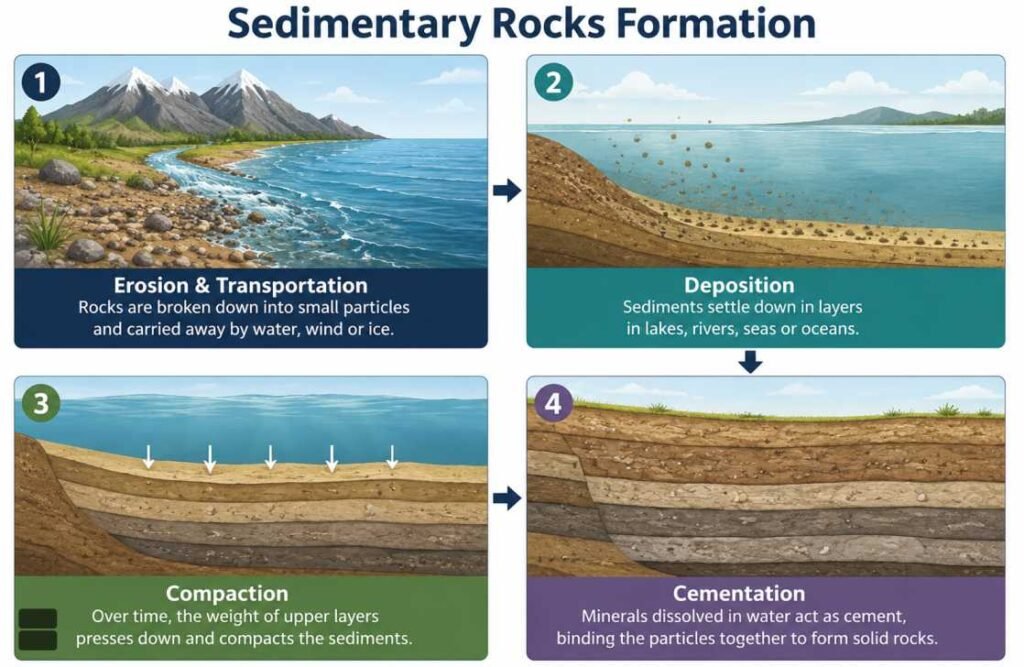
- Sedimentary Rocks are formed through the deposition, compaction, and cementation of sediments over millions of years.
- This process is collectively known as Lithification.
Formation Process of Sedimentary Rocks
The formation involves:
- Weathering
- Erosion
- Transportation
- Deposition
- Compaction
- Cementation
Characteristics of Sedimentary Rocks
- Usually layered (Stratified).
- Contain fossils of plants and animals.
- Comparatively softer than igneous rocks.
- Highly susceptible to weathering and erosion.
- Occupy nearly 75% of the Earth’s land surface, although they account for only about 5% of the crust’s volume.
Types of Sedimentary Rocks
Clastic Sedimentary Rocks
- Formed from fragments of pre-existing rocks.
- Examples:
- Sandstone
- Conglomerate
- Shale
Chemical Sedimentary Rocks
- Formed through precipitation of dissolved minerals.
- Examples:
- Rock Salt
- Gypsum
- Limestone (Chemical Origin)
Organic Sedimentary Rocks
- Formed from remains of plants and animals.
- Examples:
- Coal
- Chalk
- Coral Limestone
Common Sedimentary Rocks
| Rock | Important Characteristics |
|---|---|
| Sandstone | Formed mainly from sand-sized particles |
| Limestone | Rich in Calcium Carbonate |
| Shale | Fine-grained clay-rich rock |
| Coal | Organic sedimentary rock |
| Conglomerate | Rounded pebbles cemented together |
Economic Importance of Sedimentary Rocks
- Major source of Coal, Petroleum, and Natural Gas.
- Preserve Fossils used in geological history.
- Important for Groundwater Storage.
- Extensively used in the Cement Industry.
Metamorphic Rocks
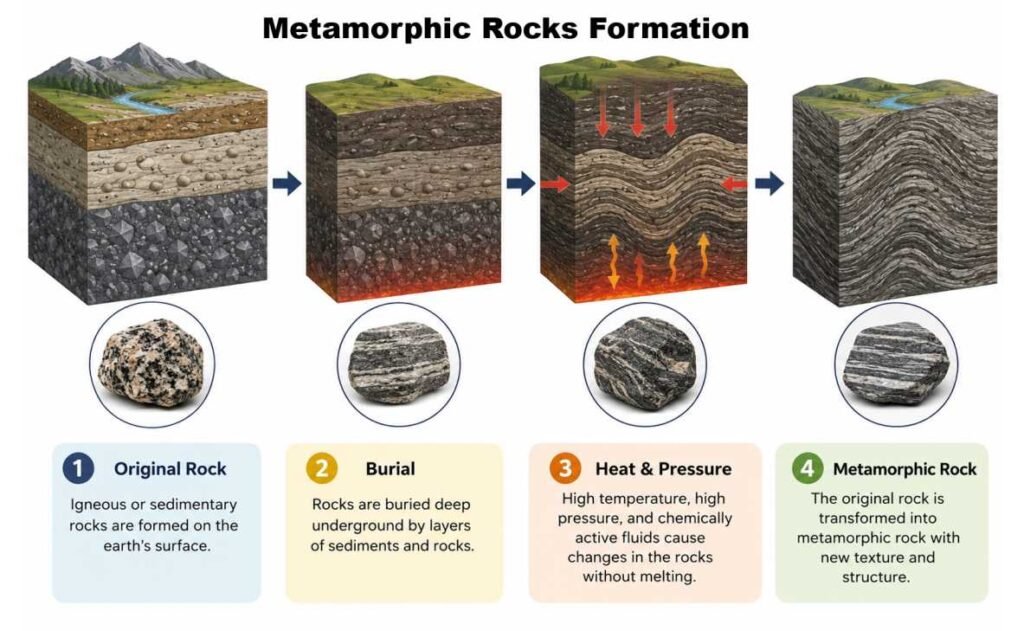
- Metamorphic Rocks are formed when pre-existing Igneous or Sedimentary Rocks undergo transformation due to high temperature, high pressure, and chemically active fluids, without melting.
- The transformation process is known as Metamorphism.
Causes of Metamorphism
- High Temperature
- High Pressure
- Tectonic Compression
- Magma Intrusion
- Chemically Active Fluids
Characteristics of Metamorphic Rocks
- Usually hard, dense, and compact.
- May exhibit foliation (layered appearance).
- Original minerals are recrystallized.
- Fossils, if present originally, are generally destroyed.
- Possess excellent decorative and constructional value.
Types of Metamorphism
Contact Metamorphism
- Caused mainly by heat from nearby magma.
Regional Metamorphism
- Occurs over large regions due to tectonic pressure and temperature.
Dynamic Metamorphism
- Caused primarily by intense tectonic stress along fault zones.
Common Metamorphic Rocks
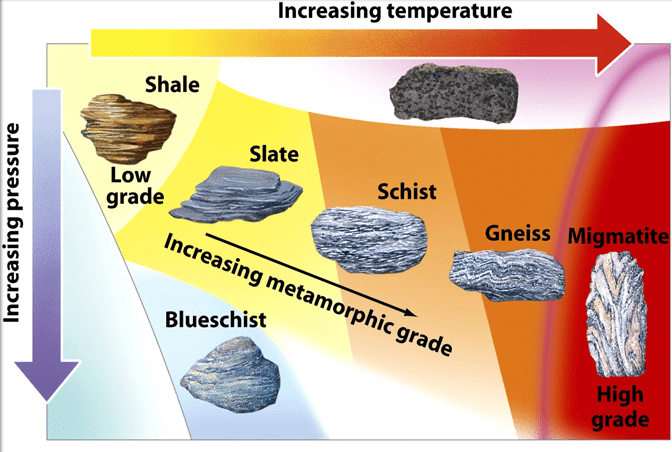
| Original Rock | Metamorphic Rock |
|---|---|
| Granite | Gneiss |
| Basalt | Amphibolite |
| Limestone | Marble |
| Sandstone | Quartzite |
| Shale | Slate |
| Slate | Phyllite |
| Phyllite | Schist |
| Schist | Gneiss |
| Coal | Anthracite |
| Graphite | Diamond (under extreme pressure and temperature over geological time) |
Economic Importance of Metamorphic Rocks
- Marble is widely used in architecture and sculpture.
- Slate is used for roofing and blackboards.
- Quartzite serves as an important construction material.
- Gneiss is commonly used as a building stone.
Rock Cycle
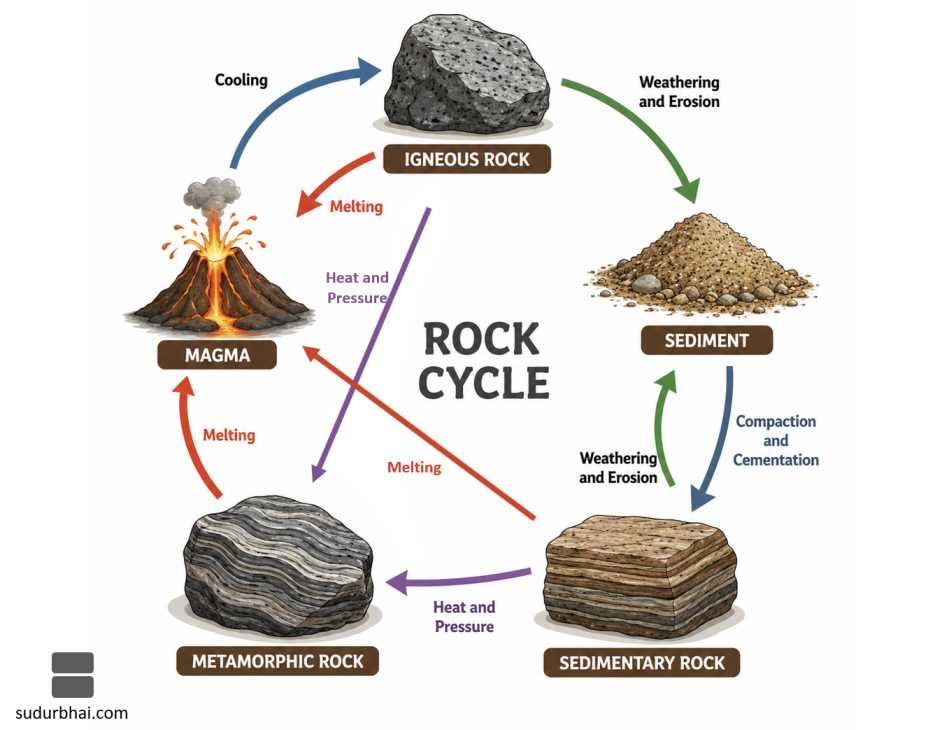
- The Rock Cycle is the continuous natural process through which Igneous, Sedimentary, and Metamorphic Rocks are transformed into one another over geological time.
Stages of the Rock Cycle
- Magma cools to form Igneous Rocks.
- Igneous rocks undergo Weathering, Erosion, and Deposition to form Sediments.
- Sediments are Compacted and Cemented into Sedimentary Rocks.
- Sedimentary and Igneous rocks undergo Metamorphism to become Metamorphic Rocks.
- Metamorphic rocks melt into Magma, completing the cycle.
Comparative Study of Rocks
| Feature | Igneous Rocks | Sedimentary Rocks | Metamorphic Rocks |
|---|---|---|---|
| Origin | Cooling of Magma/Lava | Deposition of Sediments | Transformation of Existing Rocks |
| Structure | Massive | Layered | Foliated or Massive |
| Fossils | Absent | Common | Usually Absent |
| Texture | Crystalline | Stratified | Recrystallized |
| Hardness | Generally Hard | Comparatively Soft | Very Hard |
| Examples | Granite, Basalt | Sandstone, Limestone, Coal | Marble, Slate, Gneiss, Quartzite |