
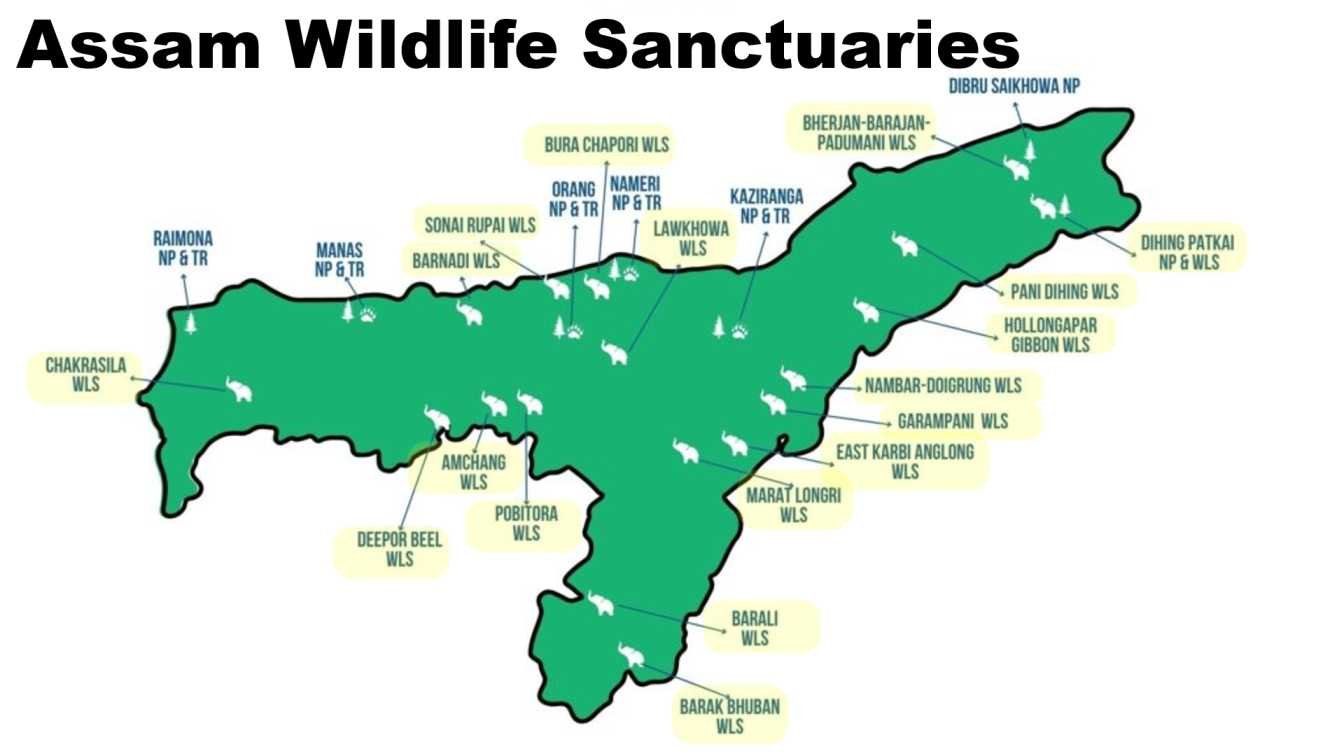
Wildlife Sanctuaries in Assam

Wildlife sanctuaries in Assam are dynamic ecological systems shaped by rivers, climate, forests, and human activity.

Wildlife Sanctuaries in Assam represent protected natural areas created by the government under the Wildlife Protection Act 1972 to safeguard wild animals plants and their habitats from hunting poaching and other human disturbances.

These sanctuaries play a crucial role in conserving Assam’s rich biodiversity which includes endangered species like the one horned rhinoceros and unique primates while also supporting local ecosystems such as wetlands grasslands and forests that help maintain ecological balance flood control and tourism.

Assam has 18 notified wildlife sanctuaries covering a total area of around 1924 square kilometers making the state one of the key biodiversity hotspots in India.


Wildlife SanctuaryDistrict(s)Year of Establishment
Garampani Wildlife SanctuaryKarbi Anglong1952
Laokhowa Wildlife SanctuaryNagaon1979
Bornadi Wildlife SanctuaryUdalguri (parts in Baksa)1980
Chakrasila Wildlife SanctuaryKokrajhar (parts in Dhubri)1994
Burachapori Wildlife SanctuarySonitpur1995
Pani-Dihing Bird Wildlife SanctuarySivasagar (Sibasagar)1995
Hoollongapar Gibbon Wildlife SanctuaryJorhat1997
Pobitora Wildlife SanctuaryMorigaon1998 (or 1987 in some sources)
Sonai Rupai Wildlife SanctuarySonitpur1998
Bherjan-Borajan-Padumoni Wildlife SanctuaryTinsukia1999
East Karbi Anglong Wildlife SanctuaryKarbi Anglong2000
Nambor Wildlife SanctuaryKarbi Anglong / Golaghat2000
Marat Longri Wildlife SanctuaryKarbi Anglong2003
Nambor-Doigrung Wildlife SanctuaryGolaghat2003
Amchang Wildlife SanctuaryKamrup Metro2004
Borail Wildlife SanctuaryCachar & Karimganj (parts in Dima Hasao)2004
Deepor Beel Wildlife SanctuaryKamrup Metro1989
Assam Wildlife Sanctuaries

These sanctuaries together form a strong network under the Assam Forest Department helping in species recovery habitat restoration and eco tourism while facing challenges like human wildlife conflict and habitat loss.

Leave a Comment

Your email address will not be published. Required fields are marked *

Scroll to Top