
What is Wind
Wind is the movement of air across the Earth’s surface, mainly driven by differences in temperature and pressure. When one area becomes warmer, the air rises and creates a low-pressure zone, while cooler areas form high-pressure zones. Air moves between these zones, creating wind.
Types of Wind
Winds can be classified into three main categories based on their behavior and scale:
- Primary (Permanent or Planetary) Winds
- Secondary (Periodic) Winds
- Tertiary (Local) Winds
Permanent winds or Primary winds or Prevailing winds or Planetary Winds
- These are large-scale winds that blow continuously over the Earth’s surface in a relatively fixed pattern.
- Major examples include:
- Trade Winds
- Westerlies
- Easterlies
Secondary or Periodic Winds
- These winds change direction periodically, often based on time of day or season.
- Seasonal winds: Change direction with seasons (e.g., monsoons in India)
- Periodic winds:
- Land and sea breeze
- Mountain and valley breeze
Local winds
- These winds affect small regions and occur during specific times.
- Examples:
- Loo
- Mistral
- Foehn
- Bora
Primary Winds or Prevailing Winds or Permanent Winds
- These are planetary-scale winds that blow across continents and oceans and strongly influence climate and human activities.
- The most important types are:
- Trade Winds
- Westerlies
Trade Winds
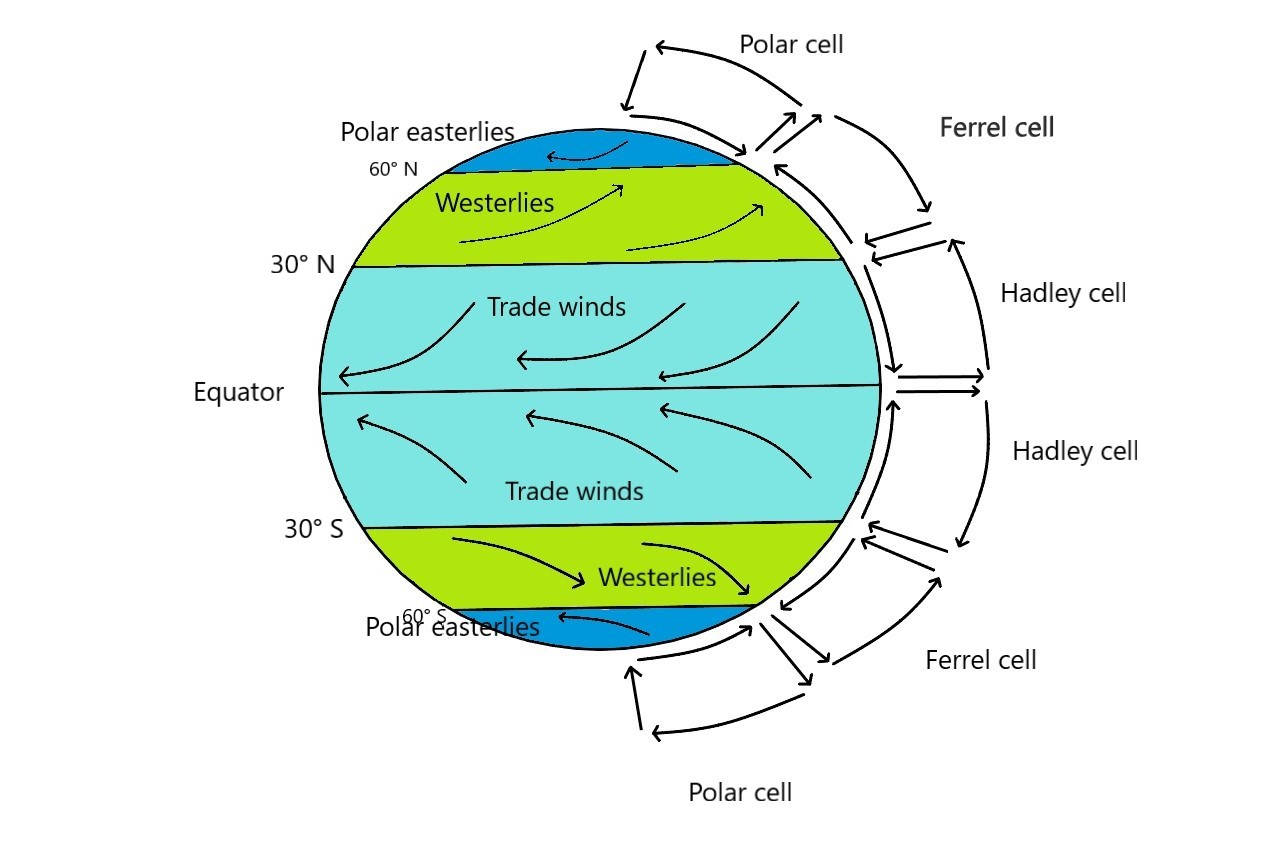
- Trade winds are steady winds that blow from subtropical high-pressure areas toward the equatorial low-pressure belt.
- Key characteristics:
- Found between 30°N and 30°S latitudes
- Directions:
- Northern Hemisphere: Northeast to southwest
- Southern Hemisphere: Southeast to northwest
- Called “trade winds” because they were historically used by sailors for navigation
- Important concepts:
- Due to the Coriolis force, winds are deflected:
- To the right in the Northern Hemisphere
- To the left in the Southern Hemisphere
- These winds:
- Start as dry and stable
- Become warm and moisture-rich near the equator
- When trade winds from both hemispheres meet:
- Air rises
- Heavy rainfall occurs
- Due to the Coriolis force, winds are deflected:
Westerlies
- Westerlies are winds that blow from subtropical high-pressure belts toward sub-polar low-pressure belts.
- Key features:
- Found between 30°–65° latitudes
- Direction:
- Northern Hemisphere: Southwest to northeast
- Southern Hemisphere: Northwest to southeast
- Important observations:
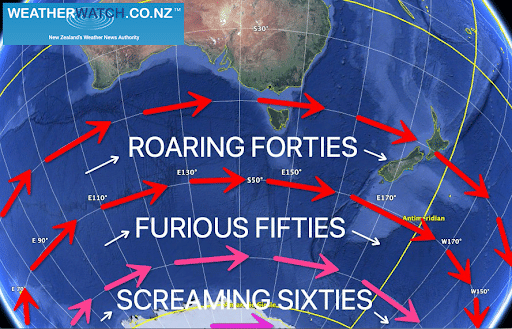
- Stronger in the Southern Hemisphere due to more ocean area
- Weaker and irregular in the Northern Hemisphere due to land barriers
- Bring rainfall to western coasts of continents
- Known for strong winds in southern latitudes:
- Roaring Forties
- Furious Fifties
- Shrieking Sixties
Polar easterlies
- These are cold and dry winds blowing from polar high-pressure regions toward sub-polar low-pressure areas.
- Direction:
- Northern Hemisphere: Northeast to southwest
- Southern Hemisphere: Southeast to northwest
Secondary Winds or Periodic Winds
- These winds change direction regularly due to seasonal or daily temperature changes.
Monsoons
- Monsoons are seasonal winds characterized by a reversal in direction.
Summer Monsoon (S-W Monsoon)
- Winds blow from ocean to land
- Carry heavy moisture
- Cause heavy rainfall, especially in South Asia
Winter Monsoon (N-E Monsoon)
- Winds blow from land to ocean
- Are dry
- Bring limited rainfall, mainly to eastern coastal regions

- Monsoons affect regions like:
- India
- Pakistan
- Bangladesh
- Southeast Asia
- Northern Australia
Land Breeze and Sea Breeze
These are daily winds caused by different heating rates of land and water.
| Time of Day | Wind Type | Direction | Reason |
|---|---|---|---|
| Day | Sea Breeze | Sea → Land | Land heats faster |
| Night | Land Breeze | Land → Sea | Land cools faster |
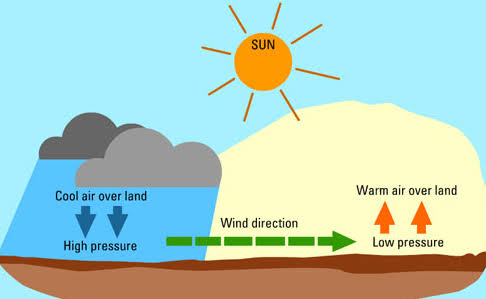
- During the day:
- Land becomes hotter → air rises → low pressure
- Cooler sea → high pressure → wind blows toward land
- At night:
- Land cools quickly → high pressure
- Sea remains warmer → low pressure → wind reverses

Valley Breeze and Mountain Breeze
- These occur in hilly or mountainous regions.
- Daytime (Valley Breeze):
- Slopes heat up
- Air moves up the slopes
- Nighttime (Mountain Breeze):
- Slopes cool down
- Cold air flows down into valleys
- Daytime (Valley Breeze):
- Important note:
- Katabatic winds are cold winds flowing downhill
- Warm descending winds on the leeward side become dry and hot, often melting snow quickly

Tertiary Winds or Local Winds
- Local winds are caused by small-scale temperature and pressure differences and affect limited areas.
Loo
- Type: Harmful wind
- Region: Northern India and Pakistan
- Characteristics:
- Very hot and dry
- Occurs in May and June afternoons
- तापमान: 45°C–50°C
- Can cause heatstroke
Foehn or Fohn
- Type: Beneficial wind
- Region: Alps
Features:
- Warm, dry, and strong wind
- Occurs on leeward side of mountains
- Helps:
- Melt snow
- Improve grazing conditions
- Ripen crops like grapes
Chinook
- Type: Beneficial wind
- Region: Rocky Mountains (USA and Canada)
Key benefits:
- Rapidly melts snow
- Keeps grasslands usable for livestock grazing
Mistral
- Type: Harmful wind
- Region: France (Rhone Valley)
Characteristics:
- Very cold, dry, and fast
- Can cause blizzards
Sirocco
- Type: Harmful wind
- Region: From Sahara to Europe
Effects:
- Brings:
- Hot, dusty air in North Africa
- Storms in the Mediterranean
- Cool, wet weather in Europe
- Brings:
| Wind Name | Description |
|---|---|
| Brickfielder | Hot, dusty wind in Australia |
| Chinook | Warm, dry wind in the Rockies |
| Foehn | Warm, dry wind in Europe |
| Haboob | Sandstorm wind in North Africa |
| Levanter | Moist wind in the Mediterranean |
| Mistral | Cold, strong wind in France |
| Sirocco | Hot wind from Sahara |
| Elephanta | Wind marking end of monsoon in India |
| Nor’easter | Storm wind in Northeast USA |
| Nor’wester | Warm wind in New Zealand |
| Santa Ana | Dry wind causing wildfires in California |
| Shamal | Sandstorm wind in the Persian Gulf |
| Calima | Dust-carrying wind to Canary Islands |
How is Wind Measured?
- Wind has two main properties:
- Speed
- Direction
- These are measured using specific instruments:
- Anemometer:
- Measures wind speed
- Wind vane:
- Shows wind direction
- Anemometer:
Causes of Wind
- The primary cause of wind is uneven heating of the Earth’s surface.
- Key examples:
- Land vs Sea heating difference
- Equator vs Poles temperature difference
- Explanation:
- Uneven heating creates pressure differences
- Air moves to balance these differences
- This movement results in wind formation
.jpg)
This structured understanding of wind helps explain weather patterns, climate behavior, and their impact on human life and the environment.