
UNIVERSE
The Universe includes everything that exists, from vast galactic megaclusters to the smallest subatomic particles. It represents the totality of space, time, matter, and energy.
- Scientists estimate the age of the Universe to be about 13.79 billion years (as of 2020).
- It contains an enormous number of galaxies.
- Observations using optical and radio telescopes suggest there are around 100 billion galaxies in the observable Universe.
- The most widely accepted explanation for its origin is the Big Bang Theory, which proposes that the Universe began from an extremely hot and dense state and has been expanding ever since.
GALAXY
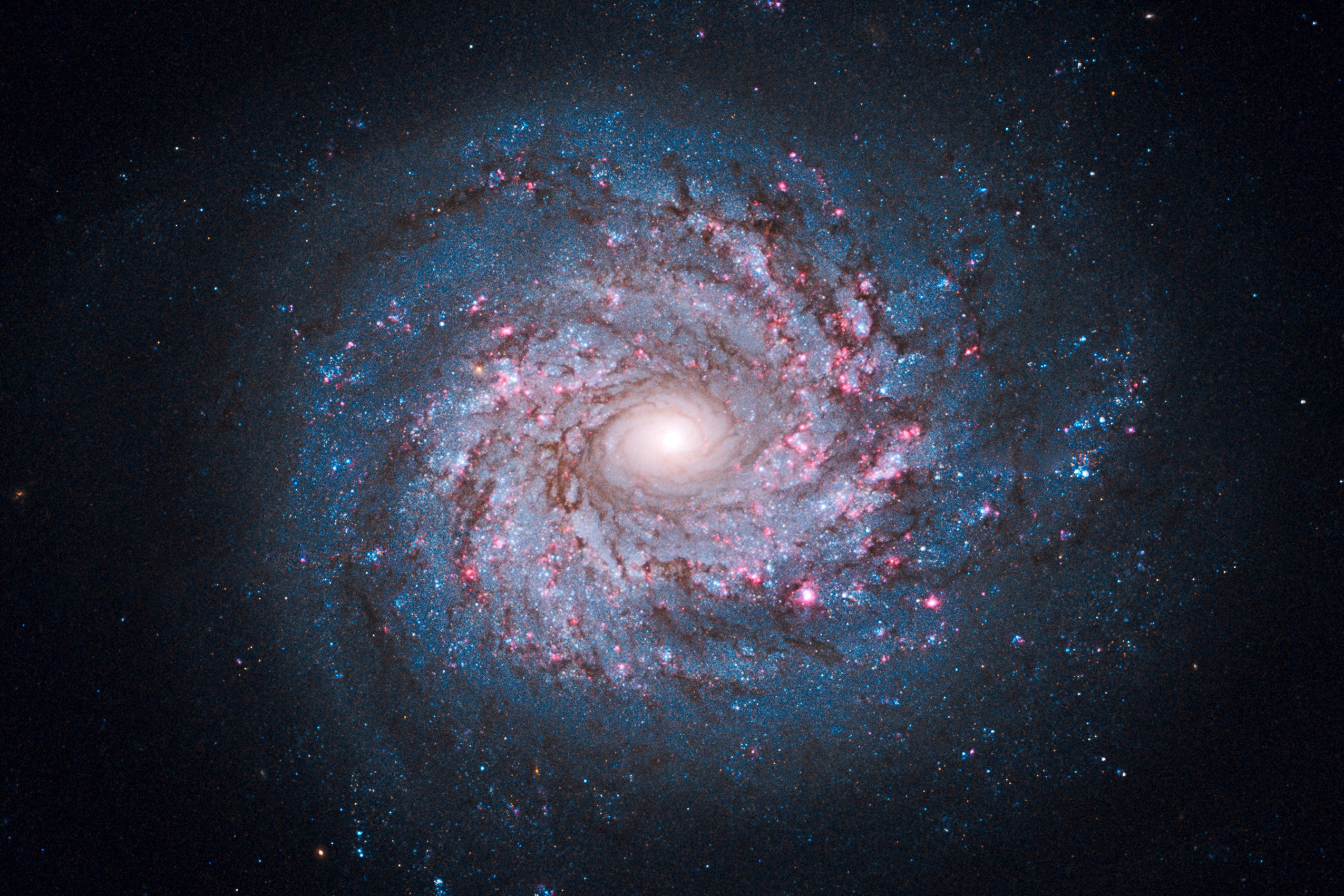
A galaxy is a massive system consisting of millions or billions of stars, planets, gas, and dust, all bound together by gravitational forces.
- The Milky Way is the galaxy that contains Earth.
- It appears as a glowing band of light in the night sky, resembling a stream of milk, which is why it is named so.
- Its structure is spiral in shape.
- In Indian tradition, it is also known as Akash Ganga.
- The closest neighboring galaxy to the Milky Way is Andromeda, which is also spiral in structure and lies about 2.5 million light-years away from Earth.
STARS
Stars are self-luminous celestial bodies that emit their own light and energy.
- They are composed of extremely hot gases, mainly hydrogen and helium.
- Their color indicates temperature:
- Red stars are relatively cooler
- Yellow stars have moderate temperature
- Blue stars are extremely hot

Star (Birth to Death)
The life cycle of a star progresses through several stages:
- A star begins as a nebula, which is a cloud of gas and dust.
- This material contracts to form a dense region called a protostar.
- As contraction continues, temperature and pressure rise until nuclear fusion starts, leading to the birth of a star.
Later stages depend on the star’s mass:
- When hydrogen is exhausted, helium fusion produces heavier elements like carbon.
- Eventually, fusion stops, and the core collapses into a white dwarf, a dense remnant.
- Over time, a white dwarf cools and becomes a black dwarf (a theoretical, non-luminous object).
Key concepts:
- The Chandrasekhar Limit (1.44 times the Sun’s mass) defines the maximum mass of a white dwarf.
- White dwarfs are considered dead stars, as fusion has ceased, though they still emit residual heat.
For massive stars:
- They expand into red supergiants after exhausting fuel.
- These may explode as a supernova or collapse into neutron stars or black holes.
Nearest stars:
- The closest star to Earth is the Sun, followed by Proxima Centauri and Alpha Centauri (about 4.35 light-years away).
Constellations
A constellation is a group of stars forming recognizable patterns or shapes in the night sky.Currently, there are 88 constellations.
- They are useful for navigation, especially at sea, as they appear in fixed positions during certain times of the year.
Examples include:
- Ursa Major (Great Bear/Saptarishi): 7 bright stars, helps locate the Pole Star.
- Orion (The Hunter): 7–8 stars, visible in winter; contains the bright star Sirius nearby.
- Leo Major (Lion): 9–10 stars, visible in summer.
- Cassiopeia: 5 stars forming W or M, represents a queen, visible in winter.
The Great Bear includes:
- Ursa Major (Vrihat Saptarishi)
- Ursa Minor (Laghu Saptarishi)

Sun
The Sun is a medium-sized star composed mainly of hot gases.
Key composition:
| Component | Percentage |
|---|---|
| Hydrogen | 70% |
| Helium | 26.5% |
| Other gases | 3.5% |
Important characteristics:
- The Sun is about 109 times larger than Earth.
- Its mass is approximately 2 × 10²⁷ tonnes, making up 99.83% of the Solar System’s mass.
- It is located about 150 million km from Earth.
- Sunlight takes about 8 minutes to reach Earth.
Role and energy:
- Its strong gravitational pull keeps planets in their orbits.
- It emits energy in various forms:
- Visible light
- Infrared radiation
- Ultraviolet rays
- X-rays and gamma rays
- Radio waves
- Plasma particles
Solar phenomena:
- Solar flares are sudden bursts of energy caused by magnetic activity, releasing charged particles that can disrupt satellite communication.
- The Sun’s energy is generated through nuclear fusion, where hydrogen atoms combine to form helium in the core.
Structure of the Sun:
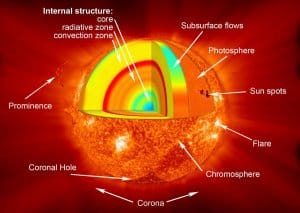
- Core: Site of nuclear fusion
- Convection zone: Energy transfer region with temperatures around 2 million °C
- Photosphere: Visible surface with temperature around 6000°C
- Atmosphere: Includes the chromosphere and corona
- The corona is extremely hot and visible during solar eclipses due to emission from ionized elements like iron and calcium.
Solar wind and auroras:
- The solar wind is a stream of charged particles emitted from the Sun’s outer layers.
- When these particles interact with Earth’s magnetic field, they produce auroras:
- Aurora Borealis (Northern Hemisphere)
- Aurora Australis (Southern Hemisphere)

Sunspots:
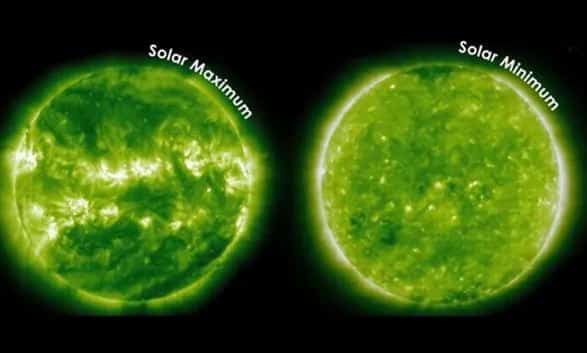
- Sunspots are darker, cooler regions on the photosphere.
- They are linked to magnetic activity and appear in cycles of about 11 years, known as the sunspot cycle.
Solar activity terms:
| Term | Description |
|---|---|
| Solar Maximum | Period with highest number of sunspots |
| Solar Minimum | Period with lowest number of sunspots |
Additional concepts:
- The solar wind consists mainly of electrons, protons, and alpha particles with energies between 0.5 and 10 keV.
- A solar storm is a disturbance on the Sun that can affect the entire Solar System and influence space weather.
- A geomagnetic storm occurs when solar wind interacts strongly with Earth’s magnetic field, temporarily disturbing the magnetosphere.
PLANETS
The term planets comes from a word meaning “wanderers”, as they appear to move across the sky. Our solar system contains eight planets: Mercury, Venus, Earth, Mars, Jupiter, Saturn, Uranus, and Neptune.
- All planets revolve around the Sun in fixed paths called orbits, which are elliptical (oval-shaped).
- The International Astronomical Union (IAU) has also identified five dwarf planets: Ceres, Pluto, Haumea, Makemake, and Sedna.
Planets are broadly classified into two main groups:
- Terrestrial Planets (Inner Planets)
- Jovian Planets (Outer Planets)
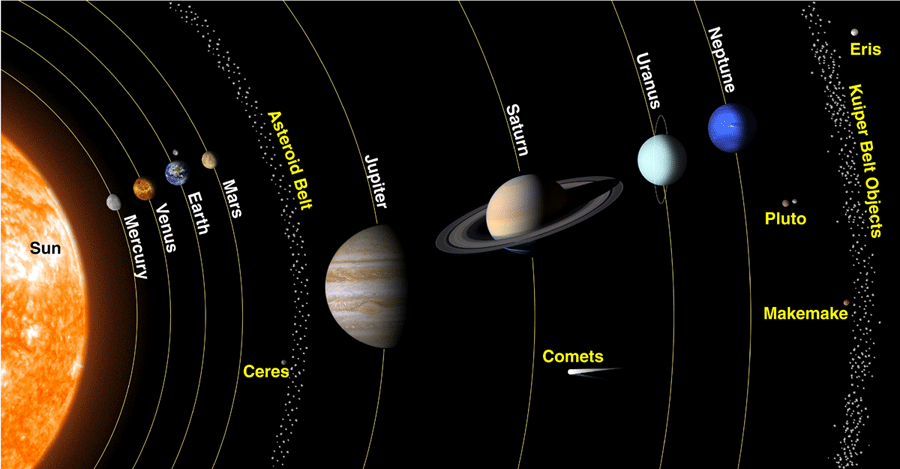
1.Terrestrial Planets (Inner Planets)
These are rocky, dense, Earth-like planets:
- Mercury
- Venus
- Earth
- Mars
Key features:
- Solid surfaces
- Smaller size
- Located closer to the Sun
2.Jovian Planets (Outer Planets)
These are large, gaseous planets similar to Jupiter:
- Jupiter
- Saturn
- Uranus
- Neptune
Key features:
- Massive size
- Composed mainly of gases
- Possess numerous moons (satellites)
Pluto, the Dwarf Planet
Pluto was once considered the ninth and smallest planet, but it is now classified as a dwarf planet.
- It is located about 3.6 billion miles from the Sun.
- Pluto lies in a distant region known as the Kuiper Belt.
- One day on Pluto equals approximately 6.5 Earth days.
Moons of Pluto:
- Charon (largest)
- Kerberos
- Styx
- Nix
- Hydra
Kuiper Belt
The Kuiper Belt is a vast region beyond Neptune, extending from about 30 AU to 50 AU from the Sun.
- It contains numerous icy bodies and remnants from the formation of the Solar System.
- It is much larger than the asteroid belt—about 20 times wider and significantly more massive.
Mercury
Mercury is the smallest planet and the closest to the Sun.
- Distance from Sun: 58 million km (0.39 AU)
- One day: 59 Earth days
- Type: Terrestrial (rocky)
Atmosphere and surface:
- Has a very thin exosphere made of oxygen, sodium, hydrogen, helium, and potassium
- Experiences extreme temperatures:
- Day: 430°C
- Night: –180°C
Exploration:
- Visited by Mariner 10 and MESSENGER missions
Venus
Venus is slightly smaller than Earth and is the second planet from the Sun.
- Distance: 108 million km (0.72 AU)
- One day: 243 Earth days
Key characteristics:
- Rocky surface with volcanic features
- Thick, toxic atmosphere composed mainly of carbon dioxide and nitrogen
- Covered with sulfuric acid clouds
Additional facts:
- Surface temperature reaches about 480°C, making it the hottest planet
- Rotates in the opposite direction (retrograde rotation)
- Explored by over 40 spacecraft, including the Magellan mission
Earth
Earth is the third planet from the Sun and the only known planet to support life.
- Distance: 150 million km (1 AU)
- One day: 24 hours
Atmosphere composition:
| Gas | Percentage |
|---|---|
| Nitrogen | 78% |
| Oxygen | 21% |
| Others | 1% |
Important features:
- Has one natural satellite: the Moon
- Maintains conditions ideal for life
- The atmosphere protects the surface by burning up most incoming meteoroids
Mars
Mars, known as the Red Planet, is the fourth planet from the Sun.
- Distance: 228 million km (1.52 AU)
- One day: Slightly more than 24 hours
- Type: Terrestrial
Surface and atmosphere:
- Marked by volcanoes, craters, and dust storms
- Thin atmosphere of carbon dioxide, nitrogen, and argon
Moons:
- Phobos
- Deimos
Exploration highlights:
- First successful mission: Mariner 4 (1965)
- Current missions study its potential for past or future life
Why is Mars red?
The reddish appearance is due to oxidized iron (rust) in its soil.
Jezero Crater :
Jezero Crater is a significant geological feature on Mars:
- Width: 45 km
- Location: Near the Martian equator, on the edge of Isidis Planitia
Key importance:
- Shows evidence of an ancient river system
- Contains traces of a delta formation
- Serves as the landing site of NASA’s Perseverance mission, aimed at studying past life possibilities
Jupiter
Jupiter is the largest planet in the solar system.
- About 1,300 Earths could fit inside it
- Distance: 778 million km (5.2 AU)
- One day: 10 hours
Composition:
- A gas giant with no solid surface
- Mainly composed of hydrogen and helium
Other features:
- Has dozens of moons (over 60 known)
- Possesses a faint ring system
- Explored by several missions, including Voyager and Juno
Note: While Jupiter itself cannot support life, some of its moons may have subsurface oceans.
Saturn
Saturn is the sixth planet from the Sun and is famous for its ring system.
- Distance: 1.4 billion km (9.5 AU)
- One day: 10.7 hours
Key characteristics:
- Gas giant composed mainly of hydrogen and helium
- Has over 60 moons
Rings:
- Consist of seven major rings with gaps between them
- Made of ice and rock particles
Exploration:
- Missions include Pioneer 11, Voyager 1 & 2, and Cassini-Huygens
Historical note:
- Galileo Galilei first observed Saturn’s unusual shape, later understood to be its rings
Uranus
Uranus is the seventh planet and is classified as an ice giant.
- Distance: 2.9 billion km (19.19 AU)
- One day: 17 hours
Composition:
- Made mostly of icy materials such as water, methane, and ammonia
- Atmosphere contains hydrogen, helium, and methane
Unique features:
- Rotates sideways, unlike other planets
- Has 27 moons, named after literary characters
- Contains 13 rings
Exploration:
- Visited only by Voyager 2
Neptune
Neptune is the eighth and most distant planet from the Sun.
- Distance: 4.5 billion km (30.07 AU)
- One day: 16 hours
Characteristics:
- An ice giant, similar to Uranus
- Atmosphere composed of hydrogen, helium, and methane
Other features:
- Has 13 moons, named after mythological sea beings
- Possesses six rings
Exploration:
- Only visited by Voyager 2
Like other outer planets, Neptune cannot support life as we know it.
Moon
The Moon is Earth’s natural satellite, orbiting at an average distance of about 384,000 km (239,000 miles) or 0.00257 AU.
- It completes one orbit around Earth in approximately 27.32 days.
- The Moon also rotates on its axis in the same time, resulting in the same side always facing Earth (a phenomenon called synchronous rotation).
Surface and structure:
- It is a rocky body with a solid surface.
- The surface is heavily marked by craters and impact pits, formed by collisions with space objects.
Atmosphere and exploration:
- The Moon has a very thin atmosphere, known as an exosphere.
- It is the only celestial body beyond Earth that humans have visited.
- Over 100 spacecraft missions have explored the Moon.
- A total of 12 astronauts have walked on its surface.
Study of the Moon is called Selenology.
Asteroids
Asteroids are often referred to as minor planets, primarily found within the inner Solar System.
- They orbit the Sun in a region between Mars and Jupiter called the Asteroid Belt.
Characteristics:
- Composed of rocky and metallic materials
- Generally irregular in shape
- Lack a significant atmosphere
Additional facts:
- Over 150 asteroids are known to have one or more moons
- The first asteroid-moon system discovered was Ida and its moon Dactyl (1993)
- Asteroids do not possess ring systems
Exploration:
- Several missions have studied asteroids
- The Dawn mission (2011) was the first to orbit a main-belt asteroid, Vesta
Notable example:
- Ceres, discovered in 1801 by Giuseppe Piazzi, is the largest asteroid and makes up about one-third of the asteroid belt’s total mass
Asteroids are not capable of supporting life.
Meteorites
Meteorites are fragments of space material that reach the Earth’s surface.
- They range in size from tiny particles to massive rocks.
- One of the largest known is the Hoba meteorite in southwest Africa, weighing about 54,000 kg.
Formation process:
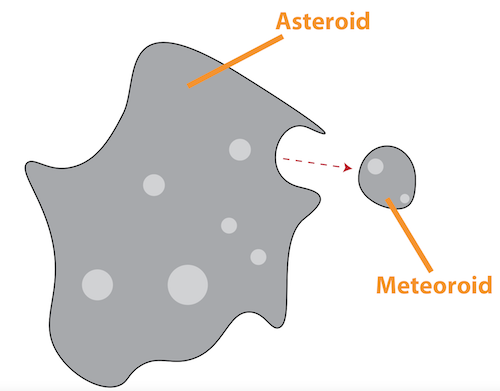
- Meteoroids are small rocky particles in space
- When they enter a planet’s atmosphere, they become meteors (visible as streaks of light or “shooting stars”)
- If they survive the journey and land on Earth, they are called meteorites
Types of meteorites:
- Iron meteorites
- Stony meteorites
- Stony-iron meteorites
Key points:
- Meteor showers are often named after nearby constellations or stars
- The Leonid MAC mission (1998–2002) studied how meteoroids interact with Earth’s atmosphere
Appearance:
- May resemble ordinary Earth rocks or show a burnt outer layer
- Some display indentations or smooth, polished surfaces
Scientific importance:
- Although they cannot support life, meteorites may have delivered amino acids, which are essential building blocks of life
Many meteor showers are linked to comets.
Comets
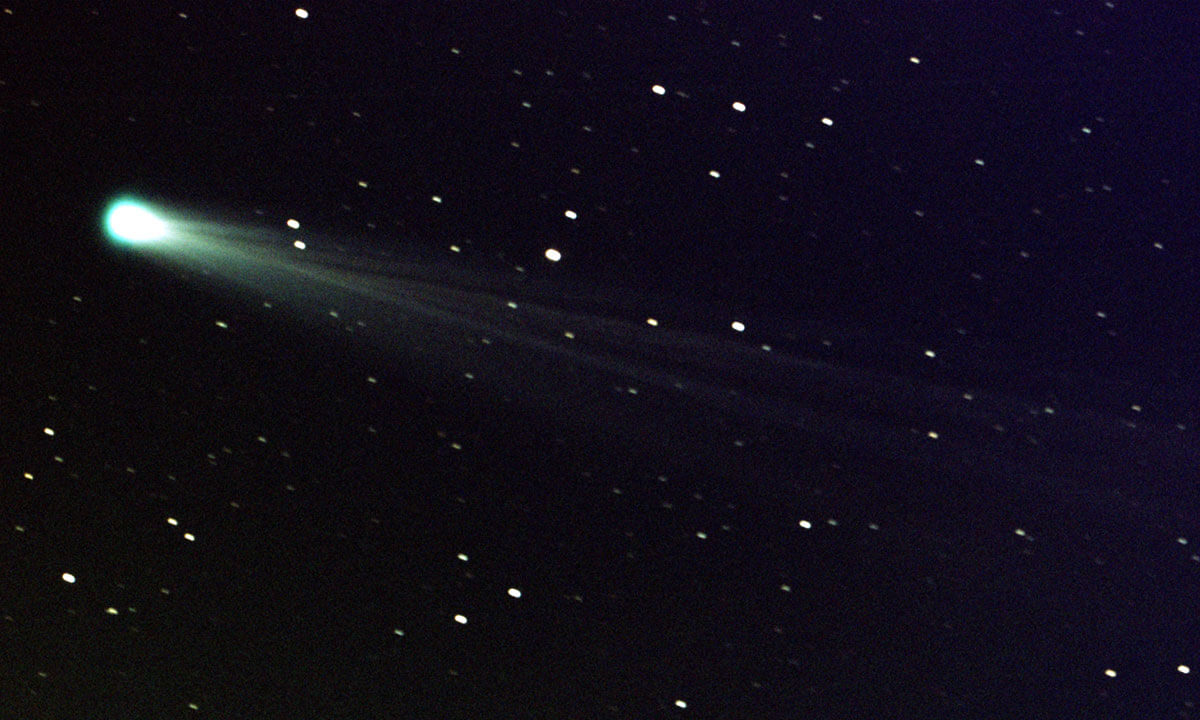
Comets are icy celestial objects often described as “cosmic snowballs”, made of frozen gases, dust, and rock.
Behavior near the Sun:
- As a comet approaches the Sun, it heats up and forms a glowing coma (atmosphere)
- The coma can extend for hundreds of thousands of kilometers
General features:
- Do not have moons
- Do not possess rings
Scientific exploration:
- Space missions have observed, impacted, and collected samples from comets
Role in meteor showers:
- Comets leave behind dust trails as they travel
- When Earth passes through these trails, particles burn up in the atmosphere, creating bright meteor streaks
Importance:
- Though not suitable for life, comets may have contributed water and organic compounds to Earth, aiding the development of life
Notable comet:
- Comet Halley is a short-period comet visible from Earth every 75–76 years
- Last seen: 1986
- Next expected appearance: 2061
- Comet Halley is a short-period comet visible from Earth every 75–76 years
Kármán Line
The Kármán Line is widely accepted as the boundary between Earth’s atmosphere and outer space.
- Located at an altitude of 100 km (about 62 miles) above sea level
Significance:
- It serves as a reference point to distinguish between airspace and space
- Important for legal and regulatory purposes, as aircraft and spacecraft are governed by different rules and international agreements
This boundary helps define where space exploration officially begins.
