
What is Temperature Inversion?
- Under normal atmospheric conditions, the air temperature decreases as altitude increases. This happens in the lowest layer of the atmosphere, known as the troposphere. On average:
- Temperature drops by 1°C for every 165 meters
- Or about 6.5°C for every 1000 meters
- This standard pattern is called the normal lapse rate.
- However, sometimes this pattern reverses. Instead of getting cooler with height, the air becomes warmer as we move upward. This unusual condition is known as temperature inversion.
- Temperature inversion helps us in understanding weather patterns and atmospheric behavior.
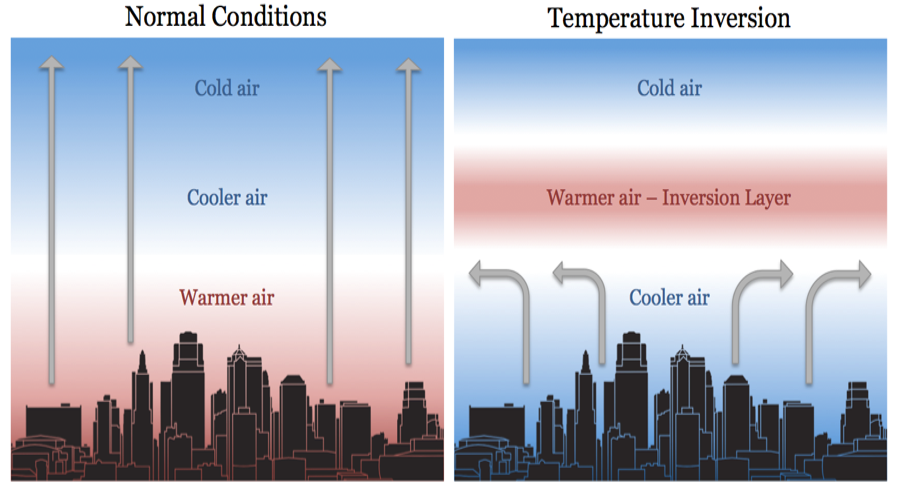
- In simple terms, temperature inversion occurs when:
- The normal decrease of temperature with height is reversed
- A layer of warm air sits above a layer of cold air
- This situation is also called a thermal inversion or negative lapse rate.
Characteristics of Temperature Inversion
- It represents a reversal of normal atmospheric temperature behavior
- Cold air remains trapped below, while warm air lies above
- It often occurs under stable atmospheric conditions
- It may also be caused by horizontal or vertical air movement
- Usually short-lived, but happens quite frequently
Effects of temperature inversion
Temperature inversion can have serious impacts on the environment, human health, and economic activities. Below are its major effects:
1. Formation of Fog and Smog
- Fog forms when clouds develop close to the ground, reducing visibility to less than 1 km
- In cities, fog combines with smoke to create smog, which is harmful to health
- Health problems include:
- Breathing difficulties
- Asthma
- Bronchitis

2. Increase in Road and Transport Accidents
- Accumulation of dust and smoke particles reduces visibility
- Leads to:
- More road accidents
- Delays in train and flight schedules
3. Damage to Crops
- Winter crops are especially affected, such as:
- Wheat
- Barley
- Mustard
- Potato
- Vegetables
- Effects include:
- Frost damage
- Reduced crop quality (e.g., lower sugar content in sugarcane)
4. Impact on Vegetation
- Temperature inversion strongly influences plant growth
- Example:
- Valley bottoms may remain too cold for settlements
- Upper slopes are more suitable for habitation and farming
5. Effect on Cloud Formation
- Prevents vertical growth of clouds
- As a result:
- Rainfall is reduced
- Clouds fail to develop into rain-bearing systems
6. Reduced Diurnal Temperature Variation
- Diurnal variation means the difference between daytime and nighttime temperatures
- During inversion:
- Temperature changes between day and night are minimal
Ideal Conditions For Temperature Inversion
Certain atmospheric conditions favor the formation of temperature inversion:
- Long nights
- More heat is lost than gained
- Clear skies
- Allow heat to escape easily into space
- Calm and stable air
- Prevents mixing of air layers
- Long nights
Types of Temperature Inversion
Temperature inversion can occur in different ways depending on environmental conditions. The main types are explained below:
1. Frontal inversion
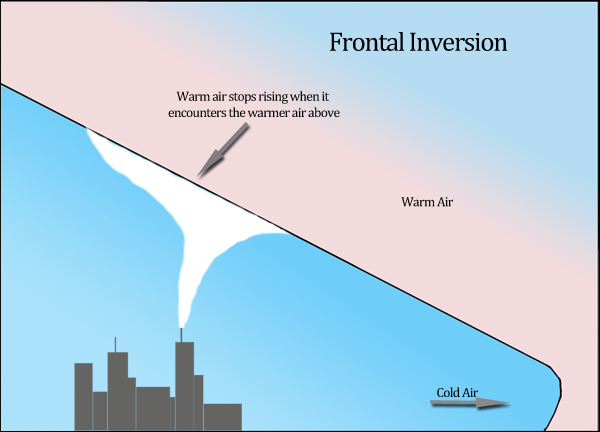
Frontal inversion happens when two different types of air — warm air and cold air — come into contact with each other. This usually occurs in changing weather conditions.
- The atmosphere is made up of large sections of air called air masses
- These air masses can be:
- Warm (lighter, rises easily)
- Cold (heavier, stays near the ground)
How does frontal inversion form?
- When a warm air mass meets a cold air mass, they do not mix easily
- Instead:
- The warm air (lighter) slowly slides (rises) over the cold air
- The cold air (heavier) remains below near the surface
- This creates a situation where:
- Warm air is on top
- Cold air is below
- This is exactly the opposite of normal temperature conditions, so it is called an inversion
Where is it commonly seen?
- It mostly occurs in cyclonic weather systems
- Cyclones are areas where:
- Air is constantly moving and mixing
- Different air masses frequently collide
What does “sloping structure” mean?
- The boundary between warm and cold air is not straight or flat
- Instead, it forms a tilted or slanted surface, like a ramp
- This happens because:
- Warm air gradually climbs over the cold air instead of rising vertically
What kind of weather does it create?
- The rising warm air cools down slowly, which leads to:
- Cloud formation
- Increased moisture (humidity) in the air
- As a result, the weather often becomes:
- Cloudy
- Damp or humid
- Sometimes rainy
Is Frontal inversion stable or long-lasting?
- No, frontal inversion is not stable
- It is a temporary condition
- It disappears because:
- Air keeps moving and mixing
- Weather systems like cyclones are constantly changing
2. Temperature Inversion in Intermontane Valley (Air Drainage Type of Inversion)
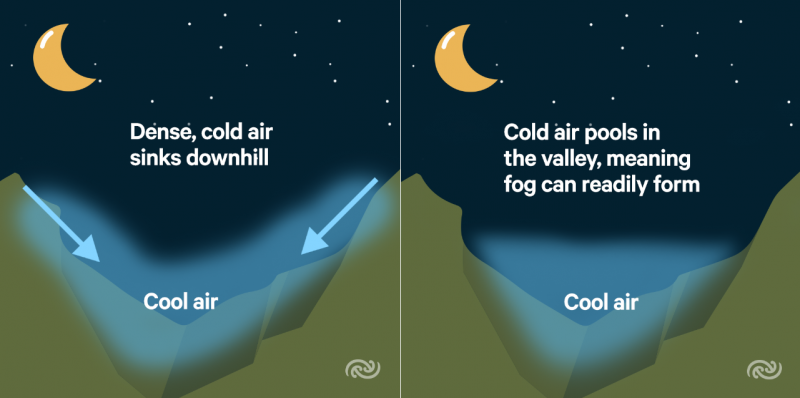
This type of temperature inversion is commonly seen in mountain areas and valleys. It is easier to understand if we imagine how air behaves on slopes during night time.
How does it form? (Step-by-step explanation)
- Cooling of land at night
- After sunset, the land loses heat quickly because there is no sunlight
- This makes the ground become cold
- Air near the ground also cools down
- The air that is in contact with the cold ground loses heat
- As a result, this air becomes cold
- Cold air becomes heavy and dense
- Cold air is heavier than warm air
- Because of this, it does not stay in higher areas
- Cold air moves downward (like water)
- The cold, heavy air flows down the mountain slopes
- This movement is called air drainage
- Cold air collects in the valley
- The valley acts like a basin or bowl
- So, the cold air settles at the bottom
- Warm air remains above
- The warmer, lighter air stays above the cold air layer
- This creates:
- It creates a layer of cold air trapped in valleys
- A warmer layer of air stays above it
- This is the reverse of normal temperature conditions
Where such phenomena is strongest?
This type of inversion is more noticeable in:
- High latitude regions
- These areas have long and very cold nights
- Mountainous regions
- Valleys easily trap cold air
- Slopes help cold air flow downward
- Cooling of land at night
3. Ground Inversion (Surface Temperature Inversion)
This type of inversion happens very close to the Earth’s surface, which is why it is called a surface or ground inversion. It is one of the most common types and is easier to understand in daily life, especially during cold nights.
How does it form? (Step-by-step explanation)
- Ground cools quickly at night
- After sunset, the Earth’s surface loses heat rapidly into the atmosphere
- This happens because there is no sunlight to warm it
- Air near the ground also cools
- The air touching the ground loses heat to the cold surface
- So, this air becomes cooler than the air above it
- Formation of inversion layer
- Now we have:
- Cold air near the ground
- Warmer air above it
- This creates a temperature inversion
- Now we have:
- Ground cools quickly at night
Conditions required for ground inversion
- Certain conditions make this inversion more likely and stronger:
- Long winter nights
- More time for the ground to lose heat
- Clear, cloudless skies
- Heat can escape easily into space without obstruction
- Dry air
- Moist air holds heat, but dry air allows faster cooling
- Calm or slow winds
- Prevents mixing of air layers, so cold air stays near the ground
- Snow-covered surface (in some areas)
- Snow reflects heat and enhances cooling of the ground
- Long winter nights
Important points
- Common in higher latitudes
- These areas have long, cold nights, especially in winter
- Temporary in nature
- It usually disappears after sunrise
- Sunlight heats the ground again, breaking the inversion
- Can lead to fog formation
- If the cold air reaches its dew point (the temperature at which water vapor condenses),
- Fog forms near the ground
- Common in higher latitudes

4. Subsidence Inversion (Upper Surface Temperature Inversion)
This type of inversion happens higher up in the atmosphere, not near the ground. It forms when air from higher altitudes slowly sinks downward.
How does it form? (Step-by-step explanation)
- Air starts sinking from above
- In some weather conditions, large amounts of air move downward from higher altitudes
- Air gets compressed as it sinks
- As the air comes down, the pressure increases
- This pressure compresses the air
- Compression causes warming
- When air is compressed, it heats up
- So, the sinking air becomes warmer
- Formation of inversion layer
- This creates:
- Warm air layer above
- Cooler air below
- This is a temperature inversion
- This creates:
- Air starts sinking from above
Where is it commonly found?
- Over continents during winter
- Especially when the air is dry and stable
- Over subtropical oceans
- These areas often have high-pressure systems
- High-pressure regions cause air to sink
- Over continents during winter
Key feature
- This inversion occurs at higher levels of the atmosphere, not near the surface
- That’s why it is called an upper surface temperature inversion
5. Marine Inversion
This type of inversion occurs in areas close to large water bodies, such as oceans or seas.
How does it form? (Step-by-step explanation)
- Air moves over cold water
- When air passes over ocean water, especially cold water, it loses heat
- Air becomes cool and dense
- The cooled air becomes heavier (denser)
- Cool air moves toward land
- This cool, dense air is blown inland (towards land) by winds
- Warm air already present over land
- Land heats up faster than water, so the air over land is usually warmer
- Formation of inversion layer
- The cool air settles below
- The warm air remains above
- This creates a temperature inversion
Key characteristics
- Common in coastal regions
- Areas near oceans or seas experience this frequently
- Frequent during spring season
- During spring, ocean water is still quite cold, increasing the effect
- Caused by temperature difference
- The main reason is the difference in heating between land and water
- Air moves over cold water
Economic Implications of Temperature Inversion
Temperature inversion has a strong impact on daily life, farming, settlements, and the economy, especially in regions like valleys and mountainous areas. Since it traps cold air and pollutants near the ground, it creates several practical problems.
It has the following Impacts :
Frost in valleys
- During inversion, cold air settles at the bottom of valleys
- This can cause frost (freezing conditions) near the ground
- Frost can:
- Damage crops
- Reduce agricultural production
- Meanwhile:
- Higher slopes remain warmer
- Crops grown there are less affected and safer
Pollution accumulation
- Temperature inversion prevents air from mixing properly
- As a result:
- Dust, smoke, and harmful gases get trapped near the ground
- This leads to:
- Poor air quality
- Increased health problems for people living in those areas
Settlement patterns
- Due to cold and polluted conditions in valleys:
- People prefer to live on higher slopes
- Reasons include:
- Cleaner air
- Less fog
- Warmer conditions compared to valley bottoms
Agricultural decisions
- Farmers adjust their practices based on inversion effects:
- They choose areas less affected by frost
- Common practice:
- Growing crops on upper slopes instead of valleys
- Example:
- Plantation crops and orchards are often located on higher land
- This helps protect them from cold air and frost damage
Reduced visibility due to fog
- Inversion can lead to formation of fog near the ground
- Fog causes:
- Low visibility
- This affects:
- Transportation (road, rail, and air delays or accidents)
- Daily activities (difficulty in movement)
- Plant growth (reduced sunlight)
Lower rainfall
- Inversion creates stable atmospheric conditions
- This stability:
- Prevents air from rising and forming clouds
- As a result:
- Cloud development is limited
- Rainfall decreases