
The Sun
- The Sun is a huge star, a glowing ball of extremely hot gas called plasma. Plasma is gas in which atoms are stripped of electrons, making it electrically charged.
- It is so big that 109 Earths could fit side by side across its diameter, and it could hold 1.3 million Earths in its volume.
- The Sun is made mostly of hydrogen (~73%) and helium (~25%). The remaining 2% are other elements like carbon, oxygen, and nitrogen, which are important for life on Earth.
- Unlike Earth, the Sun has no solid surface or core—everything is a hot, glowing gas.
- The Sun rotates in a counter-clockwise direction (if viewed from above Earth’s north pole). Different parts rotate at different speeds:
- Equator: ~24 days
- Poles: ~30+ days
- Average rotation: ~27 days
Internal Structure of the Sun
- Core
- The center of the Sun, about 20% of the Sun’s radius.
- Temperature: ~15 million °C.
- Here, nuclear fusion happens: hydrogen atoms combine to form helium, releasing huge amounts of energy. This energy is what powers the Sun and produces sunlight.
- Radiative Zone
- Surrounds the core, extending from 25% to 70% of the Sun’s radius.
- Energy moves slowly as light (photons), because the dense gas keeps scattering them.
- Convective Zone
- Outermost layer of the Sun’s interior, about 200,000 km thick.
- Energy moves through convection: hot gas rises to the surface, cools, and sinks back down, similar to a boiling pot of oatmeal.
Sun’s Atmosphere
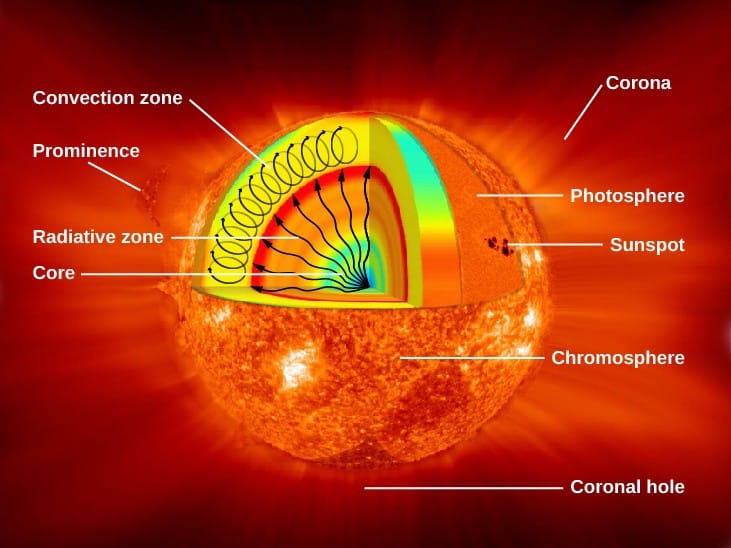
- Photosphere
- The visible surface of the Sun that we can see with telescopes.
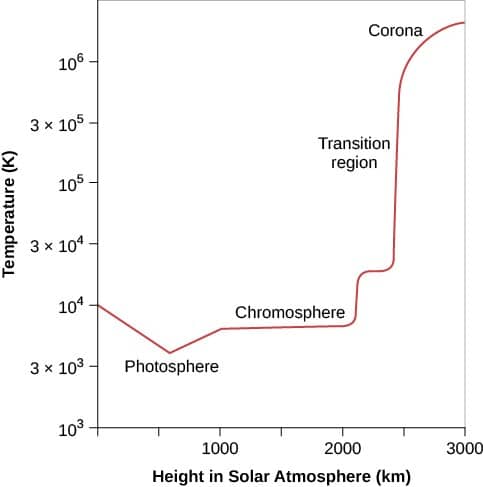
- Temperature: ~6,000 °C
- Most sunlight comes from this layer.
- The surface is uneven and has sunspots (cooler, darker areas caused by strong magnetic fields).
- Chromosphere
- A thin layer above the photosphere, 3,000–5,000 km thick.
- Temperature: ~10,000 K
- Appears red during a total solar eclipse.
- Transition Region
- A tiny layer where the temperature rises rapidly from 10,000 K to 1 million K.
- Corona
- The Sun’s outer atmosphere, extending millions of kilometers into space.
- Temperature: 1–2 million K
- Source of the solar wind (stream of charged particles).
- Visible during a total solar eclipse as a white glowing halo.
Sun’s Phenomena
- Sunspots
- Dark, cooler patches on the photosphere.
- They form where the magnetic field is extremely strong, trapping heat.
- Sunspots have a dark umbra (center) and a lighter penumbra (edge).
- Solar Flares
- Sudden bursts of energy near sunspots.
- Heat the corona to 10–20 million °C.
- Can disrupt satellites, radio signals, and power grids on Earth.
- Solar Prominences
- Huge arcs of glowing gas extending from the Sun’s surface.
- Held by magnetic fields.
- Can last months and sometimes erupt, sending solar material into space.
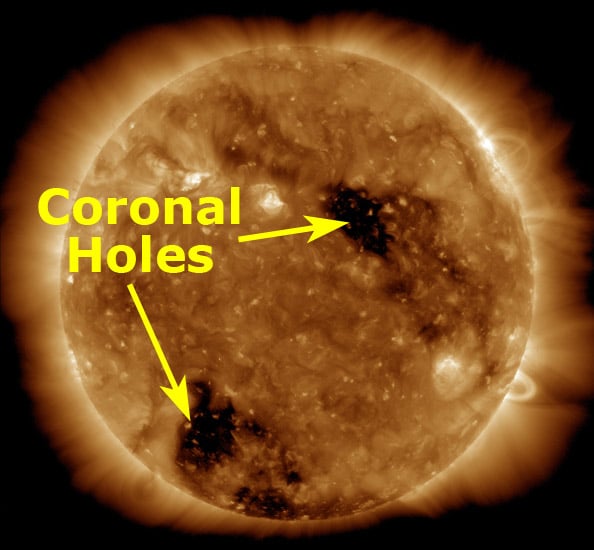
- Coronal Holes
- Darker, cooler areas in the corona where the Sun’s magnetic field is open.
- Solar wind escapes faster from these regions.
- Can last weeks to months, longer during the solar minimum.
- Solar Wind
- Stream of charged particles (electrons and protons) flowing outward from the Sun at up to 900 km/s.
- When they interact with Earth’s magnetic field, they create auroras:
- Aurora Borealis (Northern Lights)
- Aurora Australis (Southern Lights)

Plasma
- Plasma is a state of matter like solid, liquid, and gas.
- It’s made of ionized gas (atoms stripped of electrons).
- Examples: lightning, neon lights, and the Sun itself.
Why the Sun Matters
- Provides light and heat, making life on Earth possible.
- Drives space weather that affects satellites and astronauts.
- Causes geomagnetic storms and auroras through solar wind and flares.
- Coronal holes and solar winds affect conditions in space that our technology and astronauts travel through.