
The Earth’s crust is composed of different kinds of rocks, and the scientific study of rocks is known as petrology.
A rock is defined as a naturally occurring mixture of minerals, along with some non-mineral substances such as fossils and natural glass. Just as minerals form the basic units of rocks, rocks themselves act as the fundamental building blocks of the Earth’s lithosphere, asthenosphere, mesosphere, and even parts of the core.
Most rocks visible on the Earth’s surface originated within the continental or oceanic crust. Many of these rocks were formed deep below the surface and later brought upward through geological processes. In rare instances, some materials may even originate from the mantle.
Rocks reach the Earth’s surface through two primary processes:
- Formation at the surface
- Example: cooling of lava or precipitation of minerals like calcite from seawater
- Formation beneath the surface followed by uplift
- Rocks formed deep underground are exposed due to tectonic uplift and removal of overlying layers by erosion
Based on their origin and characteristics, rocks are classified into three major types:
- Igneous rocks
- Sedimentary rocks
- Metamorphic rocks
Igneous Rocks
Igneous rocks are considered the earliest rocks formed on Earth. They originate from the cooling and solidification of molten material:
- Magma: molten rock beneath the surface
- Lava: molten rock above the surface
Since they form under high-temperature conditions, igneous rocks do not contain fossils.
Common examples include granite, basalt, and gabbro.
Igneous rocks can be classified in two main ways:
- Based on origin:
- Plutonic (intrusive) rocks
- Volcanic (extrusive) rocks
- Based on chemical composition:
- Acidic rocks (rich in silica)
- Basic rocks (rich in iron and magnesium, denser and darker)
- Based on origin:
Classification of Igneous rocks on the basis of origin
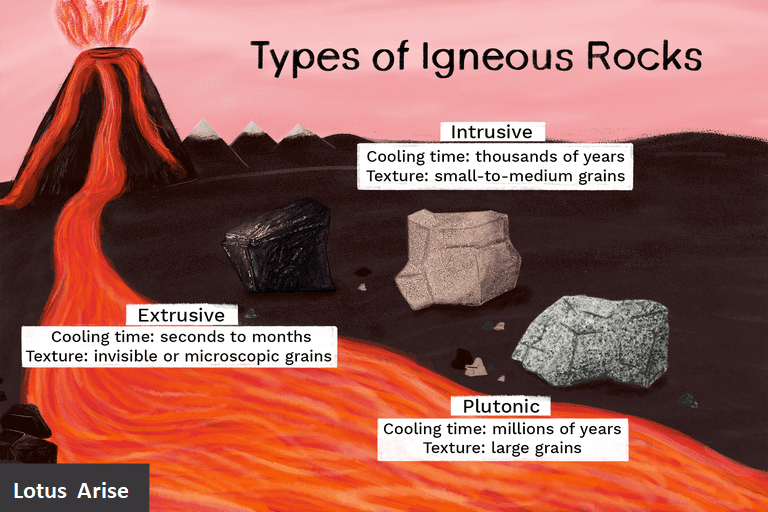
- Plutonic Rocks (Intrusive igneous rocks)
- Volcanic Rocks (Extrusive igneous rocks)
Plutonic Rocks or (Intrusive igneous rocks)
These rocks form when magma cools slowly at great depths, allowing large mineral crystals to develop.
Key features:
- Coarse-grained texture due to slow cooling
- Found deep within the Earth but exposed at the surface through erosion and denudation
Examples: granite, diorite, gabbro
Volcanic Rocks or (Extrusive igneous rocks)
These rocks are formed when lava cools rapidly either at or near the Earth’s surface.
Key features:
- Fine-grained texture due to rapid cooling
- Limited crystal formation
Example: basalt, The Deccan Traps in India are a well-known example of basaltic formations.
Distribution of basaltic regions:
- Antrim (Northern Ireland)
- Deccan Plateau (India)
- Snake Plateau (Columbia)
Sedimentary Rocks
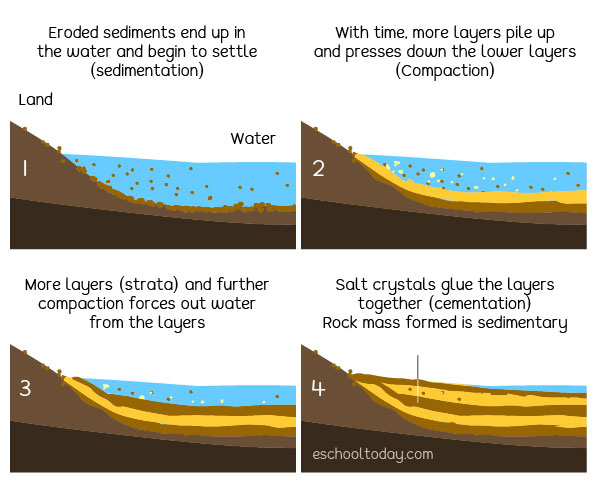
Sedimentary rocks are formed through the process of lithification, which involves the compaction and cementation of sediments.
Key characteristics:
- Typically layered (stratified)
- Formed from weathered and eroded material of pre-existing rocks
Examples: sandstone, shale
Important facts:
- Cover about 75% of the Earth’s surface
- Account for only about 5% of total crustal volume
Special types:
- Till or tillite: formed by glacial deposition
- Loess: formed by wind deposition
Based on their formation process, sedimentary rocks are divided into:
- Mechanically formed
- Organically formed
- Chemically formed
Mechanically formed sedimentary rocks
These are created by physical agents such as:
- Running water
- Wind
- Ocean currents
- Glaciers
Types:
- Arenaceous rocks
- Rich in sand-sized particles
- Porous and permeable
- Good reservoirs for groundwater and petroleum
- Example: sandstone
- Argillaceous rocks
- Rich in clay
- Fine-grained and mostly impermeable
- Examples: shale, claystone
- Arenaceous rocks
Organically formed sedimentary rocks
These rocks originate from the remains of plants and animals buried under sediments.
- Over time, heat and pressure transform these remains into rock
Examples:
- Coal
- Limestone
Types based on composition:
- Calcareous rocks: limestone, chalk, dolomite
- Carbonaceous rocks: coal
Chemically formed sedimentary rocks
These rocks form when mineral-rich water evaporates, leaving behind solid deposits.
Examples:
- Rock salt (from ancient seas or lakes)
- Gypsum (from evaporated salt lakes)
- Potash and nitrates
Also includes formations like:
- Stalactites and stalagmites in caves formed by mineral deposition
Metamorphic Rocks
The term metamorphic means “change in form.”
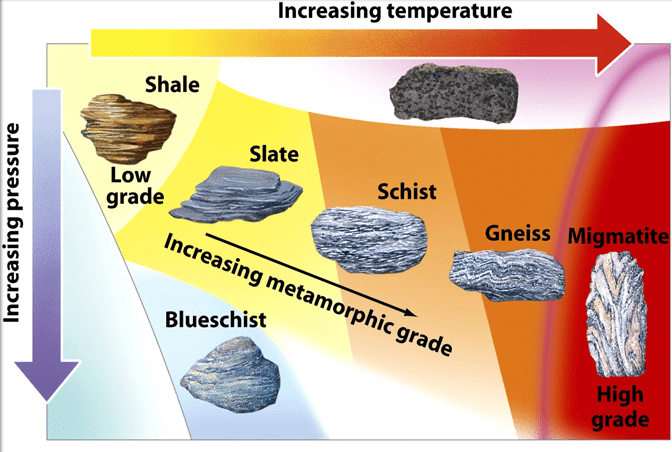
Metamorphic rocks are formed when existing rocks undergo physical and chemical changes due to:
- High temperature
- High pressure
- Chemical reactions
This transformation process is called metamorphism, involving recrystallization and reorganization of minerals.
Key structural features:
- Foliation or lineation: minerals arranged in layers or lines
- Banding: alternating layers of different minerals
Examples: gneiss, slate, schist, marble, quartzite
Causes of Metamorphism
- Orogenic (mountain-building) processes
- Involve folding, faulting, and high temperatures
- Intrusion of magma (lava inflow)
- Heat from magma alters surrounding rocks
- Geodynamic forces
- Plate tectonics plays a major role
Based on the process, metamorphic rocks are classified into:
- Thermal Metamorphism
- Dynamic Metamorphism
Thermal Metamorphism
Occurs due to high temperatures, often from nearby magma.
Examples of transformation:
- Sandstone → Quartzite
- Limestone → Marble
Dynamic Metamorphism
Occurs primarily due to intense pressure, sometimes combined with heat and chemically active fluids.
- Leads to complete recrystallization and formation of new structures
- Also known as dynamo-thermal metamorphism when heat and pressure act together
Examples:
- Granite → Gneiss
- Clay/Shale → Schist
Some examples of Metamorphosis
| Igneous or Sedimentary rock | Influence | Metamorphosed rock |
|---|---|---|
| Granite | Pressure | Gneiss |
| Clay, Shale | Pressure | Schist |
| Sandstone | Heat | Quartzite |
| Clay, Shale | Heat | Slate → Phyllite |
| Coal | Heat | Anthracite → Graphite |
| Limestone | Heat | Marble |
Metamorphic rocks are widely distributed across India:
- Gneiss and schist: Himalayas, Assam, West Bengal, Bihar, Odisha, Madhya Pradesh, Rajasthan
- Quartzite: Rajasthan, Bihar, Madhya Pradesh, Tamil Nadu, areas near Delhi
- Marble: Rajasthan (Alwar, Ajmer, Jaipur, Jodhpur) and Narmada Valley
- Slate: Haryana (Rewari), Himachal Pradesh (Kangra), Bihar
- Graphite: Odisha and Andhra Pradesh
Rock Cycle
The rock cycle is a continuous and dynamic process through which rocks are transformed from one type to another.

Key concepts:
- Igneous rocks are the primary rocks
- They can transform into:
- Sedimentary rocks through weathering and deposition
- Metamorphic rocks through heat and pressure
- Sedimentary and igneous rocks can also become metamorphic
- Rocks can melt into magma and solidify again into igneous rocks
- Through subduction, crustal rocks move into the mantle, melt, and re-enter the cycle
Examples of rock transformation:
- Clay → Slate
- Limestone → Marble
- Sandstone → Quartzite
- Granite → Gneiss
- Shale → Schist
- Coal → Graphite