What is precipitation?
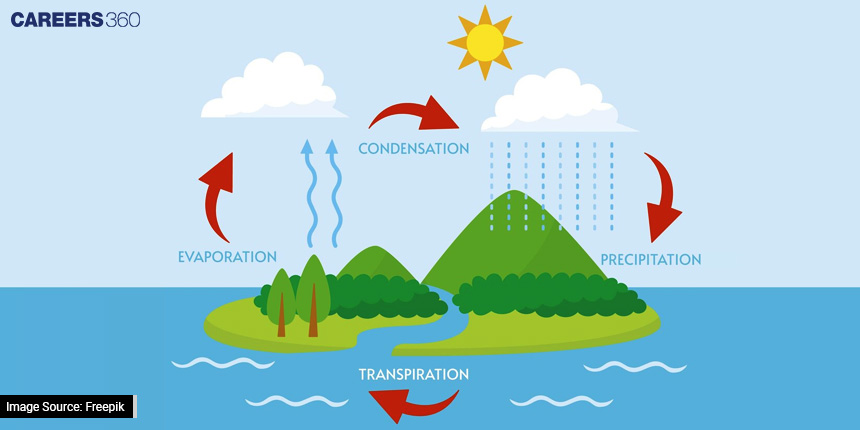
- Precipitation refers to any form of water—liquid or solid—that falls from the atmosphere and reaches the Earth’s surface.
- In simple terms, whenever water falls from clouds to the ground, it is called precipitation.
- It includes different forms such as:
- Rain
- Drizzle
- Snow
- Sleet
- Hail
- These forms differ based on temperature, air conditions, and how water changes between liquid and solid states in the atmosphere.
Types of Precipitation
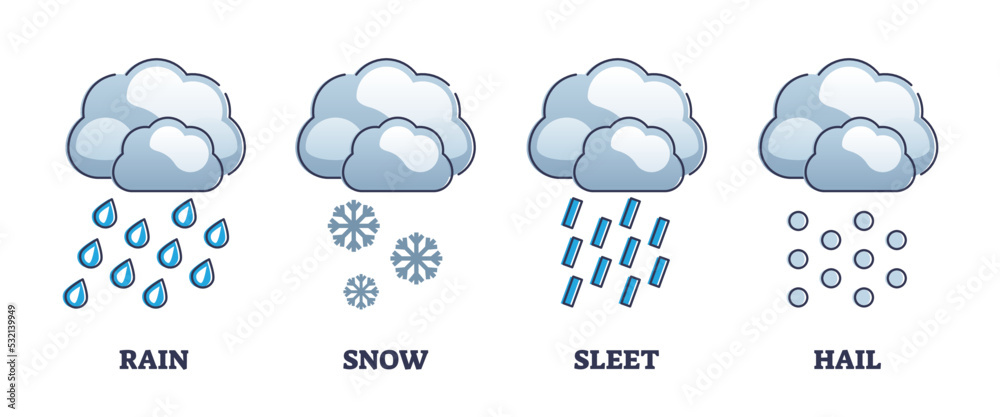
Precipitation is an umbrella term, under which lies the following types;
- Rain
- Drizzle
- Snow
- Sleet
- Hail
Rain
- Rain is the most common type of precipitation, and it is something we experience frequently in everyday life.
- In simple terms, rain is water falling from clouds in the form of liquid droplets.
How rain forms
- Inside clouds, there are tiny water droplets
- These droplets collide and combine with each other
- As they combine, they grow bigger and heavier
- When they become too heavy to stay in the air (size >0.5mm), they fall to the ground due to gravity
Important points
- Raindrops form around very tiny particles called condensation nuclei
(such as dust, smoke, or pollution particles) - These particles act like a base or surface for water to collect
- Contrary to common drawings, real raindrops are round (spherical), not tear-shaped
- Raindrops form around very tiny particles called condensation nuclei
Special case
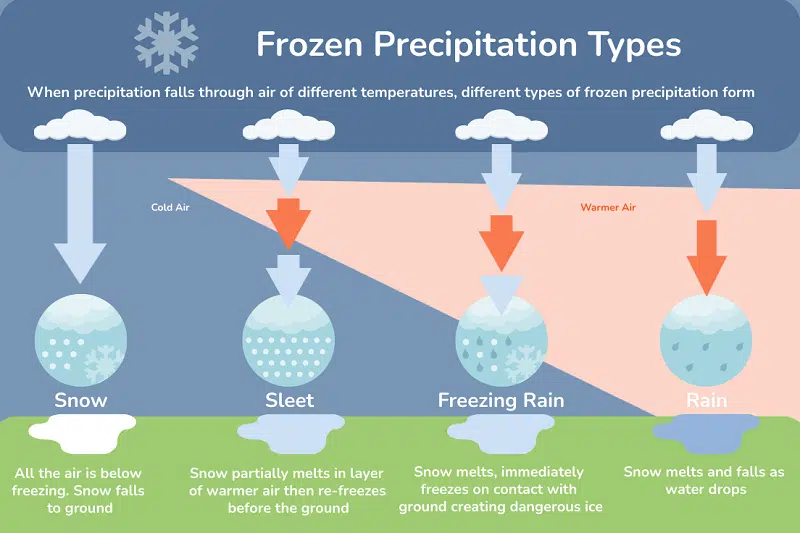
- If falling rain passes through a very cold layer of air and freezes before reaching the ground, it becomes sleet (ice pellets)
Drizzle
- Drizzle is simply a lighter and finer version of rain.
- The droplets are very small (less than 0.5 mm in size)
- It falls slowly and gently, often barely noticeable

Why drizzle forms
- Occurs when clouds are not strong enough to produce heavy rain
- Happens when upward air movement (updrafts) is weak
- Common in low-level clouds, especially stratus clouds
Special feature
- In colder regions, freezing drizzle can occur
- This creates a thin layer of ice on roads, plants, and surfaces, which can be dangerous
Snow
- Snow is precipitation in the form of ice crystals.
- It appears as soft, white flakes
- Forms when the temperature is below freezing (0°C)

How snow forms
- Water vapour in the air changes directly into ice crystals (without becoming liquid first)
- These crystals join together to form snowflakes
- Snowflakes fall gently to the ground
Snow is common in:
- Very cold regions
- High mountain areas
Sleet
- Sleet is frozen rain, forming a mix between rain and ice.
How sleet forms
- Rain falls from clouds as liquid
- It passes through a layer of very cold air
- The droplets freeze before reaching the ground
- They fall as small ice pellets
Characteristics
- Looks like a mixture of rain and tiny ice balls
- Harder than snow, but smaller than hail
Hail
- Hail is the most powerful and destructive form of precipitation.
- Falls as large ice balls or lumps
- Usually occurs during strong thunderstorms
How hail forms
- Forms inside cumulonimbus clouds (tall thunderstorm clouds)
- Strong upward winds carry water droplets up and down repeatedly
- Each time, a new layer of ice forms
- Eventually, the hailstone becomes too heavy and falls to the ground
Key features
- Has a layered structure, like an onion (layers of ice and snow)
- Size can vary from small pellets to large balls
Impact
- Can damage:
- Crops
- Vehicles
- Buildings
- Can damage:
Rainfall
Rainfall does not occur in the same way everywhere. Depending on how the air rises and cools, rainfall is classified into different types. Understanding these types helps us know why some places receive heavy rain while others remain dry.
Convectional rainfall
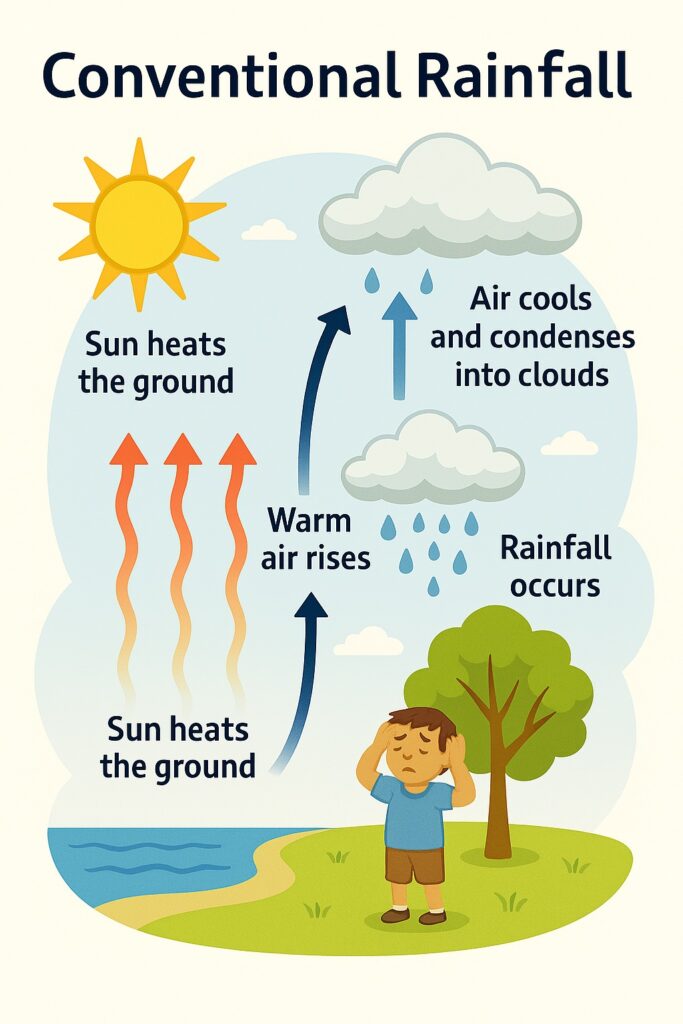
Convectional rainfall occurs due to the heating of the Earth’s surface by the sun. It is one of the most common types of rainfall in hot regions.
Process of Formation
- The sun heats the ground
- The ground, in turn, heats the air above it
- This warm air becomes lighter and starts rising upward
- As the air rises higher, it cools down
- Cooling causes water vapour to condense into clouds
- When the droplets grow large enough, rain falls
Key features
- Common in hot and humid regions
- Mostly found near the equator
- Occurs as short-duration but heavy rainfall
- Often happens in the afternoon after strong heating during the day
Limitation
- Rainfall is usually intense but brief
- A large amount of water flows away quickly as runoff
- Therefore, it is less useful for agriculture
Orographic rainfall
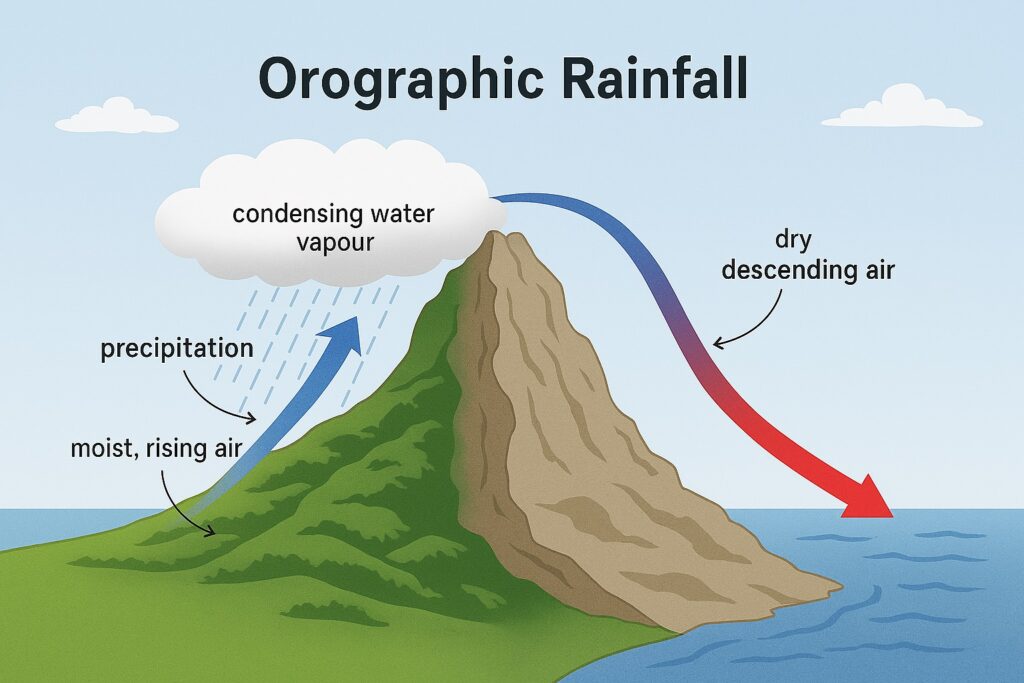
Orographic rainfall, also called relief rainfall, happens due to the presence of mountains or hills.
Process of Formation
- Moist air moves toward a mountain range
- The mountain acts as a barrier, forcing the air to rise
- As the air rises, it cools
- Cooling leads to condensation and cloud formation
- Rain falls on the windward side (the side facing the incoming wind)
Important concept
- After crossing the mountain, the air becomes dry
- The other side of the mountain (called the leeward side) receives very little rainfall
- This dry region is known as a rain shadow region
Example for easy understanding:
- One side of a mountain may be green and lush
- The other side may be dry and desert-like
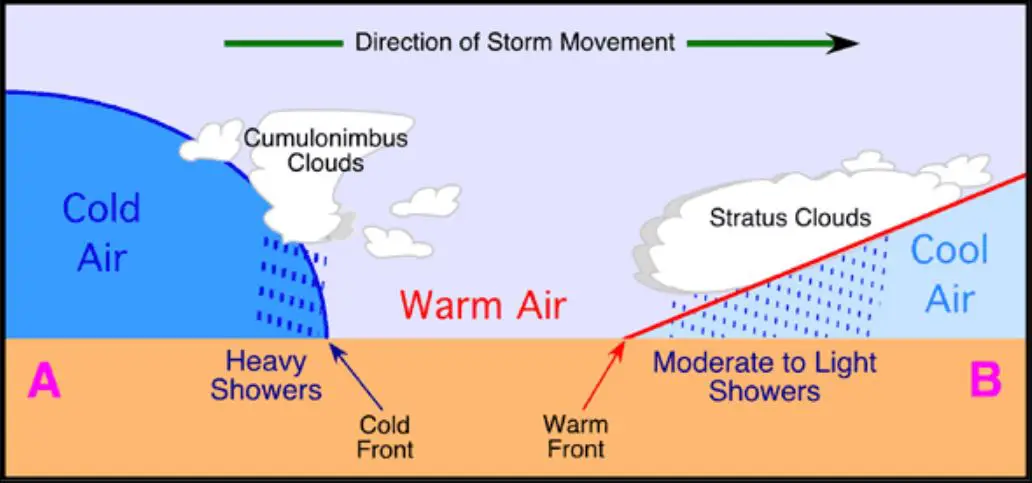
Cyclonic or frontal rainfall
Cyclonic or frontal rainfall occurs when two different air masses meet.
Process of formation
- Warm air (lighter) meets cold air (heavier)
- The cold air stays below, forcing the warm air to rise above it
- As the warm air rises, it cools down
- Water vapour condenses to form clouds
- Rain falls over a large area
Key feature
- Common in temperate regions (regions with moderate climate)
- Associated with cyclones and weather fronts
- Rainfall is usually steady and widespread, not sudden
Monsoonal Rainfall
Monsoonal rainfall is caused by seasonal changes in wind direction, known as monsoon winds.
Process of formation
- During certain seasons, winds blow from oceans toward land
- These winds carry a large amount of moisture
- When this moist air reaches land, it rises, cools, and forms clouds
- This results in heavy rainfall
Key idea
- Winds reverse direction with the change in seasons
- This reversal is the main reason for seasonal rainfall patterns
Importance
- Very important for regions like:
- South Asia
- Southeast Asia
- Supports:
- Agriculture
- Water supply
- Daily life of millions of people
- Very important for regions like:
World Distribution of Rainfall
Rainfall is not evenly distributed across the Earth.
General patterns:
- Equatorial regions receive heavy rainfall
- Rainfall decreases from equator to poles
- Coastal areas receive more rain than inland areas
- Oceans receive more rainfall than land
Based on location:
- 35°–40° latitude:
- More rain on eastern coasts
- 45°–65° latitude:
- More rain on western coasts (due to westerlies)
- 35°–40° latitude:
Mountain effect:
- More rain on windward side
- Less rain on leeward side (rain shadow)
| Region Type | Annual Rainfall |
|---|---|
| Heavy rainfall areas | More than 200 cm |
| Moderate rainfall areas | 100–200 cm |
| Low rainfall areas | 50–100 cm |
| Very low rainfall areas | Less than 50 cm |
Seasonal distribution of Rainfall:
- Some regions get rain throughout the year
- Others have seasonal rainfall (e.g., monsoon regions)