The term plate tectonics was first introduced by Tuzo Wilson from the University of Toronto. However, the Plate Tectonics Theory itself was formally presented in 1962 by W. J. Morgan of Princeton University.
Plate tectonics is a scientific theory that explains the large-scale movement of the Earth’s outer shell. It describes how seven major plates and several smaller plates of the Earth’s lithosphere have been moving over hundreds of millions of years.
This theory builds upon the earlier idea of continental drift, which emerged in the early 20th century. It gained widespread acceptance among scientists after the discovery of seafloor spreading in the late 1950s and early 1960s.
Plate Tectonics Theory
The Plate Tectonics Theory is a comprehensive explanation of the dynamic processes occurring within the Earth’s crust. It helps us understand how internal forces shape the Earth’s surface.
Key points about the development of this theory:
- It evolved during the 1960s, supported by extensive mapping of the ocean floor.
- It is based on two major ideas:
- Convection currents proposed by Arthur Holmes
- Seafloor spreading explained by Harry Hess
- It improves upon Wegener’s continental drift theory, offering a more complete and scientifically supported explanation.
- It is considered one of the most advanced and widely accepted theories explaining the movement of continents and ocean floors.
The Earth’s outer layer, called the lithosphere, is broken into several large and small pieces known as tectonic plates.
- There are 7–8 major plates and many (more than 20) minor plates.
- The way these plates interact creates different types of boundaries:
- Convergent boundaries
- Divergent boundaries
- Transform boundaries
Important geological activities occur along these boundaries:
- Earthquakes
- Volcanic eruptions
- Mountain formation
- Ocean trench formation
The plates move slowly, typically at a rate of 0 to 100 millimeters per year.
Postulates of Plate tectonics theory
The internal structure of the Earth, based on its mechanical properties, can be divided into three main layers:
- Lithosphere
- Asthenosphere
This theory does not follow the older classification of SIAL and SIMA.
Explanation of layers:
- Lithosphere
- The outermost rigid layer consisting of the crust and upper mantle
- About 100 km thick
- Less dense, so it floats over the layer beneath
- Asthenosphere
- A semi-fluid (plastic) layer below the lithosphere
- Allows tectonic plates to move smoothly.
- Lithosphere

According to the Plate Tectonics Theory:
- The lithosphere is broken into separate plates that float on the asthenosphere.
- These plates move due to convection currents in the mantle.
- The movement is mostly horizontal, and plates behave like rigid bodies.
- Additional details:
- Thickness of lithosphere:
- Oceanic regions: 5–100 km
- Continental regions: up to 200 km
- Oceanic plates:
- Thinner
- Made mostly of denser material
- Continental plates:
- Thicker
- Made of lighter material
- Thickness of lithosphere:
- Types of plates:
- Continental plates (e.g., Arabian Plate)
- Oceanic plates (e.g., Pacific Plate)
- Mixed plates (e.g., Indo-Australian Plate)
- The movement of these plates leads to:
- Formation of landforms
- Occurrence of earthquakes
- Volcanic activity
- Plate boundaries are zones of intense geological activity such as:
- Seafloor spreading
- Volcanism
- Mountain building
- Crustal deformation
Lithospheric Plates
A tectonic plate is a large, rigid segment of the lithosphere that floats on the asthenosphere and moves independently.
Types of plates:
- Continental plates
- Oceanic plates
Scientist Le Pichon divided the Earth’s surface into:
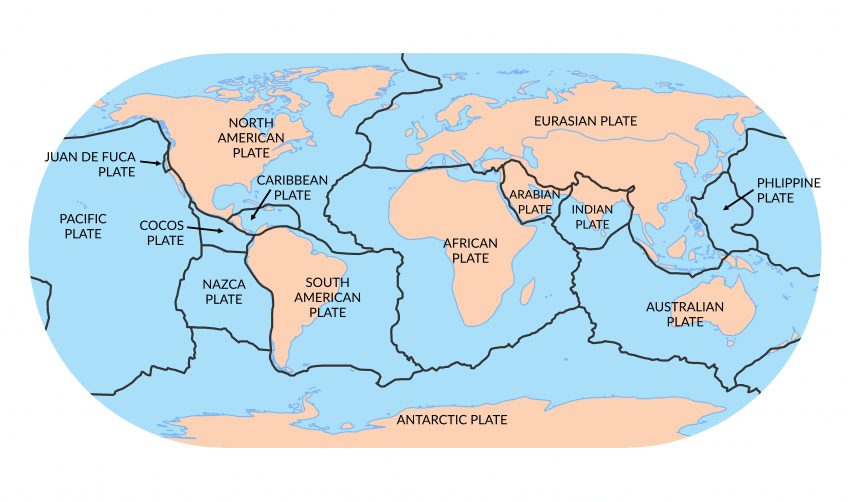
- 7 major plates
- 9 minor plates
Major tectonic plates
Here are the major plates and their characteristics:
- Antarctic Plate
- Surrounded mostly by divergent boundaries
- North American Plate
- Moves westward at about 4–5 cm/year
- Contains both oceanic and continental parts
- South American Plate
- Moves westward at 3–4 cm/year
- Half oceanic and half continental
- Pacific Plate
- Entirely oceanic
- Moves northwest at 2–3 cm/year
- Indo-Australian Plate
- African Plate (including eastern Atlantic floor)
- Eurasian Plate
- Mostly continental
- Moves eastward at 2–3 cm/year
Minor tectonic plates
Examples of smaller plates include:
- Arabian Plate
- Bismarck Plate
- Caribbean Plate
- Carolina Plate
- Cocos Plate
- Juan de Fuca Plate
- Nazca Plate
- Philippine Plate
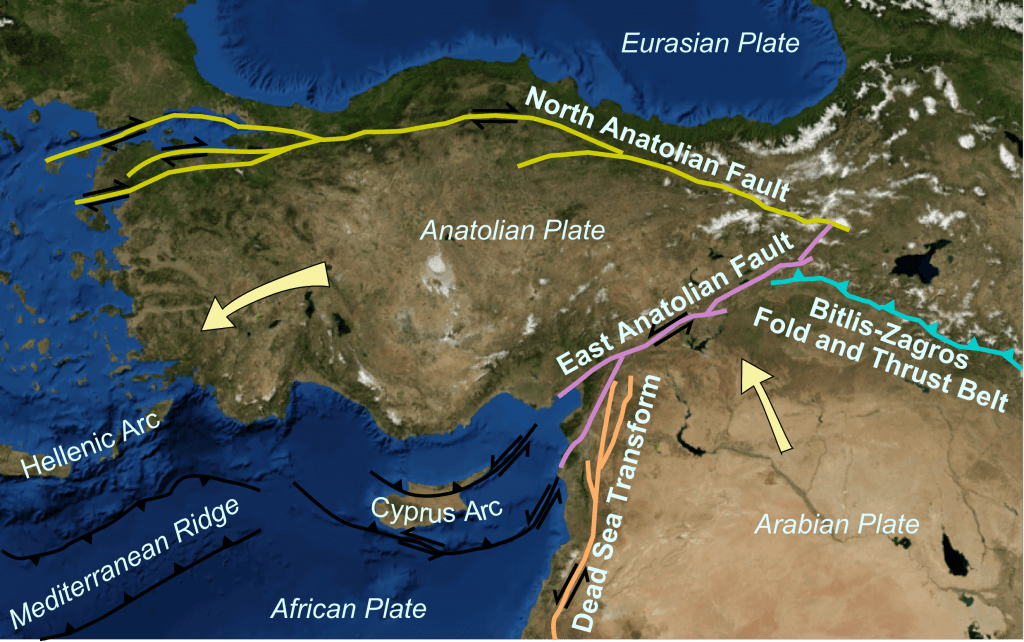
- Anatolian Plate
- China Plate
- Fiji Plate
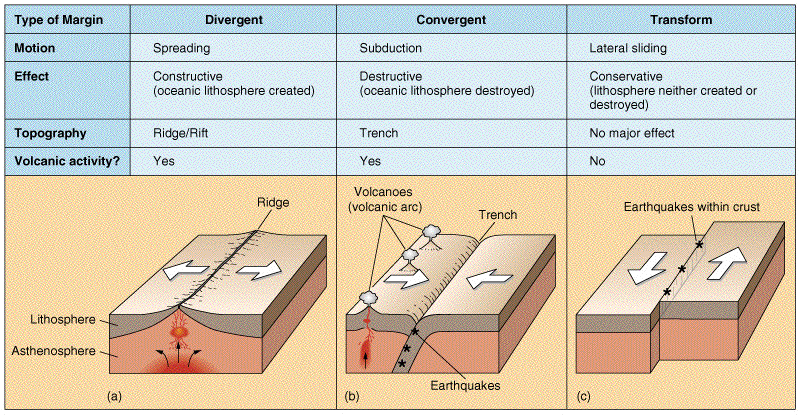
Three types of motion are possible between the plates:
- Divergent (separating) boundaries
- Convergent (colliding) boundaries
- Transform (sliding) boundaries
Divergent Boundaries
A divergent boundary forms when two tectonic plates move away from each other.
What happens at these boundaries:
- Magma rises from beneath the Earth’s surface
- Lava emerges through cracks and solidifies
- New crust is formed as the plates separate
Key processes:
- Magma cools to form basalt, a dense rock found on the ocean floor
- Continuous formation of new oceanic crust
Main features:
- Mid-ocean ridges
- Rift valleys
- Fissure volcanoes
Continental rift valleys are also formed when divergence occurs within a continent.
Examples include:
- East African Rift Valley
- Baikal Rift Valley
- West Antarctic Rift
- Rio Grande Rift

Convergent Boundaries
A convergent boundary occurs when two plates move toward each other and collide.
Effects of collision:
- Formation of mountain ranges
- Creation of deep ocean trenches
- Occurrence of strong earthquakes
- Development of volcanic chains
If one plate is oceanic:
- It sinks beneath the other in a process called subduction
- The sinking plate melts and forms magma
- This magma rises and forms new crust, often granite, which makes up continents
Types of convergent boundaries:
- Oceanic–continental convergence
- Oceanic–oceanic convergence
- Continental–continental convergence
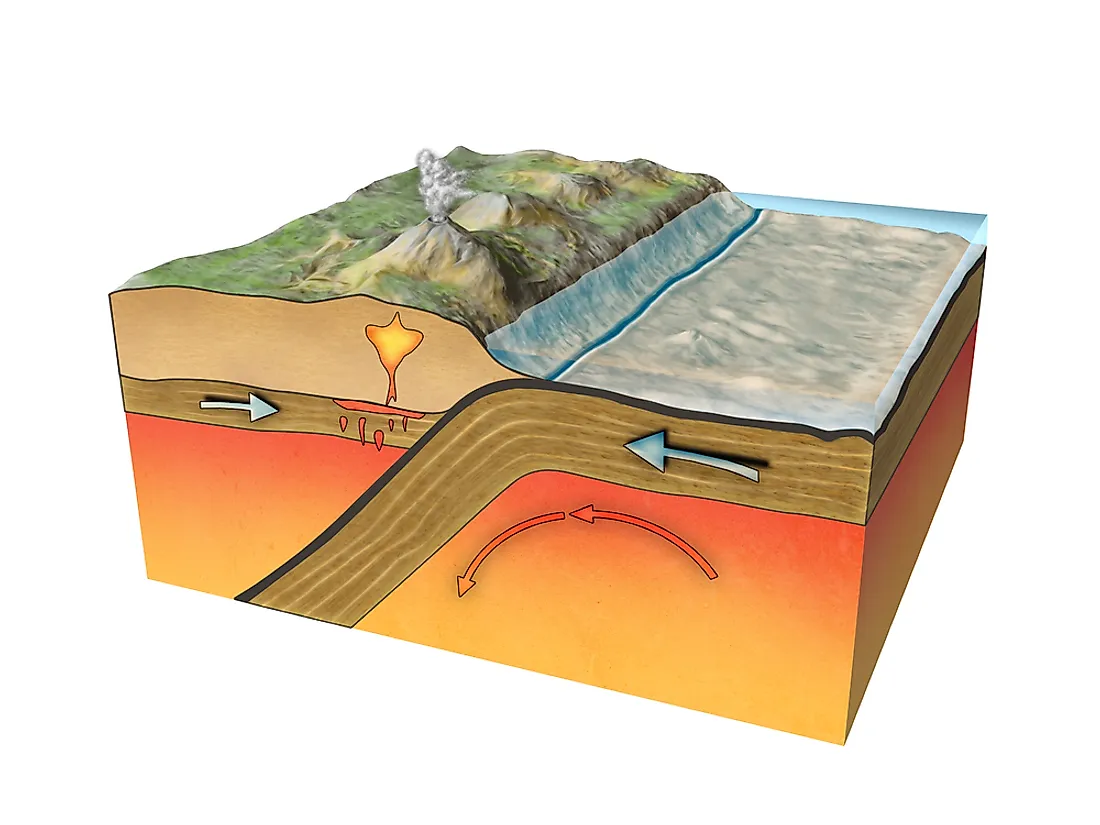
Oceanic–Continental Convergence
- The denser oceanic plate sinks beneath the continental plate
- This process is called subduction
- The sinking plate pulls the rest of the plate, known as slab pull
Oceanic–Oceanic Convergence
- One oceanic plate subducts beneath another
- Formation of:
- Ocean trenches
- Volcanic island arcs
- Over time, these arcs can grow into island chains like:
- Aleutian Islands
- Mariana Islands
- Japan
- Sumatra and Java

Continental-Continental Convergence
- Two continental plates collide
- Sediments between them are compressed and uplifted
- This leads to the formation of fold mountains
Examples:
- Himalayas
- Alps

Transform Fault Boundaries
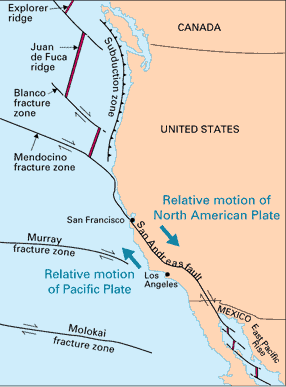
A transform boundary occurs when two plates slide past each other horizontally.
Characteristics:
- No new crust is formed or destroyed
- Existing landforms are deformed
- Movement causes earthquakes
Important examples:
- San Andreas Fault (USA)
- North Anatolian Fault (Turkey)