
Origin of Atmosphere
Other planets and moons in our solar system do have atmospheres, but none of them are suitable for supporting life as we understand it. Some atmospheres are extremely dense, such as on Venus, making the surface unbearably hot and pressurized. Others are too thin, like on Mars, meaning they cannot hold enough heat or gases. Most importantly, these atmospheres lack sufficient oxygen, which is essential for humans and many other living organisms to breathe and survive.
So, what makes Earth’s atmosphere so unique and life-supporting?
Scientists generally explain the development of Earth’s atmosphere in three major stages, each contributing step by step to the environment we experience today.
Origin of Atmosphere
- Earth is believed to have formed around 5 billion years ago. At that time, the planet was extremely hot, almost like a ball of molten rock, and its surface was not stable.
- In the first 500 million years, a thick atmosphere began forming due to the release of gases trapped deep inside the Earth.
- As Earth slowly cooled, gases and water vapor escaped from its interior rocks. This process is known as degassing, and it played a key role in forming the early atmosphere.
- The early gases released likely included:
- Hydrogen (H2) – a very light gas that can easily escape into space
- Water vapor (H2O) – which later formed clouds and oceans
- Methane (CH4) – a gas often associated with organic processes
- Carbon oxides – including carbon dioxide and carbon monoxide
- Before about 3.5 billion years ago, the atmosphere mainly contained:
- Carbon dioxide (CO2) – a gas that traps heat
- Carbon monoxide (CO)
- Water vapor (H2O)
- Nitrogen (N2) – which is now the most abundant gas in our atmosphere
- Hydrogen (H2)
- Around 4 billion years ago, as the planet cooled further, water vapor in the atmosphere began to condense into liquid water. This led to the formation of Earth’s hydrosphere, which includes oceans, seas, and other water bodies.
- Rain fell continuously for long periods, filling low-lying areas
- Oceans formed, allowing sediments (small particles of rock and minerals) to settle at the bottom
- A key feature of this early atmosphere was the absence of free oxygen. This means there was no oxygen available for breathing, making it impossible for most modern life forms to exist.
- This type of environment is called an anaerobic (oxygen-free) atmosphere. Scientists know this because ancient rocks contain elements like iron and uranium in reduced forms, which only remain unchanged when oxygen is absent.
- About 1 billion years ago, tiny aquatic organisms called blue-green algae (also known as cyanobacteria) began to change everything. These organisms lived in water and used sunlight to produce their own food through a process called photosynthesis.
- They used sunlight, water (H2O), and carbon dioxide (CO2)
- They produced organic matter (food) and oxygen (O2) as a by-product
- At first, much of this oxygen reacted with other substances, but eventually, it began to accumulate in the atmosphere.
- This increase in oxygen reduced carbon dioxide levels
- It also caused major changes in the environment, making it difficult for organisms that could not survive in oxygen
- High in the atmosphere, oxygen molecules absorbed ultraviolet (UV) radiation from the Sun. This caused them to split into single oxygen atoms. These atoms then combined with other oxygen molecules to form ozone (O3).
- The ozone layer acts like a protective shield surrounding Earth
- It blocks harmful UV rays that can damage living cells
- By around 600 million years ago, enough ozone had formed to protect life effectively. At that time, oxygen levels were about 10% of what they are today.
- Before this protection existed, life could only survive in water, which acted as a natural shield against harmful radiation. With the formation of the ozone layer, organisms were finally able to live and evolve on land. This made ozone extremely important for the development of life on Earth.
3 Phases of Atmosphere Formation
Just formed Earth:
- In the earliest stage, Earth’s atmosphere consisted mainly of hydrogen (H2) and helium (He). These were the most common gases present in the early solar system.
- The planet was extremely hot, causing gas molecules to move very fast
- Because hydrogen and helium are very light, they could easily escape Earth’s gravity
- Over time, these gases drifted away into space
- As a result, Earth’s first atmosphere did not last long.

Origin of Atmosphere
Origin of Atmosphere phase 1 (Young Earth) :
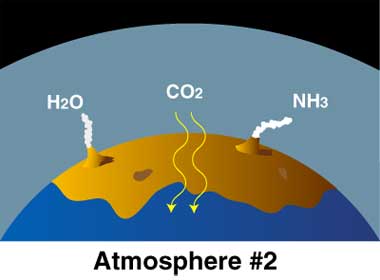
- As Earth cooled slightly, volcanic eruptions became very common. These volcanoes released large amounts of gases, forming a new atmosphere.
- Volcanoes released:
- Water vapor (H2O) in the form of steam
- Carbon dioxide (CO2)
- Ammonia (NH3)
- Important developments during this phase:
- Water vapor cooled and contributed to the formation of oceans
- Carbon dioxide began to dissolve in seawater
- Simple microorganisms started using sunlight and CO2 to survive
- These organisms released oxygen (O2) as a waste product
- This stage is known as Earth’s second atmosphere, as it formed from internal geological activity rather than leftover gases from space.
Origin of Atmosphere phase 2 (Current Earth) :
- Over millions of years, life and the atmosphere began to influence each other, creating a balanced system.
- Plants take in carbon dioxide (CO2) and release oxygen (O2) through photosynthesis
- Animals breathe in oxygen and release carbon dioxide
- Human activities like burning fuels also add carbon dioxide to the air
- Other important processes:
- Large amounts of CO2 were absorbed by the oceans
- Oxygen levels gradually increased due to continuous photosynthesis
- Ammonia molecules were broken down by sunlight into nitrogen and hydrogen
- Hydrogen escaped into space, while nitrogen remained, becoming a major part of the atmosphere

Origin of Atmosphere phase 3
- This phase represents the formation of the modern atmosphere, also known as Earth’s third atmosphere.
- It contains enough oxygen to support complex life, including humans and animals
- A natural balance exists between oxygen and carbon dioxide
- In simple terms:
- Plants and certain bacteria produce oxygen
- Animals depend on oxygen and release carbon dioxide
- This creates a continuous cycle of gases that supports life. Remarkably, the atmosphere we depend on today was largely created and maintained by living organisms themselves.
Do you know – Formation of the layered structure in the lithosphere ?
- In its earliest stage, Earth was in a highly unstable and molten (semi-liquid) condition, meaning its materials were not solid and could move freely.
- As time passed:
- The internal temperature increased due to pressure and density changes
- Materials inside Earth began to separate based on their densities
- This process is called differentiation, which simply means sorting materials by weight.
- Heavier materials like iron sank toward the center
- Lighter materials rose toward the surface
This led to the formation of different layers inside Earth:
| Layer | Description |
|---|---|
| Crust | The thin, outer layer where all living organisms exist |
| Mantle | A thick layer of hot, semi-solid rock beneath the crust |
| Outer Core | A liquid layer mainly composed of iron and nickel |
| Inner Core | The solid, extremely hot central part of Earth |
As we move from the surface toward the center, the density of materials increases, giving Earth its well-organized internal structure.
Let us know any further suggestions ,we at sudurbhai.com will be happy to hear from you in our comment section below !