
The Earth was formed about 4.54 billion years ago. This is an extremely long period, difficult to imagine. To understand this better, think of Earth’s history as a 24-hour clock—humans would appear only in the last few seconds.
Understanding the origin of Earth is not limited to just one subject. It involves cosmology (study of the universe), astrophysics (study of stars and space), and geology (study of Earth).
There are two major theories that explain how everything began:
- Big Bang Theory → Explains how the universe began
- Nebular Hypothesis → Explains how the solar system and Earth were formed
In simple terms:
- The Big Bang Theory explains how everything started.
- The Nebular Hypothesis explains how Earth specifically was formed.
BIG BANG THEORY (Origin of Universe)
Concept
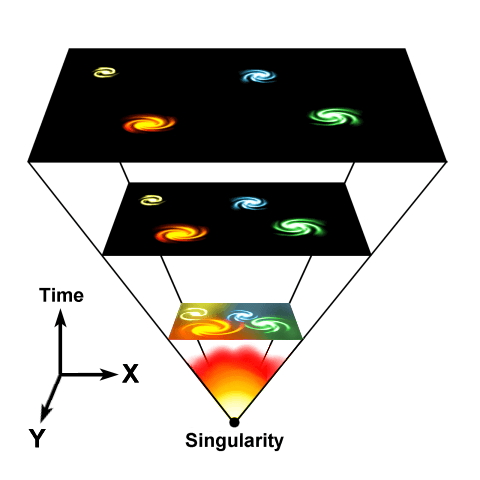
The Big Bang Theory, proposed by Georges Lemaître in 1927, suggests that the universe started from a very small, extremely hot, and dense point called a:
- Singularity – This event is known as the Big Bang. It was not an explosion like a bomb, but rather a rapid expansion of space itself.
To understand this, imagine stretching a rubber sheet. The sheet itself expands, carrying everything on it farther apart.
Key Features
- Singularity
A point where all matter and energy of the universe were concentrated in an extremely small space. - Expansion of Universe
The universe is still expanding today. This was discovered through Hubble’s Law, which shows that galaxies are moving away from each other. - Cooling of Universe
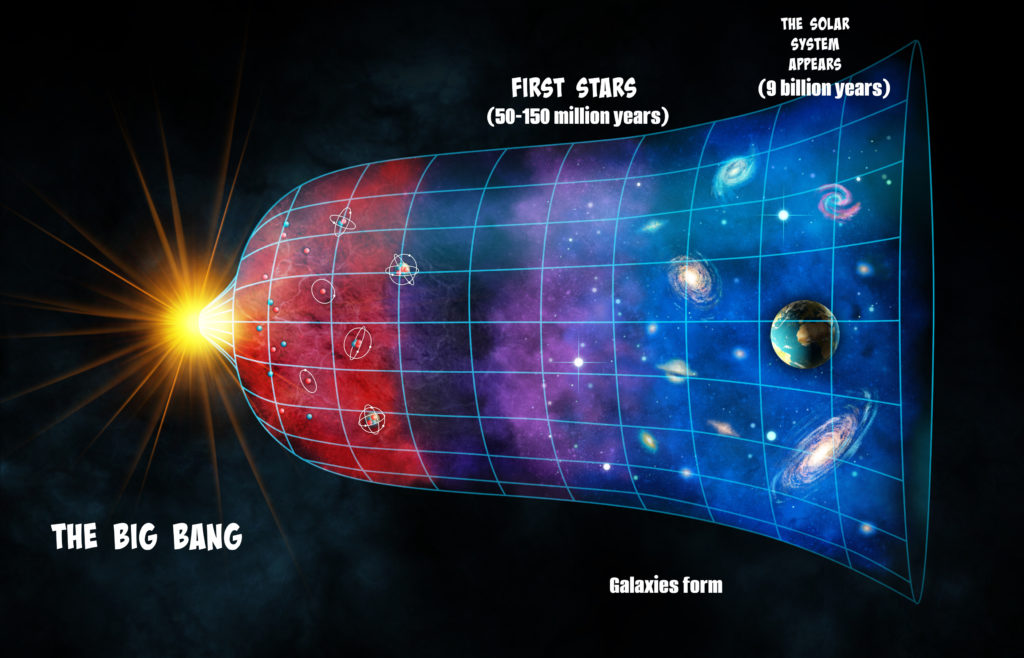
As the universe expanded, it cooled down. This cooling allowed particles to combine and form atoms, stars, and galaxies.
For Example: Imagine hot steam cooling down to form water droplets. Similarly, the universe cooled to form matter.
Stages of Evolution
| Time After Big Bang | What Happened (Simple Explanation) |
|---|---|
| ~13.8 billion years ago | The Big Bang occurred and the universe began |
| First 3 minutes | Tiny particles like protons, neutrons, and electrons formed |
| After 3 lakh years | These particles combined to form atoms, mainly hydrogen and helium |
| Millions of years later | Atoms grouped together to form stars and galaxies |
An important process here is Nucleosynthesis, which means the formation of atomic nuclei.
Evidence Supporting Big Bang
- Red Shift
Light from distant galaxies shifts toward the red end of the spectrum. This shows that galaxies are moving away, meaning the universe is expanding. - Cosmic Microwave Background Radiation (CMBR)
Discovered by Penzias and Wilson in 1965, this is the leftover heat from the Big Bang. - Abundance of Light Elements
The universe contains a large amount of hydrogen and helium, which supports the theory.
CMBR can be compared to the warmth left in a room after a fire has been extinguished.
Limitations
The Big Bang Theory does not explain:
- What existed before the Big Bang
- What caused the singularity to expand
NEBULAR HYPOTHESIS (Formation of Solar System)
Concept
The Nebular Hypothesis was first proposed by Immanuel Kant in 1755 and later improved by Laplace in 1796.
It explains that the solar system formed from a large cloud of gas and dust called a: Nebula
Basic Idea
According to this theory, the solar system began as a rotating cloud of gas and dust, mainly hydrogen and helium.
Due to gravity, this cloud slowly collapsed and started forming the Sun and planets.
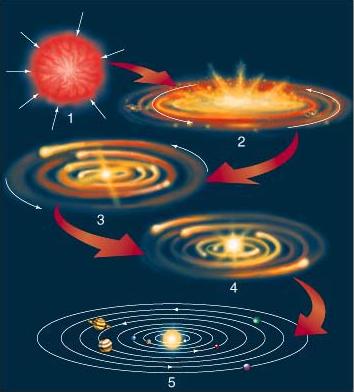
Process of Formation (Step-by-Step)
Step 1: Formation of Nebula
A huge cloud of gas and dust existed in space.
Step 2: Gravitational Collapse
Gravity pulled the particles closer together, causing the cloud to shrink. As it shrank, it began spinning faster.
This happens because of Angular Momentum, which means that when an object becomes smaller, its speed of rotation increases.
For Example: A spinning ice skater rotates faster when they pull their arms inward.
Step 3: Formation of Protoplanetary Disk
The spinning cloud flattened into a disk shape. The center became very dense and formed the Proto-Sun.
Step 4: Formation of Planetesimals
Small particles collided and stuck together to form larger bodies called:
Planetesimals (small building blocks of planets)
Step 5: Accretion Process
Planetesimals continued to collide and combine to form larger bodies.
Accretion means growth by collision and sticking together.
Step 6: Formation of Planets
These larger bodies, called Protoplanets, eventually developed into planets like Earth.
Differentiation of Earth
In its early stage, Earth was extremely hot and in a molten (liquid) state due to:
- Radioactive decay
- Gravitational compression
Because of this heat, materials separated based on their weight.
| Layer | Composition | Explanation |
|---|---|---|
| Core | Iron and Nickel | Heavier elements sank to the center |
| Mantle | Silicate rocks | Medium-weight materials stayed in the middle |
| Crust | Light elements | Lighter materials rose to the surface |
This process is similar to oil floating on water, where lighter substances rise and heavier ones sink.
Key Terms (Simple Meaning)
- Nebula → A cloud of gas and dust in space
- Accretion → Growth by particles sticking together
- Planetesimals → Small bodies that form planets
- Protoplanet → Early stage of a planet
- Angular Momentum → Tendency of a spinning object to keep spinning
Supporting Evidence
- Scientists have observed protoplanetary disks around young stars
- All planets formed around the same time (about 4.5 billion years ago)
- Inner planets and outer planets have different compositions
Limitations
This theory cannot fully explain:
- The exact distribution of angular momentum
- Some irregular movements of planets
COMPARISON: BIG BANG vs NEBULAR HYPOTHESIS
| Aspect | Big Bang Theory | Nebular Hypothesis |
|---|---|---|
| Scope | Origin of Universe | Formation of Solar System |
| Time | ~13.8 billion years ago | ~4.6 billion years ago |
| Scale | Entire universe | Only solar system |
| Focus | Matter, energy, galaxies | Sun and planets |
The Big Bang Theory explains how the universe began, while the Nebular Hypothesis explains how the Earth and solar system formed.
Together, these theories give us a complete understanding of how Earth evolved—from a cloud of gas and dust to a planet capable of supporting life.