Limestone & chalk
Limestone and chalk are types of sedimentary rocks, which means they are formed from materials that settle in layers over time. In this case, they originate from the remains of marine organisms such as shells, corals, and tiny sea creatures that accumulate on the ocean floor.
- Limestone is mainly composed of calcium carbonate (calcite) and may also contain magnesium in the form of dolomite
- Chalk is a pure, soft, and white variety of limestone, commonly found in fine-grained form
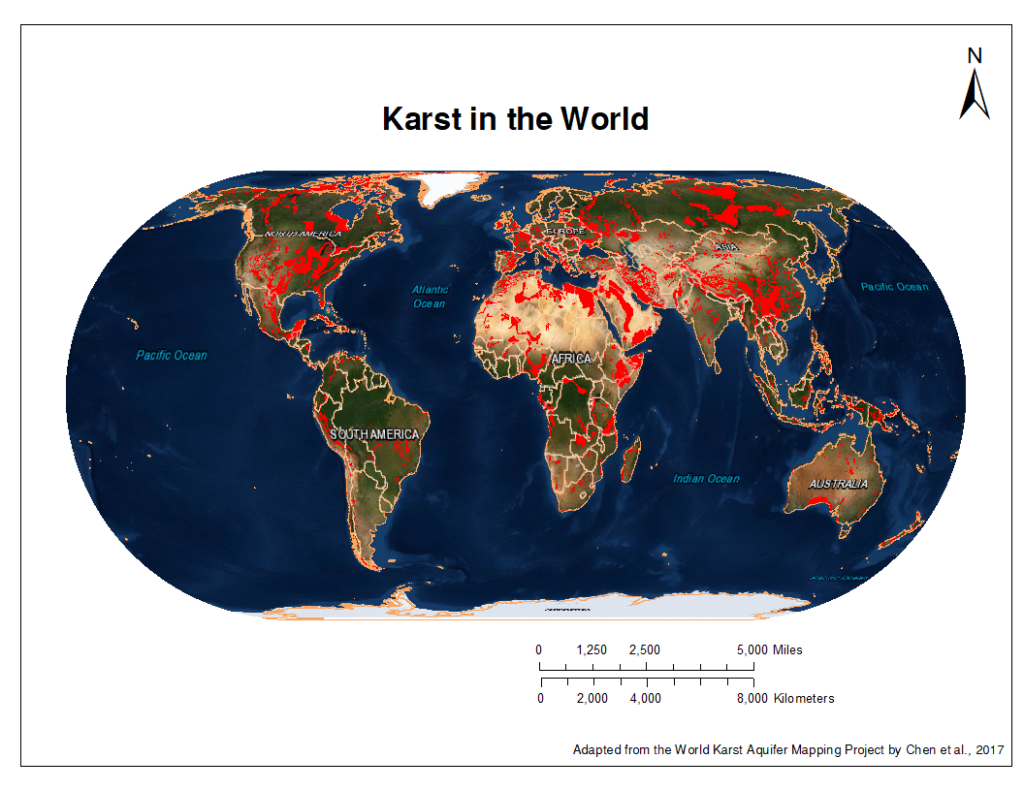
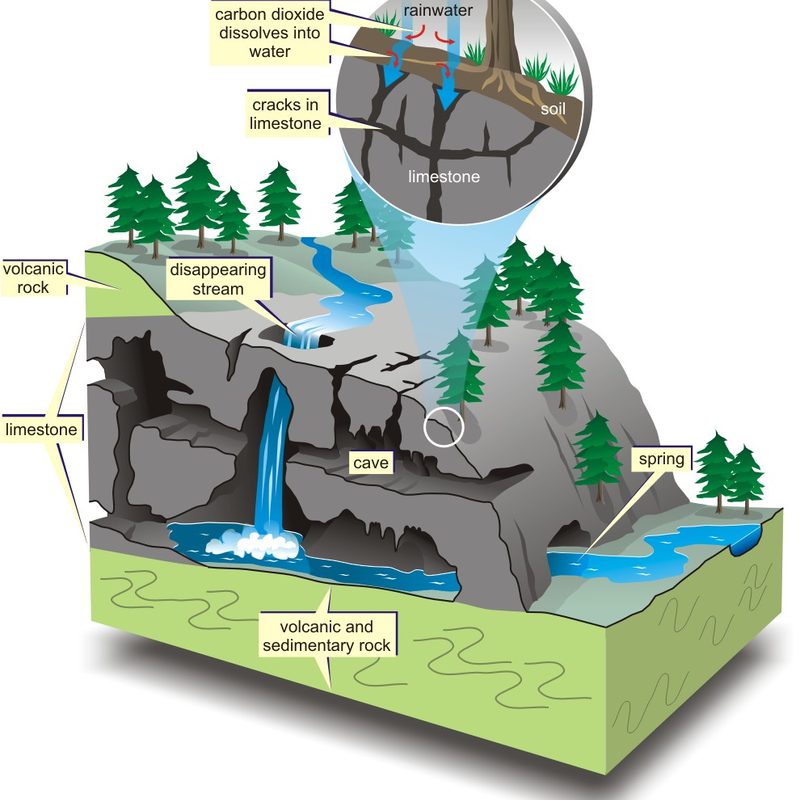
Rainwater plays a key role in karst formation. When rainwater mixes with carbon dioxide in the air, it forms a weak acid known as carbonic acid. This weak acid slowly dissolves limestone, leading to the formation of karst landscapes.
A region with a large amount of limestone will therefore develop a distinct landscape, known as a karst region.
Characteristics of Karst Landforms
Karst regions have several unique and easily noticeable characteristics. These features may look unusual compared to other landscapes:
- The land often appears rocky, uneven, and barren, with very little soil cover
- There is usually an absence of rivers and streams on the surface, because water quickly seeps underground
- Surface valleys are often dry, even if rainfall is present
- Water flows through cracks and joints in rocks, forming underground drainage systems
- When underground water reaches a non-porous layer, it may reappear on the surface as a spring
- Other important surface features include:
- Limestone pavements, which are flat rock surfaces broken into blocks
- Grikes, which are deep cracks or fissures
- Clints, which are the rectangular rock blocks between grikes
- Karst regions also contain many depressions formed by the dissolving action of water:
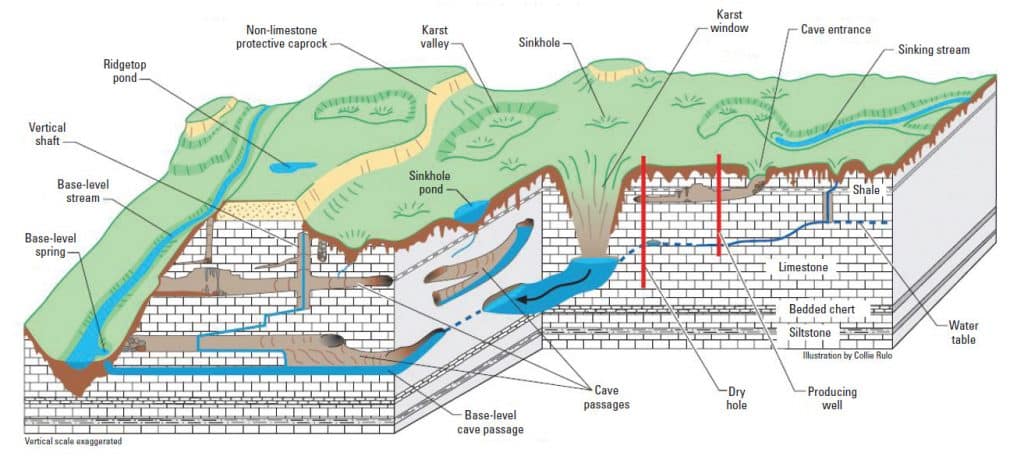
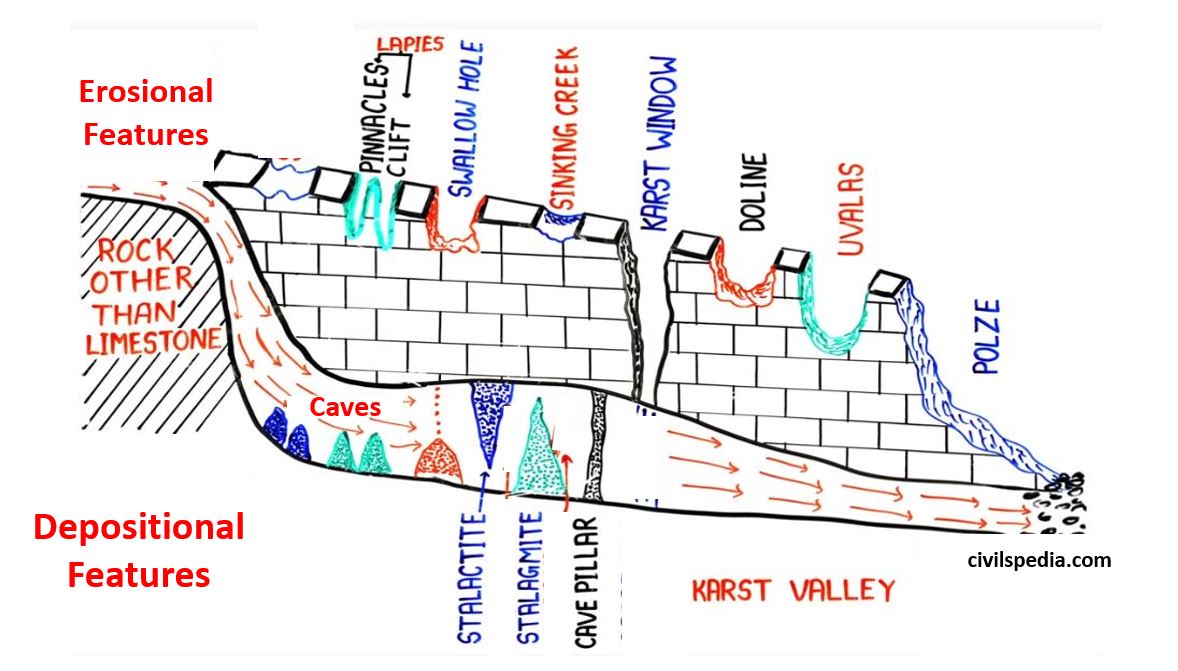
- Swallow holes (sinkholes): small openings where water enters the ground
- Dolines: larger depressions formed by the merging of several sinkholes
- Uvalas: even larger depressions created by the joining of multiple dolines
- Polje: very large, flat-bottomed depressions that can extend over vast areas
- Underground, karst landscapes are equally fascinating:
- Water creates caves and caverns by dissolving rock along cracks
- These caves may contain underground streams, ponds, or lakes
- Inside caves, special formations develop due to mineral deposits:
- Stalactites hang from the ceiling
- Stalagmites rise from the floor
- When both join together, they form pillars
- These features form when mineral-rich water drips and leaves behind calcium carbonate deposits over time.
Karst topography : Erosional landforms
Blind Valley
- A blind valley is a deep and narrow valley that suddenly ends.
- This happens because the stream flowing through the valley disappears underground instead of continuing on the surface.

Swallow Hole/Sinkholes/Doline
- A sinkhole is a depression or hole in the ground formed when the surface collapses or when rock is dissolved below the surface. These features allow water to flow underground.
- Common terms used for sinkholes in different regions:
- Black hole: associated with seawater
- Blue hole: deep underwater sinkholes
- Cenotes: found in Belize
- Sotanos: found in Mexico
- Tomo: found in New Zealand
Clift
- A clift is formed when a solution hole becomes deeper over time, creating a noticeable depression.
Pinnacles
- Pinnacles are tall, sharp rock formations created when surrounding rock is dissolved, leaving behind pointed structures.
Lapies/Karren
- These are grooved or ridged patterns on limestone surfaces, formed due to uneven dissolution along cracks and joints.
Limestone Pavements
- These are relatively flat limestone surfaces divided into blocks, separated by cracks known as grikes.
Sinking Creeks/Bogas
- These refer to streams that disappear into cracks or fissures in the ground. If the opening is clearly visible, it is called a boga.
Karst Window/Fenster
- A karst window forms when part of a cave roof collapses, allowing us to see an underground stream from the surface.
Uvalas
- Uvalas are large depressions formed by the merging of multiple sinkholes, often containing smaller depressions within them.
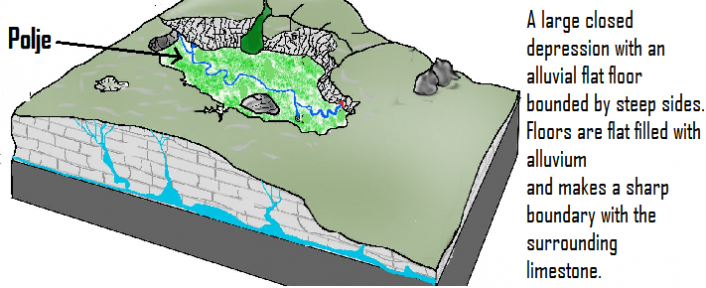
Polje
- A polje is a very large, flat depression in a karst region, often used for agriculture due to relatively better soil conditions.
Pools
- These are water-filled depressions that vary in size and depth.
Caves/Cavern
- Caves are underground spaces formed by the dissolving action of water in limestone areas. They are especially common where layers of different rocks are present.
Karst Lake
- Karst lakes form when underground cavities collapse and fill with water. These lakes may be temporary and often depend on rainfall levels.
Karst topography : Depositional landforms
Speleothems
- Speleothems are mineral formations found inside caves, created by the deposition of dissolved minerals, mainly calcium carbonate.
- They can take a variety of forms, depending on their depositional history and environment.
Stalactites & Helictite
- Stalactites are formations that hang from cave ceilings, created by dripping water
- Helictites are unusual formations that grow in curved or sideways directions, influenced by air movement and water pressure
Stalagmites & Halagmite
- Stalagmites grow upward from the cave floor due to mineral deposits
- Halagmites extend in sideways or slanting directions

Cave Pillars
- These are formed when stalactites and stalagmites join together, creating solid vertical columns.
Drapes/Curtain
- These are thin, sheet-like mineral deposits hanging from cave ceilings, resembling curtains.
Tufa
- Tufa is a soft and porous form of limestone formed when calcium carbonate settles out of water at normal temperatures.
Travertine
- Travertine is a denser and more compact form of limestone, formed from mineral-rich water in springs and rivers.
Drip Stone
- Dripstone is a general term for all mineral deposits formed by dripping water in caves, including stalactites and stalagmites.
Terra Rossa
- Terra rossa is a reddish soil found in karst regions, known for being well-drained and moderately fertile.
Human activities of Karst region
Karst regions present several challenges for human settlement and agriculture:
- The soil layer is usually thin and not very fertile
- Water is mostly found underground, making surface water scarce
- Vegetation is often limited to grasses and sparse plants
However, in tropical regions with heavy rainfall, vegetation can be more abundant and dense.
Despite these challenges, karst regions have economic importance:
- Limestone areas may contain valuable minerals like lead
- Limestone is widely used in construction, especially as a building material
- It is also a key raw material in the cement industry, making it highly valuable for development.