
Transport and Communication in Assam
Jet Stream
Jet streams are extremely fast-moving winds found high up in the Earth’s atmosphere. They flow in narrow bands within the upper layers of air, known as upper air westerlies. These wind bands are typically:
- 160 to 480 km wide
- 900 to 2150 meters thick
- Capable of reaching speeds over 300 km per hour
Because of their powerful speed, aircraft usually avoid flying directly against them, as this would increase travel time and fuel consumption.
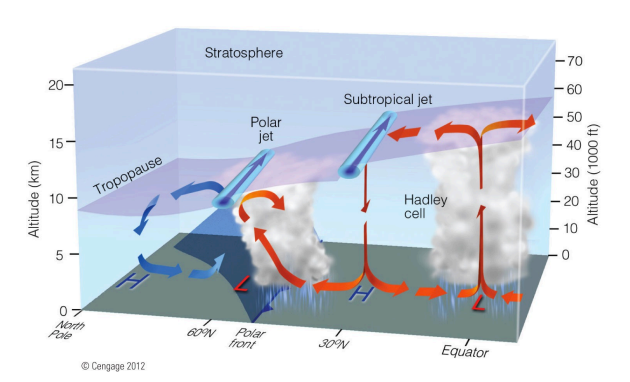
Jet streams are closely linked to major breaks in the tropopause, the boundary between the troposphere and the stratosphere.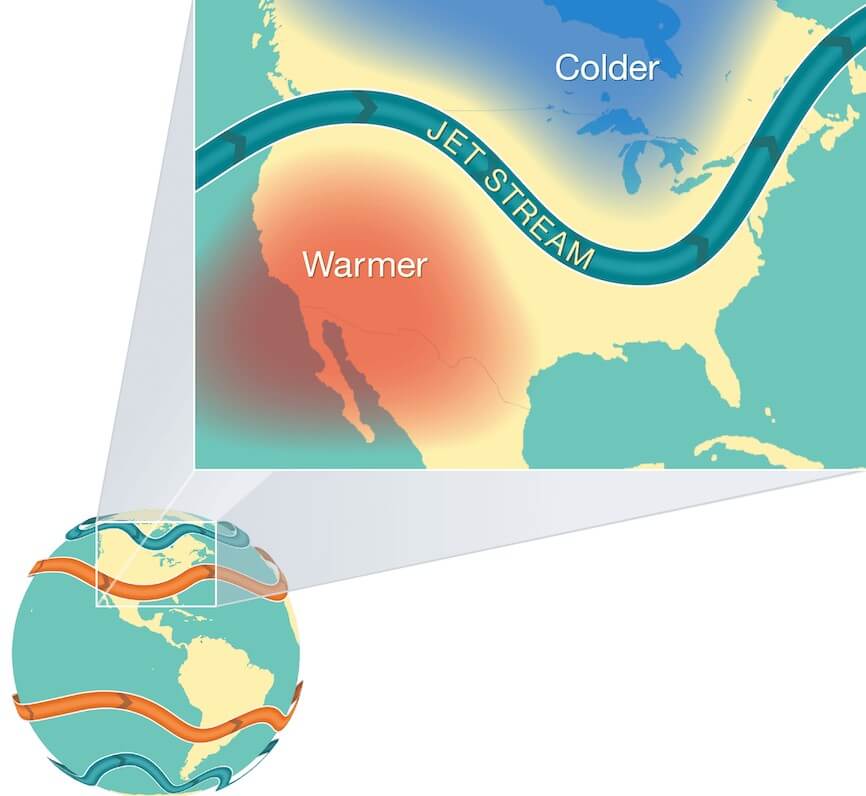 Jet Stream is a geostrophic wind that flows horizontally in the upper part of the troposphere, usually moving from west to east.
They form when air masses with different temperatures meet. This means that the difference in surface temperature plays a key role in determining where jet streams develop.
- Greater temperature difference leads to faster wind speeds
- They are generally found between 20° latitude and the poles in both hemispheres
Characteristics of Jet Stream;
In simple terms, jet streams are:
- Circumpolar: They circulate around the Earth’s poles
- Narrow and concentrated: Not spread out, but confined to tight bands
- High-speed winds: Among the fastest winds on Earth
- Located in the upper troposphere
- Bounded by slower winds on either side
- A part of the global westerly wind system
Geostrophic Wind
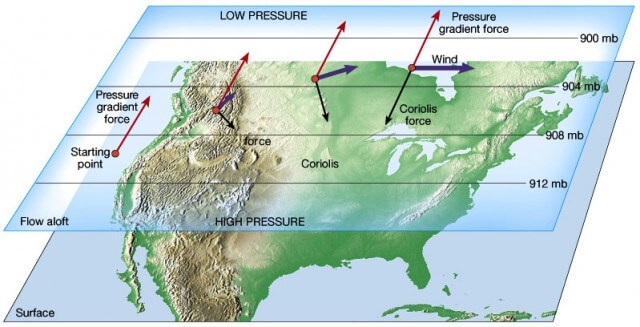
Geostrophic wind refers to a theoretical type of wind that occurs when two major forces are perfectly balanced:
- Pressure Gradient Force (PGF): Pushes air from high-pressure areas to low-pressure areas
- Coriolis Force: Deflects moving air due to Earth’s rotation

Key Points About Geostrophic Wind
- In the upper atmosphere (about 2–3 km above Earth’s surface), friction is minimal
- Winds here are mainly influenced by:
- Pressure differences
- Earth’s rotation
How It Forms
- Air initially moves from high pressure to low pressure due to PGF
- As it starts moving, the Coriolis force deflects it:
- To the right in the Northern Hemisphere
- To the left in the Southern Hemisphere
- As speed increases, deflection increases until both forces balance
- At this stage:
- Wind flows parallel to isobars (lines of equal pressure)
- This balanced flow is called geostrophic wind
Why Winds Don’t Flow Directly from Tropics to Poles
- Technically, winds should blow from High pressure region (near poles) to Low pressure region (near equator).
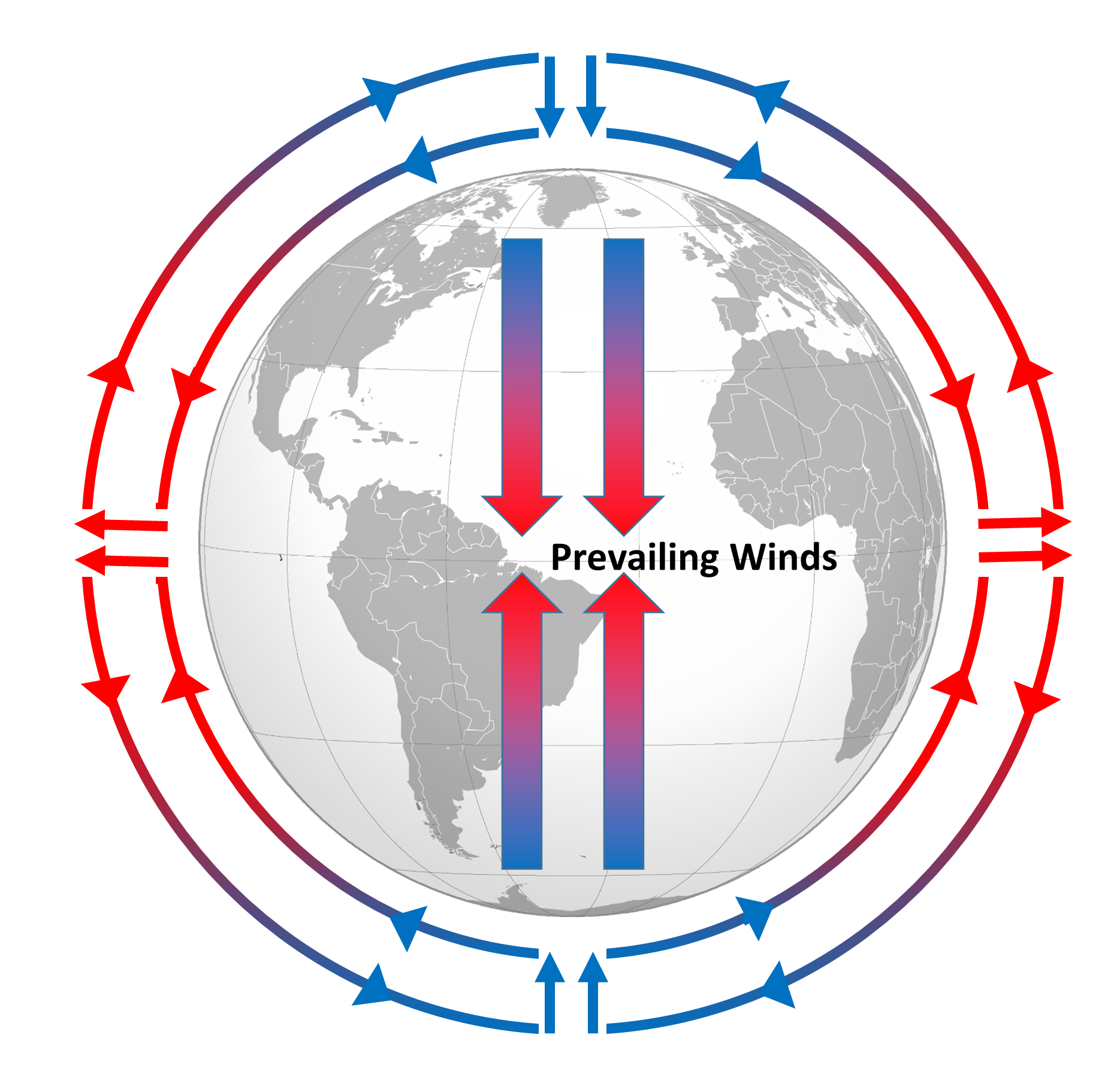
- Instead of moving straight from tropical high-pressure areas to polar low-pressure areas:
- Winds are strongly influenced by the Coriolis force
- This causes them to curve significantly
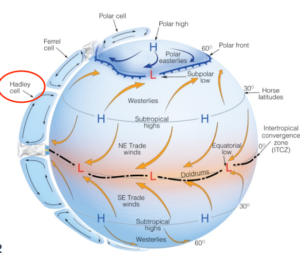
- As a result, the atmosphere forms three major circulation cells:
- Hadley Cell
- Ferrel Cell
- Polar Cell
- These three cells together distribute heat across the planet instead of one single large circulation system.
Genesis of Jet Streams
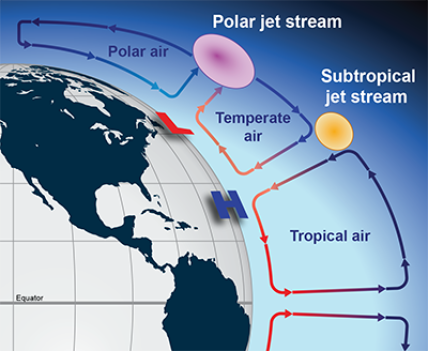
- Jet streams are formed due to three main gradients:
- Temperature gradient between the equator and the poles
- Pressure gradient between the equator and the poles
- Pressure differences between surface and upper air, especially over polar regions
- These gradients create strong forces that drive high-speed winds.
Characteristics of Jet Stream
Jet streams have several important features:
- Very high speed: Often between 400–500 km per hour, due to strong temperature contrasts
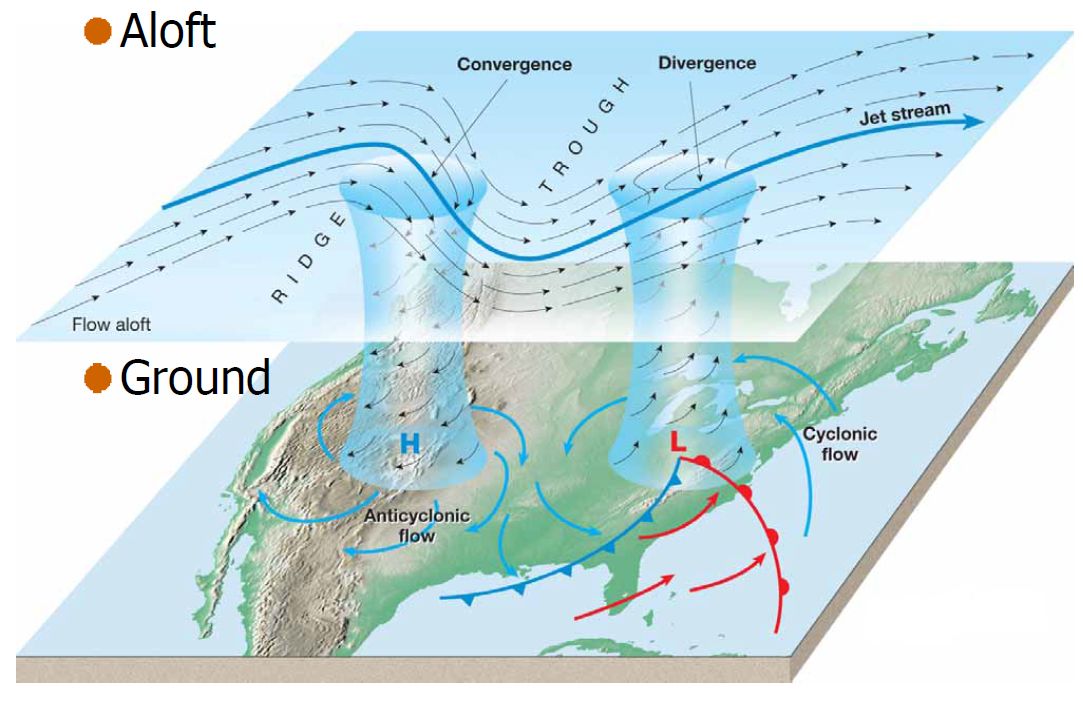
- Meandering pattern: They follow a wavy path around the globe
- Three-dimensional flow: Includes upward and downward motion
- Formation of crests (ridges) and troughs (dips)
- Size and Dimensions
- Width: About 10–12 km
- Depth: Around 2–3 km
- Length: Can extend up to 3000 km
- Other Features
- Located just below the tropopause
- Show seasonal shifts depending on the Sun’s position
- Move from west to east in both hemispheres
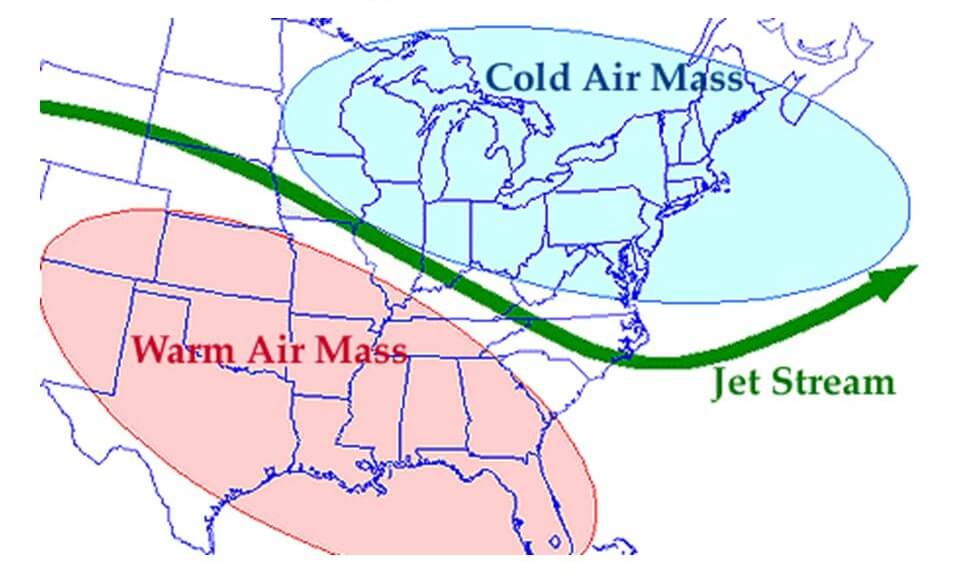
- Form where cold and warm air masses meet, creating strong thermal contrast
Types of jet Streams
- Jet streams are classified based on their location and origin:
- Polar Front Jet Streams
- Subtropical Westerly Jet Streams
- Tropical Easterly Jet Streams
- Polar Night Jet Streams
- Local Jet Streams
- They can also be grouped as:
- Permanent jet streams
- Subtropical jets (low latitudes)
- Polar front jets (mid-latitudes)
- Temporary jet streams
- Tropical Easterly Jet
- African Easterly Jet
- Somali Jet
- Permanent jet streams
Polar Front Jet Streams
- Form above regions where cold polar air meets warm tropical air (around 40°–60° latitude)
- Move generally eastward, but in an irregular pattern
Subtropical Westerly jet Streams
- Develop around 30°–35° latitude
- Located in the upper troposphere, just north of subtropical high-pressure zones
- Sometimes referred to as stratospheric subpolar jets
Tropical Easterly jet streams
- Form over India and Africa during summer
- Caused by intense heating of the Tibetan Plateau
- Play a crucial role in the Indian monsoon system
Polar Night Jet Streams
- Occur during winter near the poles
- Caused by sharp temperature differences in the stratosphere
Local Jet Streams
- Develop due to local temperature and pressure conditions
- Have limited geographical impact
Index cycle of jet streams
- Jet streams go through a cycle of development known as the index cycle, which has four stages:
Stage 1 (Incipient Stage)
- Cold polar air and warm subtropical air meet along a boundary
- Due to differences in temperature and properties, they do not mix easily
- A stable boundary zone forms
Stage 2 (Juvenile Stage)
- Cold air is pushed by easterly winds
- Warm air is pushed by westerly winds
- The boundary starts forming waves, known as Rossby waves
Stage 3 ( Mature Stage )
- Waves become more pronounced and highly curved (meandering)
- Jet streams reach their maximum development
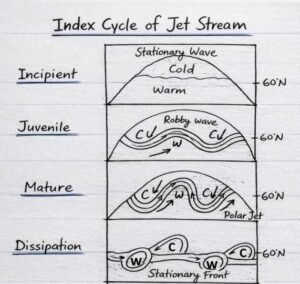
Stage 4 (Dissipation Stage )
- Cold air moves into warm regions and vice versa
- Heat exchange occurs across latitudes
- The system returns to a stable state
Significance of jet streams
- Jet streams are important because:
- They influence the strength of mid-latitude cyclones (Temperate cyclones)
- Cyclones become stronger when jet streams are positioned above them
- They play a major role in shaping the South Asian monsoon system. Monsoon system enters the subcontinent when the westerly branch of Sub Tropical Jet Stream withdraws from its position over the northern plains of India.
- They influence the strength of mid-latitude cyclones (Temperate cyclones)
Influencing factors on the Jet Stream Flow
Several factors affect how jet streams behave:
- Landmasses
- Interrupt airflow
- Cause temperature variations
- Coriolis effect
- Bends the wind path due to Earth’s rotation
- Seasonal temperature changes
- Especially in the polar stratosphere
- Ocean-atmosphere interactions
- Such as El Niño–Southern Oscillation (ENSO)
- Landmasses
Jet streams often meander like rivers, constantly shifting their path due to these influences.
Jet streams & the weather
Jet streams play a critical role in determining weather patterns:
- They act as boundaries between warm and cold air masses
- They help move weather systems across regions
- Sometimes they can stall weather systems, causing prolonged conditions
Jet stream connection with Climate Change
- Changes in jet streams are linked to global warming
- Polar regions are warming faster, affecting jet stream behavior
- This can lead to:
- More extreme weather
- Unusual climate patterns in different regions
- For example:
- If a jet stream dips south, it can bring cold air to warmer regions
Jet stream impacting Air travel
- Jet streams significantly impact aviation:
- Eastbound flights are faster due to tailwinds
- Westbound flights take longer due to headwinds
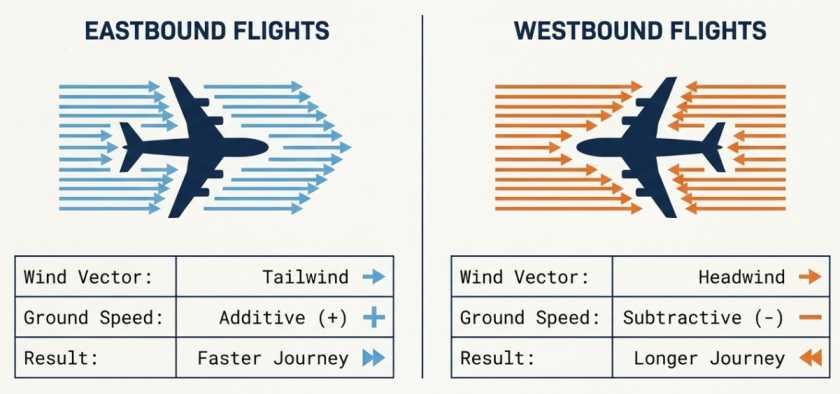
- Jet streams significantly impact aviation:
Jet stream influencing Wind Shear
- Jet streams can create wind shear, a sudden change in wind speed or direction
- This is dangerous for aircraft and can cause sudden loss of altitude
- To improve safety:
- In 1988, the Federal Aviation Administration (FAA) required aircraft to have wind-shear detection systems
- By 1996, all commercial aircraft were equipped with these systems
Jet Streams affecting the Monsoons and the Indian Sub Continent
Jet streams have a strong influence on India’s climate, especially the monsoon system.
Role of Subtropical Jet Stream (STJ)
- During early summer:
- The STJ flows south of the Himalayas
- This prevents monsoon development
- As summer progresses:
- The STJ shifts northward across the Himalayas
- This allows the monsoon system to develop rapidly
Formation of Monsoon
- Increased solar heating creates a low-pressure system over the Indian subcontinent
- Moist air is brought in by tropical jet streams from the Indian Ocean
- As this moist air rises over mountains:
- It cools
- Condenses
- Produces heavy rainfall (monsoon rains)
End of Monsoon
- As the Tibetan Plateau cools, the STJ shifts back south
- This leads to:
- Formation of a winter monsoon system
- Dry winds blowing from land to sea
- Cool and dry weather across India
Let us know any further suggestions ,we at sudurbhai.com will be happy to hear from you in our comment section below !