Irrigation in Assam
Introductrion
History of Irrigation in Assam
Irrigation types in Assam
Challenges in Irrigational development.
The Assam (SIP) State Irrigation Plan (2022-2027)
- Nessecity of SIP in Assam
Steps to improve irrigation in Assam
Introduction
- Assam’s economy is primarily based on agriculture, with the land providing a way of life for the majority of its people.Around 70% of the state’s population depends on farming for their livelihood, making our farms the true heartbeat of Assam.
- The state is known for a rich variety of crops that are vital to its economy and culture.
- Key Agricultural Crops in Assam are Tea, Rice, Sugarcane, Vegetables, Pulses, Oilseeds.
- To grow these crops successfully, farmers need a reliable supply of water. This is where irrigation comes in.
- In simple terms, irrigation is the process of applying water to the crops artificially to fulfill their water requirements. Think of it as giving our plants a much-needed drink when the rain doesn’t provide enough water on its own.
- Even though Assam is blessed with many large rivers and receives heavy rainfall, the rain can be erratic.This leads to periods of both devastating floods and damaging dry spells.This unpredictability makes farming a “gamble in monsoon” for many.
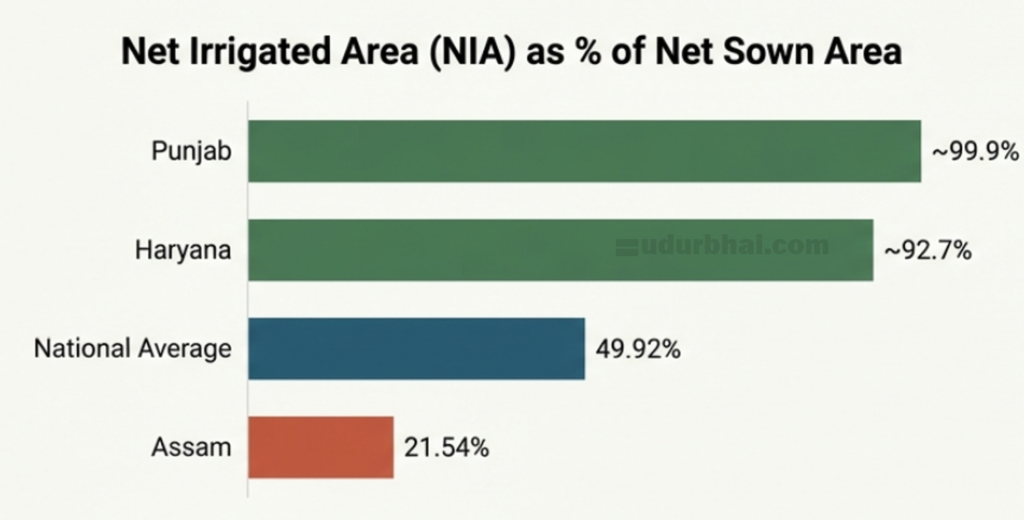
- A significant gap exists between how much farmland in Assam has access to irrigation compared to the rest of India.
Region | Irrigated Farmland |
Punjab | 99.9% |
Haryana | 92.7% |
India Average | 49.9% |
Assam (2022) | 21.5% |
Assam (2025) | 24.3% |
Assam (2027) | 52% (target) |

- This data shows that less than a quarter of Assam’s farmland has a reliable, irrigational water supply.
- A large majority of our farmlands depend entirely on rain, which is a major hurdle for growing enough food consistently and improving the livelihoods of farming families.
- To solve this problem, Assam uses different methods to bring water to the fields in the form of irrigation.
- There is a considerable potential for agricultural growth in Assam by ;
- Increasing cropping intensity (by shifting to double/multicropping from monocropping)
- Raising crop yield and
- Diversifying into pulses and oilseeds through irrigation.
- During Kharif season, uncertainty in crop production occurs due to onslaught of natural calamities like flood, storm etc. and uneven rainfall distribution.
- Rabi crops do not get priority in all areas and also less practiced by the farmers.
- Therefore, assured Irrigation along with motivation of farmers in the State is most essential.
History of Irrigation in Assam
Background and Need for a Dedicated Department
After the devastating flood of 1954, there was a strong realization of the need for a separate department to manage water resources in Assam.
Until 1968, all irrigation activities in the state were carried out by the Agriculture Department.
The department was later renamed as Public Works (Flood Control & Irrigation) Department, Assam.
The responsibility of flood control works in the Brahmaputra Valley was also assigned to this department.
Formation of Flood Control and Irrigation Authorities
In 1970, two major bodies were established:
Brahmaputra Flood Control Commission
Flood Control & Irrigation Department
The Flood Control & Irrigation Department was entrusted with:
Flood control works in the Barak Valley
Irrigation works across the entire state
Its responsibilities included:
Survey
Investigation
Planning
Designing
Execution of irrigation schemes
Operation and maintenance of schemes
Rising Demand for Irrigation
With the introduction of High Yielding Variety (HYV) crops, the demand for irrigation increased significantly.
This growing need emphasized the importance of a separate irrigation-focused department.
Establishment of the Present Irrigation Department
In 1974, the present Irrigation Department was formed.
This was done by:
Bifurcating the Public Works (Flood Control & Irrigation) Department
Amalgamating the engineering wing of the Agriculture Department
Transferring irrigation schemes earlier constructed by the Agriculture Department
The newly formed department was created to deal exclusively with irrigation development in the State of Assam.
Classification of Irrigation Schemes (During Planning Comission)
Major irrigation schemes (Culturable Command Area (CCA) of more than 10,000 hectares).
Medium irrigation schemes (Culturable Command Area (CCA) ranging between 2,000 and 10,000 hectares).
Minor irrigation schemes ( Culturable Command Area (CCA) of up to 2,000 hectares).
Classification of Irrigation Schemes (at Present)
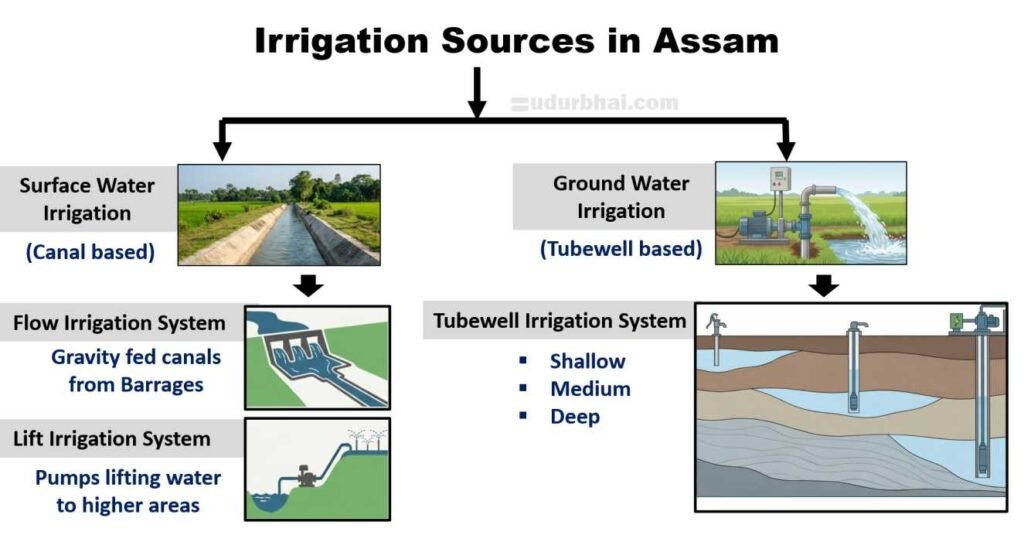
A. Surface Water Irrigation (Canal based)
1. Flow Irrigation System
2. Lift Irrigation System
B. Ground Water Irrigation (Tubewell based)
3. Tubewell Irrigation System
1. Flow Irrigation System (FIS)
Flow Irrigation Schemes involve the construction of diversion structures such as:
Weirs
Barrages
These structures are built across rivers or perennial streams.
Water is diverted to the command area through a canal system.
2. Lift Irrigation System (LIS)
Lift Irrigation Schemes use electrically operated pumps and motors.
Pumps are installed:
In pump houses on river banks, or
On floating barges
Water is lifted from rivers or water bodies and supplied to the command area through a water distribution system.
3. Tube Well Irrigation System
Tube Well Schemes involve the installation of:
Electrical or solar operated submersible pumps
Pumps are installed in:
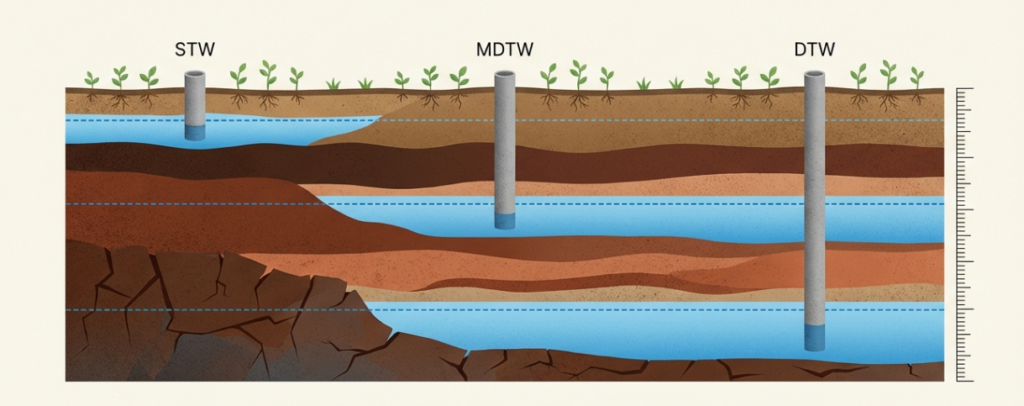
Deep Tube Wells (DTW)
Medium Deep Tube Wells (MDTW)
Shallow Tube Wells (STW)
These schemes are used to draw groundwater for irrigating cropped land.
Adopted where Flow Irrigation Schemes (FIS) or Lift Irrigation Schemes (LIS) are not feasible.
Irrigation types in Assam
- Surface Water (from rivers, streams, and lakes) and
- Groundwater (from natural water sources stored in aquifers deep under the earth).
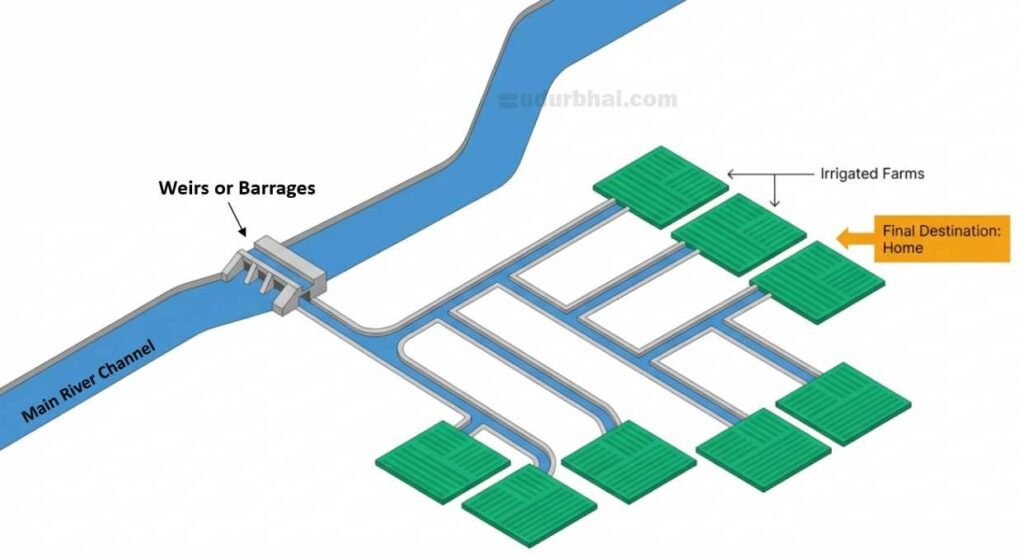
- A Flow Irrigation Scheme is a method that uses surface water.
- It involves building structures like weirs or barrages across rivers to divert water into a network of canals.
- These canals then carry the water directly to the farms.
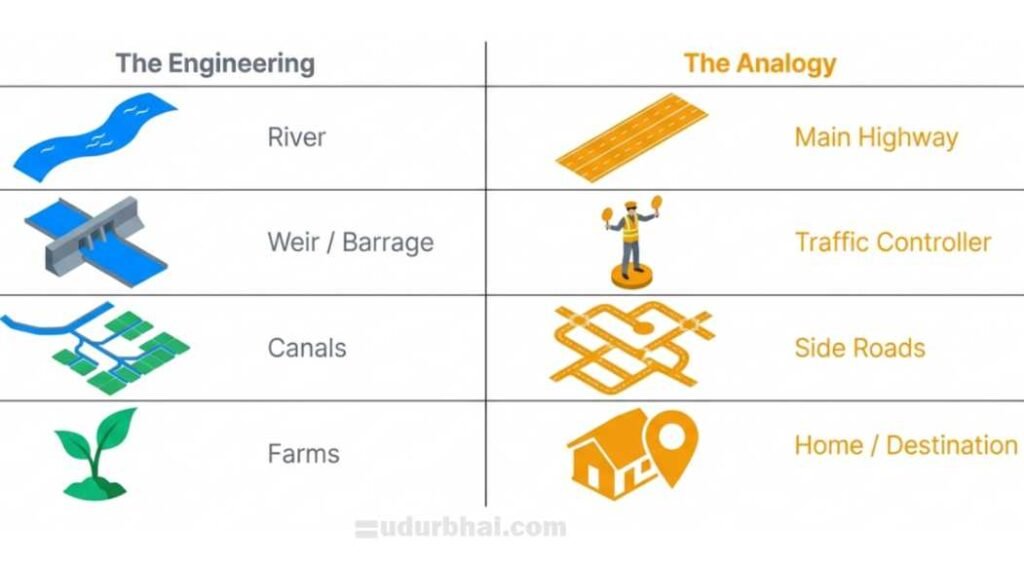
- This system works like a traffic controller for water, directing it from the main river highway down smaller roads (canals) to reach the fields where it’s needed most.
- When surface water isn’t easily accessible, farmers can use Tube Well Schemes to tap into groundwater.
- These schemes use pumps, often powered by electricity or solar energy, to pull water up from deep underground through a well.
- It’s similar to using a straw to get a drink from the bottom of a tall glass.
- There are different types of tube wells based on their depth:
- Shallow Tube Wells (STW),
- Medium Deep Tube Wells (MDTW), and
- Deep Tube Wells (DTW).
Feature | Flow Irrigation System (FIS) | Tube Well Irrigation System |
|---|---|---|
Water Source | Surface Water (Rivers, Streams) | Groundwater (Underground) |
How it Works | Diverts water using weirs and canals. | Lifts water using pumps in a well. |
Best For | Areas near rivers or streams. | Areas where surface water is not feasible. |
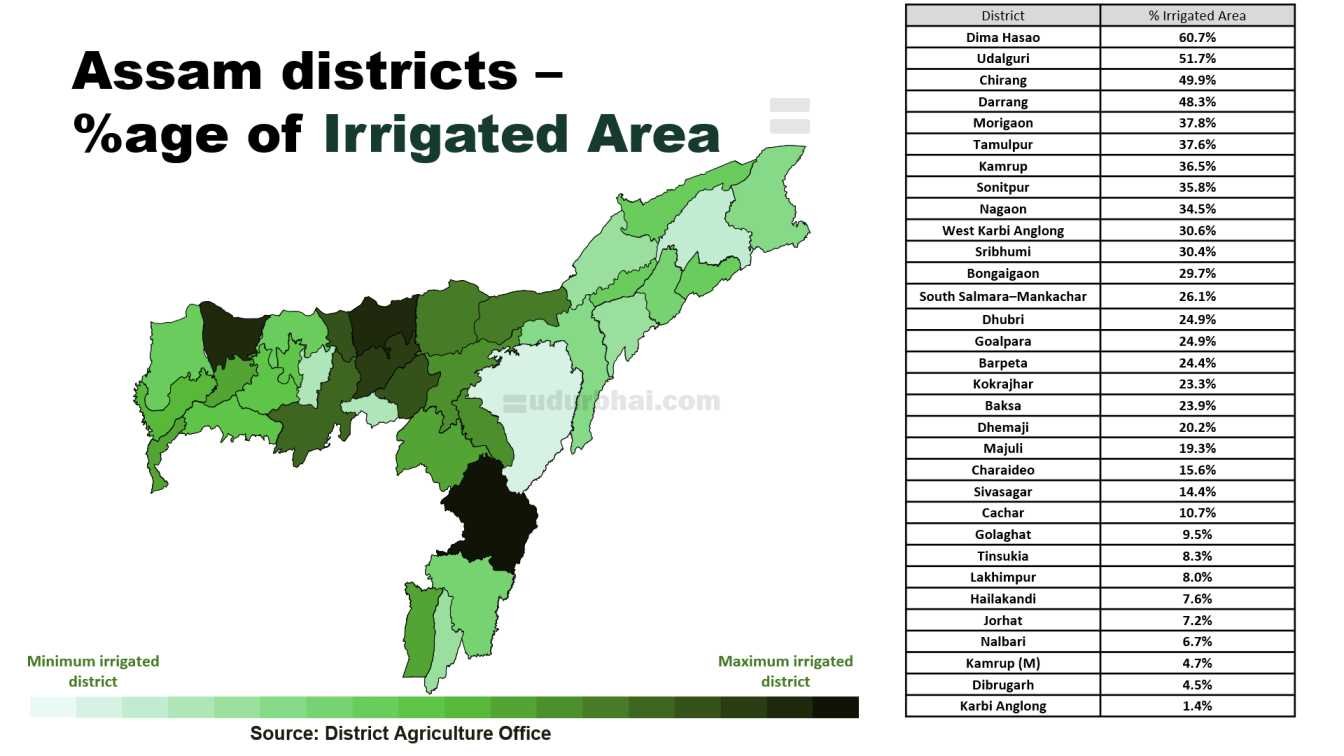
- Top irrigated districts in Assam:
→ Dima Hasao, Udalguri (hill districts with focused irrigation schemes) - Lowest irrigated districts in Assam:
→ Karbi Anglong, Dibrugarh, Kamrup (M)
- Top irrigated districts in Assam:
Most rainfed district in Assam: Karbi Anglong
Least rainfed district in Assam: Dima Hasao
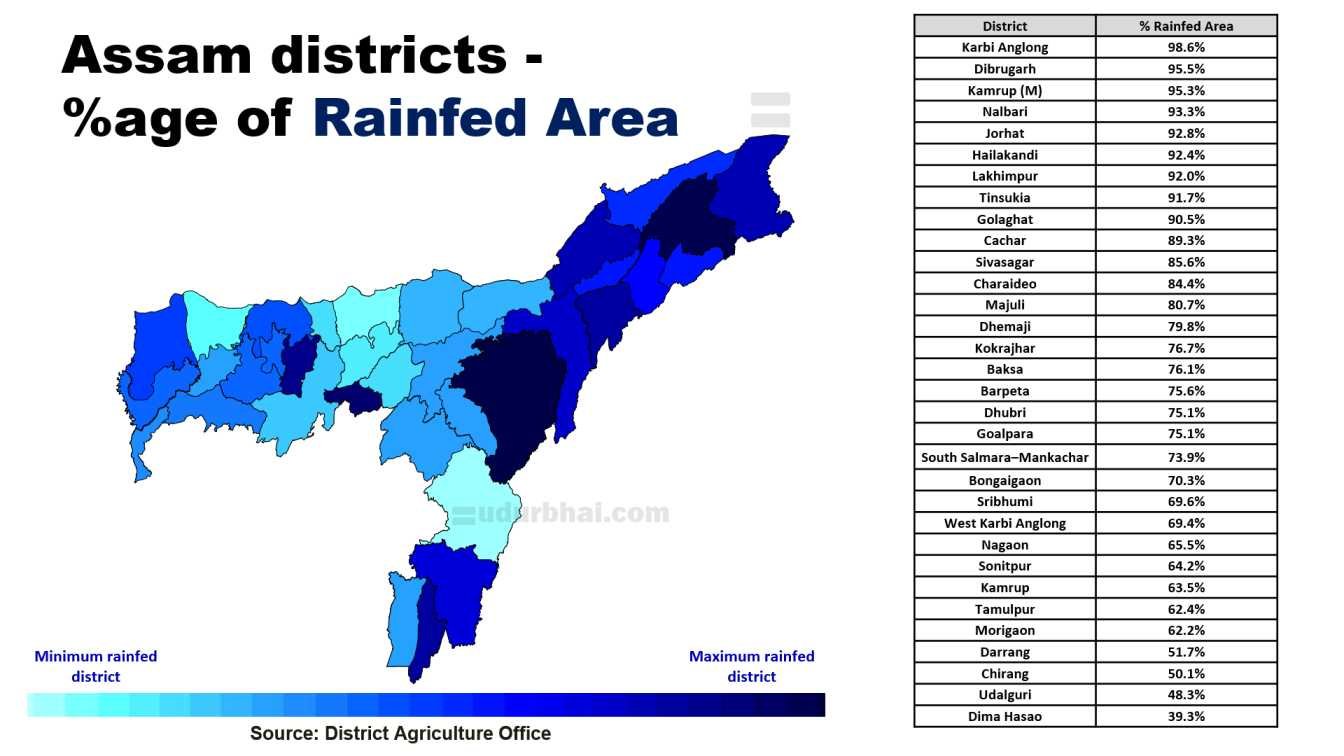
What inference can be stated by observing the above data of Irrigated and Rainfed districts in Assam?
Overall Irrigation Scenario in Assam
Assam remains predominantly rainfed
A majority of districts have 70–95% rainfed cultivation.
Over half the districts fall in the high to very high rainfed category.
This confirms that rainfall abundance has not translated into irrigation security.
High irrigation is the exception, not the rule
Only 2 districts (Dima Hasao, Udalguri) cross the 50% irrigation mark.
These districts benefit from:
Smaller command areas
Lift / minor irrigation schemes
Controlled topography (hills & intermontane valleys)
- Plains, despite rivers, lag behind in irrigation coverage.
Flood-prone plains paradox
Districts like Dibrugarh, Lakhimpur, Tinsukia, Nalbari:
Receive high rainfall
Are severely flood-affected
Yet show very low irrigation percentages (<10%)
- Floods damage infrastructure and discourage long-term irrigation investment.
Hill districts show contrasting patterns
Dima Hasao: Most irrigated & least rainfed
Karbi Anglong: Least irrigated & most rainfed
- Indicates intra-hill region disparity, driven by:
Accessibility
Project implementation capacity
Terrain-specific scheme success
Central Brahmaputra Valley performs relatively better
Districts like Morigaon, Nagaon, Sonitpur, Kamrup show:
Moderate irrigation (30–40%)
Transitional status between rainfed dominance and irrigation expansion
- These districts offer maximum scope for irrigation intensification.
Existing Types of Irrigation in Assam
Major Sources of Irrigation
- Surface Irrigation — Prominent; mainly canal-based.
- Groundwater Irrigation — Dominant overall; primarily tube wells.
- Lift Irrigation — Via pumps (electricity, diesel, solar) for groundwater/surface lift.
Surface Irrigation
- Canal-Based Irrigation
- Government canals: Major component.
- Community/Private canals (PYT): Significant in select districts (e.g., Udalguri has ~5,508).
- Total canals (approx.): ~7,475 units (Govt. ~1,966 + Community ~5,509).
- Other surface sources: Limited mention of tanks/lift irrigation schemes.
- Canal-Based Irrigation
Groundwater Irrigation
- Tube Wells (Govt.) — Major source; dominant in groundwater category.
- Total: ~11,032 units.
- Leading districts: Majuli (~1,235), Kamrup (~1,103), Sonitpur (~853).
- Bore Wells (Govt.) — Secondary; ~2,482 units.
- Notable in Sonitpur (~853), Tinsukia (~854), Kamrup (~433).
- Open Wells (Govt.) — Absent statewide (0 units).
- Groundwater dominant due to abundant alluvial aquifers in Brahmaputra & Barak valleys.
- Recent stats (CGWB 2024): Stage of groundwater extraction low (~12.61%); mostly safe blocks.
- Tube Wells (Govt.) — Major source; dominant in groundwater category.
Water Extraction Devices / Lift Irrigation
- Pumps for groundwater/surface lift.
- Diesel Pumps — Highest number (~17,623); cost-effective but fuel-dependent.
- Electricity Pumps — ~10,918; reliable in electrified areas.
- Solar Pumps — ~3,622; emerging (promoted under PM-KUSUM; target 10,000+).
- Total extraction devices: ~32,163.
- Diesel dominates (~55%), followed by electricity (~34%), solar (~11%)
Key District-Level Variations
- High surface: Udalguri (high community canals), West Karbi Anglong.
- High groundwater: Majuli, Cachar, Kamrup (tube wells dominant).
- High pumps: South Salmara Mankachar (outlier high diesel/electricity; data anomaly possible).
- Top grand totals (units): Udalguri (~5,916), Kamrup (~1,641), Majuli (~1,240).
Challenges for Development of Irrigation in Assam
- Uneven topography of the Assam results in difficulty in Gravity Flow Canal Construction , Heavy siltation due to erosion – blocks the flow, frequent Shifting of River Course.
- Change of river course in respect of Surface Flow and Surface Lift Irrigation Schemes.
- Motivation of cultivators to adopt multiple cropping system in their crop field where assured irrigation is available with high yielding variety crops (HYV)
- Farmers with small landholdings.
- Ensure availability of sufficient fund for upkeepment of the schemes.
- Protect the irrigation project from onslaught of natural calamities like flood, storm etc.
- Make provision for uninterrupted power supply for adequate hours to the electrically operated schemes (Surface Lift and Ground Water Lift) during crop season
The State Irrigation Plan (2022-2027)
- To address Assams water challenges, the Government of Assam has created a comprehensive strategy called the State Irrigation Plan (SIP).
- The primary goal of this plan is :
- To address its water challenges.
- To significantly expand irrigation coverage across the state.
- The plan aims to raise Assam’s irrigated area to approximately 52% by the year 2027.
- Achieving this goal means more than doubling the amount of farmland that has a reliable water supply.
- Crop diversification from high water intensive crops (rice) to less water consuming crops (oilseeds)
- SIP advocates for solar-powered pump installations under PM KUSUM, with a target of 10,000 pumps across Assam.
- The adoption of drip and sprinkler irrigation systems is promoted to enhance water conservation.
- The SIP incorporates climate adaptation strategies, such as the use of drought-tolerant crop varieties and flood-resistant infrastructure.
- It will bring Assam’s irrigation coverage above the current national average, transforming the state’s agricultural landscape and making farming a more stable and profitable profession.
- The SIP spans 32 districts, with individual District Irrigation Plans (DIPs) developed and approved at the district level to ensure locally relevant and customized solutions.
- For example;
- Upper Brahmaputra Valley Zone, with its annual flooding issues, will receive focused investments in flood-resilient irrigation systems.
- Barak Valley Zone, which experiences periodic droughts, will benefit from enhanced groundwater extraction techniques and rainwater harvesting structures.
- For example;
- The Budjet allocation under SIP for each district varies (Jorhat getting maximum allocation and Majuli getting minimum allocation) :
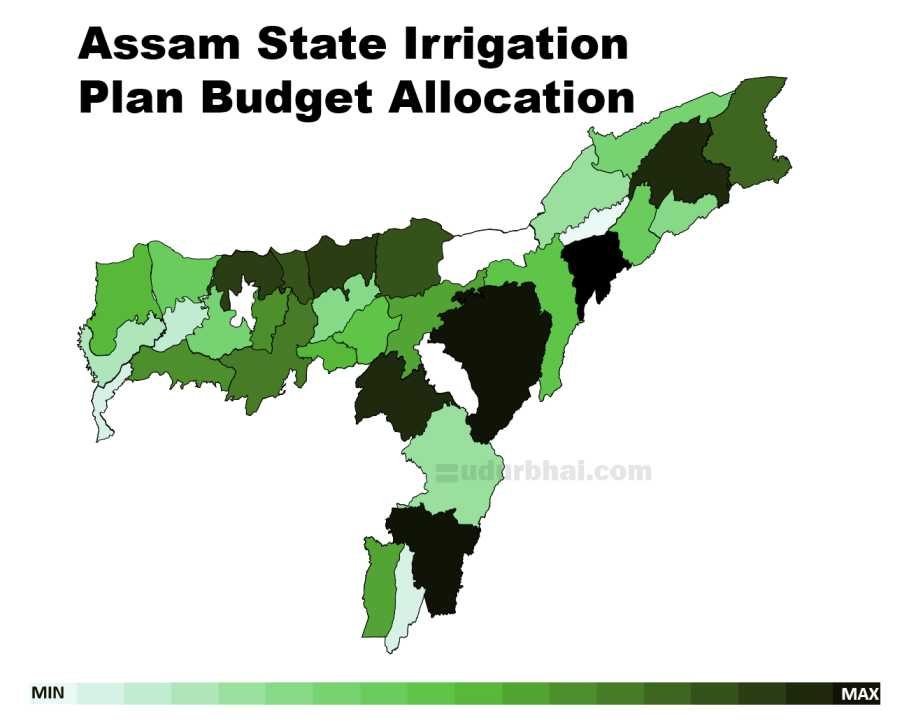
Necessity of State Irrigation Plan (SIP) 2022–2027 in Assam
1. Increasing Water Scarcity – because demand for water is rising for Domestic use and Industrial use.
2. Role of Irrigation in Developing States like Assam will help in ensuring the food security and help to reduce dependency on monsoon rainfall.
3. Need for efficient use of Irrigation water will help in reducing waterlogging ,control overuse of groundwater and reduce pollution of surface water.
4. To help Assam explore its irrigation potential and catch up with advanced states like Punjab and Haryana.
5. Help Assam to reduce the regional Irrigation imbalance by adopting region-specific irrigation planning .
6. Help Assam to reduce food deficit by adopting Multiple cropping with reliable irrigation support.
7. Help Assam farmers to reduce the struggle with Rabi crops due to Dry spells.
8. Irrigation helps protect our farms and food supply from the negative effects of climate change, such as long droughts or changing monsoon patterns, making our agricultural sector more resilient.
If the Question comes : Why Irrigation important for Assam ? You can use all the above points in your answer.
Steps taken by government to improve irrigation in Assam
- The Command Area Development (CAD) programme was initiated in 1974-75 with a view to bridging the gap between the potential created and its utilization and optimizing agricultural productivity through better irrigational management.
Adoption of State Irrigation Plan (SIP) 2022-2027 , a comprehensive 5-year master plan aligned with PMKSY that aims to raise irrigation coverage in Assam to ~52% by 2027.
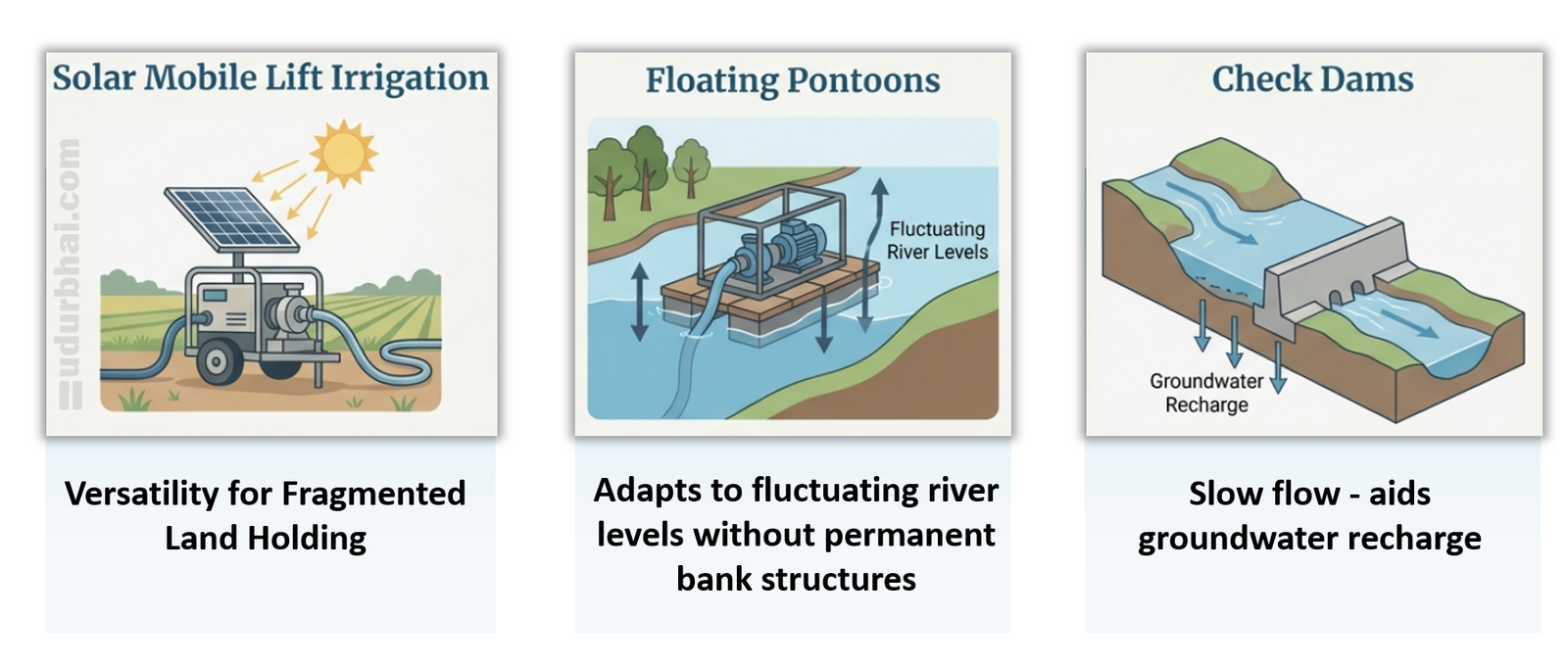
Assam specific enginerred initiatives for local topographies like Major , Medium and minor Irrigation Schemes, Solar-Powered irrigation projects (under KUSUM Scheme), Mobile Lift Irrigation Scheme.
Let us know any further suggestions ,we at sudurbhai.com will be happy to hear from you in our comment section below !