
Insolation (or Incoming Solar Radiation)
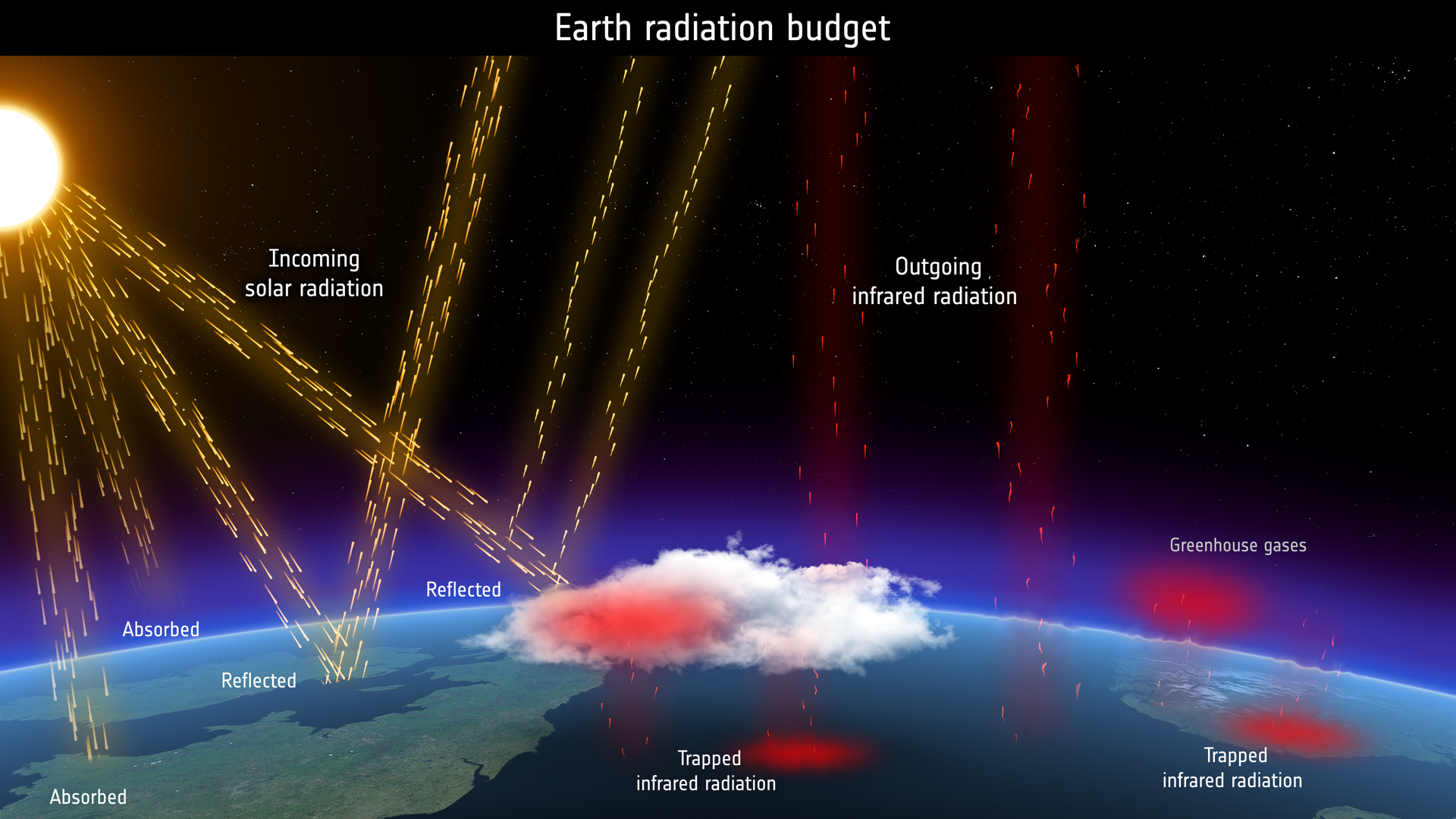
- Insolation refers to the solar energy received by a planet, especially the Earth. In simple terms, it is the sunlight that reaches the Earth. This energy travels from the Sun in the form of short waves, and when it reaches Earth’s surface, it is called Incoming Solar Radiation or Insolation.
- However, insolation is not evenly distributed across the Earth. It is more concentrated near the equator and decreases towards the poles. This happens because the Earth is round (curved), so sunlight strikes different parts of the planet at different angles.
- Before reaching the Earth’s surface, solar radiation goes through several processes:
- A portion of it is reflected back into space by the atmosphere and clouds
- Some part is absorbed by gases and particles in the atmosphere
- The remaining energy reaches the Earth’s surface and warms it
- This continuous flow and transformation of solar energy is responsible for heating the Earth’s surface and atmosphere, making life possible.
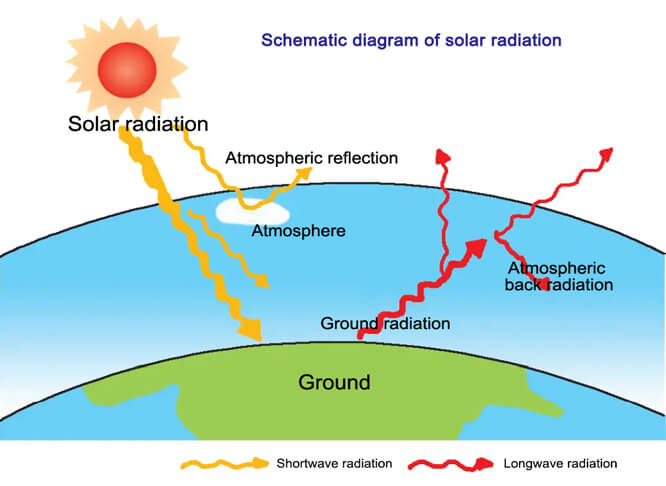
Variability of insolation at the surface of the earth
- The amount of insolation received at any place is not constant. It changes throughout the day, seasons, and year.

- These variations occur due to several factors:
- The rotation of the earth on its axis
As the Earth rotates, different parts face the Sun at different times, causing day and night. - The angle of inclination of the rays of the sun
The angle at which sunlight hits the Earth affects how much energy is received.- Region of direct Sunlight (Tropical)= More Solar Energy
- Region of Slant Sunlight (Polar) = Least Solar Energy
- The length of the day
Longer days mean more time to receive sunlight, increasing insolation.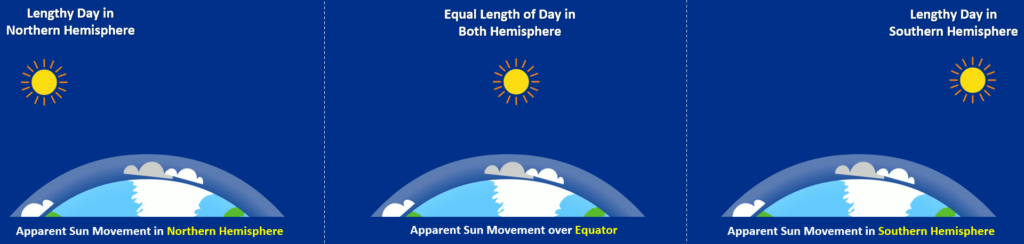
- The transparency of the atmosphere
Clear skies allow more sunlight to pass, while clouds and dust reduce it. - The configuration of the land in terms of its aspect
The direction a surface faces (like a mountain slope) affects how much sunlight it receives.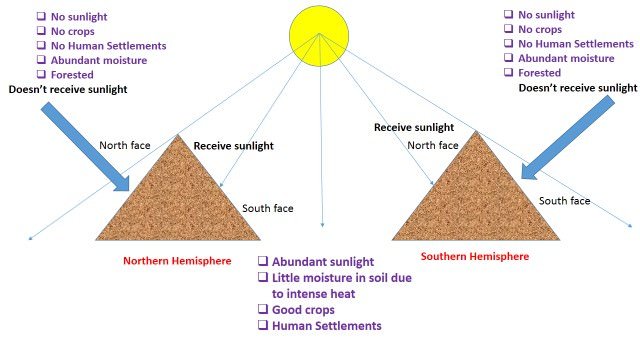
- The rotation of the earth on its axis
- Among these, the first three factors have the greatest influence.
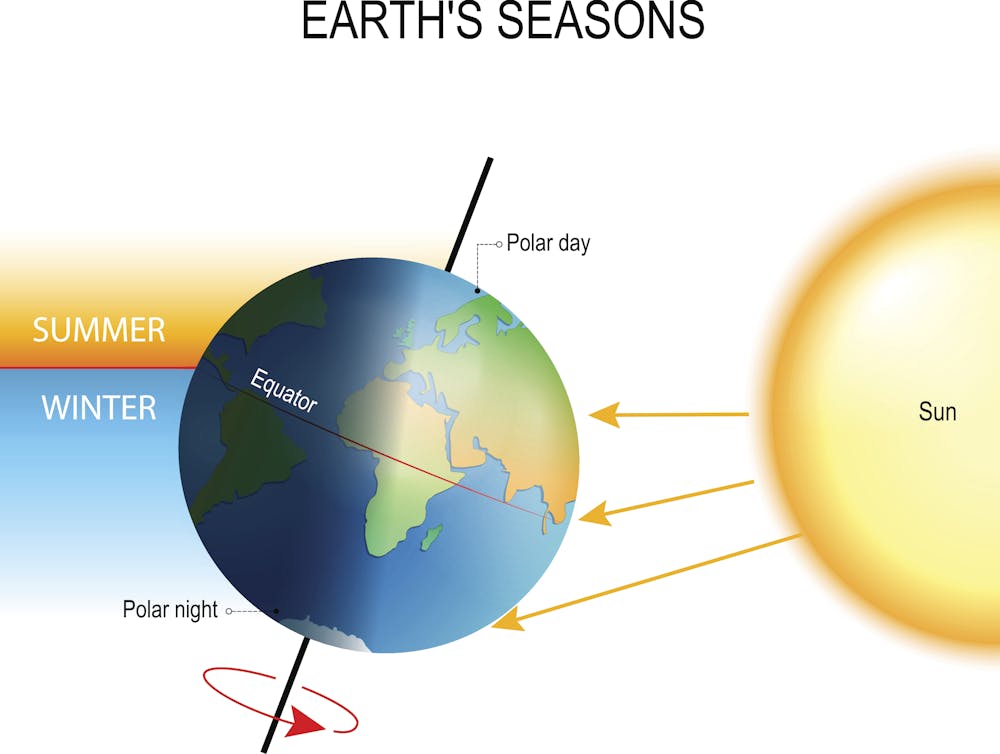
- The Earth is slightly tilted on its axis, which is called the inclination of the earth’s axis. This tilt is about 66.5° relative to its orbit around the Sun. Because of this tilt:
- Different parts of the Earth receive different amounts of sunlight at different times
- This is the main reason for seasons and variation in insolation
- The angle of the Sun’s rays is also very important:
- Near the equator, sunlight falls almost vertically, concentrating energy in a smaller area
- Towards the poles, sunlight falls at a slant (inclined angle)
- Slant rays spread over a larger area, reducing energy per unit area
- They pass through a thicker layer of atmosphere, leading to more absorption, scattering, and diffusion
- As solar radiation passes through the atmosphere:
- The atmosphere is mostly transparent to shortwave radiation, allowing sunlight to reach the surface
- Water vapour, ozone, and gases absorb some radiation (especially near-infrared rays)
- Tiny particles scatter light, which causes:
- Blue sky during the day
- Red/orange colors during sunrise and sunset
- The length of the day also plays a major role:
- Longer daylight hours mean more insolation
- Shorter days mean less solar energy received
Distribution of insolation on Earth:
- Tropical regions receive the most (about 320 watts/m²)
- Polar regions receive the least (about 70 watts/m²)
- Subtropical deserts receive maximum insolation due to clear skies and low cloud cover
- At the same latitude, land areas receive more heat than oceans, as land heats up faster

Terrestrial Radiation, Heating and Cooling of the Atmosphere
Terrestrial Radiation
- When the Earth receives solar energy, it absorbs it and becomes warm. The Earth then releases this energy back into the atmosphere in the form of long-wave radiation. This process is called terrestrial radiation.
- The Sun sends energy as short waves
- The Earth sends energy back as long waves
- This outgoing radiation heats the lower atmosphere from below. At the same time, the atmosphere also sends some heat back into space, helping maintain a balance in temperature.
Heating and cooling of the atmosphere (conduction, convection and advection):
- The atmosphere is heated and cooled through three main processes:
- Conduction
- Heat is transferred from the Earth’s surface to the air directly in contact with it
- Energy flows from a warmer object to a cooler one until temperatures become equal
- Convection
- Warm air becomes lighter and rises upward, while cooler air sinks
- This creates vertical air movement
- Convection mainly occurs in the troposphere
- Advection
- Heat is transferred through the horizontal movement of air (winds)
- Example: The hot summer wind in northern India, called the loo, is caused by advection
- This process plays a major role in daily temperature changes, especially in middle latitudes

- Conduction
Heat Budget of the Earth
- The Earth maintains a fairly stable temperature because of a balance between incoming and outgoing energy. This balance is called the heat budget of the Earth.
- In simple terms:
- The heat Earth receives from the Sun is equal to the heat it sends back into space
Let us understand this with percentages:
| Process | Percentage (%) | Explanation |
|---|---|---|
| Reflected back (Albedo) | 35% | Energy reflected by clouds, atmosphere, and surface |
| Absorbed by atmosphere | 14% | Energy absorbed by gases and particles |
| Absorbed by Earth’s surface | 51% | Energy that heats land and water |
What happens to the 51% absorbed by Earth?
- 17% is radiated directly back to space
- 34% is absorbed by the atmosphere through:
- Direct absorption
- Convection
- Latent heat (from condensation of water vapour)
The atmosphere also radiates energy back into space. This ensures:
- Total incoming energy = Total outgoing energy
- Earth’s temperature remains relatively stable
This balance is known as the heat balance or heat budget.
Variation in the Net Heat Budget at the Surface of the Earth
- The distribution of heat on Earth is not uniform:
- Regions between 40°N and 40°S receive more energy than they lose (heat surplus)
- Polar regions experience a heat deficit (they lose more energy than they receive)
- To maintain balance:
- Excess heat from the tropics is transferred toward the poles through winds and ocean currents
- This prevents:
- Tropics from becoming too hot
- Polar regions from becoming extremely cold
Factors Controlling Temperature Distribution
- The temperature at any place on Earth depends on several important factors:
- Latitude of the place
- Determines how much sunlight is received
- Near the equator: high temperature (direct sunlight)
- Towards poles: low temperature (slant rays spread energy)
- Altitude of the place
- Temperature decreases with height
- This is because the atmosphere is heated from below
- The average rate of decrease is 6.5°C per km, called the normal lapse rate
- Distance from the sea
- Land heats and cools quickly
- Water heats and cools slowly
- Coastal areas have moderate temperatures, while inland areas experience extremes
- Air mass and ocean currents
- Warm air masses increase temperature
- Cold air masses decrease temperature
- Coastal areas near warm ocean currents are warmer
- Coastal areas near cold currents are cooler
- Latitude of the place
- These factors work together to determine the climate and temperature patterns experienced in different parts of the world.