
The Earth
The Earth is the only known planet that supports life. Its surface is mostly covered by water, which is why it is often called the Blue Planet.
- Position in the Solar System: Earth is the third planet from the Sun.
- Density and size: It is the densest planet and the largest of the four terrestrial planets (Mercury, Venus, Earth, Mars).
- Overall ranking: Fifth-largest planet in the solar system.
- Shape: Earth is slightly flattened at the poles, giving it a shape called a geoid, meaning “Earth-like.”
- Distance from the Sun: About 149 million km (93 million miles), also known as 1 astronomical unit (AU).
- Age: Approximately 4.5 billion years, forming around the same time as the rest of the Solar System.
- Orbit: Earth completes one revolution around the Sun in 365.25 days, which defines a year.
Water Distribution on Earth:
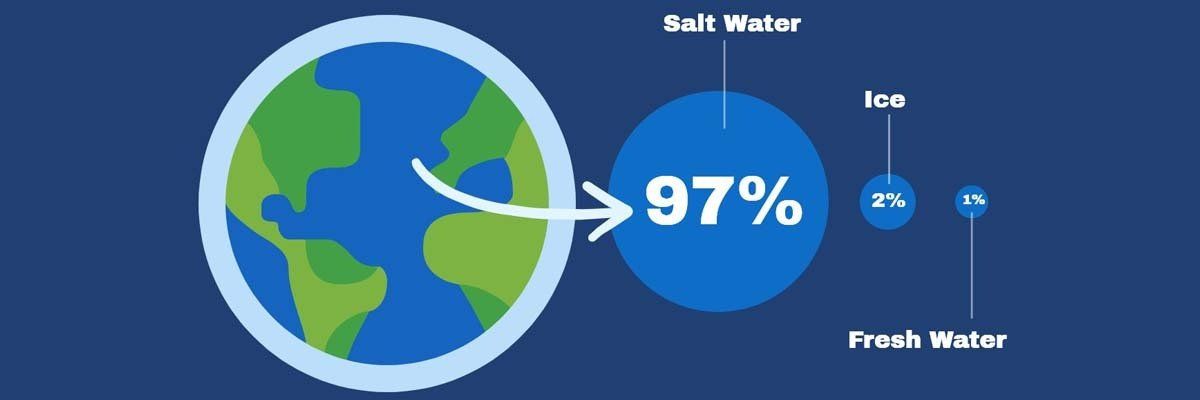
- Only 3% of Earth’s water is fresh; the remaining 97% is saltwater.
- 71% of the surface is covered by water; 29% is land.
Atmosphere:
- The Earth’s atmosphere consists of five layers:
- Troposphere
- Stratosphere
- Mesosphere
- Thermosphere
- Exosphere

Satellites:
- Earth has one natural satellite, the Moon, along with several temporary artificial satellites.
Size and Shape of the Earth
- Earth is not a perfect sphere but an oblate spheroid. This means the distance from pole to pole is slightly less than the distance around the equator.
- The Earth is bulged at the equator and flattened at the poles due to centrifugal force caused by its rotation.
- The equatorial bulge measures about 42.72 km (26.5 miles).
- The science of measuring Earth’s shape and size is called geodesy.

- Because Earth is an oblate spheroid, its circumference and diameter are larger at the equator than at the poles.
Motions of the Earth
Definition: Motion is the action of moving or changing position. Earth’s movement explains day and night, seasons, and regional climate variations.
Rotation
- Rotation is the spinning of an object around an imaginary line called its axis.
- Earth rotates on its axis from west to east (counter-clockwise).
- A full sidereal day is 23 hours, 56 minutes, and 4.09 seconds, while a mean solar day is exactly 24 hours.
- Rotation causes day and night.
- The equator moves at about 1,674.4 km/h (1,040.4 mph).
- The circle that divides the day from night on the globe is called the circle of illumination.
- Earth rotates on a tilted axis. Earth’s rotational axis makes an angle of 23.5° with the normal i.e. it makes an angle of 66.5° with the orbital plane. Orbital plane is the plane of earth’s orbit around the Sun.
Revolution
- One complete revolution takes about 365¼ days, which forms one year.
- The extra ¼ day each year is accumulated and added as one full day every four years.
- This results in a leap year, where February has 29 days, making the year 366 days.

Leap Year
- Because Earth takes about 365.25 days to orbit the Sun, we have 365 days in an ordinary year.
- To correct for the extra 0.25 day, every four years February has 29 days instead of 28.
- This 366-day year is called a leap year.
Earth rotates in an elliptical orbit around the Sun
- Earth’s orbit is not perfectly circular but elliptical, causing the distance to the Sun to change throughout the year.
- Perihelion: When Earth is closest to the Sun (~January 3).
- Aphelion: When Earth is farthest from the Sun (~July 4).
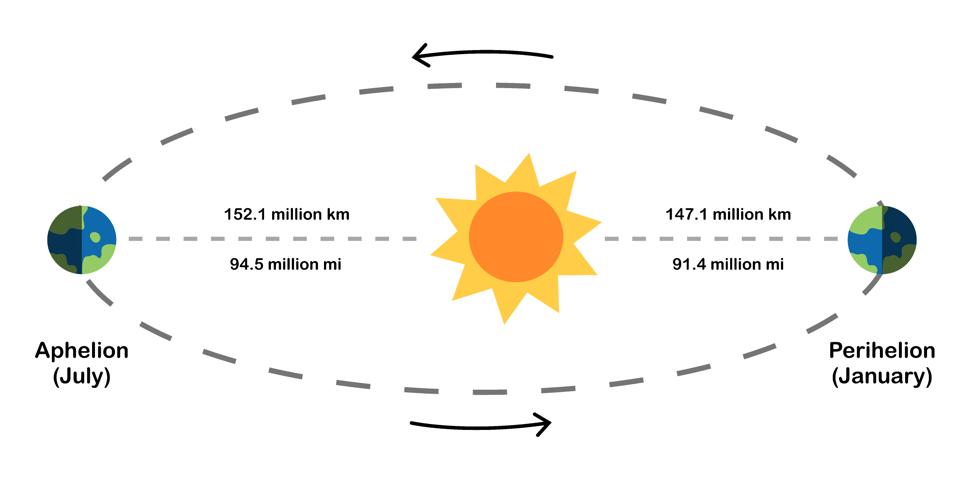
Perihelion and Aphelion - Earth’s axis points toward the same spot in the sky (the Polar Star) during its orbit, which affects the sunlight distribution on different latitudes.
Equinoxes and Solstices
Earth reaches four critical positions during its orbit, creating equinoxes and solstices.
| Term | Definition | Occurrence | Key Details |
|---|---|---|---|
| Spring Equinox | Day when day and night are equal in length | March 20 | Marks the start of spring in the Northern Hemisphere |
| Autumn Equinox | Day when day and night are equal in length | September 22 | Marks the start of autumn in the Northern Hemisphere |
| Summer Solstice | Day with the longest daylight of the year | June 21 | Marks the start of summer in the Northern Hemisphere |
| Winter Solstice | Day with the shortest daylight of the year | December 22 | Marks the start of winter in the Northern Hemisphere |
- Earth’s axis is tilted at ~23.5° relative to its orbit around the Sun.
- Solstices:
- Summer Solstice (June 21): Northern Hemisphere tilts toward the Sun → longest day.
- Winter Solstice (Dec 22): Northern Hemisphere tilts away from the Sun → shortest day.
- Equinoxes:
- Spring (Mar 20) & Autumn (Sep 22): Sun is directly above the equator → day and night are equal worldwide.
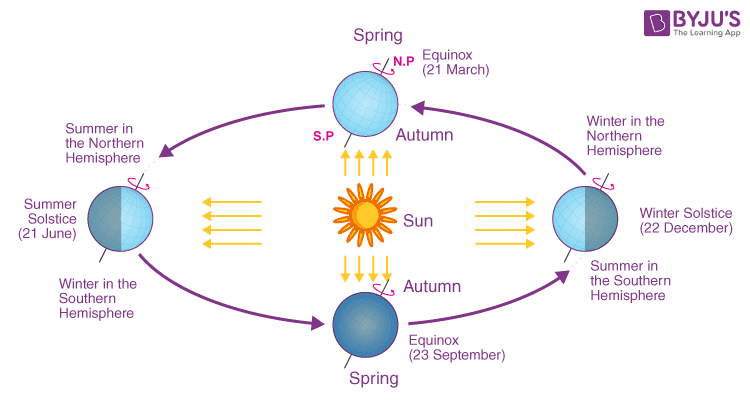
Solstice and Equinox
- Spring (Mar 20) & Autumn (Sep 22): Sun is directly above the equator → day and night are equal worldwide.