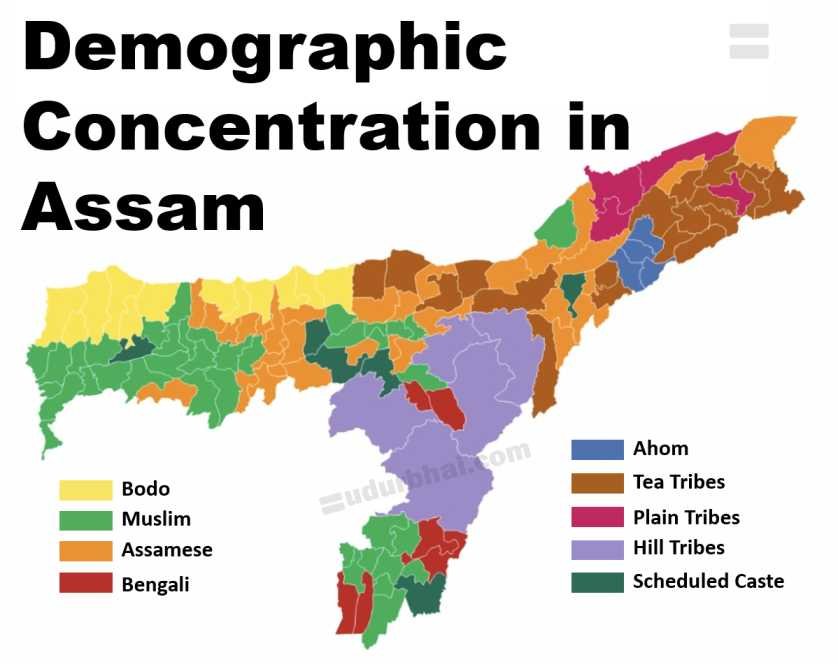
Demography of Assam

Introduction to Demographics of Assam

Geographical and Historical Context

Assam has diverse ethnic, linguistic, and religious demographic composition due to ;

Historical reasons :
      • Ahom era: Tai-Ahom migration and assimilation with locals due to political instability in Yunaan and North Myanmar region.

      • British period: Migration of tea garden labourers from Central & Eastern India.

      • Post-Partition (1947,1971): Influx from erstwhile East Pakistan (now Bangladesh).

Geographical Reasons :
      • Rich fertile land resulted in migration from nearby states.
      • Frequent floods have shaped the settlement patterns to a great extent.

Key Demographic Indicators Overview

    • Total Population:
        • Census 2011 — 3.12 crore.
        • Latest projections (2025): ~3.65 crore 
    • Decadal Growth Rate:
        • 2001–2011: 17.07% (slightly below national 17.64%).
        • Recent annual growth: ~0.9–0.95% (declining trend).
    • Density:
        • 2011 — 398 persons/sq km (higher than national 382).
        • Recent estimates (2024–2025): ~462–465 persons/sq km.
    • Comparison with National Averages: Higher rural share (~84–86%), slightly higher density, similar growth deceleration; unique due to migration and ethnic diversity.

Size, Growth, and Distribution of Population in Assam

Population Trends

    • Decadal Growth Rate (2001–2011): 17.07%

      • Slightly lower than national average (17.64%).

      • Growth peaked in earlier decades (e.g., 31–35% in 1961–1971); declining trend since.

    • Population Projection:

      • 2026/2031: Estimated 3.7–4.0 crore (based on trend growth).

    • Growth is uneven across districts.

    • Higher growth linked to:

      • High fertility rates in districts like Dhubri, Barpeta.

      • Migration (internal & cross-border).

    • Growth rate declining gradually due to improved literacy and health services.

Density and Spatial Distribution

    • Average Density (2011): 397 persons/sq km.

    • High Density Areas:

      • Brahmaputra Valley (fertile plains).

      • Kamrup (Metro): ~1,315 persons/sq km. (2011 census)

      • 2025 estimate : 1520-1580 persons/km²
    • Low Density Areas:

      • Hill districts due to rugged terrain and forests.

      • Karbi Anglong: ~96 persons/sq km.

    • Rural–Urban Split:

      • Rural: ~72%

      • Urban: ~28% (includes census towns).

District-wise Variations

CategoryDistrictKey Feature
Highest GrowthDhubriHigh fertility, migration
Moderate GrowthBarpetaAgrarian economy
Industrial InfluenceTinsukiaOil, coal, tea industries
Lowest DensityKarbi AnglongHilly terrain
Urban ConcentrationKamrup (M)Capital region

Urbanization Patterns

    • Urban Population (2011): ~14%.

    • Urban growth slower compared to national trend.

    • Major Urban Centres:

      • Guwahati (~10 lakh)

      • Silchar, Dibrugarh, Jorhat

    • Slum Population:

      • Concentrated in Guwahati.

      • Linked to migration, informal employment, housing shortage.

    • Urbanization driven by:

      • Administrative importance

      • Trade, transport, and service sector growth

Age and Sex Composition in Assam

Age Structure

    • Youth (0–14 years): ~30%

    • Working Age (15–59 years): ~62%

    • Elderly (60+ years): ~8%

    • Dependency Ratio: Moderate, due to large working-age population.

    • Assam has potential for demographic dividend if supported by:

      • Skill development

      • Employment generation

      • Health and education investment

Sex Ratio

    • Overall Sex Ratio (2011): 958 females/1000 males

      • Improved from 935 (2001).

    • Child Sex Ratio (0–6 years): ~962

      • Better than national average.

    • District Variations:

      • Higher sex ratio in tribal-dominated districts.

      • Lower in urban and industrial districts.

Gender Disparities

    • Female Workforce Participation: Lower than males, largely informal and agrarian.

    • Literacy Gap: Male literacy higher than female, though gap is narrowing.

    • Social Factors: Early marriage, unpaid care work affect women’s participation.

    • Government Initiatives:

      • Beti Bachao Beti Padhao

      • Lakhpati Baideo Scheme.
      • Nijut Moina Scheme
      • Focus on education, survival, and empowerment of girl child.

Literacy rates and Education in Assam

Literacy Rates

    • Overall Literacy (2011): 72.19%

      • Male: 77.85%

      • Female: 66.27%

    • Improvement: NFHS-5 indicates literacy levels nearing ~80% in the 2020s.

    • Rural–Urban Gap:

      • Urban literacy significantly higher than rural.

    • Gender gap persists but is gradually narrowing.

Educational Attainment

    • School Enrolment:

      • Gross Enrolment Ratio (GER) high at primary level.

      • Net Enrolment Ratio (NER) declines at secondary level.

    • Dropout Rates:

      • Higher at secondary stage due to poverty, early marriage, migration.

    • Higher Education:

      • Major universities: Gauhati University, Tezpur University, Dibrugarh University.

      • Growth in colleges but quality and access remain uneven.

Disparities

    • Tribal vs. Non-Tribal:

      • Lower literacy in hill and tribal districts.

    • Tea Garden Communities:

      • Literacy around ~50%, below state average.

    • Impact of Floods:

      • School damage, displacement, and learning loss in flood-prone areas.

Government Initiatives

    • Sarva Shiksha Abhiyan (SSA): Universal elementary education.

    • Mid-Day Meal Scheme: Improves enrolment and retention.

    • Assam Government Schemes:

      • Free education and textbooks

      • Bicycle and uniform schemes for students

    • Focus on access, retention, and gender equity.

Ethnic and Tribal Demographic Composition in Assam

Ethnic Groups

    • Assam is ethnically diverse due to historical migration and indigenous communities.

    • Major communities:

      • Assamese: ~48%

      • Bengali: ~28%

      • Tea Tribes: ~20%

      • Others: Nepali, Marwari, Bihari, etc.

    • Major tribes:

      • Bodo (largest plains tribe)

      • Mising

      • Karbi

      • Dimasa

    • Ethnic diversity influences culture, language, and politics.

Scheduled Tribes (ST)

    • ST Population: ~12.4% of total population.

    • Plains Tribes: Bodo, Mising, Rabha, Sonowal Kachari.

    • Hill Tribes: Karbi, Dimasa.

    • Concentrated mainly in BTAD (Bodoland Territorial Areas District) and hill districts.

    • Presence of Sixth Schedule areas:

      • Karbi Anglong Autonomous Council

      • Dima Hasao Autonomous Council

    • Autonomy demands is linked to identity and development.

Scheduled Castes (SC)

    • SC Population: ~7.15%.

    • Major SC communities:

      • Kaibartta

      • Namasudra

      • Hira, Jalkeot

    • Mostly concentrated in Barak Valley and riverine areas.

    • Socio-economic challenges:

      • Lower literacy

      • Limited land ownership

      • Dependence on traditional occupations

Demographic concentration in Assam

Linguistic Diversity

    • Major Languages:

      • Assamese: ~48%

      • Bengali: ~28%

      • Bodo: ~5%

    • Other languages: Karbi, Dimasa, Hindi, Nepali.

    • Multilingualism common in border and urban areas.

    • Language diversity reflected in education, administration, and politics.

Religious Demographic Composition in Assam

Major Religions

    • Hindus: ~61% (largest religious group)

    • Muslims: ~34%

    • Christians: ~3.7%

    • Others: Buddhists, Sikhs, Jains (small proportions)

    • Religious diversity shaped by history, migration, and geography.
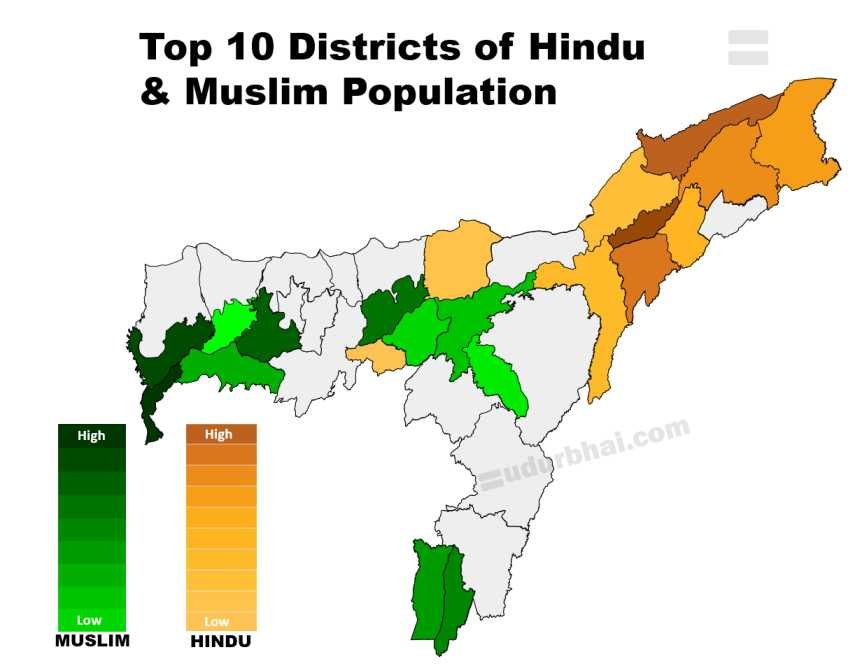
Assam Hindus and Muslims
Assam districts with majority Hindus and Muslims

Trends and Distribution

    • Lower Assam: High Muslim concentration

      • Dhubri: ~79% Muslim population.

    • Upper Assam: Predominantly Hindu.

    • Hill Districts: Rising Christian population, especially among tribal communities.

    • Urban areas show mixed religious composition.

Socio-Political Implications

    • Religious composition influences electoral politics and social dynamics.

    • Communal issues occasionally arise over identity and migration.

    • Citizenship debates:

      • NRC and CAA have demographic and political implications.

    • Emphasis on social harmony and constitutional safeguards.

Migration and Displacement in Assam

Internal and External Migration

    • External Migration:

      • Historical in-migration from Bangladesh (often termed “illegal immigration” in policy debates).

    • Internal Migration:

      • Out-migration of youth to metros like Delhi, Mumbai, Bengaluru for employment and education.

    • Migration shaped by economic opportunities, borders, and geography.

Types of Migration

    • Seasonal Migration:

      • Flood and erosion-induced displacement from riverine areas (chars, chapories).

    • Economic Migration:

      • Tea plantation labourers historically migrated from Jharkhand, Odisha, Chhattisgarh.

    • Conflict-induced Migration:

      • Displacement due to ethnic violence, e.g., BTAD-related conflicts.

Impact on Demographics

    • Changes in ethnic and religious composition in certain districts.

    • Pressure on land, resources, and public services.

    • Rapid urban influx, especially into Guwahati, leading to slums and informal settlements.

Policies

    • Assam Accord (1985):

      • Fixed 24 March 1971 as cut-off date for detection of foreigners.

    • National Register of Citizens (NRC), 2019:

      • Around 19 lakh people excluded.

    • Migration governance closely linked to identity, citizenship, and federal politics.

Socio-Economic Demographic Indicators in Assam

Employment and Occupation

    • Workforce Participation Rate: ~38.4%.

    • Agriculture: Employs ~50% of workforce; largely subsistence-based.

    • Tea Industry: ~10 lakh workers; major organized sector employer.

    • Unemployment Rate: ~7–8%, higher among youth and educated sections.

    • Economy dominated by primary sector, limited industrial diversification.

Poverty and Income

    • Multidimensional Poverty (NFHS): ~32% population poor.

    • Per Capita Income: ~₹1.2 lakh

      • Lower than national average (~₹1.7 lakh).

    • Poverty higher in rural, flood-prone, and tea garden areas.

    • Income inequality persists across regions and communities.

Health and Nutrition

    • Life Expectancy: ~66 years.

    • Infant Mortality Rate: ~41 per 1000 live births.

    • Total Fertility Rate: ~1.9 (below replacement level).

    • NFHS Findings:

      • High levels of stunting and anemia, especially among women and children.

    • Health outcomes affected by access gaps and geography.

Housing and Amenities

    • Electricity Access: ~95%.

    • Sanitation Coverage: ~70%.

    • Rural housing vulnerable due to:

      • Floods and river erosion

      • Temporary and kutcha structures

    • Infrastructure uneven across districts.

Challenges and Emerging demographic Issues in Assam

Population Pressure

    • High population growth in some Muslim-dominated and tribal areas.

    • Increased pressure on land, water, housing, and public services.

    • Leads to land fragmentation and livelihood stress, especially in rural Assam.

Aging Population and Health

    • Rising elderly population due to declining fertility.

    • Limited geriatric healthcare facilities.

    • Prevalence of endemic diseases:

      • Malaria

      • Japanese Encephalitis

    • Health challenges aggravated by poor access in remote areas.

Climate and Disaster Impact

    • Floods displace ~5 lakh people annually.

    • Riverbank erosion causes permanent loss of land and settlements.

    • Recurrent displacement alters population distribution and livelihoods.

Inequalities

    • Regional: Development gap between Upper and Lower Assam.

    • Gender: Lower female workforce participation and income.

    • Caste & Community: SCs, STs, tea garden communities remain vulnerable.

    • Uneven access to education, health, and employment.

Future Projections

    • Population likely to stabilize by around 2041.

    • Urbanization: Expected to reach ~20% by 2031.

    • Policy focus needed on:

      • Sustainable urban planning

      • Human capital development

      • Climate resilience

Government Policies and Initiatives in Assam for Population Control

    • Two-child norm: Incentive/disqualification policy for local elections and government jobs.

    • Family Planning Programs:

      • Contraceptive distribution

      • Awareness campaigns in rural areas

      • Focus on maternal and child health

Sources of Data

    • Census of India (2011) – for official baseline.
    • PLFS – for recent economic insights.
    • National Family Health Survey (NFHS-5: 2019–21 — for recent health, fertility, nutrition insights).
    • Assam Human Development Report (socio-economic trends).
    • Economic Survey of Assam / Directorate of Economics & Statistics (annual projections, state-specific data).
    • Other: NITI Aayog reports, UIDAI/Aadhaar estimates, Ministry of Health projections.

Let us know any further suggestions ,we at sudurbhai.com will be happy to hear from you in our comment section below ! 

Leave a Comment

Your email address will not be published. Required fields are marked *

Scroll to Top